 William Greider, "The Education of David Stockman" (December 1981)
In 1980, David Stockman was selected to be the budget director for the incoming Reagan Administration. Soon afterwards, William Greider approached Stockman and asked if he could write about his experiences in the budget office. Stockman agreed. When the article appeared in The Atlantic, it created a firestorm of controversy. Stockman, who had spoken too freely of his reservations about the Administration's policies, lost his job.
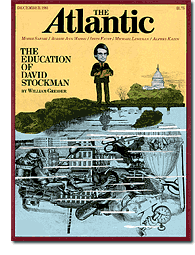 "'None of us really understands what's going on with all these numbers,' Stockman confessed at one point.... 'People are getting from A to B and it's not clear how they are getting there....'
"Reagan's policy-makers knew that their plan was wrong, or at least inadequate to its promised effects, but the President went ahead and conveyed the opposite impression to the American public. With the cool sincerity of an experienced television actor, Reagan appeared on network TV to rally the nation in support of the Gramm-Latta resolution, promising a new era of fiscal control and balanced budgets, when Stockman knew they still had not found the solution....
"The supply-side theory was not a new economic theory at all but only new language and argument to conceal a hoary old Republican doctrine: give the tax cuts to the top brackets, the wealthiest individuals and largest enterprises, and let the good effects 'trickle down' through the economy to reach everyone else. Yes, Stockman conceded, when one stripped away the new rhetoric emphasizing across-the-board cuts, the supply-side theory was really new clothes for the unpopular doctrine of the old Republican orthodoxy."
[See Flashback: "The Balanced-Budget Debate"]
Nicholas Lemann, "The Origins of the Underclass" (June 1986; July 1986)
In a two-part article, the Atlantic correspondent Nicholas Lemann traced the origins of America's urban underclass to the rural South, and revived the idea that a distinct ghetto culture existed that would have to be changed significantly before the plight of the inner cities could be overcome.
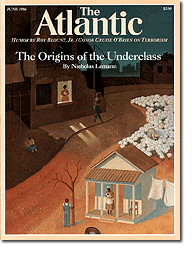 "Ascribing a society's conditions in part to the culture that prevails there seems benign when the society under discussion is England or California. But as a way of thinking about black ghettos it has become unpopular. Twenty years ago ghettos were often said to have a self-generating, destructive culture of poverty.... But then the left equated cultural discussions of the ghetto with accusing poor blacks of being in a bad situation that was of their own making; thus they would deserve no special help or sympathy from society. The left succeeded in limiting the terms of debate to purely economic ones, and today the right also discusses the ghetto in terms of economic 'incentives to fail,' provided by the welfare system....
"The view [on the left] that conditions in the ghetto would change only when white society decided to change them seems contradictory to the creed of community development, but it really isn't. The connection is this: if there is not a self-defeating culture in the ghettos, and if the ghettos nonetheless have problems, then white society must be to blame -- who else could it be? The changes by white society that would heal the ghettos were usually described as 'deep,' 'sweeping,' and 'structural.' ... The trouble with this argument is that it is defeatism clothed in hope. This country so far has been unideological and uninclined to engage in deep, structural change except by accident and in order to meet pressing needs. To single out poor blacks as the one group in our society that will really suffer unless deep, structural changes are made, or unless an entirely different value system takes hold, is to consign them to suffering for the foreseeable future."
[See an index of Atlantic articles on poverty]
Benjamin Barber, "Jihad Vs. McWorld" (March 1992)
From the perspective of 1999, Barber's vision of late-twentieth-century globalization, and the cultural and geopolitical tensions that characterize it, looks eerily prescient.
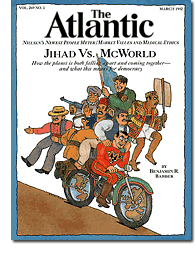 "Just beyond the horizon of current events lie two possible political futures -- both bleak, neither democratic. The first is a retribalization of large swaths of humankind by war and bloodshed: a threatened Lebanonization of national states in which culture is pitted against culture, people against people, tribe against tribe -- a Jihad in the name of a hundred narrowly conceived faiths against every kind of interdependence, every kind of artificial social cooperation and civic mutuality. The second is being borne in on us by the onrush of economic and ecological forces that demand integration and uniformity and that mesmerize the world with fast music, fast computers, and fast food -- with MTV, Macintosh, and McDonald's, pressing nations into one commercially homogenous global network: one McWorld tied together by technology, ecology, communications, and commerce. The planet is falling precipitantly apart and coming reluctantly together at the very same moment."
[See an index of Atlantic articles on foreign policy and international trade]
Introduction
The '00s and '10s
The '20s and '30s
The '40s and '50s
The '60s and '70s
The '80s and '90s
