 W.E.B. DuBois, "The Freedmen's Bureau" (March 1901)
DuBois, whose essays began appearing in The Atlantic in 1897, was to become an internationally renowned spokesman for racial justice. This article went on to form the second chapter of DuBois's classic The Souls of Black Folk (1903).
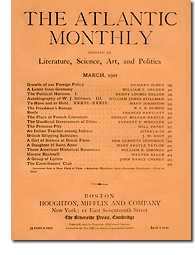 "The problem of the twentieth century is the problem of the color line; the relation of the darker to the lighter races of men in Asia and Africa, in America and the islands of the sea....
"I have seen a land right merry with the sun; where children sing, and rolling hills lie like passioned women, wanton with harvest. And there in the King's Highway sat and sits a figure, veiled and bowed, by which the traveler's footsteps hasten as they go. On the tainted air broods fear. Three centuries' thought has been the raising and unveiling of that bowed human heart, and now, behold, my fellows, a century new for the duty and the deed. The problem of the twentieth century is the problem of the color line."
[See an index of Atlantic articles on race]
William James, "Remarks at the Peace Banquet" (December 1904)
Speaking at the World's Peace Congress, on October 7, 1904, the eminent philosopher and psychologist delivered a speech that appeared two months later in The Atlantic Monthly. James sought to explain the fundamental appeal of war and to address the problem by focusing on its psychological roots. In hindsight, the grim (if unintended) irony of the speech makes it a haunting document of the young century's hopes for peace.
"Our permanent enemy is the noted bellicosity of human nature.... The plain truth is that people want war.... It is a sacrament. Society would rot, they think, without the mystical blood-payment.
"We do ill, I fancy, to talk much of universal peace or of a general disarmament. We must go in for preventive medicine not for radical cure. We must cheat our foe, politically circumvent his action, not try to change his nature.... Let the general possibility of war be left open, in Heaven's name, for the imagination to dally with.... But organize in every conceivable way the practical machinery for making each successive chance of war abortive.... Seize every pretext, however small, for arbitration methods, and multiply the precedents; foster rival excitements and invent new outlets for heroic energy; and from one generation to another, the chances are that irritations will grow less acute and states of strain less dangerous among the nations....
"The last weak runnings of the war spirit will be 'punitive expeditions.' A country that turns its arms only against uncivilized foes is, I think, wrongly taunted as degenerate. Of course it has ceased to be heroic in the old grand style. But I verily believe that this is because it now sees something better. It has a conscience. It knows that between civilized countries a war is a crime against civilization. It will still perpetrate peccadillos, to be sure. But it is afraid, afraid in the good sense of the word, to engage in absolute crimes against civilization."
[See Flashback: "Can We Live Without War?"]
John Muir, "My First Summer in the Sierra" (January - April 1911)
In 1869, John Muir spent the summer herding sheep in the Sierra Nevada mountains and kept a daily journal of his experiences in the wilderness. The area he visited was to become Yosemite National Park in 1890—thanks in large part to Muir. Near the end of Muir's life, excerpts from his journal were serialized in The Atlantic Monthly.
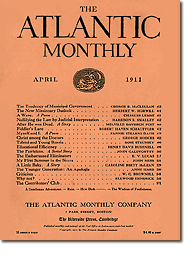 "After gaining the open summit of this first bench, feeling the natural exhilaration due to the slight elevation of a thousand feet or so, and the hopes excited concerning the outlook to be obtained, a magnificent section of the Merced Valley at what is called Horseshoe Bend came full in sight—a glorious wilderness that seemed to be calling with a thousand songful voices. Bold, down-sweeping slopes, feathered with pines and clumps of manzanita with sunny, open spaces between them, made up most of the foreground; the middle and background presented fold beyond fold of finely-modeled hills and ridges rising into mountain like masses in the distance, all covered with a shaggy growth of chaparral, mostly adenostena, planted so marvelously close and even that it looked like soft rich plush without a single tree or bare spot. As far as the eye can reach it extends, a heaving, swelling sea of green as regular and continuous as that produced by the heaths of Scotland. The sculpture of the landscape is as striking in its main lines as in its lavish richness of detail; a grand congregation of massive heights with the river shining between, each carried into smooth graceful folds without leaving a single rocky angle exposed, as if the delicate fluting and ridging fashioned out of metamorphic slates had been carefully sand-papered."
[See Flashback: "John Muir's Yosemite"]
Robert Frost, A Group of Poems (August 1915)
Edward Garnett, "A New American Poet" (August 1915)
Three years after a group of his poems had been rejected by The Atlantic Monthly, Robert Frost was invited by the editors—thanks in part to a nudge by the noted English critic Edward Garnett—to submit again. The publication of these three famous poems ("The Road Not Taken," "Birches," and "The Sound of Trees"), and an accompanying essay by Garnett, forged a relationship between the magazine and the poet that lasted until his death, in 1963. The following is from Garnett's essay.
"So complex may be the interlacing strains that blend in a writer's literary ancestry and determine his style, that the question first to ask seems to me whether a given author is a fresh creative force, an original voice in literature. Such an authentic original force to me speaks from North of Boston....
"The attentive reader will soon discover that Mr. Frost's cunning impressionism produces a subtle cumulative effect, and that by his use of pauses, digressions, and the crafty envisagement of his subject at fresh angles, he secures a pervading feeling of the mass and movement and elusive force of nature. He is a master of his exacting medium, blank verse,—a new master....
"'Mr. Frost is a true poet, but not a poetical poet,' remarked a listener to whom I read 'A Servant to Servants,' leaving me wondering whether his verdict inclined the scales definitely to praise or blame. Of poetical poets we have so many! of literary poets so many! of drawing-room poets so many!—of academic and dilettanti poets so many! of imitative poets so many! but of original poets how few!"
[See Poetry Pages: "Robert Frost in The Atlantic Monthly"]
Next Page: The '20s and '30s
Jazz, Sacco and Vanzetti, Depression, Hemingway...
Introduction
The '00s and '10s
The '20s and '30s
The '40s and '50s
The '60s and '70s
The '80s and '90s
