 Rebecca West, "Black Lamb and Grey Falcon" (January - May 1941)
In 1937 the novelist Rebecca West traveled to the Balkans in search of a better understanding of the region's tensions and conflicts. Her account of that journey, entitled Black Lamb and Grey Falcon, was published in book form in 1941, and received great critical acclaim. It was excerpted in five installments in The Atlantic Monthly.
"Violence was, indeed, all I knew of the Balkans—all I knew of the South Slavs. I derived the knowledge from memories of my earliest interest in liberalism, of leaves fallen from the jungle, of pamphlets tied up with string....
"But I must have been wholly mistaken in my acceptance of the popular legend regarding the Balkans, for if the South Slavs had been truly violent they would not have been hated first by the Austrians, who worshipped violence in an imperialist form, and later by the Fascists, who worship violence in a totalitarian form. Yet it is impossible to think of the Balkans for one moment as gentle and lamblike, for assuredly Alexander and Draga Obrenovich and Franz Ferdinand and his wife had none of them died in their beds. I had to admit that I quite simply and flatly knew nothing at all about the southeastern corner of Europe; and since there proceeds steadily from that place a stream of events which are a source of danger to me, which indeed for four years threatened my safety and during that time deprived me forever of many benefits, that is to say I knew nothing of my own destiny."
[See Flashback: "Conflict in the Balkans"]
Vannevar Bush, "As We May Think" (July 1945)
In this visionary article, Bush urged scientists to turn their energies from war to the task of making the vast store of human knowledge accessible and useful. The infostructure Bush sketched out—including a proposal for a system similar to hypertext—was destined to be realized in what we now know as the Internet.
"[The human mind] operates by association. With one item in its grasp, it snaps instantly to the next that is suggested by the association of thoughts, in accordance with some intricate web of trails carried by the cells of the brain.... Man cannot hope fully to duplicate this mental process artificially, but he certainly ought to be able to learn from it....
"Consider a future device for individual use, which is a sort of mechanized private file and library. It needs a name, and, to coin one at random, 'memex' will do. A memex is a device in which an individual stores all his books, records, and communications, and which is mechanized so that it may be consulted with exceeding speed and flexibility. It is an enlarged intimate supplement to his memory....
"Wholly new forms of encyclopedias will appear, ready made with a mesh of associative trails running through them, ready to be dropped into the memex and there amplified.... The historian ... can follow at any time contemporary trails which lead him all over civilization at a particular epoch. There is a new profession of trail blazers, those who find delight in the task of establishing useful trails through the enormous mass of the common record....
"Thus science may implement the ways in which man produces, stores, and consults the record of the race.... Technical difficulties of all sorts have been ignored, certainly, but also ignored are means as yet unknown which may come any day to accelerate technical progress as violently as did the advent of the thermionic tube."
[See Flashback: "Prophets of the Computer Age"]
Albert Einstein, "Atomic War or Peace" (November 1947)
Following the Second World War, Albert Einstein, whose scientific work had enabled the development of nuclear weapons, considered the implications of a world thus dangerously armed, and emphasized the new urgency of working toward peace.
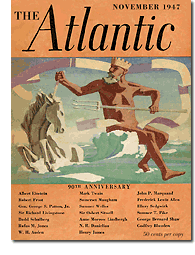 "It is not necessary to imagine the earth being destroyed like a nova by a stellar explosion to understand vividly the growing scope of atomic war and to recognize that unless another war is prevented it is likely to bring destruction on a scale never before held possible and even now hardly conceived, and that little civilization would survive it.....
"In another war the bombs will be plentiful and they will be comparatively cheap. Unless there is a determination not to use them that is stronger than can be noted today among American political and military leaders, and on the part of the public itself, atomic warfare will be hard to avoid....
"Unless the cause of peace based on law gathers behind it the force and zeal of a religion, it hardly can hope to succeed. Those to whom the moral teaching of the human race is entrusted surely have a great duty and a great opportunity."
[See Flashback: "Nuclear Warnings"]
Robert Moses, "Build and Be Damned" (December 1950)
Witnessing the proliferation of suburban communities in postwar America, New York uber-planner Robert Moses reproached crooked developers for their shoddy construction practices and lack of forethought. Calling for better regulations and more conscientious planning of new towns, Moses warned country dwellers to "resist the ruthless modern developer."
"Our overbuilt cities with their congestion, their trend to high office buildings and apartments, their complete indifference to the most elementary principles of civilian defense, their slums representing past neglect and greed, can to a considerable extent be rebuilt on better principles if we are smart enough to look the facts in the eye and brush off the Babbitts who hold that wherever the dirt flies there is progress. On the other hand, cities can not be revolutionized and turned into garden villages or green belts. In the suburbs and near-by country, however, we still have a chance to do the right thing without stultifying compromises....
"If, instead of hiring half-baked revolutionary planners to fill our college undergraduates with ingenious schemes to disperse populations, split up big cities into little ones, go underground or into distant places to escape bombs and congestion, abandon large urban areas in favor of roadside villages, we were to publish reliable, simply written, common-sense information to control the building boom, what a country this would be!"
[See Flashback: "The Godfather of Sprawl"]
Carlton Lake, "Picasso Speaking" (July 1957)
In 1957, Carlton Lake, the Paris art critic for The Christian Science Monitor, managed to interview the elusive Picasso, then seventy-five years old. Picasso opened up to Lake, at one point telling him, "I don't know what's got into me. I never talked like this to anyone in my life before." The interview is peppered with the artist's frank ruminations on everything from Guernica to his proud membership in the Communist Party to the role of art criticism.
 "'My work is a constructive one. I am building, not tearing down. What people call deformation in my work results from their own misapprehension. It's not a matter of deformation; it's a question of formation. My work obeys laws I have spent my life in formulating and adhering to. Everybody has a different idea of what constitutes reality and the substance of things. Labels are meaningless. For example, you say "red." What is red? There are a thousand reds.' He pointed to the bowl of fruit in the middle of the big table. 'We've been told that's an orange. So we call it an orange. We've been told that's an apple. So we call it an apple. But you and I look at those things and we see different objects—with the same name. I paint them in a still life and I set them down in what my intellect tells me is the order and form in which they appear to me.'"
[See Flashback: "Portraits of Picasso"]
Next Page: The '60s and '70s
Martin Luther King Jr., Mrs. X, Vietnam, the Clonal Man...
Introduction
The '00s and '10s
The '20s and '30s
The '40s and '50s
The '60s and '70s
The '80s and '90s
