 Martin Luther King Jr., "The Negro Is Your Brother" (August 1963)
Better known as the "Letter From Birmingham Jail," this article was written while King was incarcerated for participating in nonviolent demonstrations against segregation. King was writing, as the editors put it, "in response to a public statement of concern and caution issued by eight white religious leaders of the South."
"For years now I have heard the word 'wait.' It rings in the ear of every Negro with a piercing familiarity. This 'wait' has almost always meant 'never.' It has been a tranquilizing thalidomide, relieving the emotional stress for a moment, only to give birth to an ill-formed infant of frustration.... We have waited for more than three hundred and forty years for our God-given and constitutional rights. The nations of Asia and Africa are moving with jetlike speed toward the goal of political independence, and we still creep at horse-and-buggy pace toward the gaining of a cup of coffee at a lunch counter. I guess it is easy for those who have never felt the stinging darts of segregation to say 'wait.' But when you have seen vicious mobs lynch your mothers and fathers at will and drown your sisters and brothers at whim; when you have seen hate-filled policemen curse, kick, brutalize, and even kill your black brothers and sisters with impunity; when you see the vast majority of your twenty million Negro brothers smothering in an airtight cage of poverty in the midst of an affluent society; when you suddenly find your tongue twisted and your speech stammering as you seek to explain to your six-year-old daughter why she cannot go to the public amusement park that has just been advertised on television, and see tears welling up in her little eyes when she is told that Funtown is closed to colored children, and see the depressing clouds of inferiority begin to form in her little mental sky, and see her begin to distort her little personality by unconsciously developing a bitterness toward white people; when you have to concoct an answer for a five-year-old son asking in agonizing pathos, 'Daddy, why do white people treat colored people so mean?'; when you take a cross-country drive and find it necessary to sleep night after night in the uncomfortable corners of your automobile because no motel will accept you; when you are humiliated day in and day out by nagging signs reading 'white' and 'colored'; when your first name becomes 'nigger' and your middle name becomes 'boy' (however old you are) and your last name becomes 'John,' and when your wife and mother are never given the respected title 'Mrs.'; when you are harried by day and haunted by night by the fact that you are a Negro, living constantly at tiptoe stance, never knowing what to expect next, and plagued with inner fears and outer resentments; when you are forever fighting a degenerating sense of 'nobodyness' -- then you will understand why we find it difficult to wait."
[See Flashback: "Black History, American History"]
Mrs. X, "One Woman's Abortion" (August 1965)
Before the Roe v. Wade Supreme Court decision in 1973, abortion in America was, for the most part, illegal. In the mid-1960s, Mrs. X, a college graduate and mother of three, "whose credentials," the editors wrote, "are trusted by the Atlantic," found herself unexpectedly pregnant and unwilling to have another child. She sought out female friends for advice:
"I called each and stated bluntly that I needed an abortion and asked whether she knew anybody reasonably reliable who might do the job. Two ... said that they themselves had obtained abortions within the last two years. Each gave me without hesitation the name, address, and telephone number of her physician. The fourth friend did a little detective work and in twenty-four hours came up with another physician, chiefly remarkable for the fact that his office was directly across the street from one of the city's police precinct stations."
Based on her experience, Mrs. X could only wonder at the prevalence of abortion in America, and asked:
"Is the time coming when we can rid ourselves of one more hypocrisy, closing the gap between what we do and what we say we do?"
[See an index of Atlantic articles on the abortion issue]
James C. Thomson Jr., "How Could Vietnam Happen?" (April 1968)
Drawing on five years of service (1961-1966) in the White House and Department of State, the East Asia specialist James C. Thomson traced the slippery-slope of decision making that led to America's involvement in the Vietnam War.
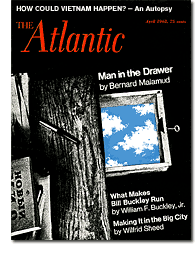 "In Washington the semantics of the military muted the reality of war for the civilian policy-makers. In quiet, air-conditioned, thick-carpeted rooms, such terms as 'systematic pressure,' 'armed reconnaissance,' 'targets of opportunity,' and even 'body count' seemed to breed a sort of games-theory detachment. Most memorable to me was a moment in the late 1964 target planning when the question under discussion was how heavy our bombing should be, and how extensive our strafing, at some midpoint in the projected pattern of systematic pressure. An Assistant Secretary of State resolved the point in the following words: 'It seems to me that our orchestration should be mainly violins, but with periodic touches of brass.' ...
"There is a final result of Vietnam policy I would cite that holds potential danger for the future of American foreign policy: the rise of a new breed of American ideologues who see Vietnam as the ultimate test of their doctrine. I have in mind those men in Washington who have given a new life to the missionary impulse in American foreign relations: who believe that this nation, in this era, has received a threefold endowment that can transform the world. As they see it, that endowment is composed of, first, our unsurpassed military might; second, our clear technological supremacy; and third, our allegedly invincible benevolence (our 'altruism,' our affluence, our lack of territorial aspirations). Together, it is argued, this threefold endowment provides us with the opportunity and the obligation to ease the nations of the earth toward modernization and stability: toward a fullfledged Pax Americana Technocratica. In reaching toward this goal, Vietnam is viewed as the last and crucial test. Once we have succeeded there, the road ahead is clear. In a sense, these men are our counterpart to the visionaries of Communism's radical left: they are technocracy's own Maoists. They do not govern Washington today. But their doctrine rides high."
[See an index of Atlantic articles on foreign policy]
James D. Watson, "Moving Toward the Clonal Man" (May 1971)
More than a quarter-century before Dolly, the Nobel Prize-winner James D. Watson tackled the ethical issues raised by clonal reproduction and asked, "Is this what we want?"
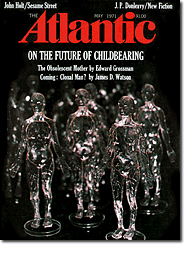 "This is a matter far too important to be left solely in the hands of the scientific and medical communities. The belief that surrogate mothers and clonal babies are inevitable because science always moves forward, an attitude expressed to me recently by a scientific colleague, represents a form of laissez-faire nonsense dismally reminiscent of the creed that American business, if left to itself, will solve everybody's problems. Just as the success of a corporate body in making money need not set the human condition ahead, neither does every scientific advance automatically make our lives more 'meaningful.' No doubt the person whose experimental skill will eventually bring forth a clonal baby will be given wide notoriety. But the child who grows up knowing that the world wants another Picasso may view his creator in a different light."
Next Page: The '80s and '90s
Reaganomics, Origins of the Underclass, Jihad vs. McWorld...
Introduction
The '00s and '10s
The '20s and '30s
The '40s and '50s
The '60s and '70s
The '80s and '90s
