 Carl Engel, "Jazz: A Musical Discussion" (August 1922)
The first of many articles about jazz to appear in The Atlantic Monthly. Though Engel's cultural biases are dated, his appraisal of jazz as a serious contribution to American music takes a progressive stance, and shows the excitement the new music generated.
"The contrapuntal complexity of jazz is something native, born out of the complex, strident present-day American life. Where did you hear, before jazz was invented, such multifarious stirring, heaving, wrestling of independent voices as there are in a jazz orchestra? The saxophone bleats a turgid song; the clarinets turn capers of their own; the violins come forward with an obligato; a saucy flute darts up and down the scale, never missing the right note on the right choral; the trombone lumberingly slides off on a tangent; the drum and xylophone put rhythmic highlights into these kaleidoscopic shiftings; the cornet is suddenly heard above the turmoil, with good-natured brazenness. Chaos in order, -- orchestral technic of master craftsmen, -- music that is recklessly fantastic, joyously grotesque, -- such is good jazz. A superb, incomparable creation, inescapable yet elusive; something it is almost impossible to put in score upon a page of paper.
"For jazz finds its last and supreme glory in the skill for improvisation exhibited by the performers.... Jazz is abandon, is whimsicality in music. A good jazz band should never play, and actually never does play, the same piece twice in the same manner. Each player must be a clever musician, an originator as well as an interpreter, a wheel that turns hither and thither on its own axis without disturbing the clockwork."
[See a collection of Atlantic articles on jazz.]
Felix Frankfurter, "The Case of Sacco and Vanzetti" (March 1927)
In 1921, Nicola Sacco and Bartolomeo Vanzetti, both Italian-Americans, were convicted of robbery and murder. Although the arguments brought against them were mostly disproven in court, the fact that the two men were known radicals (and that their trial took place during the height of the Red Scare) prejudiced the judge and jury against them. On April 9, 1927, Sacco and Vanzetti's final appeal was rejected, and the two were sentenced to death. Felix Frankfurter, then a professor at Harvard Law School, was considered to be the most prominent and respectable critic of the trial. He was appointed to the Supreme Court by Franklin Delano Roosevelt in 1939.
"In 1921 the temper of the times made it the special duty of a prosecutor and a court engaged in trying two Italian radicals before a jury of native New Englanders to keep the instruments of justice free from the infection of passion or prejudice. In the case of Sacco and Vanzetti no such restraints were respected. By systematic exploitation of the defendants' alien blood, their imperfect knowledge of English, their unpopular social views, and their opposition to the war, the District Attorney invoked against them a riot of political passion and patriotic sentiment; and the trial judge connived at -- one had almost written, cooperated in -- the process....
"Judge Thayer's opinion stands unmatched for discrepancies between what the record discloses and what the opinion conveys. His 25,000-word document cannot accurately be described otherwise than as a farrago of misquotations, misrepresentations, suppressions, and mutilations. The disinterested inquirer could not possibly derive from it a true knowledge of the new evidence that was submitted to him as the basis for a new trial. The opinion is literally honeycombed with demonstrable errors, and a spirit alien to judicial utterance permeates the whole."
[See Flashback: "The Trial of the Century?"]
John Maynard Keynes, "The World's Economic Outlook" (May 1932)
In this article, published during the Great Depression, the renowned British economist John Maynard Keynes argued that widespread reluctance to spend would only prolong the economic crisis.
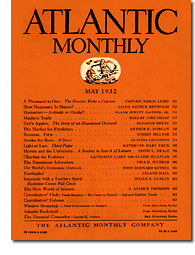 "Can we prevent an almost complete collapse of the financial structure of modern capitalism? With no financial leadership left in the world and profound intellectual error as to causes and cures prevailing in the responsible seats of power, one begins to wonder and to doubt....
"The financial and political authorities of the world have lacked the courage or the conviction at each stage of the decline to apply the available remedies in sufficiently drastic doses; and by now they have allowed the collapse to reach a point where the whole system may have lost its resiliency and its capacity for a rebound.
"The outstanding ground for cheerfulness lies, I think, in this -- that the system has shown already its capacity to stand an almost inconceivable strain.... This remarkable capacity of the system to take punishment is the best reason for hoping that we still have time to rally the constructive forces of the world."
[See an index of Atlantic articles on economic policy.]
Edmund Wilson, "Ernest Hemingway" (July 1939)
[We regret that our online rights to this article have expired.]
This essay still stands as one of the most important assessments of Hemingway's early work and the decline of his writing in the 1930s. Although Wilson remarked, famously, that Hemingway's public persona had become "his own worst-invented character," he nevertheless saw the significance of Hemingway's artistic achievement.
"Going back over Hemingway's books to-day, we can see clearly what an error of the politicos it was to accuse him of an indifference to society. His whole work is a criticism of society: he has responded to every pressure of the moral atmosphere of the time, as it is felt at the roots of human relations, with a sensitiveness almost unrivaled....
"Hemingway has expressed with genius the terrors of the modern man at the danger of losing control of his world, and he has also, within his scope, provided his own kind of antidote. This antidote, paradoxically, is almost entirely moral. Despite his preoccupation with physical contests, his heroes are almost always defeated physically, nervously, practically: their victories are moral ones. He himself, when he trained himself stubbornly in his unconventional, unmarketable art in a Paris which had other fashions, gave the prime example of such a victory; and if he has sometimes, under the menace of the general panic, seemed on the point of going to pieces as an artist, he has always pulled himself together the next moment."
[See Flashback: "Tracking Hemingway"]
Next Page: The '40s and '50s
Rebecca West, Vannevar Bush, Albert Einstein, Pablo Picasso...
Introduction
The '00s and '10s
The '20s and '30s
The '40s and '50s
The '60s and '70s
The '80s and '90s
