Reporter's Notebook

Orbital View
Show Newer Notes

From the National Oceanic and Atmospheric Administration’s description of this image of Saharan dust drifting out over the eastern Atlantic:

The dust is part of the Saharan Air Layer (SAL), a mass of very dry, dusty air which forms over the Sahara Desert during the late spring, summer, and fall months and usually moves over the tropical North Atlantic Ocean every 3 to 5 days. Associated with large amounts of dust and strong winds, the SAL can have a significant impact on the intensity and formation of tropical cyclones. Its dry air can actually weaken tropical cyclones by promoting downdrafts around the storm, while its strong winds can substantially increase the vertical wind shear in and around the storm environment. Although it is not yet clear what effect the SAL’s high dust content has on a storm’s intensity, recent studies have suggested that it can affect the formation of clouds.

(See all Orbital Views here)
On camera, that is:

From the caption on the Russian Federal Space Agency’s account:

The Geminids meteor shower begins tonight. Rush to make a wish when you see a shooting star! It is very hard to see a Meteor against the background of our beautiful planet, but not for [cosmonaut] Oleg Kononenko.

From a guide to watching the Geminid show:

The peak nights of the 2015 Geminid meteor shower are expected to be on December 13-14 (night of December 13 till dawn December 14) and 14-15 (night of December 14 till dawn December 15).

Geminid meteors tend to be few and far between at early evening, but intensify in number as evening deepens into late night. The waxing crescent moon will set at early evening, leaving dark skies for this year’s Geminid meteor shower.

Geminid meteors are bright! This shower favors Earth’s Northern Hemisphere, but it’s visible from the Southern Hemisphere, too. Follow the links [here] to learn more about the Geminid meteor shower in 2015.

One more interesting detail:

Some people mistakenly think that, since meteor showers have radiant points, you should look in the direction of the shower’s radiant point to see the most meteors. Not so! The meteors will appear in all parts of the sky. It’s even possible to have your back to the constellation Gemini and see a Geminid meteor fly by. However, if you trace the path of a Geminid meteor backwards, it appears to originate from the direction of the constellation Gemini.

(See all Orbital Views here)

From above, the northern Italian city of Albenga looks like a mosaic made from tiny shards of colored glass:

Why so much blue? From the caption:

The economy of Albenga is primarily driven by tourism, local commerce, and agriculture. When viewing the town from above, it’s easy to see the amount of space dedicated to agriculture because of the widespread use of greenhouses or “plasticulture.” The use of plastic covering is designed to increase produce yield, increase produce size, and shorten growth time.

(See all Orbital Views here)

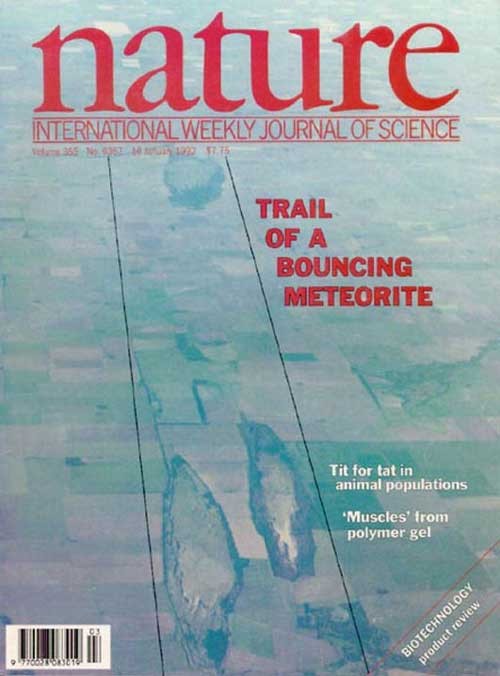
The distorted landscape looks as if the impact is pulling the fields inward:

Rio Cuarto crater scars the Argentinian landscape.

A photo posted by Kjell Lindgren (@astro_kjell) on

The crater is part of a series predominantly formed in a very rare pattern:

The [Río Cuarto] craters were thought to be due to a grazing impact of a set of objects at a very low angle, which calculations show to be a rare occurrence. Most impacts will strike at an angle of 45 degrees to the horizontal or greater, and the impact craters will always be close to circular, since the shock wave that results from the impact propagates symmetrically.

A grazing impact, however, will form an elliptical crater, with sprays of debris that look like butterfly wings. This has been confirmed by high-velocity guns used for impact experiments, and more recently by computer simulations. On impact, the object may shed chunks of itself that fly further downrange to perform secondary impacts.

Models of the Río Cuarto event suggest that the object struck at an angle of no more than 15 degrees from the horizontal, with the impact itself having 10 times more explosive energy than the Barringer Crater event and 30 times more than the Tunguska event [citation needed]. Although the age of the craters has not yet been determined precisely, it is believed they are about 10,000 years old, placing them at the start of the Holocene.

(See all Orbital Views here)

Beautiful dunes. Arrakis?

A photo posted by Kjell Lindgren (@astro_kjell) on

Kjell Lindgren must be a science-fiction nerd; Arrakis is a desert planet in the Dune book series by Frank Herbert.

Lindgren, along with Kelly, took a break from Instagramming and astronaut-ing to appear at a congressional hearing via satellite yesterday, which they ended with a backflip:

Or, as it’s actually called, an atoll:

Boats sheltering in an atoll.

A photo posted by Kjell Lindgren (@astro_kjell) on

The birth of ring-shaped islands can take thousands of years. NOAA’s National Ocean Service explains (with a handy animation):

Corals … begin to settle and grow around an oceanic island forming a fringing reef. It can take as long as 10,000 years for a fringing reef to form. Over the next 100,000 years, if conditions are favorable, the reef will continue to expand. As the reef expands, the interior island usually begins to subside and the fringing reef turns into a barrier reef. When the island completely subsides beneath the water leaving a ring of growing coral with an open lagoon in its center, it is called an atoll.

Climate change is expected to take a toll on these low-lying islands in the coming years as rising sea levels result in bigger waves and increased flooding. Daily Overview, to commemorate the start of the Paris Climate Conference, also captures an atoll:

The 2015 UN Climate Change Conference kicked off today in Paris. The event will bring together leaders from more than 190 countries with the goal of creating a legally binding and universal climate agreement that will keep global warming below 2°C. Daily Overview is providing imagery for the UN’s #EarthToParis event next week and we’ll be closely following what comes of the discussions at #cop21 in the coming days. At the conference today, Anote Tong, the president of Kiribati — a low-lying island nation in the Central Pacific Ocean —expressed his gratitude to the country of Fiji. The 102,000 residents of Kiribati may be forced to relocate as increased ice melt causes the Pacific Ocean to rise and submerges its islands. Fiji has boldly offered to take in the people of Kiribati if that occurs. Tarawa, an atoll that serves as the capital of the country and is home to half of it’s population, is seen here.

A photo posted by Daily Overview (@dailyoverview) on

The first is near Abu Dhabi:

The second comes from Nevada:

If you’re a New Yorker, or simply visited the city last fall, you may have seen an art installation next to the fountain at Lincoln Center featuring footage of the Crescent Dunes Solar Project. Here’s a video overview with the artist, John Gerrard. I stood in front of “Solar Reserve” for about a half-hour at night and was totally transfixed—much like I am scrolling through photos at Daily Overview.

Alan has an extensive gallery of this environmental nightmare, with both aerial and on-the-ground photos, but this satellite view is really something:

A photo posted by Daily Overview (@dailyoverview) on

Some details on the situation in case you haven’t read about it yet:

In this frame we see Bento Rodrigues, a small village that was destroyed when the nearby dam failed and released 62 million cubic meters of wastewater. The sludge wiped out hundreds of homes and caused the death of twelve people. Eleven others are still missing. Because of the ongoing pollution, more than half a million people still do not have access to clean water for drinking or irrigating their crops. [Monday], the contaminated water covered 400 miles of the Rio Doce River and entered into the sea, killing significant amounts of plant and animal life along the way. Officials are concerned that the toxins will threaten the Comboios Nature Reserve, a protected area for the endangered leatherback turtle.

(See all Orbital Views here)

More Notes From The Atlantic
  • Notes Home