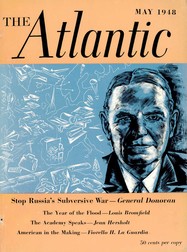
May 1948
In This Issue
Explore the May 1948 print edition below. Or to discover more writing from the pages of The Atlantic, browse the full archive.
Articles
American in the Making (Part Two)
Alfred North Whitehead: 1861-1947
A philosopher and teacher, Paul WEISS was born in New York City. A.B.S.S. of City Collage, he took his M. I. and Ph.D. at Harvard, where he worked under the friendly stimulus of Alfred North Whitehead. The tribute which follows was written directly after Professor Whitehead’s death last December, and at the urging of the Harvard Crimson, with whose kind permission the essay is reprinted. The author of three volumes, The Nature of Systems, Reality, and Nature and Man, the founder and editor of the Review of Metaphysics, Mr. Weiss is professor of philosophy at Yale University.
Failure
The Peripatetic Reviewer
Reader's Choice
Bodies and Souls
Innocents
The Divine Comedy
The Physiology of Taste
Washington
London
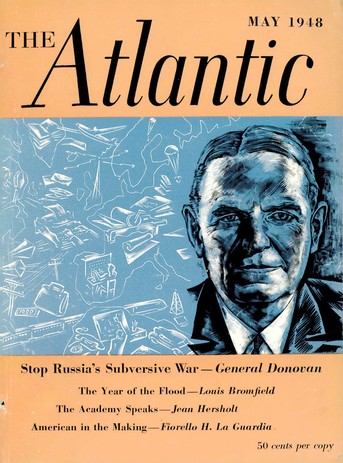
Stop Russia's Subversive War
A lawyer and man of action, born in Buffalo in 1883, WILLIAM J. DONOVAN proved his leadership in the First World War. He rose to be Colonel of “The Fighting 69th,”was three times wounded, and was decorated with the Congressional Medal and the Légion d’Honneur. He has explored China on his own, distributed relief IN Paland, and traveled in Siberia. In 1938 curiosity took him to Ethiopia, thence to Spain, and finally to the military maneuvers in Germany. In 1910 he began the secret missions FOR President Raniavh which were to next to his command of the OSS with the rank of Major General.
Shower of Gold
A short story
The Academy Speaks
Whatever the critics may say, the Academy Awards by the Academy of Motion Picture Arts and Sciences are Hollywood’s true appraisal of itself. JEAN HERSHOLT,President of the Academy, who is respected throughout the profession for his personal integrity and independence, tells how the awards are made, and emphasizes the fairness and secrecy of the voting. An American born in Denmark, Mr. Hersholt is a veteran of the European stage; he has acted in four hundred films and is one of the best-loved characters in radio — “Dr. Christian.”
Is Aid Enough?
A young American, WILLIAM CONGDON has had firsthand and sympathetic experience in the Italian Red Cross and in the reconstruction project of the Italian Abruzzo where he worked with the American Friends Service Committee in 1946 and 1947. A sculptor by profession, he closed his studio in Lakeville, Connecticut, in 1942 and for three years saw service with the British 8th Army in Egypt, North Africa, Italy, and Germany. He is at present painting in New York.
Atomic Energy
Smuggler's Gap
The Vortex of Dialectic
The most eminent philosopher in the English-speaking world, GEORGE SANTAYANA,now in his eighty-fifth year, is living in Rome and writing with vigor and sapience. It has been the Atlantic’s privilege to publish in successive issues this spring his three new Dialogues. Each contains passages characteristic of Santayana at his best; each reflects his sense of detachment from his own time, or any particular time, and his critical and contemplative devotion to truth as he sees it, regardless of age, war, or climate.
The Year of the Flood
The son of an Ohio farmer, Louis BROMFIELD revivified and extended the acres which now comprise Malabar Farm. In the process he has learned that farmers can control many things, but not the weather. A veteran of the First World War, Mr. Bromfield wrote his first four novels in France. But in 1933 his book The Farm showed that his thoughts were returning to his home country in Ohio, and when he and his family came back for good in 1939, it was with the thought of re-establishing their roots in one of the most fertile sections of the Middle West. This article is drawn from his forthcoming book, Malabar Farm, to be published by Harper.
Barring the Weight
An Irishman who was educated by the Christian Brothers and at the Universities of Wales and Oxford (Balliol College), W. B. READY married a Canadian girl while in the Service and is now teaching in a private school in Winnipeg. This is his first short story to be published, but he tells us that he wants to write a novel on the Canadian West that will compare with The Big Sky, and one day hopes to have a whole book about Brother John and all the other people who have fashioned him.
If Corporations Will Give
“A great part of our national wealth,”says LAIRD BELL of Chicago, “is locked up in corporate form. Some few of the advanced corporations recognize that it is good business to promote higher education in its research aspects. The logical next step is to recognize an obligation to promote both theoretical research at the university level and the production of good citizens at the college level.”Mr. Bell, an attorney and a director of many corporations, is closely associated with Harvard, his alma mater; he is Vice-chairman of the Board of Trustees, University of Chicago, and Chairman of the Board of Trustees, Carleton College.
Birth Day
I Like the Greeks
A British artist and writer, OSBERT LANCASTER lived for eighteen months in Greece in a semiofficial capacity at the close of the tear. Sketching and taking notes as he traveled, he has brought to his forthcoming book, Classical Landscape with Figures, of which this is a portion, a love of Greece and its inhabitants infectious to the beholder. His line drawings are as lively as his prose, as readers will know who have followed his cartoons in the English daily press, his contributions to many periodicals, and his books, Home Sweet Homes and Pillar to Post.
Arabesque
In 1941 Armande Herne, the attractive wife of a British petty officer in the Atlantic service, finds herself the object of considerable suspicion in Syria. Half French and bilingual, she had come to Beirut as the secretary to an aircraft manufacturer. But when his mission collapsed and the British and Free French took over, she was without visible means of support. Her British passport was only a partial defense against the suspicion of British Field Security, represented here by the persistent Sergeant Prayle.
The United Nations
This Month
Eardrums a Long the Mohawk
RENÉ MACCOLL, Washington correspondent of the London Daily Express, here doffs the pseudonym of “ R, .J. Hicks” under which he has written other pieces on radio for these pages.
Ballade on Experience
Twilight Furioso
LOWELL KTNDSCHI gave up teaching to serve in the Army Air Force and now lives in Platteville, Wisconsin. This is his first appearance in the Atlantic.
Tiger Lilies
The Science of Science-Fiction
JOHN W. CAMPBELL, JR., decided to study nuclear physics back in 1928 when he first read of “atomic power" in the science-fiction magazine of that day. Amazing Stories. He attended M.I.T. and Duke University and is now editor of Astounding Science-Fiction.
Pride and Prejudice
When W. SOMERSET MAUGHAM was asked to select and edit the ten best novels in world literature, he chose three novels from France, two from Russia, one from America, and four from England, and for each book he wrote an introduction. In successive issues of the Atlantic he has appraised Flaubert’s Madame Bovary, Fielding’s Tom Jones, Balzac’s Le Fère Goriot, Emily Bronte’s Wnthering Heights, The Brothers Karamazov by Dostoevsky, and Stendhal’s The Red and the Black. The set of the Ten Best Novels, edited and cut by Mr. Maugham, will be published by the John C. Winston Company this year.