Twilight Furioso
LOWELL KTNDSCHI gave up teaching to serve in the Army Air Force and now lives in Platteville, Wisconsin. This is his first appearance in the Atlantic.
MUSIC
by LOWELL KINDSCHI
IT SEEMS time that an insider told the story of some ten thousand professionals who involuntarily disbanded forever at the end of the twenties. They spent their working hours in a soft twilight making noises — sometimes music, sometimes strange sounds punctuated with gongs, whistles, and animal imitations more ambitious than anything Mendelssohn was able to make Bottom do. These nearly forgotten men and women were, of course, the movie organists and pianists of America. While they have been briefly memorialized in occasional paragraphs by outsiders looking in, I tell of them from the inside looking up — at the screen, with a crick in my neck. Others watched them slink tardily and furtively down to the pit for their dark rendezvous with vox humana and Billie Dove, but I speak as one who was himself a little slinker.
When I entered the employ of the 300-seat Gem Theater as a newcomer to that harried profession, I did so because the hours complemented those of a student and because I could work sitting down. Quite unaware of the possibilities in providing an unobtrusive welding of sight and sound, I doggedly plowed my way though Our Gang, Emil Jannings, and Laura La Plan ’wit h scarcely a change of pace. I was being paid to fill a silence, and I filled it as briskly and continuously as I knew how.
One evening my boss, undoubtedly disturbed at the frequent variance of mood between what was happening on the screen and what was coming out of the pit, brought me a bundle ol cue sheets lor coming pictures. The cue sheet was the organist s Baedeker, his guidebook in the strange territory of a new movie. This was of considerable help, for although the Wild West film was an uncomplicated product for which “Pony Boy” and “Light Cavalry,” with a bit of syrup thrown in for the love interest, were bone and sinew, most other films presented more of a problem. Here was a document of fifty to one hundred “cues” or suggested selections, with time indications and brief musical excerpts, to keep the organist from drifting along in “Clair de Lune” unaware that in fifteen seconds the Bastille would be stormed. (The hazard came the first time a picture was shown.)
The two underlying principles were simple. First, many scenes could be cued with familiar music obviously associated with the action. A shot of gay Vienna demanded Strauss (as it is likely to do today); skaters meant Waldteufel; Russia called for Tschaikowsky. But not all scenes could be managed in this way, because of a shortage of what we might call associational music. Here the cue sheet was potentially invaluable. For example, the scene in Chany, a jungle picture, showing a leopard in a sprung trap might stump the unguided organist, but the cue sheet had an immediate prescription: three fourths of a minute of “Descriptive Agitato” by Boehnlein, with a disquieting directive to begin piano, “then accelerate and crescendo until shot.” There it was: what to play, when, and for how long.
There was nothing inevitable, of course, in the choice of “Descriptive Agitato.” It was recommended as a number that would do, and the thematic excerpt gave an idea of what sort of fiddling around the organist could engage in if he didn’t have it. (Sometimes the compiler’s machinery of association operated more obscurely. I cannot now imagine why a close-up of an Army tank in Wings called for the Scherzo from “ A Midsummer Night’s Dream”; and the choice of “Love’s Tragedy” when Garbo began to wash her hair in Wild Orchids is open to interesting conjecture.)
Many of the selections called for in the cue sheets were composed expressly for the trade. One could get a whole batch of custom-built agitatos or misteriosos (sic) for the price of a good dinner. Much of the music was thoroughly banal, but that, in a way, was all the better. Then what the organist was doing didn’t distract from what Aileen Pringle was doing, which was usually plenty.
I used the excerpts as springboards for improvisation far oftener, I suspect, than the compiler intended. If no one bought any more trade music than I did, there would have been no industry within an industry. But I could see no convincing reason for not using my own musical maunderings free instead of somebody else’s at a price. “Dramatic Tension No. 2” by Zamecnik, whose muse subjected him to a whole series of such pressures, was not in my repertoire, but the five bars in the cue sheet were enough to launch me into two minutes of my own variety of Sturm and Drang, which, while being no better than Mr. Zamecnik’s, was similarly no worse. And of course every organist developed a facility in calling up a great number of selections from memory.
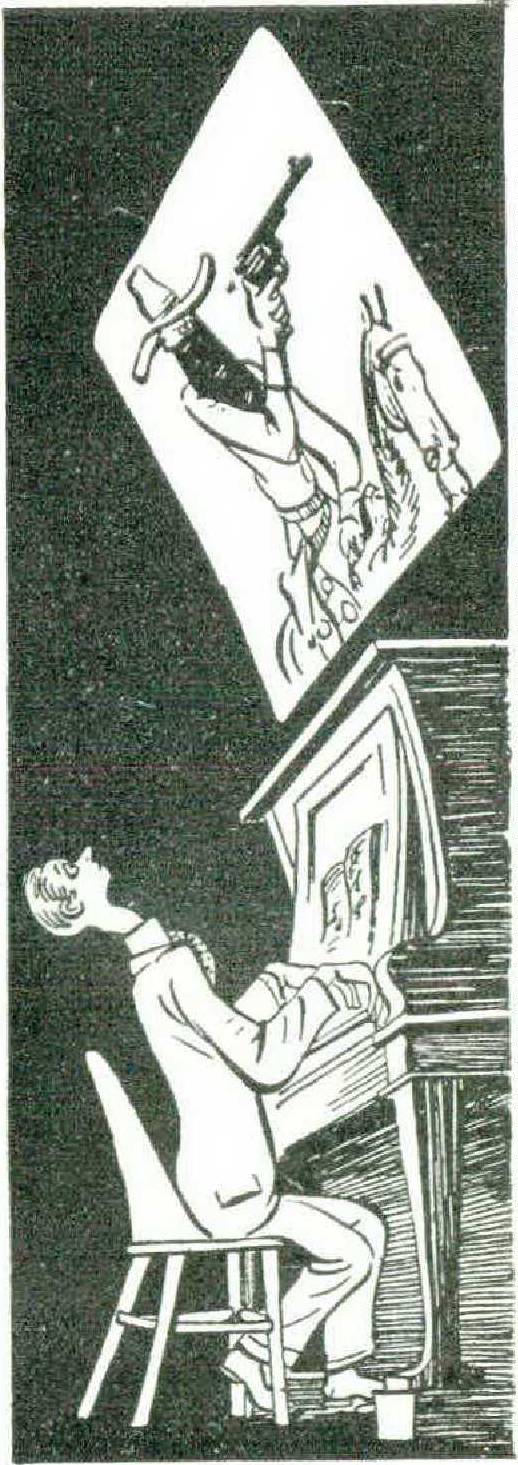
Generally speaking, however, these handy collections achieved wide circulation. All the commoner moods were taken care of. Here in God’s plenty were hurry motifs, recitativos, and furiosos; religious moods (“ABC Sacred Set No. 1”); character themes; brooding penserosos and valses dramatiques; and of course great expanses of sobbin’ music. This, then—largely in the form of my own substitutions — was what I began to serve, augmented by discreet portions of the Associated Classics. Rich fare for the Gem patrons! I sometimes wondered if they deserved it.
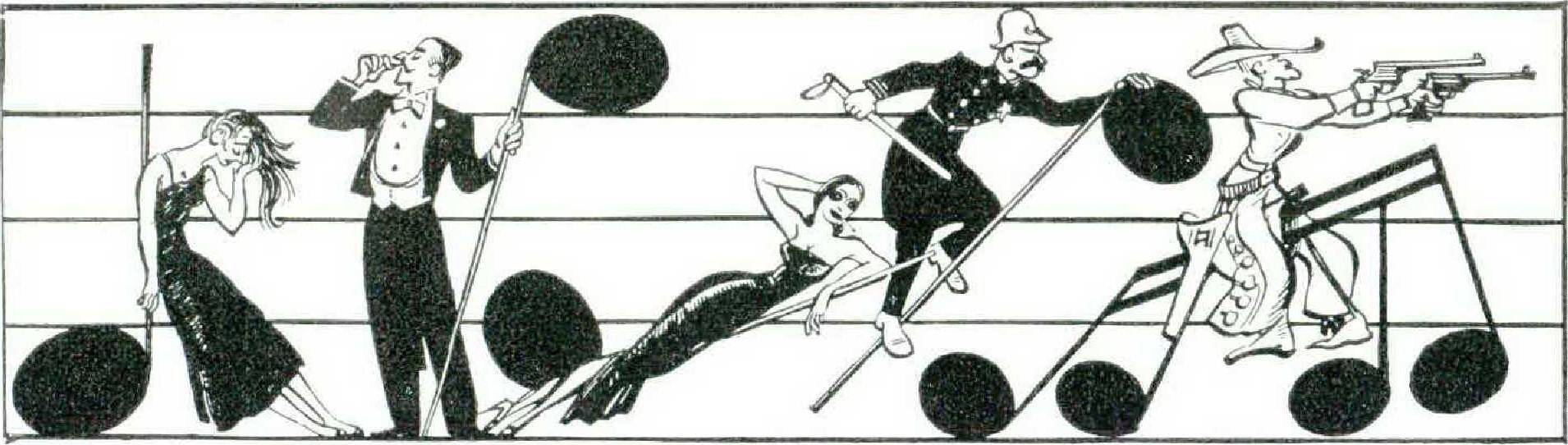
The terminology of Hollywood’s composers was as florid as that of its press agents. A plain old appassionato (the movies spelled it with an o) lacked punch —or perhaps sales appeal; the name was too generic. Thus there were souped-up and variegated appassionatos: agitato, patetico, joyous, melodic, and dramatico. There was even a hybrid called “Andante Appassionato” for love in leash.
There were also odds and ends scattered about in the cue sheets to delight one unexpectedly. A Verdi aria achieved new stature when rechristened “Heavy Character Theme”; “Eastern Romance” was credited to Korsakoff, who presumably did arrangements for Mr. Rimsky; and the California geomusicians, momentarily confused, forgot all about Tschaikowsky and cued the title “Russia! Torn by War” with “Finlandia.” Of the composers represented, a man named Kempinski was apparently the most prolific. Besides writing an impressive quantity of agitatos and defiance and gloaming music, he found time for at least thirtysix symphonies (which he designated “incidental”), an output which approached that of Mozart and which went Beethoven twenty-seven better.
But back to the pit. Since the Gem employed no supplementary artist at the traps, the responsibility for sound-effects rested on me. However, after a faulty sense of direction in the dark had betrayed me into such fiascoes as landing on the Oriental gong after aiming at the steamboat whistle, I gave up. The management preferred it that way. Anyway, the cue sheets sometimes went to extremes. Such directions as (for Chang) “Note: Produce effect of snarling leopard in cage” and “Important effects of . . . weird hammering, wild screaming of monkeys, etc.,” if conscientiously carried out, would have reduced both the audience and me to gibbers. For The Big Parade, however, my boss decided to go the whole hog for realism and engaged another college youth to come to the theater with all of his drummer’s paraphernalia, park in the wings, and lay on ad libitum. This was a mistake. Clarence’s love of action, which compensated for his aesthetic deficiencies, led him to make his debut armed with an old revolver, and when his trigger finger itched, instead of scratching it, he took to firing blanks, while the other hand simulated heavy artillery on the bass drum. If anyone in our town didn’t think war was hell, it was merely because he hadn’t been to the Gem lately.
But Dämmerung finally came to the twilight workers. With the encroachment of science and the men from Western Electric, my engagements dwindled to two or three evenings a week. Thunder, in which Lon Chaney played a locomotive engineer, was my last, picture, and in spite of the mustard plaster which I wore after over three years of neck stretching, I found the occasion rather poignant. I don’t believe it was my most artistic performance, as numbers appropriate for a 4—8—4 pounding the rails are not of the highest order, but it was probably my most rhythmic. When I colle ted my last check at midnight, I knew it was me than the money I’d be missing.
Nowadays, when I hear the lushly orchestrated background swell and fade in the films, I think hack on those nights when in thousands of theaters Kempinski’s “Incidental Symphony No. 36” (not to be confused with Marquardt’s “Symphonic Incidentals No. 14”) was being played on thin reeds and trembling flutes. It is some time since I have heard the thirty-sixth. I sort of miss it.