The Science of Science-Fiction
JOHN W. CAMPBELL, JR., decided to study nuclear physics back in 1928 when he first read of “atomic power" in the science-fiction magazine of that day. Amazing Stories. He attended M.I.T. and Duke University and is now editor of Astounding Science-Fiction.
by JOHN W. CAMPBELL, J R .
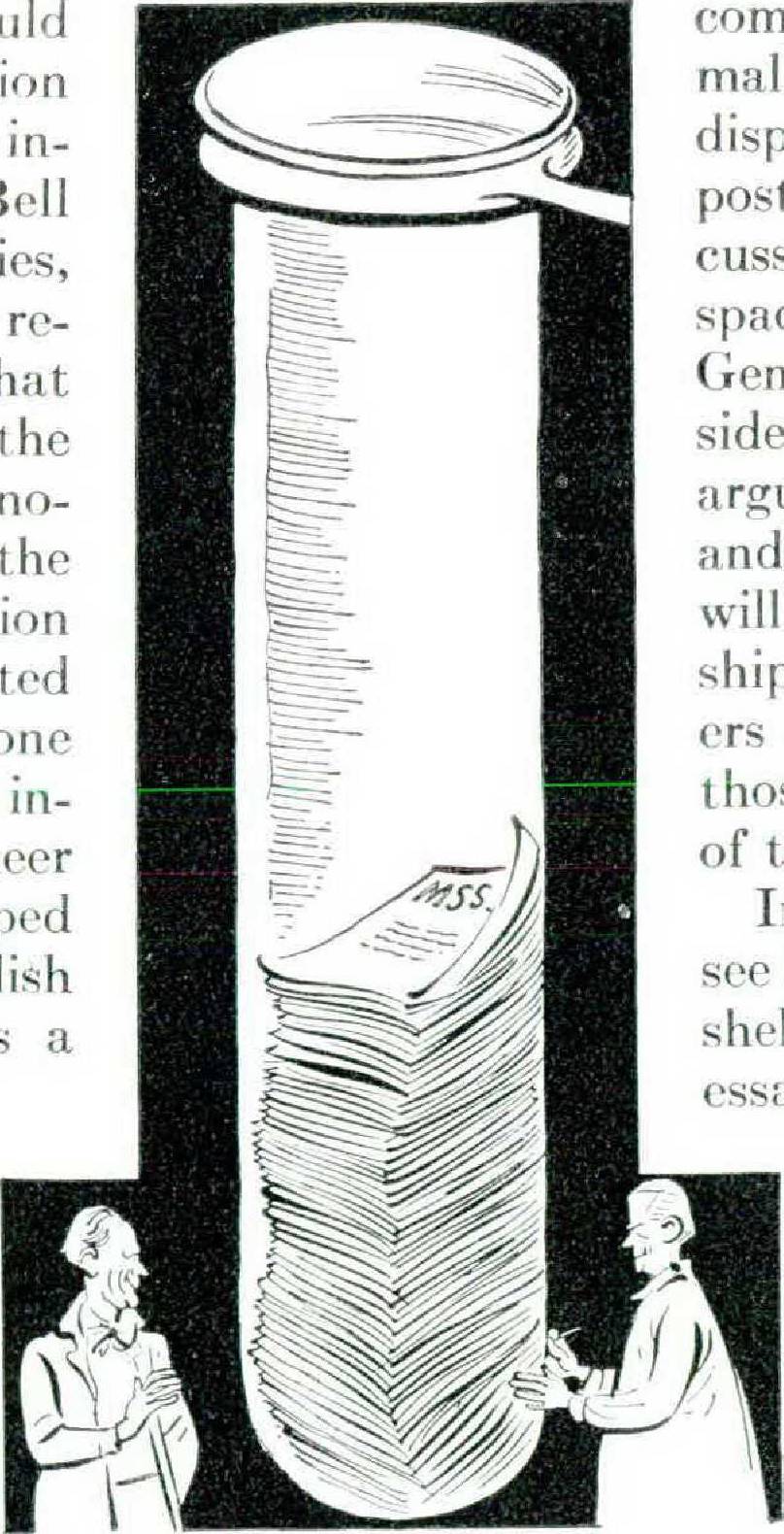
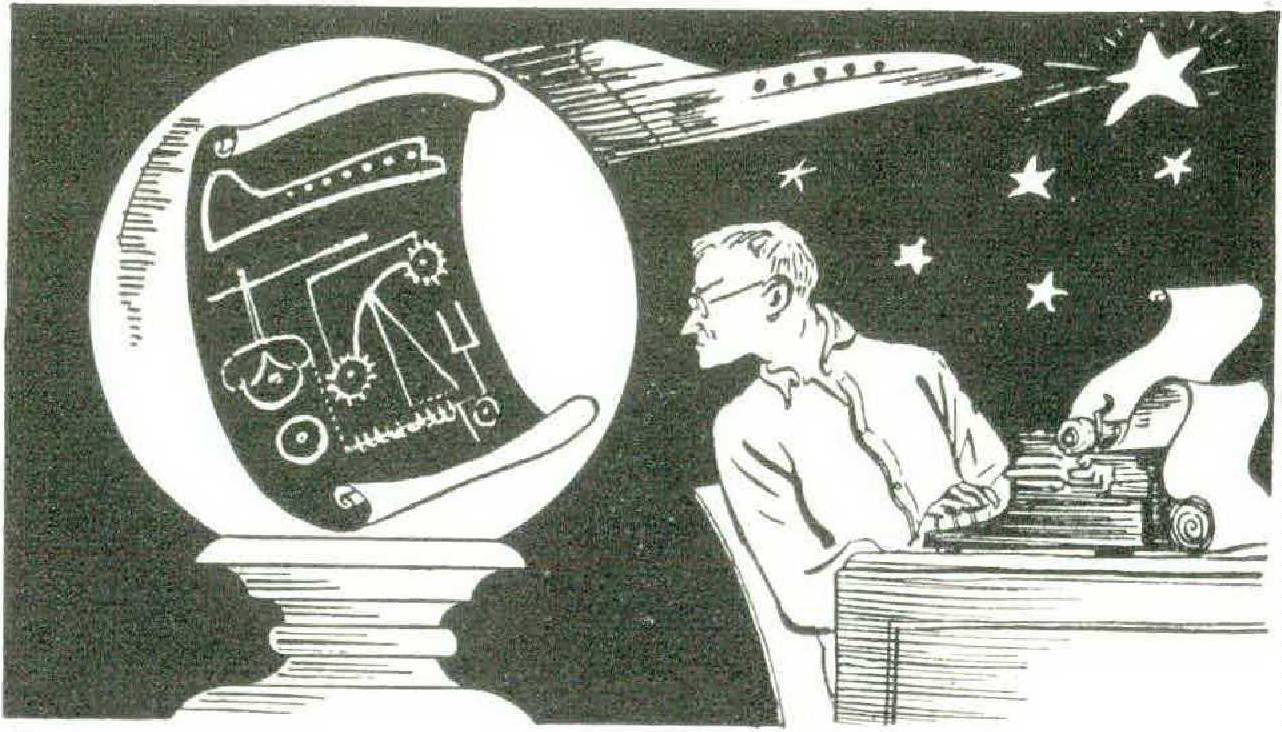
SCIENCE-FICTION is a form of prophecy. Normally, there is ;t lag of five to as much as one hundred vears between the discovery of a fact in the laboratory and the application of that fact in engineering practice. Science-fiction lives in that gap. Drawing its background material from the laboratory knowledge, it projects it to a time when the engineering application will be effected.
The science-fictioneer, you can readily imagine, has a much easier time of it than the engineer. He doesn’t have to sweat out the laborious details of the engineering apparatus for a job; he merely says that the job will be done. He knows that when men want something badly enough, sooner or later someone will figure out how to get it.
Television — long predicted in science-fiction — is a perfect case in point. Actually, back in 1920, almost none of the science necessary to practicable television was known. The seience-fictioneers’ prediction of the coming of television at that time was based largely on the proposition that people certainly wanted the gadget —and wanted it badly. If someone could just make the darned thing work, the American public would probably be willing to pay 500 million to a billion dollars for it. With that incentive, RCA, General Electric, the Bell Laboratories, dozens of big companies, put real money — millions — into research. They bought the knowledge that had to be gained; they supported the scientists that invented first the iconoscope, then the orthicon, then finally the image orthicon that makes television transmission possible. They invented vacuum tubes with properties no one imagined in 1920; they had to. They invented circuits that any radio engineer of 1920 would have instantly stamped impossible. But men can accomplish miracles when the jackpot prize is a billion or two.
A sciencc-fictioneer, however, can’t be an infallible prophet. The lag between laboratory discovery and engineering application can double-cross him. He may predict that such and such a known effect will be applied in a certain general way to produce a desired end. Ten, twenty, perhaps thirty years later the desired end is achieved — but by an entirely different method!
A perfect illustration is a story, written about 1929, describing how a single U.S. battleship, with three or four destroyers and a limping cruiser or two, defeated the entire Japanese fleet. The destroyers laid a smoke screen; the U.S. battlewagon was equipped with a device that projected ultrashort waves from two projectors, one on each of her fighting tops. The waves reflected from the enemy battleships revealed their direction. And the difference in time between the wave from projector Number I and the wave from projector Number 2 allowed an electronic device to calculate the distance to the target. Automatic devices, said the author, aimed the guns. Thus equipped, the single battleship destroyed the enemy fleet.
That system would work. But the time lag crossed up the author. Radar uses instead a single projector, because of additional discoveries made between the time the story was written and the time the U.S. Navy started equipping its battle-wagons.
Scienee-fiction has the interesting characteristic of causing its own predictions to come true. Since the stories are frequently written as a spare-time hobby by professional engineers — and thoroughly competent ones — they frequently contain sound engineering suggestions as to how a certain end can be achieved. The Manhattan Project scientists read science-fiction; so did the Nazi scientists working on V-2 at Peenemunde.
The idea of the rocket spaceship is so completely accepted today that the normally conservative Armed Forces are displaying spaceships on their recruiting posters. Science-fiction authors have discussed spaceships — specifically, rocket spaceships — for twenty years or more. Genuine engineering minds have considered the problems, mulled them over, argued them back and forth in stories, and worked out the basic principles that will most certainly appear in the first ships built — partly because their builders will have read the magazines, seen those stories, and recognized the validity of the science-fiction engineering!
In early science-fiction spaceships — see Jules Verne’s story of a man-carrying shell shot around the moon — the necessary air for the passengers was supplied chemically. There was soda lime to absorb carbon dioxide exhaled, and bottled oxygen or chemically produced oxygen for breathing. As science-fiction advanced, argued, and puzzled over the question, the right answer was worked out. Nothing could possibly do a better, simpler, more dependable, more maintenance-free job of absorbing carbon dioxide and giving off oxygen in just the right amounts than ordinary green plants. A small compact hydroponic garden aboard the spaceship will yield unlimited oxygen so long as carbon dioxide and light — either sunlight or artificial— are supplied. No delicate, fallible machinery or valves required. No danger of running out of stored oxygen. And plants deodorize the air, too.
Again, in early science-fiction, rocket ships were equipped with a main jet, a set of braking jets forward, and an indefinite number of steering jets, so that the ship could turn and maneuver in frictionless space. Science-fiction engineers worked that out; the modern science-fiction ship is a far simpler design. Major de Seversky, who has not been reading science-fiction, wrote an article describing his concept of an atomic-powered rocket ship which involved some two dozen separate rocket motors for control and steering.
The V-2 rocket was engineered by science-fiction readers and, like the science-fiction descriptions of the last ten years, has only one rocket motor — a vast saving in weight, complexity, and cost. Instead of multiple steering jets, the engineers of science-fiction said, use two simple systems. For small course corrections, put vanes in the main rocket jet and deflect the main jet stream. That will steer well enough for small angles. For braking, for slowing down for a landing, you don’t need separate landing jets; in fact you wouldn’t want them anyway. Instead, turn the whole ship end for end, and land as you take off— tail, and thus main jet, down.
Turning the ship end for end, or through a desired angle in any direction, doesn’t require extra steering jets, either. Just mount three flywheels somewhere inside the ship, with their axles at right angles to each other. If you start wheel Number I rotating to the left, then by the law of action and reaction, the ship will rotate — though much more slowly—to the right. If you rotate a wheel with a cross-ship axis, the ship will rotate oppositely, and tumble end for end. Stopping the rotation of the flywheel brings action-reaction back into the scene, and the ship will stop turning, too.
Now you don’t need steering jets; if you want to steer left, rotate the ship till the main jet — the tail — points right, and pour on the power. Your main jet under these conditions acts conveniently as a steering jet.
Even minor but important devices for use in space have been engineered by the science-fiction writers. A spaceship in flight is “weightless” — that is, you can neither perceive motion nor feel any effect of gravity. Things won’t fall. A book released from the hand won’t lie on the table, but will drift gently about the room in chance air currents. How would you keep books where you want them in a spaceship—reference tables, handbooks, and so forth? A bookcase of the ordinary type and ordinary books are impractical; instead, the title of the book is printed along the edge of the pages, and the backstrap of the binding is put against the steel wall of the ship. It has a permanent magnet built in to hold it there.
The problem of minor repairs requiring soldering of electrical circuits has also been considered. (Stray dollops of solder are hunted down with a vacuum cleaner hose.) Incidentally, you can swallow successfully without the aid of gravity — even against gravity. It has been experimentally proved; the easy way to prove it involves standing on your head, with your back supported in the corner of a room for stability, and consuming a glass of water with the aid of a tube. It can be done.
Of course, aboard a weightless spaceship, you don’t ask for a cup of coffee; since water wets chinaware, and there is no weight to restrain it, the coffee would immediately flow up the inside of the cup, over the rim, down the outside, and completely over the saucer. If you held on, it would spread itself in a fairly even layer all over your body. If you use a waxed cup, which the coffee won’t wet, the reverse trouble would appear; the coffee would draw itself into a globe and float in the air. If you tried to catch it the way you do the string-suspended apple on Halloween, the first contact would cause it to run all over your face, eyes, nose, ears, and hair, as well as your mouth.
The experienced space-traveler will order a flask of coffee — a small plastic flask of rubbery material with a tube neck on which to suck.
These things will be so partly because sciencefiction has said so. The engineers actually entrusted with the job will almost certainly have read these answers to the problems of the spaceship in science-fiction, and will accept them gratefully. They will have too many more important and more difficult problems to work out to turn down such workable ready-made answers. To this extent science-fiction causes its own predictions to come true.