What Stage Fright?
W. F. MIKSCH is a free-lance writer living in Newtown, Connecticut, and has contributed many light pieces to these pages.
The U.S. Office of Education, concerned for those who “become extremely nervous and tense when called upon to speak in public,” has awarded a $5000 research contract to the University of Illinois to find out what causes stage fright and how to cure it.
Any outfit that spends $5000 to encourage public speaking in a year of major political campaigns certainly is not acting for the public good. I only hope those Illinois researchers shoot the works on chocolate malteds or a new stadium, and then report back that “there is no cure.”
What is the point in their dashing about a lab. dropping test tubes, and running up the university’s electric bill to find a cure for something which doesn’t exist in the first place?
That stage fright is all but nonexistent must be obvious to everyone — even to a nonresearcher — who lately has been exposed to television, radio, party conventions, political rallies, candidate debates, fundraising dinners, PTA meetings, alumni banquets, or anything else which supplies a fairly captive audience. (In a very mild form, stage fright may still survive in the theater; “method” actors always strike me as being frightened of something, but I suspect it is only a fear of being heard in the lowerpriced seats.)
There was, to be sure, a time when people often pitched over in a dead faint if suddenly called upon to say a few words, but that was long ago. By now, any “open” mike, unoccupied rostrum, or vacant chair at the speakers’ table touches off a wild stampede to see who gets there first. The fear is not of being caught onstage but of being kept off it.
Speaking as one to the audience born, I am in favor of stage fright. I would like to see a return to the good old days before the proverbial cat gave everybody back their tongues, to that happier, or at least less tiresome, era when oratory was left to a handful of professional orators.
Then, baseball stars stuck to the diamond; they did not plod about in front of television cameras delivering declamations on tough beards or unruly hair. Six-day bicycle riders wisely saved their breath for pedaling; they didn’t waste it discussing postimpressionist art or public housing on panel shows. Housewives whose quince preserves won first prize at the county fair bashfully picked up their blue ribbons and went home to put up more quinces; they didn’t grab the nearest microphone and announce their candidacies for the state legislature. Novelists wrote their books, and then, blushing furiously, hid away behind a door until it was time to write their next.
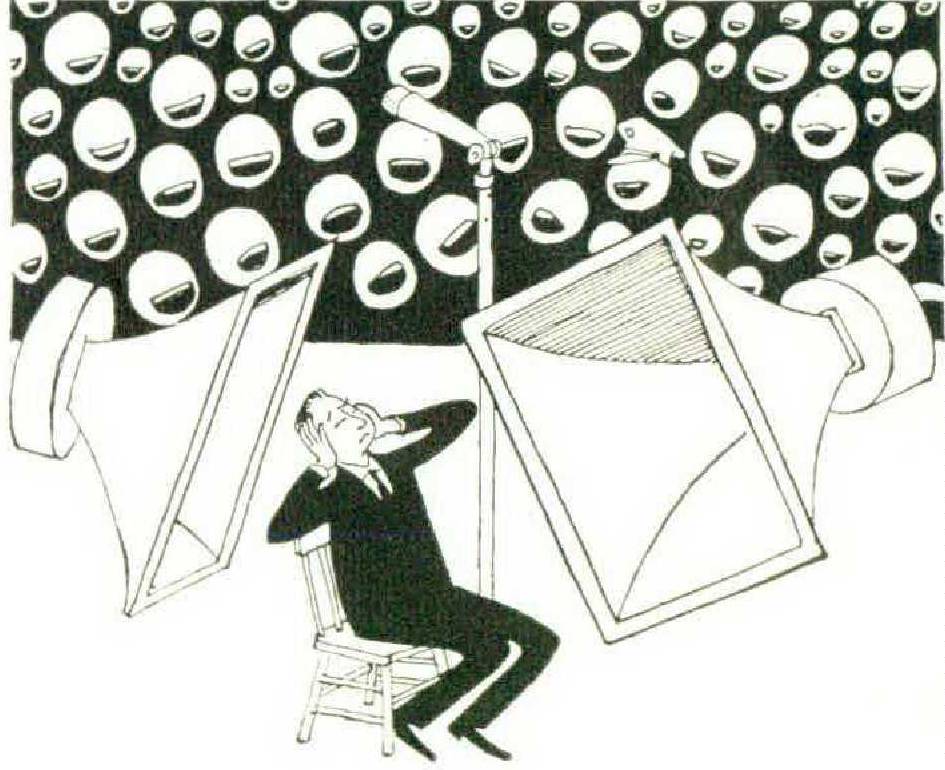
What made the age even more golden was that there were no sound trucks, public address systems, or broadcasting stations, so that anyone within earshot of a public speaker had only himself to blame. My own theory about the whole thing is that when electronic communications systems came in the door, stage fright went out the window. I shall not try to explain this; I shall just say that it’s too bad.
A good sweeping epidemic of stage fright, one that will render all orators tongue-tied, would come as a welcome relief to one pair of tin ears I can mention. Maybe the Office of Education can arrange one with the next $5000 that burns a hole in its pocket. Then it will be tackling the real problem, which definitely is not stage fright.
The real problem is to get everyone to sit down and shut up.