Tv's Supersalesman
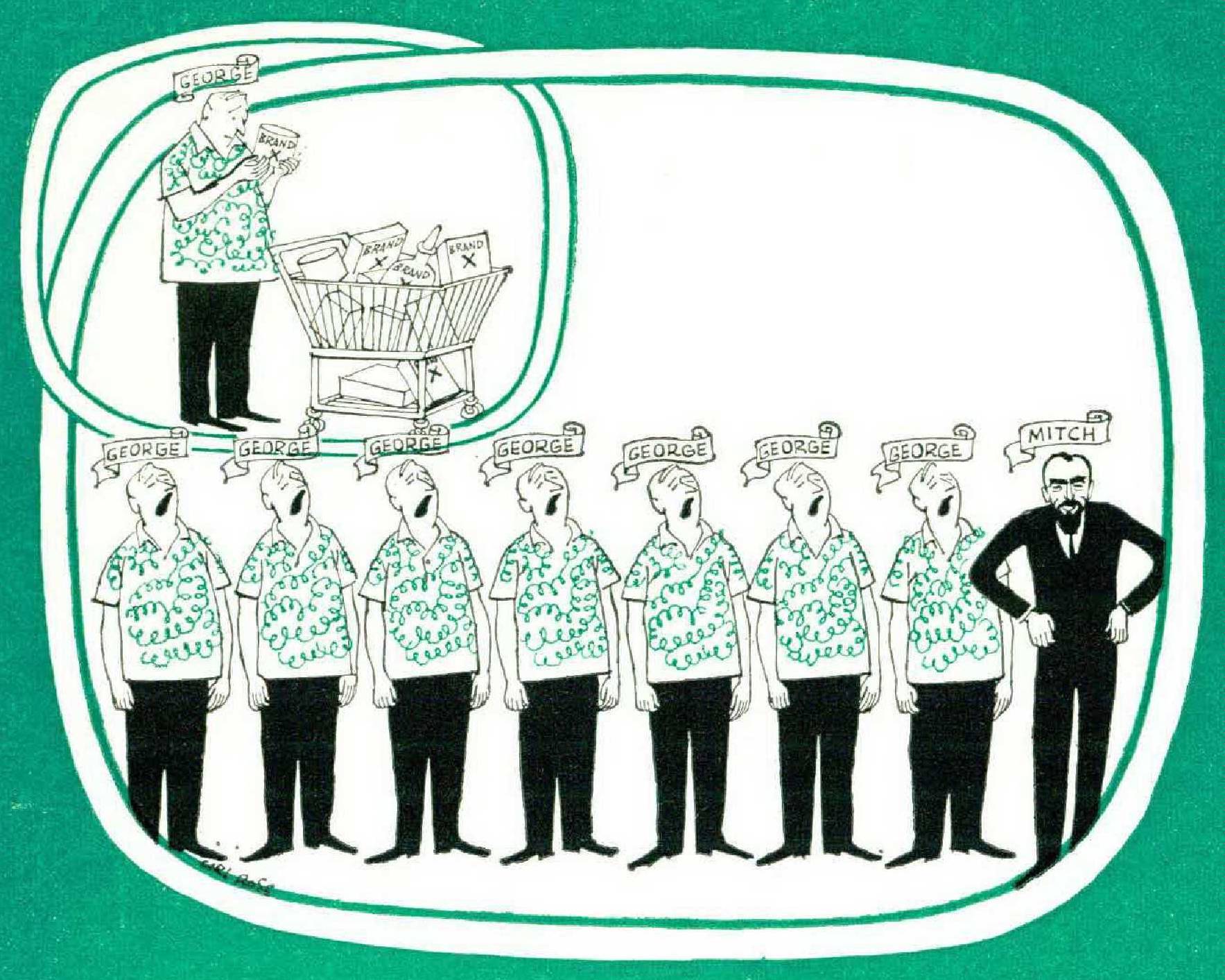
It is no longer advisable to give a male child the name George. Just as, years ago, a boy was cruelly handicapped by such a name as Percy or Cuthbert, today’s television commercials are making George the symbol of all unmanly qualities. George lives in a near hysteria; he breaks things, spills, forgets, acts oafishly, cringes before the brazen voice of his wife, and is incapable of simple arithmetic. His grammar is usually a bit sprung. (“It goes on real easy — ”)
George, in short, is the husbandchump image so stoutly believed in by the advertising agency and its Client: any housewife seeing George in the commercial will buy The Product just to show George who’s boss. It’s a handy name too, quite without embarrassing overtones of race, religion, or nationality. At this writing George is obsessed by the subject of toilet paper.
So, we see George in a telephone booth. Laden with bundles though he is, and with the phone cocked on his shoulder, he is reporting to his wife great news: instead of the three rolls of Blank’s, he has bought four rolls of “another brand” for about the same price.
Instead of hosannas, George’s wife responds with a contemptuous question. “George, how many sheets in one of those rolls?”
George drops a bundle or two, knocks his hat askew, and purports to look at the package of toilet paper. “Er — six hundred and fifty sheets.”
Follows a shouted tirade from the wife: doesn’t he realize that Blank’s roll contains one thousand sheets? So that three rolls of Blank’s . . . four rolls of six hundred and fifty sheets each, etc., etc.
George is thoroughly frightened by this time. He begins to groan and whimper at the magnitude of his transgressions. It dawns on him that he is short four hundred sheets of precious toilet paper. “You mean —” he begins, but the situation has become too hot for him. He has wasted household funds — perhaps as much as eight or nine cents — and, worse, he has been Disobedient. Fadeout on George, the husband-goof, blubbering.
One wonders what the higher executives of the Scott Paper Company, and especially their wives, have to say about George and his customer-appeal when someone brings up the subject at the Saturday night dance at the Nirvana Heights Country Club.
George works for other companies. He is wearing a regular suit in the telephone booth episode, but he usually appears in the sport-shirtoutside-the-pants costume, the maternity-blouse effect introduced at the White House by Harry S. Truman during his presidency. In kitchen scenes it is George who wears the apron, standing hang-jawed while his wife is shrilling at him the merits of the all-new miracle cake mix, laundry bleach, or denture cleaner. (It’s interesting, incidentally, to see how young our denture wearers have become; most of them seem to be under thirty.)
But even George — poor drudge that he is — even George finds his moments of happiness. Once every week George has the illusion of success, of being admired, of pleasing people. On his big weekly night out George may be in his maternity blouse and lacking a necktie, or we may see him bedizened and bcfrogged like the leader of a high school band or a chorus man in TheStudent Prince; he appears at times in a top hat and tails. Serene, confident, his toilet-paper cares forgotten, George is singing along with Mitch, and although the beat is pretty much John Philip Sousa, the sounds George is making fall gratefully on the car.
It must be that this has been the secret of Mitch Miller’s grip on the TV audience: the Georges of all sizes and ages, who buy the wrong things at the supermarkets, can sit at home and watch themselves having a wonderful time on the Mitch Miller show.