The Gourmets of San Sebastian

San Sebastian in February was a dowager with a lorgnette clinging bravely to remembered grandeur. Our enormous hotel echoed with emptiness. There seemed to be another tenant on our floor — at least, one morning I noticed the chambermaid putting fresh sheets on a bed in a room down the hall. Another time I saw a strange lady sitting in the lobby. She looked a little uncomfortable, it was true, but as if she had every right to be sitting there. The hotel was a hushed, ghostly castle, but one equipped with steam heat, plenty of hot water, and marvelously comfortable beds.
When the shutters of our room were thrown back, we saw many people walking along the seawall, purposefully, as if to work. There were children of all ages, too, deliberately stepping in puddles or streaking out on the wet sand of the beach when the tide was out. The city was not deserted, only the tourist hotels.
My one fear was that the best restaurants might be closed for lack of tourist trade, but after checking with a certain Señor Felipe Ugarte, to whom I had a letter of introduction, I soon learned this was happily not the case.
“The restaurants of San Sebastian,” he assured me, “do not depend on the tourists for patronage. On the contrary, it is the yearround citizens who are the best customers. Have you not heard about the Basque capacity for eating?”
I had indeed, and told him that it was for this reason I had come to San Sebastian, since it was the largest city in the Basque country. I was here, in fact, on a gastronomic pilgrimage.
“If you are not doing anything for lunch,” he offered, “I should be happy to escort you to one of our finer restaurants. You will encounter no better in the world.”
Sñnor Ugarte had responded with such affront to my suggestion that San Sebastian restaurants might close during the slack season, I assumed he must be a Basque himself. His air of pride in escorting me through the dark-brown foyer of the Casa Nicolasa strengthened this impression, for a happy look mellowed his face as we were met with lovely odors of roasting meat and herbaceous sauces. The Casa Nicolasa had clearly stood here for many years. Its paneled walls had the air of smug pride that only an old, respected, and dearly loved building can acquire. Upstairs a table had been reserved for us, set with a fresh blue linen cloth — almost too modern; for such a venerable place white damask seemed more appropriate. Señor Ugarte ordered lunch, his eyes lingering pleasurably over the menu.
“Some champagne first?” he suggested. It was Spanish champagne, astonishingly good, with thin slivers of lemon and orange peel floating in the bubbles.
“Is it true that Basques are noted gourmets?” I asked as I swallowed a tiny fish puff, a crisp, gold-crusted morsel with a heart of souffléed sole.
“Of course, this is one of the great gourmet centers of the world,” he pontificated. “You have heard of the gourmet clubs of San Sebastian, I assume? There are no less than twenty-five clubs here, and a waiting list for membership in each one.”
“Oh,” I breathed, “I’d love to attend one of their dinners. Do you think there is any way — ?”
He shook his head. “Their meetings are for men only. Only on one day of the year are wives invited — on San Sebastian’s Day, after midnight. To be a gourmet in the Basque country is a male prerogative.”
With a sigh of disappointment I took a bite of bright red Serrano ham sliced as thin as silken cloth.
“Have some crabmeat,” he suggested by way of consolation. “This is a Basque specialty. It is called changurro.”
The crabmeat had just been placed before me piping hot in its shell, a velvety brownish-red puree sharpened with pepper, accompanied by a mound of steaming rice. It was so good I scooped up the last row edging the shell with a crust of bread.
“And now for the soup.” Señor Ugarte nodded his head toward the waitress (the Basques may not consider women capable of reaching the heights of gourmandise, but they do permit them to wait on table even in the best restaurants). “I’ve ordered a sopa de pescado. The Cantabrian coast offers the best seafood to be found anywhere in the world. I hope you will find this tasty.”
The waitress had borne a huge tureen to our table, and she ladled from it chunks of tender white and rosy fish and pinkish bits of shrimp floating in a smooth, fragrant, scarlet broth. My soup plate was brimming before she turned her attention to Señor Ugarte. Meantime, our wine glasses had been filled, and I discovered with pleasure that my host had selected a delightfully dry white wine which was frosty cold, the perfect complement to our soup.
“Is this a local wine?” I asked.
“Naturally. There are many vineyards in this area, and some of the finest wines in the world are produced here. Unfortunately, few of them will travel. This particular wine is a Monopol Cune. There’s another local wine you must try before you leave the Basque country, called chacoli. You cannot find it anywhere else, not even in other parts of Spain. But I recommend it highly. Write down the name. They have it in nearly every restaurant, though it is not always listed on the wine card.”
The soup was superb, an exquisite melody of flavors, thick with a dozen different kinds of seafood. The serving was, however, quite enough for a meal in itself by American standards, and mindful that there would be other courses to follow, I put my spoon down when two thirds of the way through; Señor Ugarte raised his eyebrows slightly. He was having a second helping.
The sopa de pescado was followed by bacalao pil-pil, a dish I had asked for, I must confess, because of its delightful name. I have never been enthusiastic about salt codfish, though the more famous bacalao vizcaína, cod buried in a fragrant tomato sauce, can be wonderful. There had always been the lingering suspicion in my mind that the vizcaína sauce would make anything taste good. The pil-pil was white and creamy, redolent of garlic, rich with oil, and salty. Interesting, but the gargantuan portion placed before me was enough for four people.
“You don’t care for it,” pronounced Señor Ugarte.
“Oh, yes. it’s most interesting. Why is it called pil-pil?”
“Because as the sauce bubbles it makes the sound pil, pil, pil. The Basques say that a good cook must see the food, smell it, and hear it.” He beckoned for the waitress. “Now for the meat course perhaps you will have a chuleta of veal?”
“Oh, no, really. I’ve eaten as much as I can. A salad, perhaps, or some fruit — nothing more.”
Again there was a slight frown on my host’s face. I began to realize that to rate as a gastronome in this country one must have a Rabelaisian appetite. “But of course you will have dessert. I would like to recommend brazo de gitano — that is to say, ‘gypsy’s arm’ — a very nice cake.”
It was no good to protest, and when I tasted the “gypsy’s arm” I was glad I had not. It was a spongecake roll with a luscious filling, minced dates in a custard rich with eggs and wine, the top masked with a snowdrift of cream, sprinkled with almonds.
Leaving the Casa Nicolasa I felt as stuffed as a Christmas turkey and happy to take a short walk along the seawall, where the incoming tide was sending cascades of foam over the guardrails. The sky was clearing: patches of brilliant blue showed between towering cloud banks.
“And now I must take leave of you,” Señor Ugarte murmured gallantly as I insisted I would prefer to walk back to my hotel, feeling in need of some exercise. Then, unexpectedly, he announced, “I shall try my best to get one of the gourmet clubs to invite you for a dinner. But if you go to one of their dinners, you must eat everything placed before you. If anything is left on the plate, they are insulted. I remember when I first came here — ” The evening, I thought, was ended now — but there was to be a final ceremony. I had noticed that all the men wore the same sunflower emblem in their coat lapels. Suddenly Don Arrúe approached me with great ceremony, holding in his hand an opened jewel case on which rested a sunflower pin - the eguzki-lore, as I now learned it was called. The pin was for me; I had been voted an honorary member of the club and could henceforth wear this emblem wherever I went in the world, announcing myself thereby as a member of the Cofradio Vasce de Gastronomía — the Brotherhood of Basque Gourmets. I was overwhelmed with the honor. Picking up the pin, I attempted to fasten it to my dress. Alas, it had been designed only to slip into masculine coat lapels; it would not pin to chiffon. The lapel button remains, and shall always remain, however, a souvenir of a lovely evening, an evening of wine and song, when I proved to skeptical males that a woman could also possess gastronomic fortitude.
“Then you are not a Basque?” I asked in surprise.
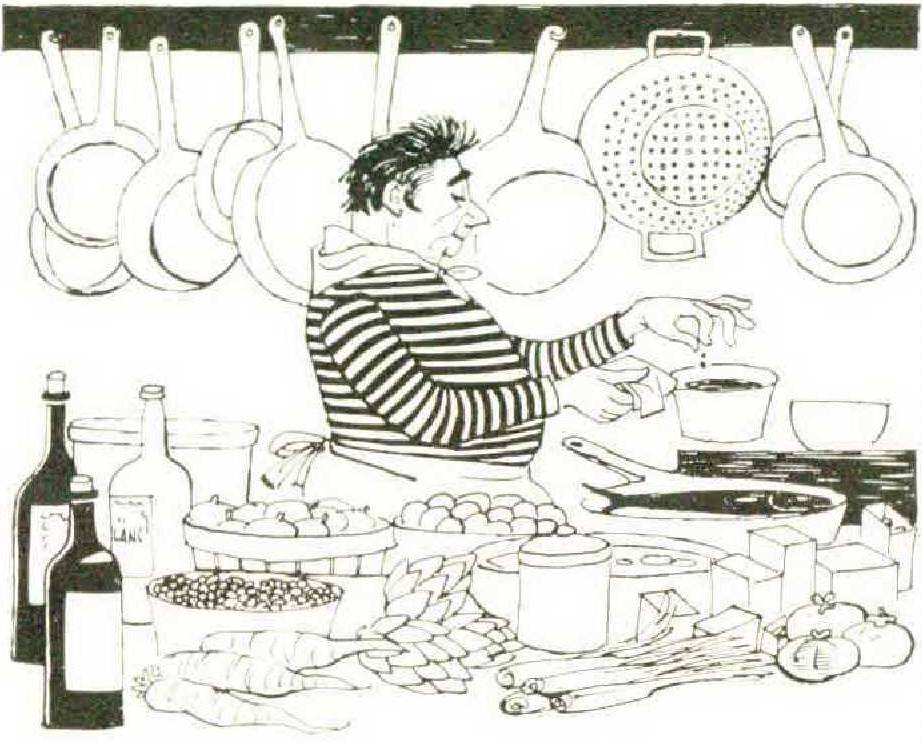
“No, I am from Seville,” he said quickly, rushing on as if to ignore my interruption. “The Basque men, you know, are as proud of their ability to put away enormous quantities of food as they are of their skill in cooking. And it’s the men who do the cooking. A woman may be permitted in the kitchen to trim vegetables and do other such chores, but the cooking itself must be done entirely by the club members. It is superb cooking. I shall try my best to get them to invite you, to make an exception, since you are an American journalist.” Then, shaking a finger, “but you must eat everything. Everything!”
A few days later the call came.
“It is all set for tomorrow,” Señor Ugarte told me. “The club where you will have dinner is called the Gaztelupe, which means ‘under the castle.’ They have asked me to accompany you, since few of the members speak English. I will pick you up at your hotel at nine.”
Aware of the precedent-shattering importance of the occasion, I dressed carefully for my dinner at the gourmet club, choosing the most feminine costume in my possession, a floating chiffon with a stole the color of a bullfighter’s cape. Remembering a gourmet dinner I had attended in New York once. I fully expected this to be a black-tie affair.
The Gaztelupe Club was located in the oldest part of the city, under the brow of a sharp hill (the castle for which the club was named could be seen silhouetted at the very top). To reach it we walked through a narrow cobblestoned street; then Señor Ugarte rapped on a huge brass-studded door. The room we entered was cavernous, dim with the light of a few bare bulbs high in the ceiling, sparsely furnished with wooden tables and benches, starkly masculine. A few men stood awaiting us, and one of them, the deputy mayor of San Sebastian, a club member, stepped forward to kiss my hand in the Spanish manner. A tall gray-haired man beside him eyed me solemnly from behind steelrimmed glasses. He was a distinguished San Sebastian lawyer, I was told, whose knowledge of culinary matters was so great he was frequently asked to speak on the subject in provincial towns.
“Look here,” a third man said eagerly, showing me a local paper headlined, “Brilliant Conference of Don Antonio Arrúe on Gastronomy.” “Señor Arrúe,” he added, “is much in demand.”
Other men were entering, and I could not help but notice that sartorial elegance was hardly the order of the evening. Many members wore jersey shirts and slacks; one rotund man, whose dimensions might well have been 40-56-50, had a well-worn apron hanging loosely over his paunch. He was an important figure, nevertheless, for it was he who brought in wine bottles to plop in rows along the tables; and soon he was pouring what I was told was cider foaming into glass mugs. (I had a taste later, and it was far more like beer than apple juice.) The sight of liquid refreshment seemed instantly to put the members into a more genial mood.
Clearly none of the members of the Gaztelupe Club worried about calories. “Barrel-chested” is a word that has been used before to describe the Basques, and I could think of no better. There was an Irish look about most of the men, too; they were ruddy, genial, heavy of jaw, and had well-padded biceps. The Basques claim to be descended from the original Iberians who dominated all the peninsula until the Celts arrived from the north, intermarrying with the Iberians to create the Celtiberian race. Celtic blood clearly is still strong in Basque veins.
On most evenings, Señor Ugarte told me, the club members joined up in informal groups, each group preparing their own food. A man might bring home a fine catch of fish and would call five or six friends to come join him at the club for a fish fry. One such group was even now sitting down at a side table, plunging into their food without ado.
“There are some men,” he went on, “who come here for dinner every night — they never eat at home.”
“Even though they have to do all the cooking and washing up?” I asked in astonishment. He nodded. “Yes, they prefer to do their own cooking.”
But now Don Antonio Arrúe had gestured for everyone to be seated, and a ripple of talk and laughter broke out as a huge casserole was brought into the room. This, I was told, was merluzo koshera, a Basque dish so unique it had even been recognized by the French as worthy of inclusion in culinary glosseries. Steaks of fish were swimming in a thick white sauce, surrounded by stalks of white asparagus and quartered hard-boiled eggs. Remembering that I must eat every morsel, I gave myself a modest serving and tasted experimentally. As I looked up I saw that a dozen pairs of eyes were watching for my reaction, and summoning all the enthusiasm I could muster, I exclaimed that this was muy rica, a phrase my dictionary had said was Spanish for “very delicious.” Actually, I was not impressed. I hoped that the remainder of the menu would be more tempting.
The wine, at least, was delightful — more of the chacoli to which I had previously been introduced — and with the second course my spirits rose. This was mero, a fish so sweet and succulent I could have taken several helpings had I not been aware that the evening’s marathon of eating had just begun. As I finished the last bite of mero, I heard exclamations ringing out at the far end of the room near the kitchen, and a young man in sports attire came down the room bearing a platter containing a single trout, crisply browned, with a rasher of bacon curled in its stomach.
“The first trout of the season,” he exclaimed, with flashing eyes, placing the platter before me. “Would you like to have it?”
As I tore into the delicate beige flesh of the trout, I felt the eyes of the company upon me again, enviously this time, for who can resist the wonders of fresh-caught brook trout?
The trout was followed by roast lamb, potatoes, and salad; then there were two kinds of cheese to devour — a creamy white cheese in a pot called mamila ó cuajada, made from the milk of ewes about to give birth, and a hard cheese called idiazabal. My appetite was less keen than when I had first arrived, especially as I had dutifully cleaned every morsel from every plate placed before me, and it was with relief that I heard Señor Ugarte whisper that I need not eat the dessert if I did not care to, but that I might take just a small taste of each of the two or three pastries that had been placed before me.
At last the plates were being carried back to the kitchen and it was time for coffee and brandy. If my dress seemed unaccountably tight around the waist, at least I had the satisfaction of having kept up with the Basque gourmands, plateful by plateful. They, in turn, now eyed me approvingly, and from the laughter around the room I sensed that the evening was counted a success.
“We are going to have singing now,” Señor Arrúe announced from across the table.
Five men were huddled together at the far end of the table, listening as their director hummed the pitch. Then suddenly they burst into magnificent torrents of song, the Basque alphabet first, in a succession of spirited arias; then a haunting Basque love song in chorus, followed by a solo in English of “Motherless Child,” sung more beautifully than I have ever heard it before. To prove their versatility, the singers next launched into an Andalusian love song with wailing Moorish overtones, and a Russian melody with the lyrics in Basque.
“All songs sound better in Basque,” the man on my left observed, while across the way another club member commented, “Russian music is very like ours.”
I agreed with them and wanted to hear more, and when the final number, another Basque song, was done, I was completely enthralled.