Weather Omens
CORNELIUS SHIELDS of Larchmont, New York, is an outstanding yachtsman. The following observations are part of his book CORNELIUS SHIELDS ON SAILING, which Prentice-Hall will publish this summer.
Weather proverbs that have come to us through the centuries contain much wisdom, and most of it is founded on practical experience.
“Red sky at night is a sailor’s delight. Red sky at morning, sailor take warning!” This is how the proverb has come down to us, and its truth is such that it is still included in texts for naval officers. Much of this folklore can be easily explained by scientific theory, but some of it cannot and must be taken on faith.
In every section of the country is some old-timer who will state, “We’re in for a spell of bad weather.” Skeptics laugh away this statement as pure mysticism, but most probably the prophet is more aware of tiny, all but imperceptible signs than those of us who have had the faculty of weather-awareness blunted by living in concrete cities. However, if you are racing sailboats, it is a wise idea to train this awareness back into your consciousness. Here are some of the weather signs that I have noticed on the Atlantic coast.
When, on a summer’s morning, there is dew on the grass and flat surfaces, it is almost a certainty that a southwest wind will come up sometime during the day.
On a still day, when the light is right, you can sometimes catch sight of gossamer strands in the rigging. I don’t know why or how they appear, but they do. They have the appearance of minute strands spun by a spider, although no spiders are involved, I am sure of that. In our area these gossamers are a sure sign of a coming southwest wind.
In The Sea and the Jungle, H. M. Tomlinson wrote that the captain of his ship, the Capella, while the ship was in the Amazon River, prophesied a storm before nightfall after seeing gossamers in the rigging.
The appearance of opening crocuses is unfailing in predicting northeast winds. The wind will come either on the day the flowers are first sighted or on the following day. Again, I don’t know why this should be, whether it is the nature of the northeast air or what, but crocuses always mean northeast winds to me.
When seabirds cluster inland in large groups and are reluctant to fly, it is a sign of an approaching storm. The reason for this is obvious. Storms accompany low-pressure systems where the air is thinner; and it is hard for birds to fly in this air. So the birds stay close to the earth where the atmospheric pressure is highest. Birds are much more sensitive to pressure changes than human beings, and behavior like this is a sure indication of future foul weather.
The appearance of porpoises on the Eastern seaboard almost always foretells a northeast wind. Why, I don’t know, unless, like me, they just love that sparkly northeast air. I have been teased about this belief, but I have consistently gotten in my licks at the porpoise-scoffers.
During one Annapolis-Newport race in John Nicholas Brown’s Bolero, the wind was southwest, making the course down the coast a dead beat. We were on the starboard tack and headed offshore. It was my watch, and around nine o’clock that night, my friends the porpoises suddenly appeared. We were beating off Montauk and taking a long board offshore, because the wind would not allow us to lay the mark directly.
I told the afterguard, “We’re going to get a northeast wind, and we’re foolish to depart from the rhumb line. I think we should go on the port tack to get closer to the course so that when the northeaster arrives we can set our spinnaker and steer for the lightship.” Well, we did just that, and within two hours the northeaster came in strong. That was the year that we beat Baruna, our great competitor, by 24 seconds in the 350-mile race. From then on, the Bolero crew always believed what the porpoises told them.
While not strictly a weather sign, there is another phenomenon that I have observed. Very often at the turn of the tide, when it begins to flood, the wind will pick up. When maximum flood is reached, the wind will slacken, and when the ebb starts, it will often die out.
When a wind shift is imminent, it often takes place when the tide is at the flood. In the summer I have noticed that an easterly will shift to southwest at the very hour that the current tables tell you the tide will be at flood. I have discussed this with people ever since I started racing, and no two have had the same answer for it. I have not found a completely satisfying one myself, but the best I have been able to come to is that the rise and fall of that enormous body of water raises and lowers the atmospheric pressure enough to trigger the natural wind changes.
Now, you might think that all the foregoing is a lot of superstitious nonsense. If you do, try keeping a weather log, as I have done. At the end of the year, when the crocuses and the porpoises have done their work, and when you begin to think of having a new mahogany breakfront built to hold your silverware, I will be happy to welcome you to the ranks of the Order of Mystical Weathermen.
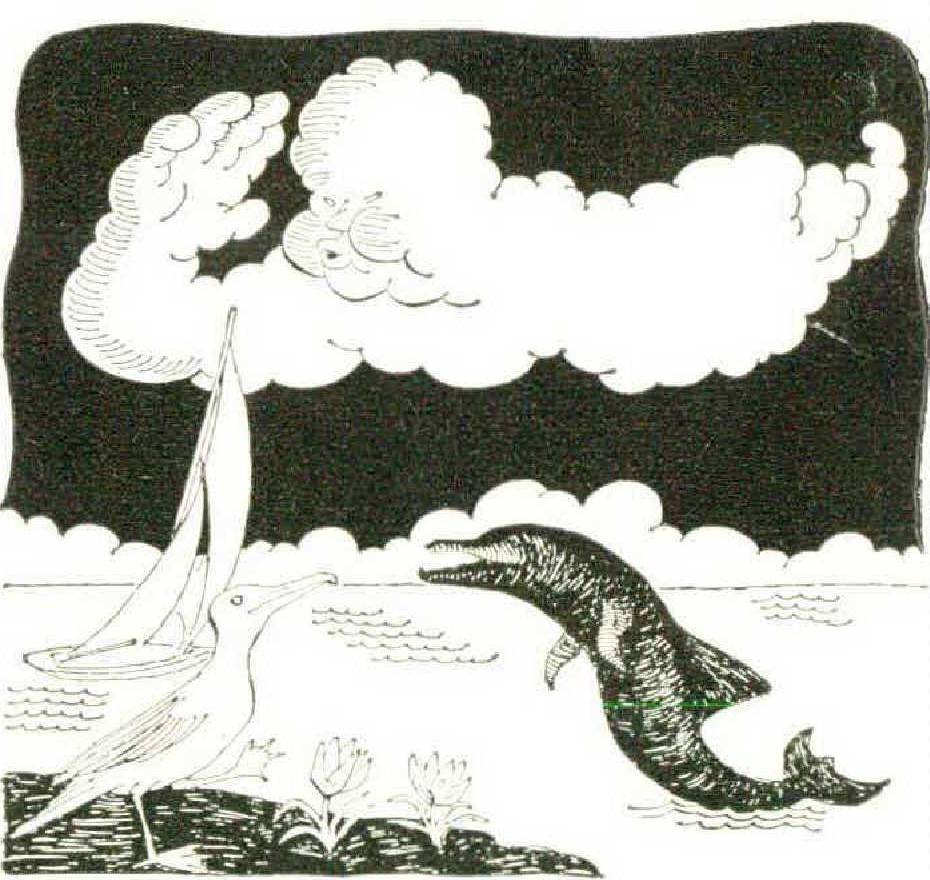
One thing is certain: if a skipper dashes out of the house to his boat, glances quickly at a falling barometer, wets his sneakers in the dew on the lawn, brushes the gossamers in the rigging off his face, and then squints up at the sky and says, “I wonder what quarter the wind’s going to come from today,” he most definitely does not deserve to win.