Democrats chose Tom Perez as new leader, Trump says he won’t attend the White House Correspondents’ Dinner, and more from the United States and around the world.
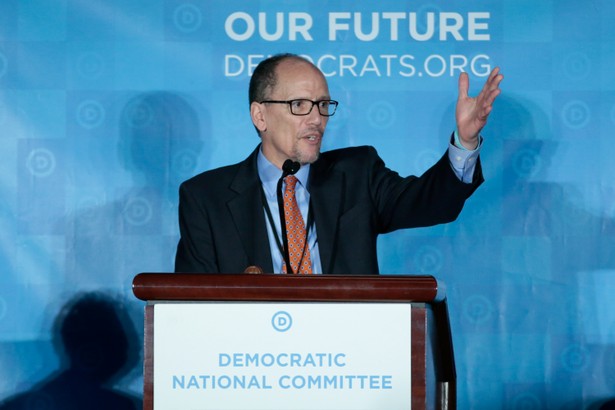
Former Labor Secretary Tom Perez
Christopher Aluka Berry / Reuters
—Members of the Democratic National Committee have selected former Labor Secretary Tom Perez as their new chairman, beating out Representative Keith Ellison for the top position. More here
—In the latest development with his contentious relationship with the press, President Trump said will not attend this year’s White House Correspondents’ Dinner. More here
—We’re tracking the news stories of the day below. All updates are in Eastern Standard Time (GMT -5).
President Trump Will Not Attend the White House Correspondents' Association Dinner
Manuel Balce Ceneta / AP
In the latest development with his contentious relationship with the press, President Trump said will not attend this year’s White House Correspondents’ Dinner. The president made the announcement over Twitter on Saturday afternoon.
I will not be attending the White House Correspondents' Association Dinner this year. Please wish everyone well and have a great evening!
Trump, who would firsthand be the subject of ridicule by a comedian selected by the association, decided to avoid the awkward showing on April 29. In 1981, Ronald Reagan was the last person to not attend the dinner, but that was because he was shot in an assassination attempt a month earlier.
Several media organizations, including Vanity Fair, The New Yorker, and Bloomberg, had already announced they would no longer host afterparties. Samantha Bee, of TBS’s Full Frontal, said she would host a Not the White House Correspondents’ Dinner event to raise money for the Committee to Protect Journalists.
Trump has never handled roast-style events well. In 2011, Seth Meyers ripped Trump at the White House Correspondents’ Dinner with some scathing jokes, including, “Donald Trump has been saying he will run for president as a Republican, which is surprising since I just assumed he was running as a joke.”
Earlier this year, there were rumors of whether this year’s dinner would even happen. But in February, Jeff Mason, a Reuters reporter and WHCA president, said the dinner was still on, adding, “the WHCA will pursue its core mission of advocating for journalists’ ability to ask questions of government officials, push for transparency, and help Americans hold the powerful to account.”
Members of the Democratic National Committee have selected former Labor Secretary Tom Perez as their new chairman, beating out Representative Keith Ellison for the top position. Democrats, still reeling after the win of President Trump in the last election, are hoping fresh leadership can get the party back on track. In recent years, Democrats have struggled to connect with voters in state and local elections, as Republicans dominate state governments nationwide. A majority of the 447 members of the DNC, who are activists and donors from across the country, thought Perez could bring the necessary change. Ellison, who is the first Muslim elected to Congress, was backed by the progressive wing of the party, including from Senators Bernie Sanders of Vermont and Elizabeth Warren of Massachusetts and former DNC Chairman Howard Dean. Perez was a darling of former administration officials, and enjoyed the endorsement of former Vice President Joe Biden. Meeting in Atlanta, the selection required two rounds of voting. Pete Buttigieg, the mayor of South Bend, Indiana, who built an outsider campaign, dropped out of consideration before the first round of voting, along with a string of other long-shot candidates. Perez said the Democratic Party is “suffering from a crisis of confidence, a crisis of relevance" after Trump’s win in the 2016 election. In his first act as chairman, Perez made Ellison the deputy chairman of the DNC.
A September 2016 view of Homs (Omar Sanadiki / Reuters)
Al-Qaeda-linked insurgents stormed two Syrian security offices in Homs, killing at least 32 people, including the head of the local military intelligence service branch. The Levant Liberation Committee attack in the central city, which has been ravaged by the civil war, also wounded at least 24 others. The twin attacks, each with three suicide bombers, hit heavily fortified buildings. As rescue workers arrived on the scene, other bombs went off at security checkpoints. This comes just one day after a suicide car bombing killed 60 people and wounded 100 in the northern city of al-Bab. The city was recently retaken by Syrian forces after three years of ISIS control.
Patients are getting stuck in the emergency department for days while waiting for a spot in an inpatient ward.
In the last months, weeks, and days of his life, “I will not go to the emergency room” became my husband’s mantra. Andrej had esophageal cancer that had spread throughout his body (but not to his ever-willful brain), and, having trained as a doctor, I had jury-rigged a hospital at home, aided by specialists who got me pills to boost blood pressure; to dampen the effects of liver failure; to stem his cough; to help him swallow, wake up, fall asleep.
“I will not go to the emergency room”—emphasis on not—were his first words after passing out, having a seizure, or regurgitating the protein smoothies I made to pass his narrowed esophagus. He said it again and again, even as fluid built up in his lungs, rendering him short of breath and prone to agonizing coughing spells. He had been a big, athletic guy, but now, in the ugly process of dying, he was looking gaunt. Ours was a precarious existence, but I understood his adamant rejection of the emergency department. Most prior visits had morphed into extended trips into a terrifying medical underworld—to a purgatory known as emergency-department boarding.
For the richest men on Earth, everything is free and nothing matters.
At the end of Paul Thomas Anderson’s 2007 movie, There Will Be Blood, Daniel Day-Lewis’s oil-baron character, old now and richer than Croesus, beats Paul Dano’s preacher to death with a bowling pin. Dano’s Eli Sunday, a nemesis of Day-Lewis’s Daniel Plainview during his seminal, wealth-building years, has come to sell Plainview the oil-rich land that he once coveted. But Plainview doesn’t need the land anymore, because—as he explains in one of the most famous monologues in modern cinema—he has sucked out all the oil hidden beneath it from an adjoining property, like a milkshake.
Desperate for money, Eli begs for a loan. Instead, Plainview chases him around a bowling alley and murders him with great enthusiasm. Once it’s over, a butler comes to see what all the noise was about. “I’m finished,” Plainview yells.
Kash Patel has alarmed colleagues with episodes of excessive drinking and unexplained absences.
This article was featured in the One Story to Read Today newsletter. Sign up for it here.
On Friday, April 10, as FBI Director Kash Patel was preparing to leave work for the weekend, he struggled to log on to an internal computer system. He quickly became convinced that he had been locked out, and he panicked, frantically calling aides and allies to announce that he had been fired by the White House, according to nine people familiar with his outreach. Two of these people described his behavior as a “freak-out.”
Patel oversees an agency that employs roughly 38,000 people, including many who are trained to investigate and verify information that can be presented under oath in a court of law. News of his emotional outburst ricocheted through the bureau, prompting chatter among officials and, in some corners of the building, expressions of relief. The White House fielded calls from the bureau and from members of Congress asking who was now in charge of the FBI.
The “disappearing scientists” story is, in its way, a remarkable achievement.
The mystery of the missing scientists began with a Silver Alert. In late February, a retired Air Force major general named Neil McCasland left his house in New Mexico for a walk and never returned. Rumors spread on social media that the elderly former astronautical engineer had been abducted or killed. Forget Nancy Guthrie, they said. Here was a guy who used to run a “UFO-linked” lab. Here was a guy with knowledge of “America’s deepest, darkest secrets.” So where was this guy?
McCasland’s wife did her best with a post on Facebook to address what she called the “misinformation circulating about Neil and his disappearance,” but wild notions only multiplied. Dots were added, then connected: Another scientist—an advanced-materials researcher at NASA’s Jet Propulsion Laboratory (JPL) named Monica Reza—had disappeared while hiking near Los Angeles in June 2025. A physicist at MIT had been murdered in December. “What is going on seems to be an enemy action,” Walter Kirn, the novelist and podcast contrarian, said last month.
Over the past 15 years or so, Democrats have won a lot of races because the opposing party’s primary voters decided to nominate right-wing ideologues (Christine O’Donnell, Todd Akin, Kari Lake) rather than normal Republicans. In all of these races, the Republican establishment warned that nominating an archconservative would undermine their chances of victory, and was proved completely correct.
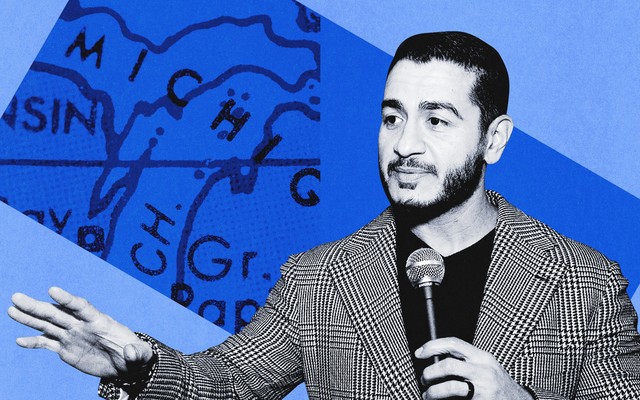
Now Democrats finally have the chance to do the same thing. In Michigan, a purple state that Donald Trump won twice, the physician Abdul El-Sayed is running a competitive race for the party’s Senate nomination. If successful, he would turn a very likely Democratic win into a jump ball.
El-Sayed has followed the classic strategy of adopting positions that appeal to a majority of his party’s voters—thus giving him an advantage over more cautious rivals—but that do not appeal to a majority of the general electorate. In El-Sayed’s case, those stances include supporting single-payer health insurance, abolishing ICE, and intensely criticizing Israel; at the same time, he positions himself as the most doctrinal left-wing candidate in the race.
More families who can afford it are hiring a house manager, a kind of “chief of staff for the home.”
Here is the promise of a house manager. Hire one, and soon someone else could be doing your laundry, washing your dishes, prepping your meals, and completing those Amazon returns you’ve been meaning to make. They could reorganize the utensil drawer, notice if your kid is outgrowing their shoes and order more, take your car to the repair shop, and be at home to meet the plumber. If your child needs food for a class party, a house manager could make the dish and drop it off; if that child also has a pet lizard, a house manager could buy the crickets to feed it.
House managers are not a nanny or a house cleaner. They’re a “chief of staff for the home,” a “personal assistant for Mom,” and “a clone of myself,” according to the more than a dozen people I spoke with who have either hired one or work as one. They are, in effect, what might have once been called a housekeeper—a person who helps oversee a household’s basic functioning. Middle- and upper-class families used to more commonly employ this kind of position (the title “house manager” dates back to at least the 1830s), but it has become rare enough that a couple of people I spoke with thought they may have come up with the term.
Stories about women living together are proliferating—and offering alternative visions to the nuclear family.
Years ago, I moved into a small, cold house with two women I’d never met. Quickly, we became very close, in part through living communally: divvying up the big chores and scarce hot water, waiting until everyone was home to watch the latest episode of Girls. We were the same age as the show’s characters and had our share of similar dramas, largely related to the boyfriends who, we rightly assumed, would eventually end our cohabitation. Much as we loved our setup, we all wanted and expected to move in with men. Still, each of us recalls that time lovingly, and I, at least, sometimes idealize it.
I know I’m not alone. I’ve heard many women daydream about setting up house with female friends. Mostly, though, those are fantasies, ones that don’t stretch to mortgages or arguments about whose hair is clogging up the shower drain. No one wants to imagine the many challenges that the Danish writer Pernille Ipsen describes in My Seven Mothers, a memoir of growing up in a women’s commune that’s full of descriptions of conflict. But Ipsen includes those struggles for a reason: She quotes one of her mothers telling her, “What I wanted, wanted, wanted, was that this way of life, women living with women, should include it all.”
Why is Donald Trump breaking bread with the “enemy of the people”?
Even in the best of times, the annual White House Correspondents’ Dinner is an awkward and ethically fraught affair. Journalists spend the evening partying with the president and administration officials whom they’re supposed to cover rigorously and skeptically. I’ve been to the dinner several times over the years. It’s typically crowded and a little chaotic, and the ratio of non-journalists to journalists is about 10 to 1. The evening is promoted as a celebration of journalism and the First Amendment, but it has always been a bit of an embarrassment.
These aren’t the best of times for White House correspondents or, for that matter, the First Amendment. And this year’s gala figures to be even more awkward and embarrassing than usual.
The people we were died at the exact moment our child did.
This article was featured in the One Story to Read Today newsletter. Sign up for it here.
My husband, David, hates Valentine’s Day. He once called it “New Year’s Eve with nuclear weapons.” I pretend not to care. Still, when the day passes entirely unremarked on, a woman can’t help but feel overlooked.
On Valentine’s Day 2024, David found a way out. He booked a speech on February 14 that required traveling from our home in Washington, D.C., to Toronto. I couldn’t object—he was getting paid. Anyway, I had my own plans: an “anti–Valentine’s Day” dinner hosted by one of the foreign embassies.
As I got ready, I called our oldest daughter, Miranda. She answered from her Brooklyn bathroom, getting ready for her own party. She propped her phone up beside her sink and laughed when I told her about her father’s strategic Valentine’s Day escape.
Montana Democrats thought they found a novel way to win control of the U.S. Senate—until the party faithful started fighting back.
Jason Boeshore, a grain-elevator manager on the eastern plains of Montana, fired off a rocket this month to the private Signal chat he shares with the 23 other members of the state Democratic Party executive board. He demanded that leaders make clear in newspapers across the state that the Democratic Party would support only Democratic candidates in the fall elections. The response was swift and not to his liking. Shannon O’Brien, the chair of the party, wrote that her staff, not the board, would set the messaging strategy. Then she addressed the unspoken concerns at the heart of Boeshore’s request. “Listen if ANY of you EVER find yourselves questioning my intentions, please call me,” O’Brien wrote. “I will continue to move forward to get Democrats elected. There’s no hidden agenda.”