Is Cohabitation the Feminist Future?
Stories about women living together are proliferating—and offering alternative visions to the nuclear family.
Years ago, I moved into a small, cold house with two women I’d never met. Quickly, we became very close, in part through living communally: divvying up the big chores and scarce hot water, waiting until everyone was home to watch the latest episode of Girls. We were the same age as the show’s characters and had our share of similar dramas, largely related to the boyfriends who, we rightly assumed, would eventually end our cohabitation. Much as we loved our setup, we all wanted and expected to move in with men. Still, each of us recalls that time lovingly, and I, at least, sometimes idealize it.
I know I’m not alone. I’ve heard many women daydream about setting up house with female friends. Mostly, though, those are fantasies, ones that don’t stretch to mortgages or arguments about whose hair is clogging up the shower drain. No one wants to imagine the many challenges that the Danish writer Pernille Ipsen describes in My Seven Mothers, a memoir of growing up in a women’s commune that’s full of descriptions of conflict. But Ipsen includes those struggles for a reason: She quotes one of her mothers telling her, “What I wanted, wanted, wanted, was that this way of life, women living with women, should include it all.”
My Seven Mothers came out in Danish in 2020 and in English last year, translated by Tiina Nunnally. It’s part of a wave of recent literature about women living together. Although these novels and memoirs come from all over—Denmark, Italy, Japan, South Korea—and vary widely in style and attitude, each of them takes female cohabitation seriously, not omitting its challenges. Indeed, these books embrace the idea that women living with women not only can but necessarily will “include it all,” even when that means loss, violence, and strife.
In My Seven Mothers, Ipsen describes the entire life of the commune, which disbanded when she was still a child, with great generosity. A similar mood pervades Fausta Cialente’s A Very Cold Winter, published in Italy in 1966 but not released in English until Julia Nelsen’s translation came out this year. Nothing in A Very Cold Winter can be idealized: Its characters have lost or been left by men and are now cobbling together a home in an icy, half-ruined Milanese attic after World War II. Most of them gripe constantly—and then grumble that everyone’s “unhappiness is so depressing, their eternal discontent!”—and yet the novel is gentle and familial, animated by a spirit of inclusion so strong that even the infant living with the women gets to narrate a page or two.
A harsher dynamic is evident in Asako Otani’s sardonic 2023 debut, Hollow Inside, newly translated into English by Ginny Tapley Takemori. Otani’s protagonist, who is averse to sex and romance, rents an apartment with a female acquaintance as a tacit declaration that she’s “given up” on marriage. For her, moving in with another woman is a rebellion against family life; the same is true in Two Women Living Together, a 2019 memoir co-written by Kim Hana and Hwang Sunwoo and recently released in Gene Png’s translation, which is especially direct about its feminist agenda. Kim and Hwang bought their apartment together after deciding that they wanted neither marriage, with the subjugation they feared it would imply, nor the solitude and precarity of living alone in a world designed for family units. Now they consider each other next of kin.
Two Women Living Together, despite its light, bloggy tone, is clearly meant to campaign for cohabitation—but to do so for a wide audience, the authors avoid discussing the full emotional weight of being a woman who exists outside the norm. The precise inverse is true of Mieko Kawakami’s Sisters in Yellow, a psychological thriller that is the darkest and most complicated of this group of books. Its characters, like Cialente’s, see living together as a way to re-create rather than rebel against family structure, though in this case it backfires. The branching trajectories of stories about women living together is fascinating. They suggest that authors taking the conceit as a starting point rather than a stage or a daydream is a rich way to consider its possibilities—and to show women confronting the misogynistic demons that haunt them even when no men are around.
Sisters in Yellow was serialized in Japan and released in full in 2023; Laurel Taylor and Hitomi Yoshio’s translation brought it to American readers last month. Kawakami is best known stateside for her novel Breasts and Eggs, which was a sensation in Japan and a slow-growing literary hit when it came out in the United States. An overtly feminist story of sisters struggling for bodily autonomy, it shows some of Kawakami’s interest in women living without men. Early in the novel, its protagonist, Natsuko, then a child, comes home to discover that her sad-sack father has vanished. “It was the same apartment,” Kawakami writes, “cramped and gloomy, dirty clothes on the floor, but without him, everything was different.” Natsuko is so thrilled that she starts to dance. She never lives with a man again.
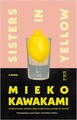
Hana, the protagonist of Sisters in Yellow, never really lives with a man—or with family—at all. Her father comes and goes when she’s young; her mother is a bar hostess for whom “home is the last thing on her mind.” Both Hana and her creator, in contrast, are home-obsessed. In a recent interview, Kawakami compared writing the book to “building a house: I started off with only a barebones floorplan. Then as I wrote, I was scrutinizing the choices for the wallpaper, the lighting fixtures, the rugs and furniture for each room.” She’s minutely attentive to Hana’s surroundings throughout the novel, as is Hana herself, but what really matters are the women around her, whom Hana idealizes to her great detriment.
Hana’s main object of worship is her mother’s acquaintance Kimiko, another hostess who crashes in their tenement one summer when Hana’s mom is off with a boyfriend. Kimiko tidies the space and cooks with Hana; the younger girl, accustomed to preparing herself simple meals, recalls Kimiko’s stay as “the first time I’d ever done anything with garlic.” Just like Hana’s mother, Kimiko leaves without warning, but Hana still longs for her so intensely that when she bumps into her on the street a few years later, she immediately agrees to move in with her and become a hostess at the bar Kimiko is about to open.
Kawakami, always an emotionally direct writer, loads this decision with both excitement and risk: Readers will at once thrill and fear for Hana. Before long, the latter takes over. Kimiko brings alarming men—both bar customers and gangsters—into Hana’s life. She also behaves, in certain negative senses, like a stereotypical male head of household: She controls their money yet expects Hana to pay the bills, and she shies from discussing their connection. When Hana tells her roommate that she’s glad to have her, she gets a terse reply: “What’s that supposed to mean?”
Still, Hana wrings a sense of security from their relationship by convincing herself that Kimiko could never get by without her. Kawakami channels this conviction through Hana’s fixation on the color yellow, with which she becomes preoccupied after Kimiko mentions her feng shui–inflected belief that it brings wealth. Hana fills their apartment with yellow trinkets, clinging to them as a source of the “courage and comfort” she so badly needs. But they’re not enough, and Hana starts seeking control on a larger scale.
As Hana’s need for security grows larger than her relationship with Kimiko, she befriends two girls her age, Ran and Momoko, both equally adrift, if slightly less vulnerable, and becomes a big-sister figure to them. At first, their friendship is a joy to read about. They have so much fun together that in one glittering scene, as they walk through a night “sparkling with light here, there and everywhere,” Hana is so overcome by contentment that she has to “stop and put my hands to my chest.”
Kawakami allows this luminous joy to spread through Sisters in Yellow for a stretch: Hana and Kimiko move into a house with Ran and Momoko, and readers may hope that the living arrangement with her friends will turn into the true, stable home Hana yearns for. Then the bar burns down. Hana, terrified that their household won’t be able to afford to stay together, turns to Kimiko’s gangster friends for work. As she plunges into crime, she becomes increasingly controlling and paranoid, dictating and monitoring everything Ran and Momoko do. Before long, she’s become something like a domineering father—or like Kimiko, who still hovers in the background, the teacher whom the student has surpassed.
An understated yet vital detail in Sisters in Yellow is that Kimiko, like Hana, has never meaningfully lived with a man. Still, she teaches her accidental protégé to deny other women authority like a prototypically macho guy might. What saves Hana—and keeps readers on her side—is her heartrendingly plain need for an anchor. Hana’s drive to control her friends comes not from disrespect but from her dream of keeping them with her; she wants a family so badly, and is so unfamiliar with the workings of a functional one, that she often forgets to consider her friends’ individual wants and needs.
Even when Hana is at her most selfish, the prospect of sisterhood stays alive in her head, and in the girls’ dynamic. Consider a scene late in the novel in which Hana loses her temper at Ran and Momoko for disrespecting her yellow tchotchkes and demands that they paint the whole house yellow in penance. But she accidentally buys outdoor paint to use inside, and all three girls quickly get high from the fumes. Still, Hana won’t let them stop, which turns the punishment into a poisoning—but also a night of “never-ending laughter,” a meaningful bonding experience even after their relationship has gone sour.
As feminist commentary, this story is as incisive as the advocacy in Two Women Living Together, if significantly more complex. Sisters in Yellow makes quite clear that a home without men doesn’t mean a home without the violence and control of patriarchal society.
Yet even when Hana is at her most controlling, she and her friends can still fling paint on one another and roll on the floor, stoned and giggling. The possibility of freedom can still glimmer throughout Kawakami’s noir nightmare—as it can in traditional family life. None of these books reject men wholesale. A Very Cold Winter ends with some of its characters falling in love and moving in with men, as does My Seven Mothers. Ipsen’s birth mother, Sanne, meets her stepfather and departs the commune, creating a nuclear family that still has room for Sanne’s radical politics.
Otani’s Hollow Inside, meanwhile, ends with an embrace of solitude. In one of its final scenes, the narrator, who has struggled throughout the book with a feeling of obligation to have a child, asks her roommate, a 3-D-printing enthusiast, to design and make her a plastic infant. The roommate does so, then asks, “Doesn’t it make you want a baby? A real one?” Cradling the toy, the protagonist replies contentedly, “I have this one, and it’s enough for me.” It’s at once an unsettling concession and one last declaration of liberation from the nuclear—and flesh-and-blood—family. All of these authors are, to some degree, making such assertions, even though they lead in divergent directions. Each of them invites readers to think more fully about how women might assert their independence in societies still designed in many ways for men—and to imagine what might get upended in turn.
When you buy a book using a link on this page, we receive a commission. Thank you for supporting The Atlantic.