
Over the past 15 years or so, Democrats have won a lot of races because the opposing party’s primary voters decided to nominate right-wing ideologues (Christine O’Donnell, Todd Akin, Kari Lake) rather than normal Republicans. In all of these races, the Republican establishment warned that nominating an archconservative would undermine their chances of victory, and was proved completely correct.
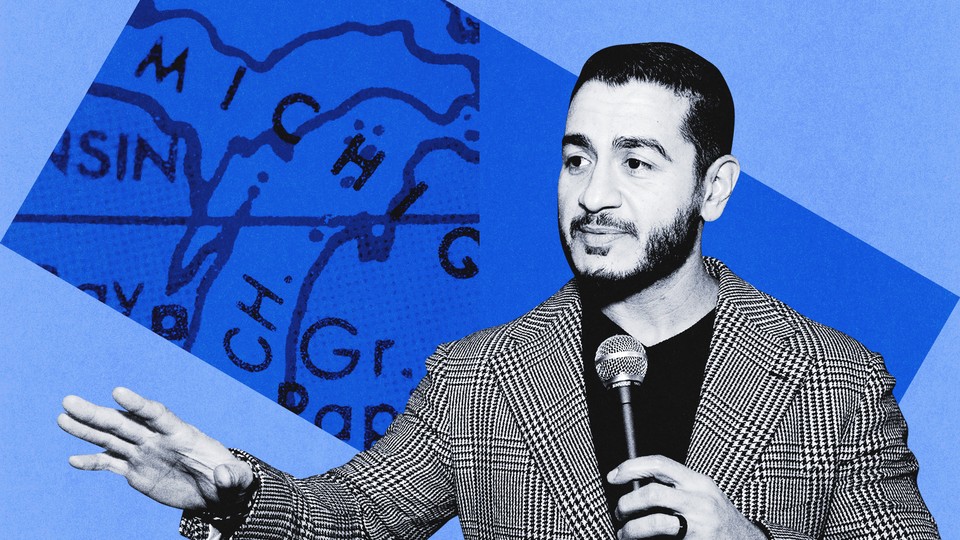
Now Democrats finally have the chance to do the same thing. In Michigan, a purple state that Donald Trump won twice, the physician Abdul El-Sayed is running a competitive race for the party’s Senate nomination. If successful, he would turn a very likely Democratic win into a jump ball.
El-Sayed has followed the classic strategy of adopting positions that appeal to a majority of his party’s voters—thus giving him an advantage over more cautious rivals—but that do not appeal to a majority of the general electorate. In El-Sayed’s case, those stances include supporting single-payer health insurance, abolishing ICE, and intensely criticizing Israel; at the same time, he positions himself as the most doctrinal left-wing candidate in the race.
The Middle East has become a special point of emphasis for El-Sayed, which makes sense: Israel is highly unpopular, especially among Democrats. The trouble with this issue is that it tends to divide the party’s base, especially in Michigan, which has large Arab and Jewish populations. The prominence of Israel as a campaign issue in 2024 cost Kamala Harris support from many Arab Americans (who blamed the Biden administration for supporting Israel’s war in Gaza) and many Jewish Americans (who blamed President Biden for attempting to restrain Israel).
The Democratic Party’s interest is to tamp down the importance of Israel. But El-Sayed’s best strategy to win the nomination is to play up the issue, which drives apart the party’s base and allows him to claim the biggest slice.
El-Sayed’s method of picking fights over the Middle East has included campaigning alongside the livestreamer Hasan Piker—a defender of Hamas, Hezbollah, and various Communist regimes. He has also campaigned with Amir Makled, a candidate for the University of Michigan’s board of regents who has shared pro-Hezbollah and anti-Semitic messages on social media. (El-Sayed has dismissed complaints about these comments as cancel culture, which is a very strange defense; nobody is saying that Piker or Makled should lose their jobs or platforms, only that El-Sayed shouldn’t tout their support.)
A candidate could potentially win statewide election in Michigan after soliciting endorsements from supporters of terrorism, but it won’t be easy. The Democrat’s likely opponent in November, former Representative Mike Rogers, presents as a mainstream Republican.
In response to concerns from fellow Democrats, El-Sayed has pointed to Trump’s ability to win two elections despite a long list of objectionable statements and positions. “I think there is this notion that electability is about being the least offensive,” he told CNN. “If that were true, why would Donald Trump have won the presidency twice?”
Many Democrats have indeed interpreted Trump’s success as proof that traditional electability—taking positions that most voters agree with, and avoiding positions they don’t—has little predictive value. Alas, this badly misreads recent political history. Trump abandoned his party’s heaviest baggage by promising not to cut Medicare or Social Security, causing voters to perceive him as more moderate than traditional Republicans. He benefited from years of marketing that depicted him as America’s greatest business genius.
Every candidate has a combination of assets and liabilities. Trump was able to defeat two opponents who were unpopular and did so despite, not because of, his noxious statements. Trump has inspired candidates on the left and the right to believe that they can dispense with the hard task of appealing to a political majority, and win instead by riling people up with offensive rhetoric. It doesn’t usually work. It hasn’t even worked especially well for Trump, who, after all, lost the popular vote two of the three times he ran.
The strategy might, however, enable El-Sayed to win the nomination. His greatest advantage is that he might not even need to win a majority of the Democratic primary electorate. He currently has two opponents, Representative Haley Stevens and State Representative Mallory McMorrow. A recent poll found the three candidates essentially tied, with Stevens at 23 percent and McMorrow and El-Sayed at 22 percent, and the remaining vote undecided. The same poll found that El-Sayed would trail in a two-way race against either Stevens (34 percent–25 percent) or McMorrow (34 percent–26 percent). If both of his opponents stay in the race until the election in August, El-Sayed could win the nomination even if most Democrats would prefer either of his opponents to him. General-election polling, meanwhile, suggests that Rogers has the best shot against El-Sayed.
The Republican establishment has spent a decade and a half pleading with Republican voters not to nominate crazy people for office in losable elections, only for the voters to routinely disregard the advice because they prefer a nominee who will fight hard. Indeed, when those candidates lose, their supporters tend to blame the establishment for undermining them, rather than admit that the establishment may have had a point. And when they win, which can happen even to the worst candidates, they conclude that they have disproved the conventional wisdom.
El-Sayed claims the difference between him and his opponents is that he’s brave. “It’s just the same lack of courage that Democrats deploy to argue as to why they should be taking money from corporations,” he said, “or why they should be hedging their bets on clear, obvious policies like abolishing ICE or guaranteeing health care through Medicare for All.” The actual difference is that his opponents are trying to beat Republicans, and he’s concerned only with beating Democrats.