Previously in Corby's Table:

Chic & Simple Cooking (December 21, 2001)
The perfect gift for the unconfident cook with a sophisticated palate.

The Curious Cook (July 18, 2001)
Corby Kummer reviews How to Read a French Fry, Russ Parsons's investigation into the science of cooking.

No Taste Like Home (June 13, 2001)
Corby Kummer extols the simple pleasures of David Page and Barbara Shinn's Recipes From Home, an all-American cookbook.

A Fortunate Crossroads (May 9, 2001)
Corby Kummer on Fred Plotkin's La Terra Fortunata, a portrait of a region with "one of the worthiest and most complex cuisines in Italy."

Pasta With a Passion (April 4, 2001)
Corby Kummer offers selections from Piero Selvaggio's The Valentino Cookbook—"one of the few Italian cookbooks I plan to keep on my shelf."

Israel on a Bun (February 28, 2001)
Corby Kummer looks at Joan Nathan's new book on the food of Israel, a country not exactly known for its cuisine.

Napa Valley Blend (January 31, 2001)
Corby Kummer on Terra: Cooking From the Heart of Napa Valley, and its authors' unique mix of Mediterranean style with a Japanese sensibility.

More by Corby Kummer in Atlantic Unbound

Atlantic Unbound | May 1, 2002
 
Corby's Table
 
A Kitchen of One's Own

.....

A Modified Graham Bread
Gekochtes Rindfleisch
Baked Fudge


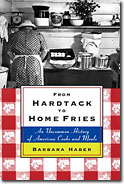
From Hardtack to Home Fries

From Hardtack to Home Fries
by Barbara Haber
Free Press
244 pages, $25.00

ot all women like to cook, of course. But like it or not, most women's lives are entwined with food. The recognition that food and everything having to do with it can offer perspective on many aspects of women's lives led Barbara Haber to build the culinary collection at the Schlesinger Library at Radcliffe into a powerhouse of women's studies. In the thirty years since Haber arrived in Cambridge, from Milwaukee by way of the University of Madison with a degree in library studies, the collection has become a magnet for scholars, journalists, and cooks. The Schlesinger is now a national touchstone for anyone interested in food, not just because it houses the books and papers of Julia Child, M.F.K. Fisher, and Ella Fitzgerald (an enthusiastic cook, it turns out), among many others, but because Haber herself is so magnetic.

She's also a terrific speaker. I've long gone out of my way to attend any lecture Haber is giving, knowing that whatever the subject I'll gain insight into a whole culture as well as the women who were active within it. Through first-person accounts, contemporary books and sources, and her own witty and sharp comments, Haber brings times and places alive. Hearing her on the social structure of the harem at Topkapi, for instance, altered my understanding of the cruel beauty of the Ottoman empire. (Haber and I were on the eve of a trip to Turkey organized by Oldways, the Cambridge-based food think tank; everyone should be able to listen to Haber at the start of a journey.)

From Hardtack to Home Fries offers a collection of nine wonderfully readable essays on an unexpected range of topics that have captured Haber's interest. Every reader will have her or his favorites. I know that Haber herself is particularly proud of her essay on Mrs. Henrietta Nesbitt, the cook who made famously bad food in the White House of Franklin and Eleanor Roosevelt. More than just a terrible cook, Haber finds in her a woman Mrs. Roosevelt valued as a helpmeet, one who cared about the President's health and about running a sensible household. Julia Child liked that chapter, too: in a sign of her regard for Haber, she wrote a warm endorsement for the back cover after decades of blanket refusals to blurb any book.

My own favorite is a chapter on the Window Shop, a bakery, restaurant, and sui generis social-service agency for genteel Jewish refugees who arrived on the academic shores of Cambridge starting in the late 1930s. The oral and written histories Haber collected yield a portrait of a turbulent and fascinating time, along with a good recipe for Sacher torte. I was also pleased to learn about the Harvey Girls—those white-aproned purveyors of good food and rectitude along the Atchison Topeka and Santa Fe Railroad, in a chapter of special charm that recalls a rough and just-civilizing time in our not-so-distant past. A chapter on the early diet gurus Sylvester Graham and John Henry Kellogg offers a crackling (even snapping and popping) account of an odd turn in American health, which gave us our national breakfast not to mention ideas about diet both sensible and peculiar.

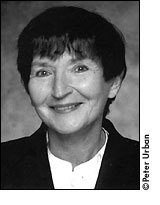
Barbara Haber
Barbara Haber   

Haber keeps her focus on women's relationships to food—especially as it pertains to personal finances. She chronicles how several women found dignity, livelihoods, and their own identities by starting catering businesses and restaurants. A lovely last essay tells how she herself came to collect and study cookbooks; it also shows a touching understanding of her own relationship to her mother. An exceedingly valuable appendix includes notes on the many books mentioned throughout, with a bonus of many more recommendations. These capsule reviews are manna for any aspiring food and social historian. They offer a generous taste of the wealth of knowledge Haber has always freely shared.

There are a few recipes, too—ones I'd like to make. "A modified Graham bread" shows what the health-promoting Sylvester Graham really had in mind: whole grains made appealing and somewhat sweet as a kind of bread, rather than just a sweet cracker for a campfire concoction with marshmallow and chocolate (although really, is there a better dessert than S'mores made over an open fire?). Gekochtes Rindfleisch, or boiled beef, sounds dull, but in the hands of the Viennese émigrés eking out a living at the Window Shop, it was a feast reminiscent of home. A feast it is, with its rich broth and fresh vegetables, and also a way of turning a humble cut into a one-dish meal that can last many days by being served as a soup or main course. Finally, baked fudge is an easy confection that demonstrates why Cleora Butler, the recipe's author, became a Tulsa legend as a talented businesswoman and cook. Like many of the women Haber discerningly chose, she turned her culinary skills into a way of supporting herself and her family.

Corby Kummer


Excerpts from From Hardtack to Home Fries, by Barbara Haber


A Modified Graham Bread

4 servings

1 package yeast (not fast-acting)

1/4 quarter cup lukewarm water

2 teaspoons brown sugar

2 teaspoons salt

2 tablespoons butter

1/3 cup molasses

1 cup evaporated milk, scalded

1 cup boiling water

4 cups whole-wheat flour

1 to 2 cups white flour

In a small bowl, mix the yeast with the water. Add the brown sugar. In a large bowl, combine the salt, butter, molasses, milk, and boiling water. Stir well. Let cool to room temperature and add the yeast mixture. Add the whole-wheat flour and just enough of the white flour so that dough is not sticky and can be kneaded. Knead for 7 minutes. Let rise until doubled (2 hours). Knead 1 minute. Cut in half, shape into loaves, and place in buttered 9-inch pans. Let rise until doubled (1 1/2 hours). Bake at 400˚F for 20 minutes. Lower oven to 350˚F and bake 35 minutes longer. Brush surface with butter and turn out on a wire rack to cool.


Gekochtes Rindfleisch
Boiled Beef

Boiled beef, usually eaten with horseradish, is an Austrian specialty made with different cuts of meat. It was said to be the favorite dish of Emperor Franz Josef I. Many Viennese followed his example by eating it for lunch every day, varying the meal by the cut of beef and such garnitures as sauces, salads, and pickles.

4 servings

3 pounds boneless beef (bottom round, rump, or chuck)

3 pounds bony chicken parts (wings, backs, necks)

1 or 2 beef soup bones

2 quarts water

Salt

3 tablespoons cooking oil

2 cups large chunks of onions

3 carrots, cut into large chunks

4 stalks celery, cut into large pieces

1 leek

3 tablespoons chopped parsley

1 bay leaf

8 black peppercorns

3 whole allspice

Horseradish, for serving
Place the beef, chicken parts, and beef bones in a large soup kettle. Add the water and salt. Bring to a boil, making sure the water covers the meat. Skim. Heat the oil in a skillet. Add the onions, carrots, celery, leek, and parsley and cook until lightly browned. Add to the soup kettle and continue to boil. Add the bay leaf, peppercorns, and allspice. Cover and cook at low heat for about 2 hours. Test meat for tenderness and cook longer if necessary. Remove the beef from the pot. Skim the fat from the soup and strain, making sure that the vegetables are pressed for that last bit of flavor. The soup can be served separately before the beef is sliced and served with horseradish.


Baked Fudge
Adapted from Clora's Kitchens

9 to 12 servings

4 eggs

2 cups sugar

1 cup (2 sticks) butter

4 heaping tablespoons cocoa powder

4 rounded tablespoons flour

1 cup pecans, broken into large pieces

2 teaspoons vanilla

Whipped cream, for serving
Preheat the oven to 325˚F. Beat the eggs well, add the sugar and butter, and beat well again. Sift the cocoa and flour together. Add broken pecan meats. Fold into butter mixture. Mix in vanilla. Pour into 9 x 12 x 3-inch Pyrex dish or tin pan. Set pan in a pan of hot water (enough to come 1/2 inch to 1 inch up on the sides of pan). Bake for 45 minutes to 1 hour. The fudge will have the consistency of firm custard and will be crusty on top. Serve with a dollop of whipped cream on each piece.


What do you think? Discuss this article in More by Corby Kummer in Atlantic Unbound and The Atlantic Monthly.

Corby Kummer is a senior editor at The Atlantic Monthly and the author of The Joy of Coffee.

Copyright © 2002 by The Atlantic Monthly Group. All rights reserved.
Recipes from From Hardtack to Home Fries by Barbara Haber. Free Press. Hardcover, 244 pages. ISBN: 0684842173. $25.00. Copyright © 2002 by Barbara Haber.