
Previously in Corby's Table:

"Israel on a Bun" (February 28, 2001)
Corby Kummer looks at Joan Nathan's new book on the food of Israel, a country not exactly known for its cuisine.

"Napa Valley Blend" (January 31, 2001)
Corby Kummer on Terra: Cooking From the Heart of Napa Valley, and its authors' unique mix of Mediterranean style with a Japanese sensibility.

"Revelations of Greece" (December 20, 2000)
Corby Kummer on Aglaia Kremezi's revelatory new Foods of the Greek Islands, a book that offers "a short course in how Greeks cook for themselves."

"Confessions of a Cookie Eater" (October 4, 2000)
Corby Kummer makes a shameless plea to readers of Nick Malgieri's new Cookies Unlimited.

"The Bygone World of the Bialy" (August 31, 2000)
Corby Kummer on Mimi Sheraton's The Bialy Eaters, a food critic's account of her seven-year, still-incomplete search for the origin of the distinctive little onion roll that is often mistaken for a bagel.

"The Chowder King" (July 26, 2000)
Corby Kummer on Jasper White's 50 Chowders, the latest from Boston's master seafood chef.

"Simply Summer" (June 22, 2000)
Corby Kummer satisfies his fresh-herb lust with a new book by Lisa Cowden, Ladle, Leaf, & Loaf.

"Tuscany, Reluctantly" (April 26, 2000)
Corby Kummer is tired of Tuscany, but he likes Pino Luongo's new cookbook, Simply Tuscan.

"Matzoh Makeover" (March 22, 2000)
Corby Kummer on Jayne Cohen's The Gefilte Variations, a new cookbook offering multiple versions of Jewish holiday classics.

More by Corby Kummer in Atlantic Unbound

Atlantic Unbound | April 4, 2001
 
Corby's Table
 
Pasta With a Passion

.....

Marinated Shrimp with Couscous
Fusilli with Olives, Peas, and Pecorino
Spaghetti with Tomatoes and Tuna


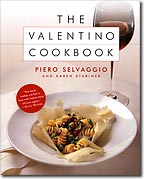
The Valentino Cookbook

hether they'll admit it or not, critics and food people go to certain favorite restaurants whenever they pass through a city. Not because these are the most daring spots, or the places to be seen, but because the diner knows he or she will eat wonderfully. It's like settling back into home.

Valentino, in Santa Monica, California, is one of those restaurants. It might be hard for anyone who knows its lofty reputation, its prices, and its legendary 100,000-bottle wine cellar to think that Valentino could seem like home, but the warmth and unstoppable energy of the owner, Piero Selvaggio, makes it feel that way. He designs menus on the spur of the moment for half the guests, whether they're friends or not. The dishes may be elegant and enormously time-consuming to prepare. Others may be extremely simple. They're all good.

Now Selvaggio has written his own cookbook, together with Karen Stabiner, and it's one of the few Italian cookbooks I plan to keep on my shelf. His introductory notes on coming to America as a teenager from a modest but deeply rooted life near Modica, Sicily, are delightfully honest and characteristic of his charm and generosity. He wound up in Los Angeles, where the Italian-American culture wasn't nearly as evolved as in Brooklyn, where his family first settled. He mastered the LA life, and after his first restaurant had become a success, he traveled back to Italy to learn about serious food. "I ate fettuccine with porcini for the first time," he writes, "though with my limited knowledge, I expected pasta with 'little pigs' instead of mushrooms."

At the beginning his charm and energy pulled him through and in fact thrust him forward. But after a while he became ambitious to set standards, which he did without ever leaving behind his initial passions. Selvaggio has a knack for getting the basic things right (including perfect service, another reason first-time diners at Valentino generally become loyalists). For instance: "Cooking pasta is like swimming. There has to be room for the pasta to move as it cooks, lots of breathing room so it doesn't stick together."

Selvaggio also has my taste in food, so of course I think he gets things right. He loves pasta with undying passion and respect. He knows the pleasure of grazing for a while—he prefers the many small tastes at the beginning of the meal to the relative tedium in the middle. "I accept the main course," he writes. "I'm never absolutely enchanted by it.... In my heart I am a pasta and antipasto eater."

This is, of course, the way to eat, especially in restaurants. But in The Valentino Cookbook Selvaggio and Stabiner offer recipes for numerous main courses, to reflect the way most diners tend to eat, along with the first courses and pastas that are the way to the author's heart. Many recipes are beyond the reach of the casual cook and some require daunting amounts of preparation. Others are exactly what Selvaggio's grandmother would make if she went into her grandson's Los Angeles pantry. Marinated shrimp with couscous, for instance, is a very easy introduction to the kind of fusion Selvaggio has encouraged his chefs to pursue: chilies and onion give hot and sweet notes to an easy dish that can be a main course, too.

Two pasta recipes exemplify why so many of us fell in love with Italian food and why not all of us have fallen out of love. Fusilli with olives, peas, and pecorino provides many tastes of spring with just a few ingredients. And spaghetti with tomatoes and tuna is a staple of my survival diet, because of its ease to make and satisfyingly rich flavor with a slightly spicy aftertaste. Buy some wonderful imported oil-packed tuna, which really does have better flavor, and the best imported cherry tomatoes you can. I'd say that this is summer on a plate, but the truth is that I make this dish practically once a week year round, with many variations depending on what I find at the market or while wandering. Selvaggio would doubtless approve. He's a master at thinking on his feet.

Corby Kummer


Excerpts from The Valentino Cookbook, by Piero Selvaggio and Karen Stabiner


Couscous con Gamberoni Piccanti

Marinated Shrimp with Couscous


With a lot of the food at Primi, we started with the basics and livened them up. This is a very Mediterranean dish, done in a fusion style: strong, bold flavors with an elegant presentation. Couscous is a popular porridge with its own flavor, but it's like mashed potatoes—it needs a kick; it's too quiet on its own. The tomatoes and the couscous are a southern Italian influence, but the reason I love this dish has nothing to do with my childhood. I just bless it because I like the way it tastes, and because you can eat it cold. It's the perfect starter.

4 servings

16-20 medium uncooked shrimp, shelled and deveined

1 tablespoon olive oil, plus extra for garnish

2 tablespoons red wine vinegar

2 tomatoes, diced to equal 1 1/2 cups

1-2 serrano chilies, finely chopped

1/4 medium yellow onion, cut in thin slivers

1 1/2 cups couscous, prepared according to package instructions, with 1 teaspoon butter added

Salt and pepper, to taste

Curly leaf lettuce, for garnish
Preparation: Bring a medium-size pot of water to a boil. Boil the shrimp for 4-5 minutes. Drain and immediately plunge into ice water or rinse under cold running water to stop the cooking process, and set aside.

The Dish: In a medium-size bowl, whisk the olive oil and vinegar to combine. Add the tomatoes, chilies, onion, and couscous and mix well. Season with salt and pepper to taste.

Mound the couscous mixture into a lightly oiled pastry mold or cup, pack firmly, and turn out onto a plate. Arrange a leaf of lettuce alongside and stand the shrimp so that they lean against the molded couscous.

Drizzle olive oil on the shrimp.

Wine: I would start sipping right away on a supple white wine with personality—a Soave from Gini or Pieropan, or a Vermentino from Liguria, which is refreshing with a wonderful structure. From California, Tocai Friulano by Podere dell'Olivos is fresh and clean, and it perfectly complements the strong flavors of the dish.


Fusilli con Olive, Piselli, e Pecorino

Fusilli with Olives, Peas, and Pecorino


This dish is the marriage of three wonderful flavors: the salty chunks of olive, the delicate taste of sweet pea, the finish of sharp pecorino. Pecorino is a sheep's milk cheese, not as creamy and sweet as Parmesan, but saltier, more masculine. This recipe is typical of southern Italy—strong flavors but intriguing in the mouth, especially if you match it to a nice robust wine. It's a very intense and satisfying dish. Serve it as a whole lunch or as a second or third course at dinner.

6-8 servings

I pound fusilli

1/2 cup olive oil

1 cup fresh peas, steamed until tender

1 pound raw spinach, steamed and chopped to equal 1/2 cup

Salt and pepper, to taste

2 whole garlic cloves

Red crushed chili peppers, optional

1/4 cup dry white wine

5 fresh basil leaves, finely chopped

1/2 cup imported black olives, chopped

1/2 cup aged pecorino cheese, grated

Preparation: In a large pot of boiling salted water, cook the fusilli until just al dente. Drain and toss with 1 tablespoon of the olive oil to keep the pasta from sticking. Set aside to cool.

In a food processor combine half of the peas and half of the spinach with 5 tablespoons of the olive oil. Puree until smooth. Salt and pepper to taste, and set aside.

The Dish: In a large skillet over medium heat, brown the garlic with the remaining olive oil. Discard the garlic. Add the chili flakes and sauté. Add the wine and let evaporate. Add the remaining peas and spinach, and the basil, and sauté another minute. Season to taste and set aside to cool.

In a large bowl, combine the pasta, sautéed vegetables, olives, three-fourths of the pureed vegetables, and the pecorino cheese, and toss well. Add more vegetable puree if needed. Serve within 3-4 hours at room temperature.

Wine: For this dish, we need a complex wine of rich fruit to cut through the saltiness of the ingredients and cleanse the palate with renewed sensations. I would try a robust Merlot (Matanzas Creek, Lewis Cellars, or St. Francis) or a Chianti Riserva (Antinori, Fonterutoli, or Castello di Ama).


Spaghetti al Tonno con Tanti Pomodorini

Spaghetti with Tomatoes and Tuna


This is Mamma's traditional dish, and I ate a great deal of it in my childhood. It requires very little work, but is nutritious and tasty. Tuna packed in water or olive oil is better for a quick dish than fresh tuna, which you would have to cook and flavor. But if you want to do this in an elegant way, you can grill the tuna and make the sauce with fresh tomatoes. There's the long road and the shortcut. It is a summer dish, made to be eaten at room temperature.

4 servings

2-3 garlic cloves, thinly sliced

3 tablespoons olive oil

1 1/4 pounds fresh tomatoes, preferably Romas, peeled, seeded, and diced, or 20 ounces canned Italian tomatoes, drained well (reserve 1/4 cup tomatoes for garnish)
Two 5 1/2-ounce cans imported Italian tuna in water or olive oil, drained

1 pound spaghetti

Salt and pepper, to taste

6 large basil leaves, julienned, for garnish

Chef's Tip: The easiest way to peel tomatoes is to score the stem end with an X and plunge them into a pot of boiling water for 1 minute. Rinse under cold water until cool enough to touch and the peels will slip right off.

In a skillet over medium-high heat, sauté the garlic in 2 tablespoons of the olive oil for 1 minute.

Stir in the tomatoes and tuna and cook 2-3 minutes on medium-high heat.

Bring a large pot of water to a boil, add salt, and cook the pasta until just al dente. Drain and add to the sauce.

When cool, add the remaining olive oil and season with salt and pepper. Garnish with reserved chopped tomatoes and shredded basil.

Wine: The starch of the pasta, the rich tuna, and the acidity and texture of the tomatoes make a bold challenge, so I go for a big red, even though it's fish. I would try a rich Sangiovese or velvety Merlot, where the character of the wine and the richness of the grape will enlarge the texture and marriage of flavors even more.


What do you think? Discuss this article in Post & Riposte.

More by Corby Kummer in Atlantic Unbound and The Atlantic Monthly.

Corby Kummer is a senior editor at The Atlantic Monthly and the author of The Joy of Coffee.

Copyright © 2001 by The Atlantic Monthly Group. All rights reserved.
Recipes from The Valentino Cookbook by Piero Selvaggio and Karen Stabiner. Villard Books: New York, NY, 2001. Hardcover, 280 pages. ISBN: 0-679-45242-7. $34.95. Copyright © by Piero Selvaggio and Karen Stabiner.