Previously in Corby's Table:

"A Fortunate Crossroads" (May 9, 2001)
Corby Kummer on Fred Plotkin's La Terra Fortunata, a portrait of a region with "one of the worthiest and most complex cuisines in Italy."

"Pasta With a Passion" (April 4, 2001)
Corby Kummer offers selections from Piero Selvaggio's The Valentino Cookbook—"one of the few Italian cookbooks I plan to keep on my shelf."

"Israel on a Bun" (February 28, 2001)
Corby Kummer looks at Joan Nathan's new book on the food of Israel, a country not exactly known for its cuisine.

"Napa Valley Blend" (January 31, 2001)
Corby Kummer on Terra: Cooking From the Heart of Napa Valley, and its authors' unique mix of Mediterranean style with a Japanese sensibility.

"Revelations of Greece" (December 20, 2000)
Corby Kummer on Aglaia Kremezi's revelatory new Foods of the Greek Islands, a book that offers "a short course in how Greeks cook for themselves."

"Confessions of a Cookie Eater" (October 4, 2000)
Corby Kummer makes a shameless plea to readers of Nick Malgieri's new Cookies Unlimited.

"The Bygone World of the Bialy" (August 31, 2000)
Corby Kummer on Mimi Sheraton's The Bialy Eaters, a food critic's account of her seven-year, still-incomplete search for the origin of the distinctive little onion roll that is often mistaken for a bagel.

"The Chowder King" (July 26, 2000)
Corby Kummer on Jasper White's 50 Chowders, the latest from Boston's master seafood chef.

"Simply Summer" (June 22, 2000)
Corby Kummer satisfies his fresh-herb lust with a new book by Lisa Cowden, Ladle, Leaf, & Loaf.

More by Corby Kummer in Atlantic Unbound

Atlantic Unbound | June 13, 2001
 
Corby's Table
 
No Taste Like Home

.....

Salmon Cakes
Summer Three-Bean and Radish Salad
Spring Mushroom and Sweet Pea Hash
Devil's Food Cupcakes


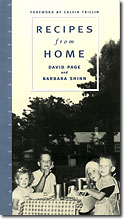
Recipes from Home

Recipes from Home
by David Page and Barbara Shinn
Artisan
448 pages, $30.00

n the early 1990s, when David Page and Barbara Shinn would stand outside their tiny new Greenwich Village restaurant handing out fresh-baked cookies, the bohemian passersby must have thought they'd better ease up on those very late nights.  Couples don't get more wholesome-looking, or attractive.  People don't offer free tastes of home-made food or invite you into a place that looks as though Mom should be coming in with a platter from the backyard grill.

Diners who sat in the painted wooden booths of Home—a brilliant name suggested by the modern inventor of American food himself, James Beard, a Village neighbor—were transported by a simple, pure version of home cooking that Page and Shinn learned from their intensely food-minded families—his near Oshkosh, hers in Ohio.  This was different from the "comfort food" (unbrilliant name) coming into vogue ten years ago, when Home was first attracting its extremely devoted customers.  Either innocently or cynically, cooks used "comfort food" as an excuse to make indiscriminate use of butter and cream after they were nutritionally outlawed—and as a pretext not to worry if dishes were overcooked and bland.

Page and Shinn grew up in the heartland, and their families cared about fresh, seasonal ingredients prepared simply—the way people with limited resources but good appetites and a strong connection to the country always ate, before all those attributes became fashionable catchphrases.  Recipes from Home, their charming and serene new book, is full of wonderfully evocative family snapshots and stories in language as simple and direct as their food.

When I joined the many city folk who wanted to believe that Home was actually like any home they'd ever known, the shelves of the restaurant were covered with jars of ketchup for sale (Home's motto is "Fine Wine. Fine Ketchup"), and relishes and pickles too; I remember packing several sausages to take on the shuttle from New York to Boston.  The couple stopped putting up enough preserves to sell—business was too good, but there are recipes for all these pantry staples in the book, plus many for sausages; and there's the best set of Thanksgiving recipes I can remember seeing—country stuffing with ham; bourbon-cranberry sauce with molasses, lime, and orange; mushroom gravy with heavy cream, sherry, and fresh herbs.

Here is an equally appealing and all-American summer menu fit for the Fourth of July: salmon cakes that can serve as a template for any rich-flavored fish; three-bean salad with radishes, a mustard-seed dressing, and my favorite green beans—wide romano beans, which I find succulent enough to be a main course on their own; spring mushroom and sweet pea hash, whose featured ingredients will be at their peak in northern climates at the start of July; and, for dessert, devil's food cupcakes with a chocolate and evaporated-milk frosting I plan to make separately for late-night refrigerator raids.  Cupcakes are just now the late-night rage, as it happens, of young people on their way home from all-night raves.  They'll still be just as good when the same sweets cravers go back to doughnuts and the kinds of cookies Page and Shinn handed out to surprised New Yorkers.  Recipes from Home will still be just as good when people get over calling honest food comfort food.

Corby Kummer


Excerpts from Recipes from Home, by David Page and Barbara Shinn


Salmon Cakes

Fish cakes, once a beloved American supper dish, have given way to the ubiquitous crab cake. That's a shame, because richly flavored salmon is great in cakes. We add only a minimum amount of bread crumbs, allowing the flavor of the fresh fish, and the vegetables, to dominate.

While we think its flavor can't match that of wild salmon, the reasonably priced, farm-raised salmon from Maine or Canada, Norway or South America, is just fine.

Serves 4 to 6

FOR THE SALMON

2 dry cups white wine

2 cups water

1/2 cup diced onion (1/2-inch dice)

1/2 cup diced celery (1/2-inch dice)

1/2 cup peeled and diced carrots (1/2-inch dice)

1 fresh bay leaf

1 fresh thyme sprig

8 black peppercorns

4 salmon fillets, about 8 ounces each and 1 inch thick

FOR THE CAKES

2 tablespoons unsalted butter

1/2 cup minced yellow onion

1/2 cup minced celery

1/4 cup minced red bell peppers

2 large egg yolks

2 tablespoons Dijon mustard

2 tablespoons fresh lemon juice

2 tablespoons minced fresh chives

1 tablespoon Worcestershire sauce, preferably homemade

2 teaspoons Tabasco or other hot sauce

1 teaspoon cayenne pepper

1 teaspoon kosher salt

1/2 cup seasoned bread crumbs

FOR THE COATING

1/2 cup all-purpose flour

2 large eggs, beaten

1 cup seasoned bread crumbs

3 tablespoons olive oil

Place the white wine, water, onion, celery, bay leaf, thyme, and peppercorns in a large pot over medium heat. Bring to a simmer, cover, and cook for 25 minutes.

Add the salmon, cover, and gently simmer, being careful not to let the liquid boil, until the salmon is cooked through, 6 to 8 minutes. Remove the salmon from the poaching liquid, cover, and refrigerate for about 20 minutes, until cool. Flake the fish into a bowl.

For the cakes, melt the butter in an 8-inch skillet over medium heat. Add the onion, celery, and red peppers and cook until softened, about 5 minutes. Transfer to a shallow bowl and refrigerate for about 10 minutes.

Whisk together the egg yolks, mustard, lemon juice, chives, Worcestershire, Tobasco, cayenne, and salt in a large bowl. Add the flaked salmon, the cooked vegetables, and the bread crumbs and gently stir the mixture together.

Shape the mixture into 14 cakes about 3 inches across and 1 inch thick. Place the cakes on parchment paper on a baking sheet and refrigerate for at least 30 minutes.

For the coating, dust the cakes with flour, dip them in the eggs, and then in the bread crumbs to cover.

Heat the olive oil in a 10-inch skillet over medium heat. Fry the salmon cakes in batches until golden, about 3 minutes on each side. Serve hot.


Summer Three-Bean and Radish Salad

Although the traditional three-bean combination is green beans, wax beans and kidney beans, this variation with fresh Romanos instead of kidney beans is very dear to us because we made it for our wedding barbecue.

Serves 6

1/2 teaspoon kosher salt

1/2 pound Romano beans, trimmed

1/2 pound yellow wax beans, trimmed

1/2 pound green beans, trimmed

1/4 pound red radishes, thinly sliced

3/4 cup olive oil

1/4 cup red wine vinegar

2 tablespoons fresh thyme leaves

1 tablespoon Dijon mustard

1 tablespoon coarsely ground yellow mustard seeds

1 tablespoon minced shallot

Kosher salt and freshly ground black pepper to taste

Fill a large pot with water, add the 1/2 teaspoon kosher salt and bring it to a boil. Fill a large bowl with ice water.

Blanch the beans until they are tender, 3 to 5 minutes. Drain and plunge them into the ice water. Let them cool for about 2 minutes, then drain well. Combine the beans and radishes in a large bowl.

Whisk together the olive oil, vinegar, thyme, mustard, mustard seeds, and shallots in a small bowl. Add the dressing to the salad, toss together, and season with salt and pepper. Serve right away, or chill for 1 to 2 hours.


Spring Mushroom and Sweet Pea Hash

Serve this early-season hash with other spring fare: roast young chicken, roast leg of lamb, shad roe, or baked spring flounder. Use any spring mushrooms available.

Serves 4

1/4 cup olive oil

2 1/2 cups peeled and diced Yukon Gold potatoes (see Note) (1/4-inch dice)

Kosher salt and freshly ground black pepper to taste

1 cup minced yellow onions

2 teaspoons minced garlic

1 cup shelled fresh peas

1 cup halved morels and other spring mushrooms

1/2 cup pitted and coarsely chopped Kalamata olives

2 tablespoons unsalted butter

1 tablespoon minced fresh herbs, such as thyme, oregano, and/or marjoram

Juice of 1/2 lemon

NOTE: This is a variety of all-purpose potato with pale brown skin and golden flesh that makes it look (and, some say, taste) as though it's full of melted butter.

Heat the olive oil in a large nonreactive skillet over medium-high heat. Add the potatoes and salt and pepper. Brown the potatoes on all sides, tossing occasionally.

Add the onions and garlic. Reduce the heat and cook until the onion and garlic soften. Add the peas, mushrooms, and olives and cook until tender, 3 to 4 minutes longer. Add the butter, herbs, and lemon juice and stir and cook until the butter is melted, 1 to 2 minutes longer. Season with salt and pepper. Serve hot.


Devil's Food Cupcakes

I make a devil's food cake for David every Valentine's Day. At other times of the year, when he has been especially well behaved, I make him these. This quick and easy recipe makes a frosting as rich and chocolaty as much more complicated preparations
Barbara

Makes 16 Cupcakes

FOR THE CUPCAKES

4 ounces unsweetened chocolate

2 cups granulated sugar

1 1/2 cups all-purpose flour

3/4 teaspoon baking soda

1/2 teaspoon salt

1 cup hot brewed coffee

1/2 cup sour cream

1/2 cup vegetable oil

2 large eggs, lightly beaten

FOR THE FROSTING (MAKES 1 CUP)

4 ounces unsweetened chocolate

3/4 cup evaporated milk

1 cup confectioners' sugar

1/4 teaspoon kosher salt

For the cupcakes, preheat the oven to 350 degrees Fahrenheit. Line 16 muffin cups with liners.

Melt the chocolate in a double boiler over hot, not simmering, water. Remove the pan from the heat.

Sift the sugar, flour, baking soda, and salt together into a large bowl. In a medium bowl, whisk together the hot coffee, sour cream, and vegetable oil. Gradually whisk in the eggs, then stir in the chocolate. Add the wet ingredients to the dry ingredients and stir until the ingredients are smoothly blended.

Fill the cupcake liners about two-thirds full. Bake until a toothpick inserted in the center of a cupcake comes out clean, 20 to 25 minutes. Cool completely on a wire rack.

For the frosting, melt the chocolate in a double boiler over hot, not simmering, water. Place the milk, sugar, and salt in a medium bowl and stir until the sugar is dissolved, about 2 minutes. Add the chocolate in a slow stream and mix until thoroughly blended. Refrigerate for about 30 minutes before using. Frost the cupcakes with the frosting.


What do you think? Discuss this article in Post & Riposte.

More by Corby Kummer in Atlantic Unbound and The Atlantic Monthly.

Corby Kummer is a senior editor at The Atlantic Monthly and the author of The Joy of Coffee.

Copyright © 2001 by The Atlantic Monthly Group. All rights reserved.
Recipes from Recipes From Home by David Page and Barbara Shinn. Artisan: New York, NY, 10003-9555. Hardcover, 431 pages. ISBN: 1-885183-99-2. $30.00. Copyright © 2001 by David Page and Barbara Shinn.