



Lentil Soup With Pasta and Mint
Baked Chicken With Orzo
Veal Stew With Quinces
Roasted Potatoes With Garlic, Lemon, and Oregano
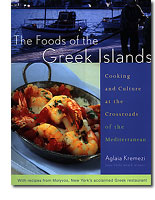 Greece has fascinating food every bit as appealing as that of its famous Mediterranean neighbors—and historical rulers—Italy and Turkey. But Americans haven't known much about Greece's food, for good reason. Visitors don't see even a hint of the rich variety and freshness of Greek cuisine in restaurants, which serve the same tired retinue of a few disastrously meaty dishes (kebabs, moussaka) that became universal as a way to vaunt postwar affluence. Beans and greens are too humble to offer to people willing to pay good money, caterers to tourists assume, and nowadays they're also too time-consuming to find and prepare. As for Greek chefs working in American restaurants, they're almost too good at adapting their native palate to more fashionable Mediterranean dishes.
 Now Aglaia Kremezi has come to the rescue of those unlucky enough not to have a Greek grandmother. Her new Foods of the Greek Islands goes far beyond the cuisine of the mostly clement and paradisal islands of the title to offer a short course in how Greeks cook for themselves. It's revelatory.
Previously in Corby's Table:
Confessions of a Cookie Eater -- October 4, 2000
Corby Kummer makes a shameless plea to readers of Nick Malgieri's new Cookies Unlimited.
The Bygone World of the Bialy -- August 31, 2000
Corby Kummer on Mimi Sheraton's The Bialy Eaters, a food critic's account of her seven-year, still-incomplete search for the origin of the distinctive little onion roll that is often mistaken for a bagel.
The Chowder King -- July 26, 2000
Corby Kummer on Jasper White's 50 Chowders, the latest from Boston's master seafood chef.
Simply Summer -- June 22, 2000
Corby Kummer satisfies his fresh-herb lust with a new book by Lisa Cowden, Ladle, Leaf, & Loaf.
Tuscany, Reluctantly -- April 26, 2000
Corby Kummer is tired of Tuscany, but he likes Pino Luongo's new cookbook, Simply Tuscan.
Matzoh Makeover -- March 22, 2000
Corby Kummer on Jayne Cohen's The Gefilte Variations, a new cookbook offering multiple versions of Jewish holiday classics.
Ham and Beans to the Rescue -- February 16, 2000
Weary of the Boston winter, Corby Kummer serves up "one of history's great couplings."
How to Cook (and How It Should Look) -- January 20, 2000
Corby Kummer on James Peterson's Essentials of Cooking, a kitchen primer that should fascinate beginners and old pros alike.
Encyclopedia Gastronomica -- December 22, 1999
Corby Kummer makes his way through The Oxford Companion to Food -- and still finds Room for Dessert.
Italian Soul Food -- October 14, 1999
Corby Kummer serves up selections from Lynne Rossetto Kasper's The Italian Country Table.
More by Corby Kummer in Atlantic Unbound
That's because Kremezi has generally avoided calling for hard-to-find ingredients and has stuck to basic techniques. Her simple food is uniquely satisfying: lentil soup with pasta and mint, with the unexpected appearance of crushed red pepper and Kalamata or another sweet vinegar. Baked chicken with orzo is seasoned with cinnamon stick and dried oregano, the herb that even when used alone is enough to identify a dish as Greek. Veal stew with quinces gives adventurous cooks a chance to indulge in a favorite (and rare) ingredient—quinces, which turn a beautiful ruby when cooked. There are plenty of stewed greens, of course, since they kept families alive for millennia and as recently as the postwar period.
My nomination for immortality goes to roasted potatoes with garlic, lemon, and oregano, little cubed potatoes baked until tender and baked some more, until they are dark and crisp. My guess is that they'll make Greek converts of foodlovers who've never given Greece a second thought.
-- Corby Kummer
Excerpts from The Foods of the Greek Islands, by Aglaia Kremezi
Lentil Soup With Pasta and Mint
Fakes Me Pastoula Ke Diosmo
I first tasted this soup in Astypalaia, the tiny picturesque Dodecanese island. The lentils were mixed with small, somewhat crude pieces of homemade pasta and seasoned with plenty of fresh mint. In T. F. Horowitz's book Generation of Mediterranean Sephardic Cooking, with recipes from the island of Rhodes—which is also in the Dodecanese—I found a similar soup: lentils with vermicelli cooked in tomato sauce. In my version of the dish, I prefer to use tiny pasta shapes such as stellini or small orzo and follow the Astypalaian recipe, which has no tomatoes.
| 4 cups water | Salt |
| 1 cup brown lentils, picked over and rinsed | 1/3 cup stellini, small orzo or other tiny pasta shape or 2/3 cup crushed vermicelli |
| 1 bay leaf | Freshly ground black pepper |
| 3 tablespoons olive oil | 1/4 cup chopped fresh mint, plus a few leaves for garnish |
| 1 cup chopped red onions | Extra-virgin olive oil |
| 1/2-1 teaspoon Aleppo pepper or pinch of crushed red pepper flakes | Sweet Greek vinegar, such as Kalamata vinegar, or balsamic vinegar |
| 3 cups chicken stock or vegetable stock |
In a large pot, combine the water, lentils and bay leaf and bring to a boil. Reduce the heat to low and simmer for 20 minutes, or until the lentils are tender. Drain, reserving 1 cup of the cooking liquid. Discard the bay leaf. Wipe out the pot with paper towels.
Heat the oil in the pot and sauté the onions with the Aleppo pepper or pepper flakes over medium heat until soft, about 5 minutes. Add the lentils and sauté for 1 minute. Add the reserved cooking liquid, the stock and salt to taste, bring to a boil, reduce the heat to low and simmer for 10 minutes.
Return the broth to boiling, add the pasta, increase the heat to medium and cook for 8 minutes, or until the pasta is al dente. Taste and adjust the seasonings, adding a few grindings of black pepper. Stir in the mint.
Ladle the soup into bowls, drizzle oil and a little vinegar over each serving and garnish with the mint leaves.
Baked Chicken With Orzo
Kotopoulo Youvetsi
This chicken dish is a common Sunday one-pot meal of the islands. In her wonderful taverna in Avgonima, Chios, Kalliopi Delios cooks homemade macaroni in the chicken-tomato stock. Orzo, elbow macaroni, ziti and penne rigate are good alternatives. This recipe is based on Kalliopi's.
| 1/3 cup olive oil | 2 cups grated ripe tomatoes or canned diced tomatoes with their juice |
| 1 4 1/2-pound free-range chicken or capon, cut into 6 pieces, or six turkey drumsticks | Salt |
| 1 large onion, halved and thinly sliced | 2 cups chicken stock, plus more if needed |
| 1/3 cup chopped oil-packed sun-dried tomatoes | 1 pound orzo or elbow macaroni, cooked in plenty of boiling salted water for 2 minutes and drained |
| 1 cinnamon stick | 2 tablespoons chopped fresh flat-leaf parsley |
| 1 teaspoon dried oregano, crumbled | 1/2 cup coarsely grated hard myzithra, kefalotryi, pecorino Romano or Parmigiano-Reggiano cheese |
| 1 teaspoon Aleppo pepper or pinch crushed red pepper flakes |
Preheat the oven to 400°F.
In a Dutch oven, heat the oil over medium-high heat and sauté the chicken or turkey in batches until golden brown on all sides. Set aside.
Add the onion to the pot and sauté until soft, about 3 minutes. Add the sun-dried tomatoes, cinnamon stick, oregano, pepper or pepper flakes and tomatoes. Sprinkle the turkey or chicken with salt and return to the Dutch oven. Add about 1/2 cup stock, or enough to come about two-thirds of the way up the chicken or turkey. Bring to a boil, cover and transfer to the oven.
Bake for about 1 1/2 hours, or until the meat is very tender. Transfer the chicken or turkey to a platter and cover with aluminum foil to keep warm.
Meanwhile, bring the remaining 1 1/2 cups stock to a simmer.
Add the stock to the cooking liquid, stir in the pasta and bake, uncovered, for about 15 minutes, or until most of the liquid has been absorbed, adding more stock if the pasta begins to dry out.
Place the chicken or turkey on top of the pasta and bake for another 10 minutes, until the pasta is tender. Serve immediately, sprinkled with parsley and cheese.
Moschari Kydonato
This is one of my favorite winter stews. Quinces are equally delivious in savory and sweet dishes, and Greek islanders cook all kinds of meats with quince. On Chios, they pair quinces with free-range chicken; on Crete, with lamb, and on Lesbos, with veal. Here, the firm, fragrant fruit, with its appealing sour taste, balances well with the sweet sugar syrup and spicy rich meat sauce.
The combination of meat with quinces is not new. In the Roman cookery of Apicius, we find similar stews, and quinces must have been quite common in old traditional Greek cooking.
This stew can be prepared almost entirely in advance and refrigerated. Then you need only simmer the meat in the sauce for a few mintues and caramelize the quinces just before serving. Leftover sauce makes an unusual but excellent pasta sauce, or it can be used in pasticcio (page 66).
Accompany with Polenta with Currants and Onions (page 162) or Chickpeas with Rice (page 154).
| 2 pounds boneless veal breast or top round roast | 1 cinnamon stick |
| 1 large onion, quartered | 1 bay leaf |
| 2/3 cup olive oil | 1/2 teaspoon coarsely crushed allspice berries |
| 3-4 teaspoons sugar | About 1 1/2 cups beef stock or chicken stock |
| Juice of 1 lemon | Salt |
| 4 quinces | 1-2 tablespoons red wine vinegar (optional) |
| 1/2 cup dry red wine | Freshly ground black pepper |
| 9 pitted prunes | 2 tablespoons chopped fresh flat-leaf parsley |
| 1 teaspoon Aleppo pepper or pinch of crushed red pepper flakes | 1/2 cup sweet red wine, such as Mavrodaphne or sweet Marsala |
In a large pot, combine the veal, onion, 1/4 cup of the oil, 1 teaspoon of the sugar and enough water to come two-thirds up the sides of the roast. Bring to a boil and skim off the foam that rises to the top. Cover and simmer for 45 minutes, turning the meat once. Remove from the heat and let cool, then refrigerate overnight.
Fill a medium bowl with water and add the lemon juice. Quarter and core each quince, then halve each quarter lengthwise. Drop the quince pieces into the bowl of lemon water as you work.
In a large skillet, heat the remaining 6 tablespoons oil. Pat the quince pieces dry with paper towels and sauté, in batches, stirring, for 4 minutes, or until they start to color. Transfer to a medium bowl and set aside. Discard any remaining oil and add the sweet wine to the skillet, scraping up any caramelized bits in the bottom of the pan. Remove from the heat and set aside.
Remove the veal from the pot and cut it into four 1/2-inch-thick slices. Bring the cooking liquid to a boil and boil over high heat until it has evaporated and only fat remains in the pot, 10 to 15 minutes. Return the veal slices to the pot and sauté, turning, for 5 minutes, or until browned. Add 8 of the less attractive quince pieces, the sweet wine from the skillet, the dry wine, 5 of the prunes, the Aleppo pepper or pepper flakes, cinnamon stick, bay leaf, allspice, stock and salt to taste. Bring to a boil, reduce the heat to low, cover and simmer for 45 minutes, or until the meat is very tender.
Transfer the veal to a plate and set aside. Discard the cinnamon stick and bay leaf. Transfer the quinces, prunes, and sauce to a blender and puree. Return to the pot and add the remaining 4 prunes and the remaining quince pieces to the sauce and simmer for 15 to 20 minutes, or until the quinces are soft but not mushy. Carefully transfer the quinces to a small baking pan in a single layer, cover and keep warm.
Add the vinegar, if using, and black pepper to taste to the sauce. Taste and adjust the seasonings. Return the meat to the sauce and simmer for 10 minutes more, or until heated through.
Meanwhile, preheat the broiler. Sprinkle the quinces with the remaining 2 to 3 teaspoons sugar and broil until caramelized, about 2 minutes.
Place a slice of veal, a prune and some caramelized quinces on each plate. Pour a little sauce over the meat, sprinkle with the parsley and serve, passing the remaining sauce at the table.
Patates Riganates
Few people can resist these potatoes, which are capable of stealing the show from any food they accompany—so make sure you have plenty for seconds. Although it is served all over Greece, this dish is particularly good on islands like Naxos, where the local potatoes have an exceptional taste. On the special days when a leg of lamb or a chicken is roasted, the potatoes are cooked in its juices.
If you want to cook this dish using small potatoes, there is no need to peel them, but I suggest that you halve them, because they taste best when they can absorb more sauce.
| 3 pounds baking potatoes, peeled and cut into 1 1/2-inch cubes | Freshly ground black pepper |
| 1/2 cup olive oil | 1/2 cup beef stock or chicken stock |
| 4 garlic cloves, minced | 1/3 cup freshly squeezed lemon juice |
| 1 1/2 teaspoons dried oregano, crumbled | 2-3 tablespoons chopped fresh oregano |
| 1 teaspoon salt |
Preheat the oven to 400°F.
Place the potatoes in a single layer in a 13-x-9-inch baking dish and pour the oil over them. Add the garlic, dried oregano, salt and pepper to taste and toss well to coat with the oil.
Bake the potatoes for 15 minutes. Add the stock, toss and bake for 10 minutes more. Add the lemon juice, toss and bake for 10 to 15 minutes more, or until the potatoes are cooked through. If you like, preheat the broiler and broil the potatoes for 2 to 3 minutes, or until golden brown.
Sprinkle with the fresh oregano and serve at once.
VARIATION
Dissolve 1 tablespoon tomato paste in the stock, and reduce the amount of lemon juice to taste. Substitute Aleppo pepper or crushed red pepper flakes for the black pepper.
Corby Kummer is a senior editor at The Atlantic Monthly and the author of The Joy of Coffee.
More by Corby Kummer in Atlantic Unbound.
Copyright © 2000 by Corby Kummer.
Recipes from The Foods of the Greek Islands by Aglaia Kremezi. Houghton Mifflin: Boston, MA, 2000. Hardcover, 298 pages. ISBN: 0395982111 $35.00. Copyright © by Aglaia Kremezi.
 |  |  |  |  |  |