




December 22, 1999
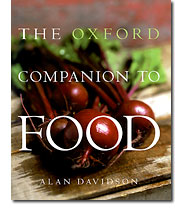 Opening The Oxford Companion to Food, written by Alan Davidson, is like falling into Wonderland -- both exhilarating and slightly dangerous, because one entry leads to another, and you might never emerge. Also, the world of this long-awaited encyclopedia is distinctly British and wholly eccentric, as befits the work of a passionate British scholar whose erudition and peculiarities have become legend in the world of international food scholarship. That world is expanding thanks in large part to Davidson -- he is the founder of the scholarly journal Petits Propos Culinaires and the cofounder of the Oxford Symposia on Food, an annual summer meeting that both unites and inspires those who research the history, sociology, anthropology, and even the semiotics of food.
The Companion, most of whose 2,650 entries were written by Davidson himself (no wonder it took twenty years to complete the book) is irresistible fun to read. Searching for an entry on Christmas Foods, for example, I was waylaid by a sentence in the Chef entry: "Men-cooks in private households in the 20th century were often given the courtesy title of chef, although Anatole, Aunt Dahlia's matchless Frenchman in P. G. Wodehouse's The Code of the Woosters (1938), remained simply a cook."
Previously in Corby's Table:
Italian Soul Food -- October 14, 1999
Corby Kummer serves up selections from Lynne Rossetto Kasper's The Italian Country Table.
Countercultural Cooking -- September 15, 1999
Corby Kummer on Chez Panisse -- the influential Berkeley, California, restaurant that started as a countercultural collective -- and the new Chez Panisse Café Cookbook.
Charmed by Chile -- August 18, 1999
A new collection of home-style recipes reflects the Chilean way of life.
Hail to the Chef -- July 15, 1999
A tribute to Patrick Clark, a chef who was a model for many young African-Americans and an inspiration to other chefs.
Persian Appeal -- June 3, 1999
A look at Najmieh Batmanglij's A Taste of Persia, and the subtle yet persistent spices of Iranian cuisine.
Help! My Child Is a Vegan! -- April 28, 1999
Stephanie Pierson's useful new guide for teenage vegetarians, and those who love them anyway.
Seasons and Seasonings -- March 3, 1999
A seasonal guide to cooking from the garden by Amanda Hesser, a young woman who knows and loves food.
Seductions of Rice -- January 27, 1999
Selections from a new guide to the universal grain's many flavors.
A Passion for Pastry -- December 17, 1998
Two books that will have you dreaming of the perfect holiday dessert.
Soup With Style -- November 11, 1998
A look at the new book by Barbara Kafka, a cook who takes a fearlessly original approach to soup.
More by Corby Kummer in Atlantic Unbound
You see the lingering danger, or rather the danger of lingering. The Oxford Companion is a must-have for anyone much interested in food. With luck an online bookstore will have it if you can't find a copy nearby. Technically the book is already out of print, according to my friend Joe Carlin, who runs the admirable foodbooks.com (which I urge you to visit); he sold out his initial order of twenty-one copies, and the publisher is giving him a March shipping date for the next printing.
In the meantime, to keep yourself occupied, you might want to confirm the Companion observation that the Christmas holiday is a popular time for baking special treats: "What is, however, relatively common ground and relatively unchanging is the seasonal frenzy of baking in most European countries, as households (one used to say housewives, but patterns of activity change) make a stock of special foods for the Christmas period."
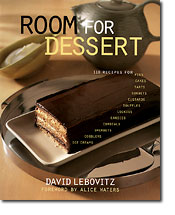 This year's baking books are for the most part either disappointingly skimpy or far too technical for the home cook, but there are exceptions: Susan G. Purdy's The Family Baker; Gale Gand and Rick Tramonto's Butter Sugar Flour Eggs; Cookies and Brownies, a superbly concise book by the chocolate guru Alice Medrich; and the one I feature here, Room for Dessert. The author, David Lebovitz, has been a leader of Bay Area baking since he went to work at the Berkeley restaurant Chez Panisse, where he spent twelve years as pastry chef. He now writes and teaches and even has his own Web site, at davidlebovitz.com.
Lebovitz's approach to desserts is mostly straightforward, as shown by a five-ingredient recipe for a very rich chocolate gelato; a simple recipe for Flo's Chocolate Snaps, which will add crisp elegance to any holiday dessert tray and which come from one of my dearest friends, the champion baker Flo Braker; and one for spiced candied nuts, an easy recipe adaptable to several nuts. A batch of this recipe would be an excellent last-minute gift for someone's Christmas stocking.
-- Corby Kummer
Excerpts from Room for Dessert, by David Lebovitz
I am constantly asked about the difference between ice cream and gelato. Gelato has a richer, more concentrated flavor than regular ice cream, and generally has both less fat and less air (which is referred to as "overrun" in the business). Gelato takes a little longer to freeze and will not freeze as firm as American ice cream. It should resemble very thick pudding.
This chocolate gelato, my favorite, was inspired by a recipe of Marcella Hazan's. I always enjoy watching people as they take their first bite and seeing their shock give way to ravishment as they are seduced by the intensity of the chocolate. Serve chocolate gelato as an Italian sundae in little footed bowls, topped with spoonfuls of whipped cream, a few candied cherries with some of their syrup, and a scattering of toasted sliced almonds.
| 1/2 cup Dutch-process cocoa | 3/4 cup sugar |
| 2 cups milk | 4 egg yolks |
| 5 ounces bittersweet chocolate |
1. Whisk the cocoa with 1 cup of the milk in a saucepan. Bring to a boil over moderate heat. Remove from the heat. Coarsely chop the chocolate and stir it into the cocoa mixture until it has completely melted.
2. In another saucepan, warm the remaining 1 cup of milk with the sugar.
3. Whisk together the egg yolks in a bowl and gradually pour in some of the warmed milk and sugar, whisking constantly as you pour. Pour the warmed egg mixture back into the saucepan.
4. Cook over low to moderate heat, constantly stirring and scraping the bottom, until the custard thickens enough to coat the spatula. Strain the custard into the chocolate mixture and mix well. Chill thoroughly, then freeze in an ice cream maker according to the manufacturer's instructions.
A snappy chocolate cookie from my friend Flo Braker. Unusually flavorful for a butter cookie, and with a short crispness that explodes with chocolate flavor in your mouth. I also use these to make ice cream sandwiches -- simply roll the dough into larger-size logs or, if you are a traditionalist, roll out the dough with a rolling pin on a lightly floured surface, cut the snap dough into rectangles, bake them, and then use them for ice cream sandwiches.
| 1/2 pound (2 sticks) butter, at room temperature | 3/4 cup cocoa (preferably Dutch-processed) |
| 1 1/4 cups sugar, plus more for sprinkling on the cookies | 3 cups flour |
| 1/2 teaspoon vanilla extract | 2 1/2 teaspoons baking powder |
| 1 egg, at room temperature | 1/4 teaspoon salt |
| 1 egg yolk, at room temperature |
1. Beat together the butter and the 1 1/4 cups of sugar until smooth, about 1 minute in an electric mixer. Stop the mixer and scrape down the sides to make sure all the butter is incorporated. Do not overbeat. Add the vanilla.
2. Beat in the egg and the egg yolk, stopping again to scrape the sides of the mixing bowl.
3. Sift together the cocoa, flour, baking powder, and salt. Set the mixer at the lowest speed and gradually add the dry ingredients, mixing until completely incorporated. There should be no streaks of butter visible.
4. Divide the dough into three pieces. On a lightly floured surface, roll each portion with your hands into a log about 7 inches long and 2 inches in diameter. Wrap the logs in plastic and refrigerate them until they're firm enough to slice. The dough can also be frozen at this point for up to 2 months.
5. To bake the snaps, position the oven racks in the center and upper part of the oven, and preheat the oven to 350 degrees. Slice the logs into 1/3-inch-thick rounds and bake on parchment-lined baking sheets for 10 to 12 minutes, until puffed and slightly firm. Rotate the baking sheets and switch racks midway through baking to make sure the cookies bake evenly. Remove the cookies from the oven and sprinkle the warm cookies with sugar. Allow to cool completely. They will continue to firm up and get "snappy" as they cool. Once they have cooled, store the cookies in an airtight container.
Years ago I made these candied nuts for the first time to spice up a fresh batch of bourbon-flavored ice cream. I ended up liking them so much I now include them in all sorts of things -- chopped up in cookie dough, as a garnish for caramelized bananas, and in many a candy box. However, they may be most delicious when eaten right out of the jar in your pantry.
| 2 teaspoons ground cinnamon | 3/4 cup sugar |
| 2 teaspoons ground ginger | 1 1/2 cup walnut halves (or pecan halves or whole almonds), lightly toasted |
| 1 teaspoon ground cloves | |
| 1/4 teaspoon cayenne pepper | Pinch of salt |
| 1/4 cup water |
1. Mix together the cinnamon, ginger, cloves, cayenne pepper, and salt.
2. In a heavy saucepan fitted with a candy thermometer, heat the water and the sugar over medium-high heat. When the syrup reaches 236 degrees, remove the thermometer.
3. Reduce the heat to low and stir in the nuts. Keep stirring until the syrup crystallizes and becomes dry. This will take about 1 minute.
4. Continue to stir for a few minutes until the sugar crystals in the bottom of the pan begin to liquefy. Add the spice mixture and keep stirring over low heat until most of the sugar crystals have melted and the nuts are coated. Do not overcook.
5. Spread the nuts on a baking sheet, separating them with your hands once they are cool enough to handle, and allow them to cool completely. Store the nuts in an airtight container for up to one week.
Variation: For Sichuan-style spiced nuts, make the syrup with 1/4 cup of Shaoxing wine (or dry sherry) instead of water and add 2 teaspoons of chili oil and 2 teaspoons of ground Sichuan pepper to the spice mixture.
Corby Kummer is a senior editor at The Atlantic Monthly and the author of The Joy of Coffee.
More by Corby Kummer in Atlantic Unbound.
Copyright © 1999 by Corby Kummer.
Recipes and links from Room for Dessert by David Lebovitz. Harper Collins: New York, New York, 1999. Hardcover, 221 pages. ISBN: 0060191856. $30. Copyright © by David Lebovitz.
 |
 |
 |
 |
 |
 |