




Quick Dishes Using Cooked Ham
Sources for Country Ham
Breakfast Ham and Eggs
Ham and Corn Chowder
White Bean Salad with Country Ham
Cooking Beans
Boston Baked Beans
February 16, 2000
 Is your winter eternal? Ours, in Boston, shows no signs of stopping -- the cold weather is endless. This calls for food of substance. This calls for ham and beans.
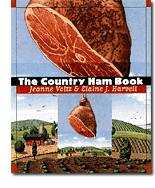
Jeanne Voltz seems to know everything about rib-sticking Southern food. Her Barbecued Ribs, Smoked Butts, and Other Great Feeds remains one of my favorite regional-American cookbooks, and last year she collaborated with Elaine J. Harvell to write The Country Ham Book, a short and excellent introduction to one of America's great native specialties. "The flavor of ham is as complex as that of fine wine," the authors write; they share childhood recollections of pig slaughtering and sausage and ham preparation, and also summarize the ancient history of curing ham.
Previously in Corby's Table:
How to Cook (and How It Should Look) -- January 20, 2000
Corby Kummer on James Peterson's Essentials of Cooking, a kitchen primer that should fascinate beginners and old pros alike.
Encyclopedia Gastronomica -- December 22, 1999
Corby Kummer makes his way through The Oxford Companion to Food -- and still finds Room for Dessert.
Italian Soul Food -- October 14, 1999
Corby Kummer serves up selections from Lynne Rossetto Kasper's The Italian Country Table.
Countercultural Cooking -- September 15, 1999
Corby Kummer on Chez Panisse -- the influential Berkeley, California, restaurant that started as a countercultural collective -- and the new Chez Panisse Café Cookbook.
Charmed by Chile -- August 18, 1999
A new collection of home-style recipes reflects the Chilean way of life.
Hail to the Chef -- July 15, 1999
A tribute to Patrick Clark, a chef who was a model for many young African-Americans and an inspiration to other chefs.
Persian Appeal -- June 3, 1999
A look at Najmieh Batmanglij's A Taste of Persia, and the subtle yet persistent spices of Iranian cuisine.
Help! My Child Is a Vegan! -- April 28, 1999
Stephanie Pierson's useful new guide for teenage vegetarians, and those who love them anyway.
Seasons and Seasonings -- March 3, 1999
A seasonal guide to cooking from the garden by Amanda Hesser, a young woman who knows and loves food.
Seductions of Rice -- January 27, 1999
Selections from a new guide to the universal grain's many flavors.
More by Corby Kummer in Atlantic Unbound
The recipes are big and simple, like breakfast ham and eggs baked with bread cubes and cheese to feed a crowd; a hearty winter ham and corn chowder; and a white bean salad with country ham that can be served cold or at room temperature and could easily become a bring-a-dish staple.
 Beans are, of course, ham's natural partner, but Americans are out of the habit of fusing them. Jane Brody, the esteemed Personal Health columnist for The New York Times, recently commented when we met at a conference that Americans seem not to be getting the bean message: beans are essential for fiber and protein and should be part of the American diet. She frequently has leftover bean stew for breakfast, she said, and enthusiastically follows her own recommendation that beans be eaten nearly everyday. "You can always get them canned," she added, since most people are downright frightened by the idea of soaking and cooking beans.
I was long one of these people, until I cooked and tasted about twenty kinds of beans for a magazine article a while ago. I became a connoisseur of the many beautiful kinds of heirloom beans becoming newly available, and was delighted to encounter all of them anew in the small, pretty Elizabeth Berry's Great Bean Book by Florence Fabricant, another much-admired Times writer (Berry is a crusading bean farmer and cook near Santa Fe, New Mexico).
Fabricant, who can and does write about every aspect of food, gives an elegantly succinct description of how to prepare and soak beans, which I include; she ticks off the various types of heirloom beans and gives her typical good, no-nonsense advice. Of the recipes, I was immediately drawn to a version of Boston baked beans with the essential cider vinegar, maple syrup, and brown sugar, that's given extra kick with cilantro, cumin, and jalapeño. The recipe also calls for smoked bacon -- yet another revered pig product, and another reminder of one of history's great couplings.
-- Corby Kummer
Excerpts from The Country Ham Book, by Jeanne Voltz & Elaine J. Harvell
Sauté a few oysters in butter until plumped, about two minutes. Spoon onto paper-thin ham slices for an elegant lunch or first course.
Serve thin slices of ham on toasted and buttered cornbread, fried grits, or polenta with a spoonful of hot green or cooked dried black-eyed peas.
Mix finely chopped ham into an equal measure of cream cheese or sour cream; use as a filling for stuffed celery or as a spread for jiffy canapés.
Toss a few snippets of ham into Waldorf or mixed green salad; toss the greens and ham with a light vinegar-oil dressing. Or strew shreds of ham over spinach salad with peaches, oranges, or strawberries.
In season, cut fine fresh fruit, cantaloupes, or other melons for serving. Wrap a thin slice of cooked ham around each chunk of fruit. Or arrange fruit on a platter and serve with three or more thin slices of ham on each luncheon plate; pass the fruit for each diner to select and taste. Whole unpeeled figs are a classic and one of the loveliest choices to complement the ham. Fresh peach or pear wedges rubbed with lemon are always welcome.
In the spring, top a platter of hot cooked asparagus with thin slices shaved off a cooked ham. Or wrap a slice of ham around a bundle of the asparagus for one serving. Pass honey mustard or a fruit vinegar and oil dressing.
Stir bits and pieces cut off a ham bone into the batter for cornbread. Bake and serve hot with cooked greens or other fresh vegetables or salad.
Mince or grind cooked ham and mix into a rice or bread stuffing for baked bell peppers. Ditto for poultry stuffing, adding sauteéd sliced mushrooms or chopped apple with the ham.
Sprinkle a couple tablespoons of julienne-cut ham, cooked or uncooked, into the oil for stir-fry Chinese cabbage or other vegetables.
A few slivers of ham glorify primavera and other vegetable sauces for pasta. Steam a vegetable or combination for lunch or dinner; drop a hunk of ham on top of the vegetables to warm and add flavor. Especially good is a wedge of cabbage, chunks of peeled sweet or white potatoes, and wedges of onion.
For a satisfying, moderate-fat breakfast or lunch, split and spritz an English muffin with butter-flavored cooking spray. Toast the muffin halves and spread one lightly with tart marmalade or preserves. Lay a thin slice of ham, trimmed of visible fat, on the spread, close with the other half, and eat.
A thin slice of ham on a turkey, chicken, mild cheese, or egg salad sandwich on rye or whole-grain bread perks up interest in a sandwich lunch.
Craver's Olde Salem Country Hams
900 Thurmond St.
Winston-Salem, NC 27105
(336) 724-5508 or (800) 898-7675
Brochure; retail outlet; mail and phone orders; limited supermarket distribution. Cured with salt, brown sugar, and black pepper; aged four months; whole or sliced, uncooked. Family owned and operated.
Goodnight Brothers
Post Office Box 287
Boone, NC 28607
(800) 828=4934
Mail order: Cured with salt and brown sugar; not smoked; aged for three months; whole and variety of cuts.
Hobe's Country Hams
Post Office Box 350
Wilkesboro, NC 28697
(336) 670-3401
Mail and phone orders. Wide variety of cuts, none cooked; cured with salt, granulated and/or brown sugar; not smoked; aged at least three months. Popular in Baltimore and Washington, D.C., area. Grand champion at N.C. State Fair.
Johnston Country Hams, Inc.
204 North Brightleaf Blvd.
Smithfield, NC 27577
(800) 543-4267
Retail, mail, and phone orders; available in markets nationally. Cured with salt and sugar; aged three to six months; cooked and uncooked; none smoked. Biscuit and sandwich slices in vacuum-sealed packages; boneless cooked ham in specialty shops and fine food catalogs.
Lundy's Tomahawk Farms
Post Office Box 49
Clinton, NC 28329
(910) 592-2104, ext 294
This company has fifty years' experience curing and slow-aging hams. Cured with sugar and salt; wide variety of cuts, from bits and pieces to whole hams in bags.
Mom 'n' Pop's Smokehouse
Post Office Box 399
Claremont, NC 28610
(800) 222-9771
Mail order: Cured with salt, sugar, and black pepper; not smoked; aged three to six months; whole hams and large choice of cuts. Given award of merit by American Association of Meat Processors.
Nahunta Pork Center
200 Bertie Pierce Rd.
Pikeville, NC 27863
(919) 242-4735
Brochure available; retail outlet in state farmers' market in Raleigh. Cured with salt and sugar; pepper on request; aged up to ten months; not smoked; uncooked whole, parts, and slices; cooked whole. Family operated.
Ralph Medlin and Son, Inc.
700 Lincoln St.
Post Office Box 665
Benson, NC 27504
(919) 894-2626
Retail store fills mail and phone orders. Cured with salt and black pepper; not smoked; no nitrates; aged seven months; whole hams, bone-in or -out, sliced.
Thomas Brothers Country Hams
1852 Gold Hill Rd.
Asheboro, NC 27203
(336) 672-0337
Mail order. Whole and wide selection of cuts; cured with salt, sugar, and black pepper; not smoked; aged at least three months.
Wayco Hams
508 North Williams St.
Goldsboro, NC 27530
(800) 962-2614
Mail order: Whole hams and slices, cooked or uncooked; cured with salt and brown sugar; no pepper. Wayco label is smoked and aged six to twelve monthls. Waynesboro label made here, not smoked, aged three to six months, and sold in retail groceries.
This is a great way to use leftovers from the Christmas ham, and a brunch with close friends may be the best party of the season. This is put together the night before to allow bread to soak up the flavors, and leaving the host and hostess free to enjoy their guests.
| 9 eggs, beaten just until blended | 3 cups milk |
| 1 1/2 teaspoons dry mustard | 12 slices bread, crusts removed, cut in cubes |
| 1 1/2 cups shredded sharp Cheddar cheese | 1 cup diced cooked ham |
Butter a 13x9x2-inch baking dish.
Beat the eggs in a medium-size bowl just until blended. Stir in milk and mustard, then the bread cubes, cheese, and ham; mix gently.
Pour into the prepared baking dish. Cover with plastic film and refrigerate overnight.
An hour and a quarter before serving, heat the oven to 350°.
Uncover the baking dish and bake one hour. Serve immediately.
All early settlers learned to appreciate corn. This satisfying soup was a staple of the Pennsylvania Dutch and makes fine winter fare anyplace. Ham fat or lard was traditionally used for sauteéing the onion, but oil adds needed richness with modern ham, which is leaner than the original.
| 1 tablespoon canola or olive oil | 2 medium onions, peeled and rough cut |
| 1/2 cup chopped cooked or uncooked country ham | 1 large or 2 small potatoes, peeled and cubed |
| 1/2 cup water | salt and white pepper or hot pepper sauce to taste |
| 1 cup milk | 1/2 cup half-and-half or undiluted nonfat evaporated milk |
| 1 1/2 cups corn cut off the cob or drained canned whole-kernel corn |
Heat oil in a large saucepan or soup pot. Add onion and ham and sauteé, stirring occasionally to prevent scorching, until onion is translucent. Add potato and water. Cover and simmer fifteen minutes or until potato is very soft.
Puree soup in food processor or blender. For smooth chowder, press through a mesh strainer; this soup need not be completely smooth, but suit your own taste.
Return soup to pan, and salt and pepper lightly. Stir in milk, half-and-half, and corn. Heat for ten to fifteen minutes, until corn is tender, but do not boil. Taste and add more salt and pepper if needed. Ladle into warm bowls and serve.
Any cornbread is appropriate with ham, obligatory with fresh vegetables and ham.
White Bean Salad with Country Ham
Warm this salad slightly and serve small spoonfuls on crisp arugula or mesclun greens as an appetizer. To serve with grilled chicken or fish, pile it in a large bowl and wreath with the greens.
| 1 pound dried cannellini or navy beans, cooked, or 2 cans (15 1/2 ounces each) | 2 tablespoons balsamic vinegar |
| 1 small bay leaf, crumbled fine | 1/4 teaspoon salt |
| 1/4 teaspoon freshly ground pepper | 1/4 teaspoon sugar |
| 3 tablespoons minced parsley, perferably flat-leaf | 2 cloves garlic, minced |
| 1/4 cup finely chopped onion (1/2 small) | 2 to 3 tablespoons olive oil |
| 1/2 to 1 cup diced or chopped cooked ham | leaf lettuce or other greens, Mediterranean-style olives, tomato wedges, and cucumber slices |
Pour beans into a strainer and rinse well under cold running water to remove pasty substance surrounding beans. Drain well and turn beans into medium-size bowl.
In a small saucepan, combine vinegar, bay leaf, salt, pepper, sugar, parsley, garlic, and onion. Heat to simmering, remove from heat, and cool ten to fifteen minutes.
Pour vinegar mixture over beans, add the ham, and toss lightly. Sprinkle with oil, just enough to lubricate salad evenly.
Let mellow at room temperature for an hour or two. Garnish with greens, olives, tomato, and cucumber. This salad is best at room temperature.
Excerpts from Elizabeth Berry's Great Bean Book, by Florence Fabricant
Before cooking, most recipes will advise sorting through the dried beans for pebbles and other debris. I must confess that I have all but eliminated this step because I cannot remember the last time I found a pebble. But I always rinse beans before using them.
The cooking process essentially reconstitutes the beans. They absorb water and become tender during heating. It is better to overcook beans than to undercook them.
There are three basic methods for cooking beans: The first is to place them in a bowl and cover them with cold water to a depth of at least two inches, then allow them to soak for at least four hours at room temperature. Drain the beans, place them in a saucepan, add fresh cold water to a depth of two inches, and bring them to a boil. Skim off any foam that accumulates on the surface, lower the heat to a slow simmer, partially cover the saucepan, and allow the beans to cook until tender. Depending on the type of bean, this will take anywhere from thirty minutes to three hours. Watch your beans from time to time as they cook and add additional water as needed to keep them well covered.
The quick-soak method calls for bringing the beans to a boil and cooking them for two minutes, then allowing them to soak for one hour. Cook them in fresh water as directed above.
Dried beans, especially those that are reliably fresh and have not been sitting on the shelf for years, can also be cooked without soaking. Indeed, many cooks do not bother with the soaking. But the beans will take up to one hour longer to become tender. In Mexico, for example, beans are rarely soaked. But Mexican cooking is so dependent on beans that they are also rarely old.
Cooking beans without soaking preserves more nutrients. Some kinds of beans, like lentils, flageolets, rice beans, split peas and adzuki beans, do not require soaking.
In some bean recipes, the beans are combined with other ingredients and baked for as long as six to eight hours. With these recipes, which can be cooked largely untended, there's never a problem of underdone beans. But it is important to check on the beans from time to time to be sure there is enough liquid in the pot.
Another shortcut is to use a pressure cooker. Place the rinsed beans and water (three cups of water for 1 cup of beans, plus 2 cups of water for each additional cup of beans) in the pressure cooker. Lock the lid in place. Bring to full pressure and cook for one minute, then remove from the heat and allow the pressure to drop. After fifteen minutes, release any additional pressure. Large beans, such as runner beans, should be cooked two to three minutes.
The one problem with using a pressure cooker is that the foam that accumulates, or debris like floating bean skins, can clog the apparatus and cause problems. Watch carefully and if anything untoward seems to be happening -- strange noises, for example -- bring down the pressure by placing the pot under cold running water. Some cooks say adding a little oil reduces the potential for this to happen. Whatever you do, be sure to follow the manufacturer's directions. Also, using a pressure cooker makes it difficult to gauge when the beans are done. And if you stop the cooking but find the beans are not yet tender enough, you'll have to finish the cooking conventionally, simmering the beans in a pot.
Classic Boston baked beans are made with navy beans. This recipe, adapted from one created by Lydia Shire and Susan Regis at Biba in Boston, ratchets up the flavor of the dish with the addition of cumin seeds, a jalapeño pepper, and a whiff of orange.
| 1 cup dried navy beans | 1/2 cup dried kidney beans |
| 1/2 cup dried pinto beans | 2 sprigs thyme |
| 1 tablespoon cumin seeds | 1 tablespoon extra virgin olive oil |
| 1 large onion, chopped | 1 carrot, peeled and chopped |
| 1/2 pound thick-sliced smoked bacon, diced | 1 jalapeño chile, seeded and chopped |
| 2 cloves garlic, chopped | 1/2 cup crushed canned tomatoes |
| 4 ripe plum tomatoes, diced | 1/4 cup pure maple syrup |
| 1/4 cup firmly packed brown sugar | 1 bay leaf |
| Grated zest of 1 orange | 1/2 tablespoon crushed black peppercorns |
| 1/3 cup chopped fresh cilantro | Approximately 1/4 cup cider vinegar |
| Salt |
Place all the beans in a bowl, cover them with cold water to a depth of at least two inches, add the thyme, and allow them to soak for at least four hours or overnight.
Heat a heavy 2- to 3-quart casserole. Add the cumin seeds and stir until they begin to dance around and smell toasty. Remove the seeds and set them aside.
Add the oil to the casserole. Sauté the onion, carrot, and bacon for ten minutes, or until the bacon is golden. Add the jalapeño, garlic, and toasted cumin seeds and cook for a few minutes.
Preheat the oven to 300°.
Drain the beans and add them to the casserole along with the canned and fresh tomatoes, maple syrup, brown sugar, bay leaf, orange zest, and peppercorns. Stir in all but 1 tablespoon of the cilantro.
Add 2 cups of cold water, cover, and bring to a slow simmer. Place the casserole in the oven and cook for one hour. Add the vinegar and season to taste with salt. Cook for one hour longer, or until the liquid has been absorbed but the beans are still very moist.
Adjust seasonings, adding salt and pepper and up to two tablespoons more cider vinegar to taste. Serve, garnish with the remaining cilantro.
Corby Kummer is a senior editor at The Atlantic Monthly and the author of The Joy of Coffee.
More by Corby Kummer in Atlantic Unbound.
Copyright © 2000 by Corby Kummer.
Recipes and links from The Country Ham Book by Jeanne Voltz and Elaine J. Harvell. The University of North Carolina Press: Chapel Hill, North Carolina, 1999. Hardcover, 141 pages. ISBN: 0807825190. $24.95. Copyright © by Jeanne Voltz and Elaine J. Harvell.
Recipes and links from Elizabeth Berry's Great Bean Book by Florence Fabricant. Ten Speed Press: Berkeley, California, 1999. Paperback, 1291 pages. ISBN: 1580080316. $15.95. Copyright © by Jeanne Voltz and Elaine J. Harvell.
 |
 |
 |
 |
 |
 |