




Fava Bean, Artichoke, and Asparagus Fricassee
Roasted Veal with Lemon and Sage
Panna Cotta with Strawberries and Balsamic Vinegar
Pastina with Milk and Eggs
Chicken and Ricotta Polpettine with Pink Tomato Sauce
Basic Tomato Sauce
April 26, 2000
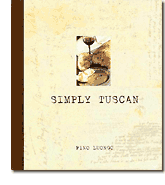 Why, exactly, is Tuscany the beginning and end of most people's Italian fantasies? Does it really seem the most Italian of Italian regions? It's a paradox I'll never understand, like the south of France equaling France (at least non-Paris France) in the popular imagination.
 Enough grousing. Suffice it to say that I prefer almost any region of Italy to Tuscany, because I like the pleasure of discovery, and also because I think most other regions have much more varied and interesting cuisines -- heresy! A recent survey I conducted of most cookbooks ever written on Tuscany, for the current issue of Bon Appetit (dedicated to guess which region), didn't much change my mind.
Previously in Corby's Table:
Matzoh Makeover -- March 22, 2000
Corby Kummer on Jayne Cohen's The Gefilte Variations, a new cookbook offering multiple versions of Jewish holiday classics.
Ham and Beans to the Rescue -- February 16, 2000
Weary of the Boston winter, Corby Kummer serves up "one of history's great couplings."
How to Cook (and How It Should Look) -- January 20, 2000
Corby Kummer on James Peterson's Essentials of Cooking, a kitchen primer that should fascinate beginners and old pros alike.
Encyclopedia Gastronomica -- December 22, 1999
Corby Kummer makes his way through The Oxford Companion to Food -- and still finds Room for Dessert.
Italian Soul Food -- October 14, 1999
Corby Kummer serves up selections from Lynne Rossetto Kasper's The Italian Country Table.
Countercultural Cooking -- September 15, 1999
Corby Kummer on Chez Panisse -- the influential Berkeley, California, restaurant that started as a countercultural collective -- and the new Chez Panisse Café Cookbook.
Charmed by Chile -- August 18, 1999
A new collection of home-style recipes reflects the Chilean way of life.
Hail to the Chef -- July 15, 1999
A tribute to Patrick Clark, a chef who was a model for many young African-Americans and an inspiration to other chefs.
Persian Appeal -- June 3, 1999
A look at Najmieh Batmanglij's A Taste of Persia, and the subtle yet persistent spices of Iranian cuisine.
Help! My Child Is a Vegan! -- April 28, 1999
Stephanie Pierson's useful new guide for teenage vegetarians, and those who love them anyway.
More by Corby Kummer in Atlantic Unbound
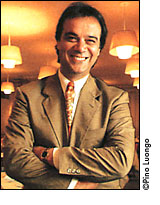 |
| Pino Luongo |
As in his first book, Luongo takes a recipes-are-just-blueprints approach, saying, "You would actually be doing me a great disservice by following the book to the letter." This time, though, he spells out quantities, and the recipes are somewhat more complicated than in his previous books. Yet the final effect is straightforward, and in the following dishes very fresh and springlike: fava bean, artichoke, and asparagus fricassee, taking advantage of the prettiest, greenest, nicest spring vegetables; roasted veal with lemon and sage, which uses my favorite cut of veal, the shoulder, and is a beautiful spring holiday meal; and for dessert panna cotta, ever so much more delicate and lovely than creme brulée and easy and perfect with strawberries and balsamic vinegar (a specialty of Emilia-Romagna, to the north of Tuscany, and hardly known in frugal Tuscan kitchens, but let's not remind the native Tuscan).
I've also included a children's menu, one of two clearly inspired by Luongo's three children. I like his instructions on inculcating a sense of hospitality, and the idea of chicken and ricotta meatballs, the making of which will appeal to children and the eating of which will appeal to adults. I'm also a pushover for pastina -- the tiny star-shaped pasta that supposedly only children really like -- and so have included Luongo's version, made with milk and eggs. It's plain to the point of bluntness, easy, and very satisfying -- like the best Tuscan food.
-- Corby Kummer
Excerpts from Simply Tuscan, by Pino Luongo
Fava Bean, Artichoke, and Asparagus Fricassee
| 1/4 cup extra virgin olive oil | 1/2 pound shelled fresh or frozen peas, blanched for 30 seconds in boiling water if fresh |
| 4 shallots, chopped fine | 2 pounds fresh in-shell fava beans, shelled, blanched, and peeled |
| 3 ounces prosciutto, diced | 1 small head romaine lettuce, sliced crosswise |
| 12 baby artichokes, trimmed of tops and outer leaves, each cut into 8 pieces and soaked in 1 quart water and 1 tablespoon lemon juice | 6 leaves basil, torn |
| 1/4 cup water | Salt and freshly ground pepper to taste |
| 1 pound asparagus, tough stems snapped off and bottoms peeled, cut into 1/2-inch lengths | 1 tablespoon chopped fresh Italian parsley |
In a wide, heavy pan or casserole over medium heat, warm the olive oil. Add the shallots and sauté until golden. Add the prosciutto and cook 2 minutes more.
Drain the artichokes, add them to the pan, and cook for 3 minutes. Add the water and continue to cook for another 5 minutes. Add the asparagus, peas, fava beans, romaine, basil, and salt and pepper. Cook until the vegetables are just tender and still bright green, about 5 minutes. Stir in the parsley and serve.
Roasted Veal with Lemon and Sage
| 5 tablespoons extra virgin olive oil | 2 cups veal, chicken, or vegetable stock or broth |
| 2 pounds veal shoulder (deboned and tied) | 1 lemon, zest removed, julienned and reserved, pith removed and discarded, and pulp sliced 1/4 inch thick |
| Salt and freshly ground pepper to taste | 16 sage leaves |
| 1 cup finely chopped Spanish onion |
In a large covered casserole over medium-high heat, warm the oil. Season the veal all over with salt and pepper, and sear the meat on all sides until golden brown, about 10 minutes, total. Add the onion and reduce the heat to low. When the onion is translucent, after 3-4 minutes, add the broth, sliced lemon, and half the sage. Cover tightly and simmer until the veal is cooked through, about 1 1/2 hours. (Insert a knife into the center, and look for a light pink to white color in the center and ensure that no blood runs out.) Stir in the julienned lemon zest, and the remainder of the sage. Cook, covered, for 10 minutes more and serve, sliced into 1/4-inch thick pieces.
Panna Cotta with Strawberries and Balsamic Vinegar
| 3 cups heavy cream | 4 1/4 leaves of gelatin, soaked for 10 minutes and squeezed dry |
| 1 cup whole milk | 1 pound strawberries, washed and stemmed |
| 2 cups confectioners' sugar | 4 tablespoons granulated sugar |
| 1 vanilla bean, split open lengthwise | 4 teaspoons very good aged balsamic vinegar (see Note) |
NOTE: Use only high-quality Aceto Balsamico Tradizionale di Modena.
In a heavy saucepan, mix the cream, milk, confectioners' sugar, and vanilla. Bring to a boil, reduce the heat to low, and simmer for 6 minutes. Remove the pot from the fire. Add the gelatin, and stir until the gelatin is dissolved. Pour the mixture into individual molds, ramekins, or small bowls, and chill for at least 3 hours.
In a bowl, mix the strawberries, granulated sugar, and the balsamic vinegar. Let the fruit macerate at room temperature for at least 30 minutes or up to an hour before serving around the panna cotta.
Dinner for Children and Their Friends
In the "Spring" chapter, I wrote of how to entertain children and their friends in that season, because the summer often finds children surprisingly alone, as their friends are off at camp or traveling with their families. But for those special summer times when your children do have friends around, perhaps as house guests, this is a great meal to prepare for them.
Like the Lunch for Children and Their Friends, this is a rich, carbohydrate-heavy feast that will please the kids much more than it will the parents. But I don't find this meal any more or less unhealthy than the burgers and pizzas many children eat these days, and it's far more civilized and sophisticated.
When my kids have friends over for dinner, I use it as an opportunity to teach them about hospitality. My wife and I turn over control of the house to whatever child is entertaining, and we make ourselves their staff, acting as cooks, waiter, and waitress, serving their friends according to their instructions. Providing, that is, that they treat us and their guests with respect.
This is a very serious matter to me. Instructing my children about how to be a proper host is as important as teaching them about right and wrong or the birds and the bees. "Listen," I tell them when they reach the right age, "tonight you have invited people to spend time with you. Of all the things in the world they could be doing, they have decided to put themselves in your hands. This is a big responsiblity. Are you ready to give them your full attention? Are you ready to make them comfortable? Are you ready to cook them something special? Okay, then, let's go."
Several of the dishes, or combinations, in this menu will be familiar to Americans, though in slightly different form. For example, the Chicken and Ricotta Polpettine with Pink Tomato Sauce are the most delicate meatballs you'll ever pop in your mouth, made light as a feather with chicken and ricotta, and topped with a pale, salmon-colored sauce.
The Pastina with Milk and Eggs, is a wonderful childhood favorite in Tuscany. Pastina are tiny pasta that come in a variety of shapes, like the noodles you sometimes see in store-bought children's soups here. My daughter loves the star-shaped version because they remind her of the summer sky. I do, too.
Pastina with Milk and Eggs
| 6 cups milk | 3 oz. grated parmigiano cheese |
| 10 ounces pastina (4 fistfulls) (tiny pasta, sometimes in the shape of stars or seeds) | Salt and freshly ground pepper |
| 3 eggs beaten |
Bring the milk to a boil in a large, heavy saucepan over high heat. Add the pastina and cook until it is slightly softer than al dente, and the milk is as thick as cream. Remove the pan from the heat and stir in the eggs, cheese, and salt and pepper to taste.
Chicken and Ricotta Polpettinewith Pink Tomato Sauce
| For the meatballs: | For the sauce: |
| 1/2 pound ground chicken | 6 cups Basic Tomato Sauce (recipe follows) |
| 1/2 pound ricotta cheese | 4 tablespoons unsalted butter |
| 1 cup freshly grated Parmesan cheese | 1 cup freshly grated Parmesan cheese |
| 1 tablespoon chopped fresh rosemary | 6 leaves fresh basil |
| 1 tablespoon chopped fresh thyme | 1 tablespoon chopped fresh Italian parsley |
| 1 tablespoon chopped fresh sage | |
| 2 tablespoons chopped fresh Italian parsley | |
| Salt and freshly ground pepper to taste | |
| Flour, for dusting | |
| Vegetable oil, for frying |
Make the meatballs, in a bowl, mix together all the ingredients except the flour and oil. Use your hands, and make sure that all the ingredients are evenly distributed throughout the mixture. Put a heap of flour in a large bowl or plate. Keeping your hands well dusted, form the mixture into 2-inch balls, rolling each one in flour before lining them up in a single layer on a floured tray. Chill the tray of meatballs in the refrigerator for 30 minutes to firm them up.
In a deep pan set over medium-high heat fry the meatballs in 5 inches of very hot oil (375° F. -- a drop of water will sizzle and splatter) until they turn golden, about 5 minutes. Fry the meatballs in batches so as not to crowd the pan. As they are done, transfer them to drain on paper towels.
Bring the tomato sauce to a simmer in a saucepan, then add the butter, Parmesan, and basil. Process for a minute in a food processor (or use a hand-held immersion blender), just until homogenous. Pour the sauce into a large, heavy casserole, bring it to a boil, reduce the heat to low, and carefully drop in the meatballs. Simmer for 10 to 15 minutes to make sure the meatballs are warmed through by the sauce, stirring frequently but gently to prevent them from sticking to the bottom. Arrange the meatballs and sauce on a serving platter and sprinkle with the parsley.
Basic Tomato Sauce
| 2 1/4 pounds ripe tomatoes | 1/2 stalk celery, chopped into 1/4-inch dice |
| 1 cup extra virgin olive oil | 1 clove garlic |
| 1 onion, chopped into 1/4-inch dice | 6 basil leaves |
| 1/2 carrot, chopped into 1/4-inch dice |
Wash the tomatoes and chop them coarsely. In a skillet, warm the olive oil over medium heat, and brown the vegetables and the garlic clove until the onion is translucent, 3 to 4 minutes. Add the tomatoes and half the basil leaves, and cook for about 30 miutes. Remove from the heat and add the remaining basil. Pass through a food mill.
Corby Kummer is a senior editor at The Atlantic Monthly and the author of The Joy of Coffee.
More by Corby Kummer in Atlantic Unbound.
Text copyright © 2000 by Corby Kummer. Images copyright © 2000 by The Atlantic Monthly Group. All rights reserved.
Recipes and links from Simply Tuscan by Pino Luongo. Doubleday: New York, 2000. Hardcover, 320 pages. ISBN: 0385492901. $35.00. Copyright © by Pino Luongo.
 |
 |
 |
 |
 |
 |