Reporter's Notebook

Trump Nation
Show Newer Notes
Fortune telling machine in New York Lucas Jackson / Reuters

In Time Capsule installment #142, and in a followup item in this thread, I mentioned Donald Trump’s penchant for “projection”—blaming his opponents for flaws he very obviously has himself.

Seth Knoepler, a PhD psychologist in California, writes in to give me the Official Perspective:

Since you’re evidently receiving some “completely amateur” opinions, you might as well have a more professional one.

To clinical professionals, “projection” is one of the “mechanisms of defense” which Anna Freud and others have described. These are mental maneuvers which are intended to protect the person from uncomfortable feelings that are associated with particular impulses or ideas. Each defense mechanism results in a perception of reality which has been distorted in some way.

As can be seen, for example, in “The Choice: 2016,” the recent Frontline documentary, Trump grew up in a family that was dominated by his almost unbelievably driven, perfectionistic father, a man who with both his words and his actions created a world in which you either dominated others or were hopelessly, humiliatingly dominated. In such a world, any flaw or imperfection represents a weakness which, sooner or later, will be catastrophically exploited by people who see the world as the same Darwinian struggle that you do. Someone like Trump must “defend” himself against the overwhelming feelings of helplessness and vulnerability that would accompany any acknowledgement of his human fallibility by denying that he is in any meaningful way flawed—by insisting that “he alone” out of hundreds of millions of Americans is smart, strong, and ruthless enough, and without any exploitable flaws or weaknesses.

Each defense mechanism has its own idiosyncratic characteristics. Projection has the advantage of implicitly acknowledging the reality that someone is flawed in a certain way, while at the same time protecting the person from the uncomfortable feelings that would be precipitated by acknowledging that he is, in fact, that person.

And another person with a professional perspective:

Your correspondent writes, “Since he has no understanding of anyone but himself, when he tries to attribute motive, needs or desires in others they are therefore at best something from himself that he recognizes in them, or simply a reflection of feelings he himself has.”

A different description might be:

Trump is aware that there are other views of reality than his own. The narcissistic project is to argue, charm, bully the world into accepting his view of reality, including but also going beyond his grandiose view of self. Insisting on this view leads others to mistake his aberrance for lying.

Now you know.

***

I agree about the excellence of PBS’s The Choice, available for streaming online. One of its messages is that each of these nominees has had a surprisingly consistent life story and affect over the decades. In the case of the GOP’s nominee, it means the man we now behold.

Although The Choice doesn’t explicitly address this point, it implicitly undercuts the idea the outbursts and excesses of Nominee Trump reflect any age-related distortions of his personality. He appears to have been this way for a long time.

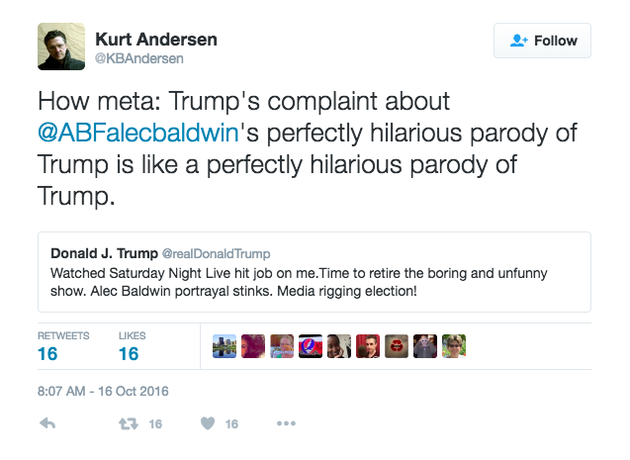
Kurt Andersen on Twitter, on the limits on Donald Trump’s self-awareness.

In installment #142 of the Time Capsule series, I argue that “projection,” in the psychological sense, is the default explanation for anything Donald Trump says or does.

Projection means deflecting any criticism (or half-conscious awareness) of flaws in yourself by accusing someone else of exactly those flaws. Is Trump’s most immediately obvious trait his narcissistic and completely ungoverned temperament? (Answer: yes.) By the logic of projection, it thus makes perfect sense that he would brag that he has “the greatest temperament” and judgment, and criticize the always-under-control Hillary Clinton for hers.

How can this be? A reader offers an analysis worth considering (emphasis added):

I am writing to comment on “Drug Test,” item #142, and the idea of self-projection as the first rule of Trump analysis. Here’s my completely amateur opinion:

Trump is a man with almost zero ability to empathize or imagine other people’s motives or drives. His ego and narcissism are so oversized they warp all his opinions into reflections of himself. Since he has no understanding of anyone but himself, when he tries to attribute motive, needs, or desires in others, they are therefore at best something from himself that he recognizes in them, or simply a reflection of feelings he himself has.

In simple terms, one might say his mind is empty of any thoughts that are not self-referential. And so self-projection is simply a consequence of this vacuity.

George S. Patton Military Personnel Records Center, via Wikipedia

In last night’s debate, the Republican nominee said, apropos military policy: “General George Patton, General Douglas MacArthur are spinning in their grave at the stupidity of what we’re doing in the Middle East.”

In most of his speeches Trump mentions those same two generals. Reader Marcus Hall assesses what the reliance on Patton and MacArthur might tell us about Trump:

It is easy to see why these two military legends are attractive to Trump:

1) Both were known as showmen and motivators. This is clearly Trump’s modus operandi as well; he is most comfortable being the showman and motivator. When he isn’t in the granted position of head of the dais, he looks, seems, and acts out of place. (For example, think back to the instance in Flint where the pastor takes the initiative to challenge him as a person.)

2) Both were known to take personal animus against rivals on their own side to extremes. Think of Patton’s constant infighting with Montgomery, and his less than amicable relationship to Bradley after Sicily.

3) Both were known for strident aggressive stances against an enemy without consideration for larger picture effects. MacArthur’s blunders with antagonizing the Chinese after Inchon, and Patton’s immediate post-war desire to go to war with the Soviets before the armed forces and the country (or its non-Russian allies) could even recover from WWII.

4) Both faced disgrace at the hands of the media and at the hands of those who were better able to handle the larger context of events (Eisenhower for Patton, and Truman for MacArthur).

5) Both had authoritarian tendencies supposedly in defense of freedom.

6) Both are seen as the epitome of the “masculine” general—the ones who take action and get the job done, rather than the kind of general who sees complexity and takes a more complicated approach (Patton v. Eisenhower and Bradley, or MacArthur v. Ridgeway).

7) Both had great strengths but fatal flaws that ended (or almost ended) their careers. Patton’s consideration of PTSD as cowardly is particularly insightful, as some of Trump’s comments seem to indicate a similar attitude.

Trump’s use of these particular generals fits in line with both his own, and his base supporters’, attitudes towards conflict, war, and masculinity. These men chose to see events in binary paradigms and reacted accordingly—hero/coward, friend/enemy, good/bad—with deliberate elimination of room for something in-between or more complex. With Trump, if something’s good, it is The Greatest. If something is bad, it is totally The Worst. His choice of dichotomy helps make issues simpler and condenses them for people who don’t want to spend a lot of time (or can’t spend a lot of time) determining complexity, or who don’t want to be bothered with complexity. It makes for great bumper stickers, but usually terrible policies, especially when it comes to larger picture actions.

I keep wishing a moderator would ask Trump “What then?” when he states his preferential policies on numerous fronts. Ally with Russia against ISIS!  (What then? What if Russia does what is has so far, and really refuses to take on ISIS because they are a useful bogeyman?) Not get involved in ousting dictators about to commit atrocities! (What then?  Sit back and allow the atrocities to continue?) etc. There are debates to be had and points to be made in favor of Trump’s preferred choices, but no one seems capable of following up a question to get to his next steps and plan B, C, and D in case his preferred plan doesn’t work.

MacArthur’s plan if the Chinese entered the Korean War was to go nuclear, period. It wasn’t much of a plan, although it fit MacArthur’s small picture needs of tactically dealing with an in-theater enemy.  When the issue became clear that MacArthur’s plan B was so poor of an alternative, Truman removed him.

However, no one has bothered to figure out Trump’s plan B to even judge how good or bad it is (and Trump himself probably doesn’t even have a Plan B because he believes all his Plan A’s are The Greatest). This is one of the tells that shows more than just about anything else that he isn’t qualified to be President. Plan A’s fail all the time. Having a workable plan B, C, D, and E is the difference between an Eisenhower and a Patton, a Ridgway and a MacArthur.

In installment #137, I mentioned Jane Goodall’s prescience in foreseeing primal-dominance moves from Donald Trump if he had a chance to move around in the same debate space with Hillary Clinton. Now a sample of reader reaction. From a woman named Sarah:

You are wondering how Trump’s behavior last night played with women. I can tell you that I and every other woman I know are having a collective freakout right now. Granted, not one of us was going to vote for Trump, anyway—but that’s not the point.

Last night’s debate was a triggering event for pretty much every woman I know. That also seems to be the general reaction online amongst women I don’t know. Whether we were raped, assaulted, harassed, or in an abusive relationship, Trump last night embodied everything we have had to deal with throughout our lives. Some women wanted to jump on stage and throw themselves between the candidates to protect Hillary. Others were afraid he was going to attack her. Many wondered how she could even maintain a train of thought.

Women with young daughters are struggling with how to discuss what they saw last night with their girls. For those of us with sons, it’s a bit easier: 1) Don't be That Guy; 2) If you see That Guy in action, call out his bad behavior.

But—we, collectively, are having a difficult time shaking off what we saw last night. It was terrifying, frustrating, enraging, and depressing. Other women, perhaps, will shake it off as “all men are like that.” The fact that some women think that this is normal behavior is, in itself, deeply depressing.

***

From a man named William:

I read your Trump Time Capsule #137 with interest. For what it’s worth, way back in the day I was an Anthropology major, albeit not in primates. So I know a tiny fraction more than the stereotypical man in the street.

We have a rather long history, in the United States, of electing the taller of our two candidates for President, at least when the difference is immediately visible. My thought that this is, at least somewhat, a matter of security. People who want to feel secure tend to feel so around a father figure—not all fathers, obviously, but the sort of father that Jesus had in mind when he used that analogy to describe a loving God.

But while Trump is taller than Clinton, is that dynamic in play here?  Obviously it slips partly because someone looking for security is going to think Mother Figure vs Father Figure. How that part plays out depends a lot on what specific kinds of fears they are working from.  

But the other factor is, would you want Trump, or anyone like him, as your father? How many women voters would feel more secure with a father who spoke of them in the terms Trump used about his daughter on that tape? I’m guessing not many.

Those dominance rituals only work if you have correctly tapped into the reasons why they work. Trump hasn't.

And from another (male) reader:

I started enjoying your blog posts again after finding them increasingly depressing over the past months (not your fault … ). Re your recent post, I bet Nigel Farage is not aware of the inverse relationship among primates between body size and specific portions of the anatomy that Trump seems to care very much about.

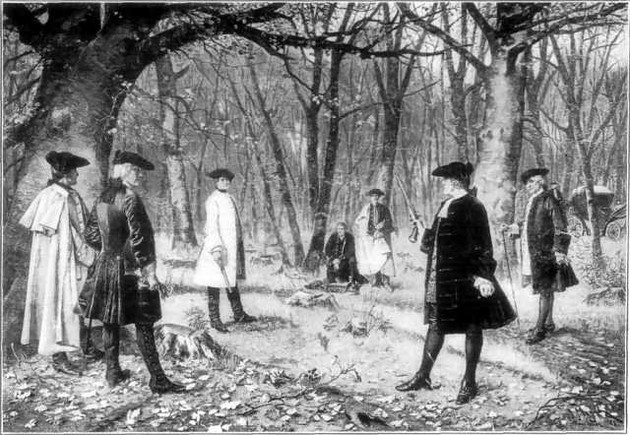
Imaginative recreation of Aaron Burr preparing for his duel with Alexander Hamilton. After his service as vice president, Burr got into legal trouble, though not for the crime-in-history’s-eyes of killing Hamilton. What might happen to a post-election non-President Trump?  (J. Mund-Lord painting, via Wikimedia.)

A reader in the tech business offers an uncomfortably plausible scenario on what might happen beginning November 9:

What comes after the campaign of 2016?  It now appears likely that Hillary will win, that Trumpism will be soundly discredited, and that people will soon forget that the contest ever seemed close. Losing campaigns are always harmless in the rear view mirror: no one has family stories about working for Joe McCarthy or Charles Lindbergh. That’s why we need the Time Capsule.

But, after the campaign is over and the election lost, Trump faces trouble unprecedented in American history*. It’s conceivable that Trump could face civil or criminal prosecution on several fronts: federal income tax evasion, mail fraud connected with Trump University, fraud connected to his charitable foundation, espionage associated with Wikileaks, illegal lobbying associated with Russia.

(* Well, there’s Aaron Burr. Warren Harding died in office. Eugene Debs wound up in prison, but he wasn’t quite a major party candidate, his offense—if offense it was—occurred years after the campaign, and his red-scare prosecution is not something of which the country has been proud.  I can’t recall another example.)

We can easily imagine that some of these matters might arrive in federal or state court in the coming years. Whatever the outcome of those cases, Trump supporters will believe that the charges are Hillary Clinton’s personal retribution. And, next time the Democrats lose the White House, they will call for matching prosecutions of the losing candidate. “Lock Her Up” may have awful echoes.

As you know, this mirrors one of the defects that led to the collapse of the Roman Republic. Romans didn’t want every private complaint to stop public business, so you couldn’t bring suit against officials until their terms expired.  Toward the end of the Republic, this meant that anyone could expect to be sued as soon as they left office, which meant that people had to find ways to stay in office indefinitely. Losing a big election meant endless litigation, possibly ending in death or exile.

As things stand, I fear creating the expectation that every losing presidential candidate will face prosecution.  

One escape hatch could be a pre-emptive pardon. I was not a fan of Ford’s pardoning Nixon, but the national interest might be stronger here than it was after Watergate. History has been kinder about another precedent, the decision not to prosecute officials of the purported Confederacy. The question then becomes, is it preferable for Clinton to pardon Trump, or for Obama?  

Six days ago: the debate. Carlos Barria / Reuters

I think this is simple, rather than simplistic:

  1. The people who are for Donald Trump, are for him. And almost nothing he can say or do, or that can be said or revealed about him, will undercut that support. The things that ordinarily would be considered “shocking” or “disqualifying” haven’t eroded belief among his base, and probably won’t.
                                                                                             
  2. But there are not enough of these people to get 270 electoral votes for Trump. There were enough to give him an initial plurality in a huge GOP field, and to keep him coming out ahead as his GOP rivals foolishly attacked one another rather than concentrating on him. But in the general election his core support has remained below winning levels in virtually all honest polls. He has so far seemed to hit a ceiling at around 40% support—sobering in itself, but not enough.
                                                                                             
  3. Therefore he needs new supporters—more women, more blacks and Latinos and Asians, more Muslims, more educated people, more of the young.
                                                                                             
  4. Therefore2, the test of everything Trump does now—the debates, the “Miss Piggy” controversy, the taxes, everything—is whether it brings him anyone new. The question is not the one we mainly hear after debates or Trump flaps: how this affects his supporters. They already support him. The question is whether what he does and says brings in anyone undecided, or new.

    My guess is that is has not.

The main point is: since Trump starts with not enough votes to win, the logical test to apply, in the 36 days that remain, is whether what he does with each speech, each answer in a debate, each tweet, each flux of the news cycle, expands his base. If it doesn’t, he has lost.

The late New York real estate heiress and hotelier Leona Helmsley in 2003. She was famous for saying, before she went to prison, "only the little people pay taxes." Reuters

Following installment #119 in the Trump Time Capsule series, which contrasted Donald Trump’s “they’re freeloaders!” complaint about NATO allies with his own “that makes me smart!” comment about not paying taxes himself, readers weigh in.

1) If this makes Trump “smart,” most people are forced to be dumb. Friend-of-the-site and Congressional veteran Mike Lofgren highlights an aspect I neglected to mention:

An important point that wasn’t emphasized is that among the vast majority of Trump’s supporters, not paying taxes isn’t even an option, regardless of how much they might want to chisel the IRS.

FICA taxes are automatically deducted, and the employer automatically files a W2. The option of setting up tax-exempt foundations, shell companies, and engaging in transfer pricing simply does not exist for these folks.

An ordinary person would resent someone who can get away with various tax dodges; maybe Trump’s supporters have such a masochistic identification with him that it doesn’t matter.  

***

2. Only the little people pay. From a reader in California:

With his recent “That Makes Me Smart” comment at the debate, I am reminded of Leona Helmsley, famous for saying, as I’m sure you remember, “Only the little people pay taxes.” I haven’t seen anyone make the connection recently, perhaps I have missed it, but they have much in common.

I know she went to jail for a while and while refreshing my memory with Wikipedia and Google, I see that she had the same attitude towards not paying contractors and taxes as Trump does. Seems they were both friends and rivals as well. Billionaires with no empathy for the “little people” they mock and ruin. Too bad Trump is unlikely to meet the same fate Helmsley did, but it certainly would be fitting.

***

3. Come back, Mitt; all is forgiven. A reader points out differences between the two most recent GOP nominees:

People have pointed out similarities between how Romney explained his low tax rate at his debate (“I pay all the taxes owed. And not a penny more. I don’t think we want someone running for president who pays more taxes than he owes.”) and Trump (“That [paying zero tax] makes me smart!”).

But there’s a difference: A possible explanation for Trump's refusal to release his returns is that Trump annually cheats on his taxes and puts the burden on the IRS to investigate and sue him to get paid. It’s just one facet of his selfish personality where he derives a minor benefit from majorly inconveniencing others. Romney revealed he’d been audited at least once and was found to be in compliance... has anyone asked Trump what the results were from his past audits?

***

4. If he’s not paying taxes, why does he care about “takers”? A reader in Florida examines another logical paradox:

In context of the last 8 years (at least) of Republican claims about “makers and takers” and their whole Ayn Rand sensibility, doesn’t the expressed sentiment by their party leader—“I’m smart not to pay taxes”—reveal the glaring inconsistency—fraud, even—at the heart of the Republican ethos? If he’s already not paying taxes in this country—something that was also suspected of Mitt Romney (Mr. 47%)—how exactly are the so-called “takers” holding him back?

Does Trump’s statement not conflict with Trump’s tax plan, which would aim tax breaks toward the wealthy, but not so much for the “left behind middle class” he purports to represent?  Isn’t he exactly like Leona Helmsley (“taxes are for the little people”)?

And yet he’s not perceived as a completely selfish elitist.

***

5) And while we’re talking about taxes. A reader suggests another angle:

After the debate Monday, I was thinking about Trump’s comments about forcing companies to pay a huge tax when importing from their international factories. Forget how he can actually implement that as president.

Would it apply to his own foreign investments? How is a Trump hotel in Rio or golf course in Scotland different from a Ford plant in Mexico or a TI plant in the Philippines?

I don't recall seeing this idea being explored anywhere, but after googling today, I did found this article that covers my thoughts pretty well. It’s over a year old ...

***

39 days and a few hours until the election; early voting starting in some places now; tax returns (of course!) not forthcoming; GOP “leadership” still standing firm behind their guy.

The Club™ in action, via Winner International.

A reader in Southern California whom I’ve corresponded with over the years sent several photos with accompanying description. I’m not using the pictures, for the contradictory reasons that they are blurry looking but also clear enough that they might be identifiable. But I’ve seen them and can say that they support the case the reader makes.

Why is Trump popular? The reader says that he is the living human version of that familiar car safety device, The Club™ from Winner International.

Or, that if Richard Hofstadter were rewriting The Paranoid Style in American Politics, he would need a multi-volume special edition to cover 2016. Over to the reader:

I work on a studio lot in Los Angeles. Hollywood is lousy with liberals, so you can imagine my surprise when I pulled in next to a car with a Trump 2016 sticker. [The reader sent a photo.]

I immediately liked the owner of the Trump car, in the same way that I would like the owner of a Clinton car in the Bible belt. Going against the grain like that takes independent thinking, guts.

But what really got my attention was The Club. [A photo of this, too, across the steering wheel.]

I don't know if you remember The Club, but it was popular in the ’80s and ’90s. It’s a long steel bar that you stick in the steering wheel. Truly the only way to prevent car theft.

I haven’t seen a car with The Club in a long time, but I saw one today. It was protecting the Trump car. And this, for me, perfectly sums up the Donald Trump supporter.  

To begin with, consider the driver’s morning. To get onto the lot, they had to pass through a security checkpoint. Once on the lot, they were in an officer-patrolled environment. In fact, every inch of this place is monitored with security cameras.

In other words, this is a safe place.

Even if a car thief did decide to break onto the lot and steal a car, there’d be better cars to steal than this one. Suffice it to say, it was middle-of-the-road SUV. A great car, but then again, this is a major Hollywood studio. The car thief would have their pick of Teslas, Porsches, Range Rovers and Bentleys.

In short, all signs point to one conclusion: no one is stealing the Trump supporter’s car.

And yet the Trump supporter was afraid.

That’s because they know better. The world has never been more dangerous, we have never been more vulnerable. We need a wall. We need a stronger military. We need The Club.

And The Club is Donald Trump.

Look, I might be in the wrong. Maybe the car really is in danger. But I’ve spent four years on this lot without a single incident (besides my bumper getting side-swiped by a tour guide’s golf cart). So I’m going to say the car is safe.

Therefore the driver’s fear is not justified. In other words, they're paranoid.

A paranoid electorate is nothing new. I’m sure you’re familiar with Richard Hofstadter’s, The Paranoid Style in American Politics. [Yes.] I’m no political theorist, but he more or less says that we, as citizens, can fall prey to “heated exaggeration, suspiciousness, and conspiratorial thinking.”

Hofstadter is careful to point out that the paranoid style is not reserved for the right. But this year it is.

Donald Trump is stoking paranoia, perhaps even creating paranoia. And it’s a smart move. Because he is the protector, the strong arm, The Club.

One last point: I’m not saying that ALL Donald Trump supporters are paranoid. I very much dislike that kind of blanket statement (including Hillary Clinton’s “basket of deplorables” comment). In fact, I wouldn’t even venture to guess what percentage of Trump supporters are paranoid. But I do think some are, and I think The Club has merit as a metaphor.

And so going forward I will think of Donald Trump supporters as those who see their country just like they see their car: in imminent danger, in need of The Club.

***

I DO realize there are limits to the metaphor. The United States is not Paramount Studios. Crime does happen in our country. So do terrorists attacks and tons of other bad stuff. There are legitimate reasons to be afraid.

But paranoia is different, and I think this is a nice example of it.

I agree. A snapshot of part of the American electorate, 2016.

A new archive makes the thoughts of the nominee available and searchable. For instance here, the 63 times he has called someone "lightweight." Trump Twitter Archive

Talk about a time capsule! This is quite an amazing piece of work. Courtesy of a Georgetown grad and former Peace Corps volunteer who now works as a programmer, we now have a searchable archive of 16,000+ tweets from @realDonaldTrump since 2009.

The main page, with selected highlights, is here. The search utility is here. For instance, if you’d like to see all 63 tweets in which Trump calls someone (usually Little Marco) “lightweight,” you can just click here.

You can donate to support the site here. (I have no involvement with it or its creator in any way, except as a citizen grateful for further documentation of our times.)

48 days and a few hours to go. The Republican leadership, minus one former president, is still saying: He’s fine!

Back in 2009, when I was living in China, I was digging into the birther issue. This was before Donald Trump made it his own. But it reflects part of the genius of Trump’s multi-year birther crusade. Let’s think about the fundamental idiocy of the line that the Republican nominee was pushing for many years. Here’s the 2009 post:

I don’t know whether the birthers are petering out on their own. If they’re still around, here’s an additional challenge for them that springs from the glory days of Mad magazine.

A friend has recalled a classic Mad riff from its “Strangely Believe It!” series, produced by comedian Ernie Kovacs in the late Fifties as a knock-off of Ripley’s Believe It or Not. It concerned—well, see for yourself, in this detail of a scan of the original page, courtesy of Scott Gosar at TheMadStore.

MadMag.jpg

The punch line—hardee har!—is that news of the baby girl’s birth had to be telegrammed to her mother, who had missed the plane on which the surprise birth occurred.

What’s the connection to the birthers? If Barack Obama had actually been born in Kenya, then his mother would have to have been in Kenya too! I don’t think anyone has dreamed of suggesting that his mother was other than the one he has always claimed, Stanley Ann Dunham. Presumably somewhere in the passport records of the United States or Kenya is information about whether his mother (a) left the United States, or (b) entered Kenya in 1961 when her son was born. If she didn’t leave the United States, including the fully-fledged state of Hawaii, in the summer of 1961, then by definition her child has to have been a natural-born U.S. citizen.

I recognize that if this were a matter of—how do we say?—“reality” or “facts,” it would have been settled long ago, as it has been for everyone except the birther stalwarts. But this is an interesting additional angle worth considering; plus, it’s great to see these detailed old Mad drawings.

***

So the point is, for Obama to have been born in Kenya, his mother would have had to get there. And there has never been any evidence of any sort that she left Hawaii in the summer of 1961. Good to have a major-party nominee admit it after many years of suggesting the reverse.

Because I’ve been on the road talking about my new story on the upcoming presidential debates—read it here! and then subscribe!—I am again falling behind the accelerating reality of the Trump Time Capsule era. Will add several updates at the next opportunity.

Meanwhile: Yesterday afternoon I spent a long time talking with Brian Beutler, of The New Republic, for his Primary Concerns podcast series. We talked about what the “false equivalence” brouhaha reveals and conceals, what the Trump movement shows and doesn’t about the country, what the political press can and cannot do, and other topics with a yin-and-yang aspect to be explored. We ended on the high note of what we’d each learned about the world from growing up, a generation apart, in the same small inland-California town. I enjoyed it and think you’ll find it interesting. It’s here.

Also, the Atlantic’s video team has made a great short video that accompanies my debate article, and for which I do the voice-over. You can see it here and below.

This guy, "D. J. Quacker," shown outside Trump Tower in New York yesterday, wants Donald Trump to release his taxes. So does a former commissioner of the IRS. Lucas Jackson / Reuters

With 61-plus days until the election, Donald Trump remains the only major-party nominee for the presidency or vice presidency of the post-Watergate era who has refused to release his tax returns. Not coincidentally, of all nominees through that period, Trump also has the most complicated and least-publicly-understood personal and corporate finances.

Why is he drawing the line here? Readers offer their hypotheses:

I started my career with a year as an IRS agent before jumping across the desk to work for a “Big Eight” firm (which I think is now the Big Four?).

It’s been a long time since I’ve been doing taxes, but my gut tells me Trump hasn’t filed in the first place.

I remember being involved with clients who had endured bankruptcies, the implosion of complex energy partnerships, and/or the collapse of the real-estate market.

Their partnership K1s would be delayed for so long that we’d sometimes have to file with numbers we ... well... sorta made up. Once the K1s arrived we could always go back and amend, but by providing some form of a reasonable estimate we could show good faith.

However, there were some clients that hated the tax code, and the entire Byzantine process (not to mention our fees). So some of them opted out until something came along and forced their hand to file (e.g., an audit).

Many more were just procrastinators.

All this to say Trump reminds me of some of those clients who literally kept a small army of accountants and lawyers busy year round. One of my friends called clients like that “Pig-Pen,” after the Peanuts character that always left a trail of dust behind him.

Guys like Trump are “Masters of the Universe,” and maneuver in and out of bankruptcies, and partnerships, and *deals* in such a fluid manner that dealing with the IRS is like just another banker sitting around the table.

No big deal, just the cost of doing business.

***

In August, a reader sent this note from an online discussion of Roger Stone’s observation that of course Trump should release his taxes:

“As [a] former … IRS agent in large dollar cases I can tell you why Trump is being audited every year and what he doesn’t want you to know.

“It’s this: high net worth individuals with multiple corporations have tax departments that deliberately take positions they know they can't sustain and just wait for the IRS to go out and hopefully find only a fraction of the money they really owe. It’s a low interest loan from the government to which they don't have to submit an application … just submit a return they know is wrong and wait for the IRS to come along and correct it … thus the annual audits. IRS does not audit unless they are going to get big bucks.

“Simple answer, Trump is a taxcheat. That’s what he doesn’t want you to know.”

After quoting the former IRS agent, the reader adds:

As you mentioned, as long as Trump's tax return remains private, the public is free to speculate as to why he would not release them. You mention over and over again that he hasn’t released them but, unless I’ve missed some of your writing, haven’t delved too much into what it really means.

Right, because I have no idea. All we can logically infer is that something in those returns would be worse and more embarrassing for Trump than his refusal to release them has been.

***

Another reader speculates on what the source of embarrassment might be:

You have mentioned many times about Trump’s failure to release a medical report.  This omission is likely very analogous to his refusal to release his tax returns.

The likelihood is that the reason for both is not either criminality (in the case of his taxes) or infirmity (in the case of his medical records).  The likelihood is that both are due to embarrassing private details.

It has often been speculated that his tax returns might show embarrassing details such as much lower than advertised wealth, sleazy financial connections to Russia, or chiseling on charitable donations.

My assumption is that his health-care records reveal a stigmatized health condition.  As he was by all accounts, including his own, quite the swordsman in his day (the ’70s and ’80s) there is a very high likelihood he has at some point contracted herpes or HPV.  That is the only plausible reason why he would be unwilling to release his medical records.  Both conditions are extraordinarily common and total irrelevant to his fitness to be president.  But either would be mortifying for him (as well as just about anyone else) to have the condition revealed publicly.

This may be idle speculation but frankly pales in comparison to Trump and his allies’ repulsive Swiftboating of  Hillary’s health.

***

The next reader, a lawyer, begins with a reference to an essay by Fred Goldberg, former IRS Commissioner, called “Trump has no excuse not to release his tax returns”:

Fred Goldberg’s essay reminds me of an important point about Trump:  Throughout this campaign, he has consistently placed his personal and business interests over his duty to the public as a candidate.

From his refusal to disclose tax returns (because it might possibly impact his ongoing audit) to his billing for the use of his business facilities to his trip to Scotland in the middle of the campaign (a task which he could certainly have delegated to one of his children), it has become clear that, if elected President, there will be constant conflicts of interest that arise and that we should have no confidence that he would opt to advance the public’s interests over his own.

***

A brief note on the value of the returns:

So far there is cloud of unreality investing and obscuring the entire Trump phenomenon . For that reason alone  the tax returns are of added value because they will contain at least a breath of reality. They might be the only real thing we can know about this very peculiar candidate.

***

Finally, a reader refers to something that has been in and out of the news during Trump’s campaign:

With regard to Trump’s taxes, he has received the NY State STAR tax rebate for the past two years. This tax reduction is automatically given to anyone making less than $500,000 in reported income... The STAR rebate has not been revoked as far as I've seen (it is granted electronically). Trump is a billionaire claiming a tax credit meant for middle-class New Yorkers, because of depreciation rules for his real-estate holdings. I'm sure that's a big part of why he doesn't release his tax returns.

There is of course one person who could end all this speculation, and that is none other than the man Paul Ryan, Mitch McConnell, Marco Rubio, Tom Cotton, Pat Toomey, and a long list of other luminaries think should become president. He’s also the man at the bottom of the list below, re-upped from yesterday.

  • Post-Nixon presidential and vice-presidential major-party nominees who have agreed to release their tax returns before the election: Gerald Ford (summary statement), Bob Dole, Jimmy Carter, Walter Mondale, Ronald Reagan, George H.W. Bush, Geraldine Ferraro, Dan Quayle, Mike Dukakis, Lloyd Bensten, Bill Clinton, Al Gore, Jack Kemp, George W. Bush, Dick Cheney, Joe Lieberman, John Kerry, John Edwards, Barack Obama, Joe Biden, John McCain, Sarah Palin, Mitt Romney, Paul Ryan, Hillary Clinton, Tim Kaine, Mike Pence.
                                                                                                                                                        .
  • Nominees who have refused: Donald Trump.

More Notes From The Atlantic
  • Notes Home