Most of what I think about last night’s results I discussed in a long talk early this morning with Terry Gross, which will be on the Fresh Air this afternoon. The embed for our discussion just went live and you can listen below.
More in this space when I can manage.
***
An ongoing theme here in recent years has been the contrast between increasingly paralyzed and bitter national-level politics, and a positive-minded and forward-looking sense of practicality at the community level. In that silver-lining spirit, I am happy to report that all of the local initiatives and candidates I mentioned two days ago came to what I consider the right result:
The voters of California rejected Proposition 53, which would have made it much harder for the state to undertake big, long-term investments.
The voters of Stockton approved Measure M, a small sales-tax increased devoted to the city’s libraries and recreation centers. The measure needed a two-thirds majority for approval, and it got nearly 75 percent.
The voters of San Bernardino approved Measure L, which will reform the flawed city charter that in itself is a source of the city’s problems. The measure required only a majority vote, and was getting more than 60 percent.
The voters of San Bernardino, Redlands, and environs comfortably re-elected former Redlands mayor Pete Aguilar to a second term in the U.S. House.
The voters of the District of Columbia comfortably elected Robert White (and David Grosso) to at-large seats on the City Council, and approved the statehood referendum by 86 percent to 14 percent.
We’ll take progress where we can find it.
On the larger prospect, after the jump a thought for the day from W.B. Yeats.
Apropos for today, “To a Friend Whose Work Has Come to Nothing,” by William Butler Yeats, 102 years ago. For the reminder about this poem I thank a Republican friend who took an early and honorable stand against Donald Trump.
Stockton, a recently bankrupt city in California, is one of the venues considering important measures in tomorrow's election.Robert Dawson
A for-the-record personal-preference note on election eve.
Yes for Aguilar. If I lived in my original hometown of Redlands, California, tomorrow I would vote to give the city’s former mayor, Pete Aguilar, a second term as Representative from California’s 31st Congressional district. His district includes San Bernardino, site of the horrific massacre nearly a year ago, and he has done a good job both in the immediate aftermath of the killings and in addressing the city’s deeper, longer-term economic challenges. He’s part of the next generation of practical-minded leadership for the state.
Yes on Measure L. If I lived a few miles west of Redlands, across the city line in San Bernardino itself, I would vote in favor of Measure L. This is a long-overdue proposal to revamp the city’s unusual and dysfunctional governing charter, which itself has been an important reason the city has been officially bankrupt for four-plus years. I wrote about the bankruptcy, and the charter’s role in it, last year here and here. Ryan Hagen of the San Bernardino Sun, who has chronicled the city’s recent ups and downs, did an explainer on Measure L and how it would change the charter here. The Sun’s editorial board formally endorsed Measure L last month. Some previous charter-reform efforts failed. A lot depends on the city’s ability to pass this one. Yes on L!
Yes on Measure M. If I happened to be living instead in California’s other best-known recently-bankrupted city, Stockton, I would vote in favor of Measure M. (Stockton formally entered bankruptcy in 2012 and left it last year.) I’ll plan to say more about Stockton tomorrow, but its story has much in common with San Bernardino’s. Each is physically close to a rich and glittery part of California—San Bernardino and its Inland Empire are an hour’s drive away from Los Angeles, Stockton is due east from the tech riches of the Bay Area—but economically and culturally they are far removed. Stockton’s arc in the past century also resembles, on a smaller scale, Detroit’s: industrial and commercial wealth, and the civic benefits that came from it, and then a long decline. The story of its downtown resembles Fresno’s, which we’ve written about here.
Measure M, whose official description you can read here, would approve a very small sales tax, one-quarter of one percent, to develop libraries and recreation facilities for a city that badly lacks them. The measure passed the city council with a 7-0 vote but now requires a two-thirds supermajority approval to go into effect. Here’s more from the Yes on M group, and a wonderful profile from the Stockton Record about one of the people behind it, a local dentist name Mas’ood Cajee. The story about him is titled, “Man passionate about using books to rebuild Stockton.” More to come about the larger lessons from this kind of investment.
No on Prop 53. In my profile of Jerry Brown three years ago, I said that his lifetime’s immersion in California politics had equipped him, in his return stint as governor, to make the big long-term investments that had been so important to the state’s past growth. One of California’s challenges is its arcane “direct democracy” system of initiatives and referendums, which were enacted in a reform spirit more than a century ago but in practice turn out mainly to favor well-financed interests and pressure groups. One well-financed activist, a rich farmer from the Stockton area, has put millions into financing a proposition that would add another layer of gridlock and impediment to big statewide projects. Most newspapers in the state have editorialized harshly against it, e.g. Sac Bee, SF Chronicle, SJ Mercury News, Santa Cruz Sentinel, East Bay Times, and the Monterey Herald. Here is a video from Brown himself. As the governor puts it in that clip, “It may sound OK, but it’s bad for California.” If I lived anyplace in California, I would vote No on 53.
Yes for Robert White. If I lived and voted in D.C., which in fact I do, I would (and will) vote for Robert White for an at-large seat on the City Council. As I mentioned back in June, his upset victory in the Democratic primary over incumbent Vincent Orange was a positive step for the city. And while I’m at it, also Yes for Mary Lord for the at-large seat on the D.C. school board. (And, very locally, Yes for Chuck Elkins for the Advisory Neighborhood Commission.)
Yes on D.C. Statehood. The 99%+ of the U.S. population that lives in the 50 states doesn’t care. But it’s just not fair that those who live in D.C. pay the same income taxes as everyone else, but have no representation in Congress, and no state-style sovereignty over local decisions. How would the Utah or New York legislatures like it, if some Congressman from another part of the country got to double-check laws that they passed? We don’t like it either. It’s a symbolic vote, but: C’mon.
Ten days ago I argued that FBI Director James Comey had changed the dynamics of the 2016 election in an irreversible way, with his announcement of a new trove of potentially “relevant” emails on Anthony Weiner’s computers. After Comey’s “oh, never mind” followup yesterday, less than 48 hours before election day, I argued that his series of mis-judgments about the FBI’s proper role in electoral politics, and his apparent lack of control over the agency, meant that someone else should take his place. But it would be better all around, according to me, if Comey resigned sometime soon after the election, instead of forcing either the president who appointed him (Obama) or the next president in line (presumably Clinton) to fire him.
Readers disagree—most of them because they think Comey deserves harsher treatment, but some for the opposite reason. Here we go:
There is a silver lining. A reader in the tech industry says that the whole episode might have one positive result:
It should put to rest the storyline that Clinton obstructed justice by destroying damaging emails. This previously unknown cache of unscreened email yielded no evidence of criminality, thus undermining the argument that Clinton’s emails were sanitized.
***
‘Egregious error.’ From a lawyer on the East Coast:
I disagree with your conclusion that Clinton, if she wins, should not fire Comey (or demand his resignation, which amounts to the same thing). Yes, to some people, particularly the Trump supporters, this might look like revenge. And certainly, GOP elected officials will take the opportunity to make the same claim. But those people are incorrigible, and trying to appease them or seek their approval is a no-win situation.
The fact is that pretty much everyone, including Republicans, agree that Comey made an egregious error in judgment. Can you think of any other post-Hoover FBI Director who has made such a significant public mistake? But for the twisted political environment we’re in, that alone should be grounds for firing. Assuming that Comey stumbled innocently with his original letter a week and a half ago, he should, within 48 hours, have issued a clarification intended to remove any unintended implications. That he waited in silence until now compounded his error.
In addition, it appears to be that Comey has, as a number of commentators put it, lost control of his agency. Again, this should be grounds for termination, and Clinton should bring in a new director to clean house and impose some real discipline on the agency. That some agents are intervening in the political process by leaking information is inexcusable.
I note that, when first elected, Obama chose not to pursue criminal actions against any members of the Bush Administration, even though there likely were sufficient grounds to do so. The reason was that Obama feared that the partisan reaction to prosecuting would have poisoned the well and eliminated any chance of the GOP working with him on his legislative agenda. Of course, as we now know, the GOP refused to cooperate anyway. (In addition, Obama chose not to seek indictments because he was loathe to create the apparent precedent of prosecuting the prior administration. IN this regard, he showed prudent, long-range thinking.)
***
Investigations would be good, not bad. Another reader wanting a tougher line:
Respectfully, I think you’re way off base here. First, you summarily conclude that “hearings or investigations into whatever has happened at the FBI would not be worth it for anyone.”
The problem here is that an investigation into whatever happened at the FBI is not simply a matter of punishing the director for his error/malfeasance, but actually investigating a disturbing series of events at the nation’s national largest law enforcement agency. It wasn’t just Comey. Credible reports indicate that (1) Comey acted in part because he knew an anti-Clinton faction at the FBI would leak it first; and (2) that there is a rogue faction at the FBI that was pushing against FBI and DOJ orders to investigate a public candidate for office and to leak damaging information and innuendo at a critical time in the election season. At the very least, the director is unable to control his bureau. What happened absolutely needs to be investigated, and whatever bad actors responsible need to be rooted out. If there is a larger cultural problem at the FBI, that needs to be exposed and fixed.
Otherwise, this will continue. And not just in elections. What if this faction decides to investigate members of the Clinton administration, and leak personal information to the press? How can President Clinton or her AG trust the FBI, if they suspect the FBI will leak critical information? Just because Republicans have abused their investigative powers does not mean there isn’t a real value to them.
Second, you recognize that Comey cannot continue at the FBI, but you argue that neither Clinton nor Obama should fire him, because that would appear too political, and the FBI director’s 10-year term is supposed to insulate the FBI from political pressure.
Well, that ship sailed. Maybe the 10-year term was supposed to insulate Comey from political pressure, but it clearly did not. The president also possesses the authority to fire the director, presumably in situations where politics be damned, the director cannot continue in his job. This is just one situation, as you yourself recognize.
Third, if firing Comey would be too political, how is it any better for Obama to publicly castigate him and pressure him to resign?
Fourth, you’re judging the Democrats by a double standard. Comey can interfere in a general election in violation of both agency policy and arguably a statute (the Hatch Act), but he cannot be punished by the president, even when a statute specifically authorizes the president to fire him? If the president fires him, it is Comey who made the U.S. look like a banana republic, not the president.
***
‘A kind of coup.’ A reader who identifies himself as a disabled Vietnam veteran sends a copy of his open letter to the president:
President Obama:
In my view, a Special Prosecutor should be created to investigate the FBI.
It would appear that an FBI in-house group of Republican political operatives staged a kind of coup and created a serious political crisis on the eve of the 2016 election. They did it deliberately and with the clear intent of affecting the election. Whether Director Comey knew about it or not is irrelevant (I suspect he did). The constitutional implications of this act are fundamental to the sanctity of our government. Nothing less.
Not since Gore/Bush in 2000 has a presidential election been so blatantly tampered with. It remains to be seen how the election will come out, but there is no doubt that the so-called “FBI letter” put a serious dent in Clinton’s sizable lead. According to Nate Silver (who I consider the most reliable source), her lead dropped from roughly 10 points to roughly 4 points. The actions of the FBI, including Comey, had a clear effect. [JF note: the Silver/538 model, which rated Trump’s chances lower than some other sources during the primaries, has consistently rated them higher than most others during the general election campaign. When the results are all in, the polling experts can figure out which approach worked out best in this extraordinary year.]
This is a gravely serious threat the security of the U. S. government and should be seen as such. We all have been pointed to the Russians, when all along the real tampering has come, once again, from our own Republican Party. Please take swift and strong action to expose this national security threat.
***
On the other hand. Another reader with a military background says that Comey took a difficult but unavoidable step:
I live in Maryland and am strongly supporting Clinton. However, I have friends and family who are adamant Trump supporters and who, with justification, believe the Clintons are not forthcoming about their dubious behavior, an issue that is hard to refute!
They believe the system is rigged. Had Comey not come out with his announcements prior to the election and had there been evidence of Clinton misconduct, what would have the reaction? Total belief on the part of Trump and his base that the system had been rigged—that the FBI held evidence back that would have elected Trump—confirming exactly what Trump had been saying!
Comey inoculated the country from that disaster! And it would have been a disaster!
Do you disagree that had Comey withheld the fact that he had more emails and it turned out that they contained inappropriate behavior by Secretary Clinton, that would have sparked widespread outrage, and right so! The fairness and legitimacy of the election would be challenged by the 48 percent of Americans who were Trump voters .
Frankly, I do not believe that the Washington media has little, if any, understanding of the Trump supporters! Frankly, I am stunned by them, I disagree strongly with them, but they are not stupid; they are concerned about the country. I had hope that your flight across the country would have provided some insight to the divisions of the country and the unfortunate passion with which those divisions are held.
To address this central part of the final reader’s argument: “The fairness and legitimacy of the election would be challenged by the 48 percent of Americans who were Trump voters.” First, he’s not going to get close to 48 percent of the vote. Even if he did, what I’ve seen convinces me that most or all of his real base would believe there was “an email problem” regardless of anything Director Comey ever said.
The email “scandal” is a very peculiar one. Hillary Clinton made a significant mistake in setting up the system to begin with, and for being so grudging about recognizing that. But as far as I can tell, it’s a mistake whose main victim is herself. I’m not aware of anyone demonstrating or even claiming specific harm to the national interest because of her email practices. Yet people who chant “lock her up” usually start with this on the bill of particulars.
***
Clinton should “go high” by keeping Comey. Here’s another reader with a somewhat sympathetic view of the FBI director (previous readers along those lines here):
Yes, Comey should resign, but I’m not sure that his resignation should be accepted. His sin—being obsessed with his reputation—is one of which the Founders (George Washington above all), not to mention all modern politicians, have been guilty. And many if not most of them typically go about tending to their reputations in far less salubrious ways than he has.
Justin Dillon is right: The original decision and announcement not to prosecute Clinton should have been made by AG Lynch and her lieutenants. That way anyone who believed that a Democratic AG had made a partisan decision to decline to prosecute her party’s nominee could have expressed their displeasure at the ballot box in November. We don’t know whether Comey tried to pass the buck to Lynch (as he should have), but if he did, it seems likely that such an attempt would have been rejected.
Instead, the FBI—and Comey personally, with his reputation for probity—were used as a kind of heat shield, like the protective layer which, with one tragic exception, kept the space shuttle astronauts safe during their re-entry into the atmosphere. Then the late-breaking emergence of the Wiener emails put Comey on an even nastier spot, especially with the “fifth column” of troglodytes in the Bureau that Wayne Barrett has described (thank you very much for that link) itching to inflict far greater damage on his reputation (a cover-up!) by leaking their preferred version of the story.
If Clinton and the country manage to survive Comey’s horribly clumsy attempt to salvage what remained of his reputation, refusing to accept his resignation would give her and her party a very visible opportunity to “go high.” She and they would undoubtedly be accused of rewarding Comey for his last-minute announcement re-exonerating her. However, these are career politicians and partisan operatives, and being criticized unfairly is a baked-in part of the gig that they signed up for.
***
Fix the (metaphorical) bayonets. From a reader who starts out agreeing with me that no one should fire Comey:
I think I agree with you on this. From a purely cerebral analysis, I’m sure I do. But all this norm smashing—as we’ve all been discussing for months—isn’t going to end just because Trump loses. Indeed, the Republican elected officials are going to be driven by a political constituency driven to madness to act in an increasingly undemocratic fashion during the Clinton II Presidency.
So, as you say, the Democrats have two choices. They can resist the (reasonable) impulse to act in kind, playing the adult in the room while the Republican burn down the house around them. Or they can—at least selectively—fight fire with fire and step outside the previously accepted norms of behavior in order to thwart at least some of the craziest Republican actions.
We already know we’ll be facing problems with appointments (not just judicial, don’t kid yourself), appropriations legislation, and perhaps most ominous of all, a renewed debt ceiling fight led by the most nihilistic politicians in recent memory.
I’m not sure which course I favor. I’d like to at least be proud of our actions, but there’s no doubt that American small-d democracy is in peril, and maybe it’s time to fix bayonets ...
I know from context that he means the last line metaphorically.
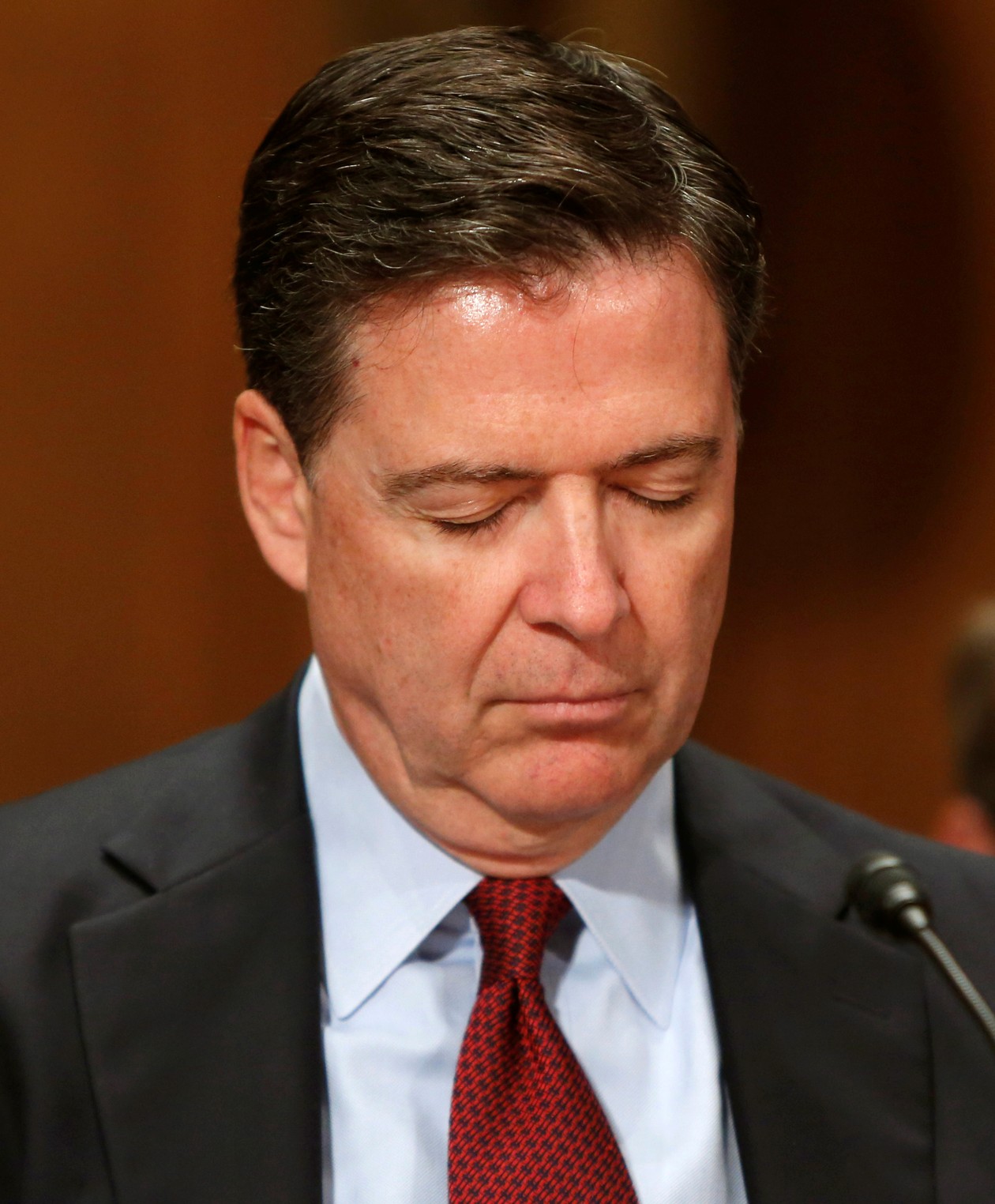
Director Comey, before his latest two intrusions into the election.Joshua Roberts / Reuters
With his ill-advised intrusions into this year’s election, FBI Director James Comey has already damaged U.S. interests and the fabric of American democracy more grievously than even Hillary Clinton’s harshest critics could contend that her email-policies have done.
Damaged, how? I made the long-term case a week ago, after Comey’s reckless announcement about the Anthony Weiner emails. The shorter-term case is evident right now: No one can ever know how the 2016 election would have turned out—in ultimate victor, in margin and “mandate,” in the way specific states go, in down-ballot and Congressional effects—had it not been for Comey’s decision to put himself in the middle of charge and counter-charge.
We can’t ever know, because some 40 million people have already voted. We can’t ever know, because his latest last-minute announcement comes too late to be fully digested by the time everyone else votes on election day.
I have no reason to believe that Director Comey was operating out of base motives. He probably thought he was doing the right thing for the right reasons. But he was mistaken, and the results were damaging—to the country, to the political process, to the FBI and the Department of Justice, and to Comey himself.
***
In the hyper-litigious current political realm, the usual next step would be hearings and investigations—hearings like those on the deaths at Benghazi, investigations like the endless ones on email. American public life at the moment is all too hearings-bound and criminalization-crazy. Hearings or investigations into whatever has happened at the FBI would not be worth it for anyone.
So what, instead?
Hillary Clinton, if she wins, should not fire Director Comey. If she cares about the norms of governing, as she should and presumably does, she would realize that this would inescapably look like revenge and a purge.
For similar reasons, Barack Obama, who appointed Comey to this job in the first place, should not fire him. FBI directors are given 10-year terms precisely to insulate them from politics. Obama should observe the letter of that apolitical norm, even if Comey himself has not.
But as soon as the election is over, Obama should make clear, bully-pulpit style, what Comey has done wrong, and why Comey has tarnished his bureau’s reputation, lost Obama’s trust, and forfeited the public’s deference to his judgment.
And then, sometime soon, Comey should resign. He shouldn’t be fired, but if he cares about his institution and its values, he should recognize that his continued presence is an unavoidable source of continued harm.
Plus, he is sure to get a lucrative follow-on job.
We’ve had enough hearings and investigations. But this was a big and damaging mistake.
No one should fire Director Comey, because a firing would damage governing norms. But in defense of those norms, Director Comey should resign.
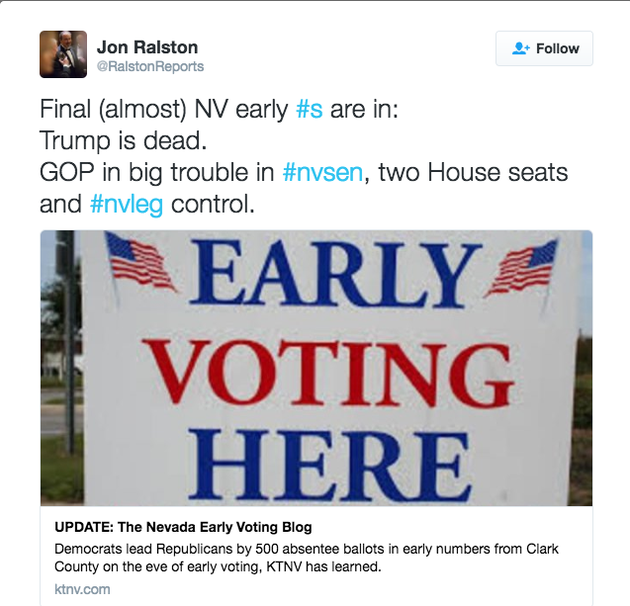
Two of my long-time, politically well-experienced friends have been in Nevada recently, doing get-out-the-vote work. Independently, each has just sent me a note saying that their experience and observations match what the Jon “the sage of Nevada” Ralston has been reporting: Namely, a huge surge in early voting among Democrats and especially Latinos in Nevada, which bodes very negatively for Donald Trump’s prospects there and by implication elsewhere.
I haven’t been in Nevada so can’t compare impressions first-hand. But I can say that based on what Deb and I have seen around the country in the past few months—in Central Valley and inland southern California, in western Kansas, in rust-belt Pennsylvania and Michigan, in both Mississippi and Alabama—I’ve been preparing for the least surprising “surprise” of election day. Namely, “surprisingly” high turnout among Latino voters, which will play a “surprisingly” important part in sparing the country and the world a Donald Trump presidency, if in fact we are to be spared.
The surprise factor depends on Latinos across the country being more deeply offended by everything about Trump’s campaign, from “they’re rapists” onward—and being more determined to show up and vote than their past often-low turnout rates might have indicated or (the surprise part) than this year’s polling may fully capture. I’m not a pollster, but all the anecdotal and reportage evidence we’ve come across supports both halves of this equation. People are really (and rightly) offended. And they are really determined to make their views known.
(I’m prepared for a similar “surprise” in the margin from women voters but don’t know of early-voting results that yet give such indications.)
I’ve argued for years, for instance here and here, that the long-term secret of American greatness is its ability to draw on an outsized share of the world’s talent, entrepreneurial creativity, culture, heart, and general human genius through its openness to people of many races and backgrounds. Latino Americans have long had higher-than-average rates of service and sacrifice in the U.S. military. In 2016, they may be defending American freedoms in another way.
The Libertarian candidate, Gary Johnson.Jim Young / Reuters
A reader in New York writes about the way he is casting his vote. He also asks a question, for which my answer is below.
From the reader:
As a two-time Obama voter and Obama fan, I am not at all enthusiastic about HRC and plan to vote Gary Johnson to register my unease with her. Your views on Trump are well known, but I would like to know: what do you think of HRC, not as an alternative to Trump per se—who’s obviously so much worse—but as an affirmative choice for president?
Put another way, if you set aside the idea of influencing the outcome / blocking Trump and instead focus on voting as an act of affirmation, do you actively support HRC despite her flaws and why? Do you think we should feel good that she will be president? I have seen no evidence of her having “learned” from past ethical missteps or foreign policy misjudgments. My own views are below, and I see three main negatives in HRC.
Her poor judgment and paranoid streak (see: email fiasco) are not just unappealing, but undermine her effectiveness when they blow up in her face. This pattern will continue into her presidency.
The nexus of public service and personal enrichment known as Clinton Inc., regardless of whether it rises to the level of actual corruption. (That they’ve figured out how to land just shy of criminality almost makes the whole thing worse.)
Her foreign policy will be conventionally hawkish, with all the unnecessary / counterproductive use of resources that entails. Her presidency will be paralyzed domestically by unprecedentedly fierce opposition, so foreign policy will be the only arena where she can demonstrate “effectiveness.” This increases the risk of ill-conceived misadventures abroad for the sake of “doing something”—e.g. I expect the U.S. will be dragged into a morass in Syria that Obama has largely resisted. Her clearly telegraphed Syria policy will cost a lot of money; American servicemen will die; and it will worsen terrorist blowback from the Middle East. And this is to say nothing about new crises she’ll be faced with.
These negatives bother me very much—but they’re livable.
***
The negatives against Trump are overwhelming and intolerable, and stem only partly from his policies (which I do believe will be worse for America). Cracking down on immigration, banning Muslims or “extreme vetting” of foreign visitors, trade protectionism, massive unfunded tax cuts, haircutting the national debt—all of these will be worse for the country IMO….
But I’m even more swayed by Trump’s farcically, outrageously unfit temperament for the presidency. As prolifically chronicled in his Twitter feed, in the context of the U.S. presidency, Trump is a man of unprecedented pettiness, vulgarity, sensitivity to perceived slights, and emotional immaturity.
Yes, Clinton’s administration will be 50%+ preoccupied with fending off sundry investigations, inquiries, commissions, inquests, and controversies—some her own fault, others concocted by detractors. But President Trump will be 50%+ preoccupied with obsessively reading his own press, answering slights, and settling a continuous flow of spats, feuds, arguments, tizzies, vendettas, quarrels, and brouhahas—whether with b-list celebrities like Rosie O’Donnell and Alicia Machado, members of the press, bureaucrats and elected officials, or foreign leaders.
Why is that significant? Because it’s a near-certainty that he will re-purpose the powers of the presidency in general—most ominously including the U.S. military—as a vehicle for settling disputes, saving face, getting the last word, and asserting dominance. And he’ll be equally pliable by flatterers and favor-curriers, within his administration or without, domestic or foreign—including foreign despots much cleverer, more strategic than he is.
His decisions will be guided by emotion, vanity, and ego first, and a rigorous calculation of the national interest only a distant second. Not because he wants them to be, but becausehe can’t help it. By its very nature, this setup makes it literally impossible to predict what those decisions may be, except that they will bear only an incidental relation to what’s best for the country.
With Clinton, you know what you’re getting: a basically conventional policy offering—left of center domestically, relatively hawkish and interventionist abroad—combined with likely ethical and/or legal lapses; an unhealthy degree of secrecy / paranoia; probably some fresh embarrassments courtesy of Bill’s sex addiction (which I assume is alive and well); and maybe even health problems of some severity.
But the negatives are known and bounded. Either she has a decent, effective, scandal-free presidency; or she engages in various scandals, whether or not she gets away with it. But that’s the range of outcomes. Not all are desirable, but all are survivable. She may well blow up her presidency, sure—but what could she conceivably do that would be catastrophic not just to her legacy, but to the country? HRC’s range of outcomes is between “tolerable” and “pretty shitty,” with a non-zero if remote chance of “good.”
With Trump, we have no idea what we’re getting. The range of outcomes is unbounded and skewed to the negative. He could be great—one of the best. He could be Reagan Redux, as some have hoped. But he could also be catastrophic. Almost nothing is too far-fetched, too fantastical, to put in the realm of possibility. He could be the most negatively consequential president of the post-war era. Why not, given that he gets into 3 a.m. Twitter feuds with 1990s Venezuelan beauty queens while ostensibly running for president?
Forget about his hucksterism, his profound vulgarity and tackiness, his trail of credible sexual assault accusers, his policy ignorance and lack of curiosity… All bad things, but the dispositive issue for me is the signature Trump constellation of vindictiveness, vainglory, impulsiveness, and an ultra-fragile sense of pride. He could offer the best set of policies imaginable, and it wouldn’t matter. Those traits alone still make him a gamble that neither the status quo nor the many flaws of HRC are so bad as to justify.
So, if I’m casting the deciding vote, there is no contest: in this particularly loathsome election, HRC is the only sound choice. Thankfully, I’m not in that position and I do consider a third party vote a perfectly honorable thing to do in this cycle.
***
Like the reader, I vote in a jurisdiction whose Electoral College result is not in question—for him, New York; for me, D.C. Unlike him, I think it’s important to cast a vote for one of the two candidates with a chance of becoming president, which in my case means voting for Hillary Clinton.
I didn’t write TheAtlantic’s unusual (third time in 159 years) editorial endorsing Clinton, but I agree with its logic. Essentially: Hillary Clinton is a candidate of clear strengths and some very well-known weaknesses. Her foreign policy instincts and record are more hawkish than I would choose, which is the main reason I preferred Barack Obama in the Democratic primary eight years ago. In principle, it would be better if two families, Bush and Clinton, had not supplied four out of five successive presidents, which will be the case if she wins. But also in principle, it is long past time to have a female president, and if it doesn’t happen now it could be quite a while.
Most of all, as the reader points out, her weaknesses are known. Apart from a million such discussions from other people, I wrote about them recently here and here. There’s zero risk they’ll go undetected. There is a non-zero chance she might adjust and learn.
In contrast, her strengths have been taken for granted or under-appreciated. For evidence I’ll rest my case on these past three debates, since I’ve written so much about them. In terms of knowledge, she was never at a loss. In terms of poise and under-stress self-control, she had it while her adversary manifestly did not. (“Such a nasty woman.”) In terms of strategic planning, she had a plan and carried it out, as opposed to Brownian Motion on the other side. And all of this, “backwards and in high heels”-fashion, while dealing with judgments of her as a “shrill” or “harsh” woman that would not have been made of a man.
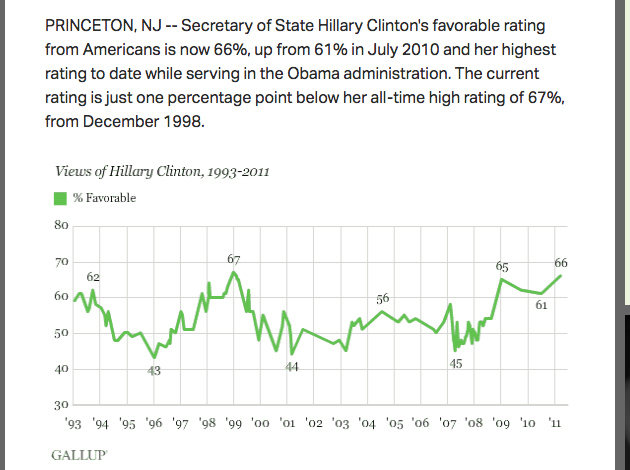
She was popular with her colleagues of both parties when she was in the Senate. She had a sky-high public popularity rating when she was Secretary of State:
As president she would do some things that I, personally, would be enthusiastic about, and others I would not like. But in all cases, from my perspective, she would be competent, intelligent, and serious about the job.
Since the real-world alternative is a someone who is ignorant, impetuous, and contemptuous of both the rules and traditions on which our democracy is based, with no hesitation I say: vote for her, and work out the problems later on. They’re the kind of problems our political system is supposed to cope with. The alternative is a problem for the system itself (as Conor Friedersdorf has argued here).
And to my taste, the third-party alternative of saying “Oh, there’s something wrong with them both, I’ll vote for this other person” is wrong on the merits (Gary Johnson has his obvious weaknesses) and also in its long-term implications. Hillary Clinton, with her strengths and flaws, is the alternative to Donald Trump six days from now. Voting for her is a recognition of that reality; it adds to her popular vote as well as Electoral College strength, both of which matter for her (sure to be challenged) legitimacy; and it gives the voter better karmic standing to hold her accountable afterwards.
My vote in D.C. doesn’t “matter,” but it matters to me.
In northern Wisconsin recently: two deer, same species, different hues. Read on to learn what they have to do with the campaign. (Reader photo, with permission.)
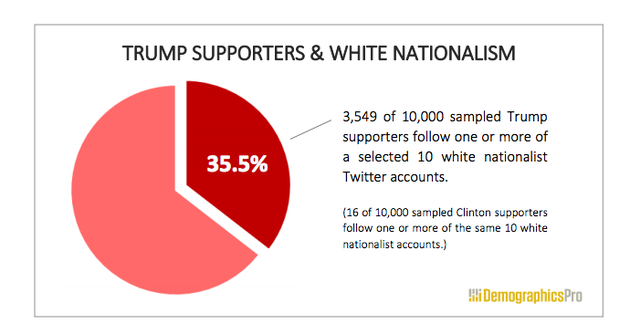
Yesterday I mentioned a social-media analysis showing that 35 percent of active Trump supporters on Twitter (versus less than one-tenth of one percent of Clinton supporters) followed prominent “white nationalist” Twitter feeds, like @DrDavidDuke.
Now readers respond. First, what I’ll simply call a dissent, from a reader in South Carolina:
Your article on White Nationalists is disgusting and irresponsible and does not even rise to the level of journalism.
I am a Trump supporter and surprisingly NOT a Russian bot, a white nationalist, or an anti-Semite. I vote for Trump not because I think he’s a great politician, but because I cannot allow Hillary Clinton destroy America with her failed and deadly policies.
I vote for Trump to keep Hillary out. Plus, it is obvious to me and many others that Trump cares deeply about America as a country—Hillary cannot say the same.
Quit reducing patriotic Americans who cannot abide the thought of Hillary Clinton in the White House to ridiculous stereotypes. We are people who love America and do not wish to see it destroyed by her harmful policies. Disgraceful piece of work. I will no longer be reading the hate-mongering that goes on at The Atlantic.
Noted. After the jump, a different sort of response from a successful advanced-tech entrepreneur in the industrial Midwest who sent in the photo at the top of this item.
***
The reader in Wisconsin writes:
That something like “white supremacy” as conscious action would still exist is incredibly sad ...
But sometimes when I hear of “white nationalist” groups or other peculiar views of human diversity, I think about how strange it would be to have “brunette supremacists” or “green-eyed supremacists” or something equally ridiculous. How about “freckled nationalist”? I feel particularly aggrieved by people born in July, so perhaps an “October supremacist” group would be an appropriate response.
This time when I read your latest post I couldn’t help thinking of a white deer I saw recently near a place in Wisconsin where we have a small log cabin in the woods. I felt really lucky to see her since I had heard of many sightings this summer nearby.
When I saw her, she froze in position as if I wouldn’t notice—like any other (color) deer would. The part I marvel at is that she seems entirely unaware she is white and easily visible!
If only we could all be that way.
What I do love about this photo, as the reader suggests, is the obvious-once-you-point-it out unselfconsciousness of the white deer, who imagines that she is as camouflaged as the practically invisible one in the rear. This has larger implications about self-perception and real-vs-imagined differences, which I will leave to each reader to fill in.
Offered for the record as samples of opinion in this varied land, nine days before the election.
Vehement Trump supporters abound on Twitter. That much is obvious to anyone who has used the service. Who exactly they are, and how broad a swath of society they represent, has been harder to pin down.
Are they largely Russian bots, as some reports have suggested? Are the angriest ones really just a handful of activists, racists, and anti-Semites, who through nonstop posting in multiple accounts exaggerate their true numbers? (Though even a very few would be enough.) Are they in any kind of coordinated activity, or mainly working as loners?
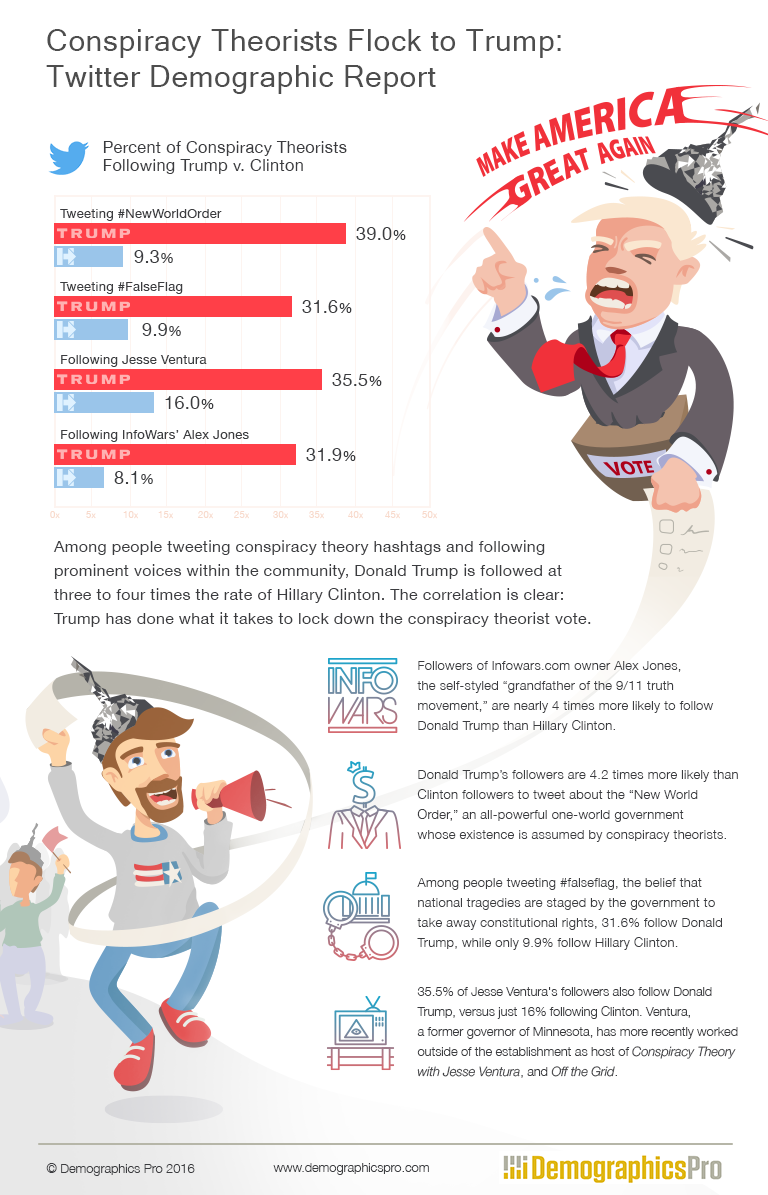
A social-media analytics firm called Demographics Pro has released an analysis of 10,000 Trump supporters who are active on Twitter, and 10,000 Hillary Clinton supporters. It then matched those accounts with a list of 10 active, major white-nationalist Twitter accounts. (The company describes the way in which it chose and classified such sites here.)
What were the results? They’re shown on the chart above. Of the 10,000 Clinton followers, a total of 16 followed one or more of the major white-nationalist accounts, the likes of @DrDavidDuke and so on. Of the 10,000 Trump supporters, a total of 3,549—well over one-third—followed the white nationalists.
Following an account doesn’t necessarily make you an adherent. I follow @DrDavidDuke myself, along with several others on the list. But the disproportion here, while it doesn’t answer all questions about Trump Twitter world, suggests something about its nature.
A similar Demographics Pro analysis, of the overlap between conspiracy-theory sites and Trump supporters, is here.
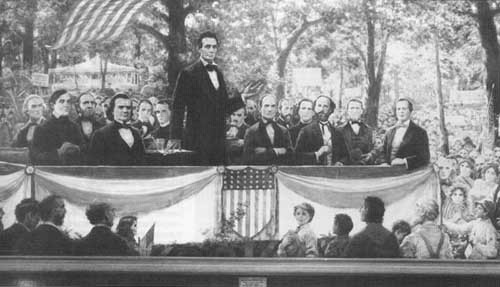
The Lincoln-Douglas debates of 1858, one year after The Atlantic’s founding, “mattered” in American history because of the ideas they advanced. (Stephen Douglas held onto his seat in the Senate; not long afterward Lincoln began his campaign for the presidency.) Is it possible that the Clinton-Trump debates of 2016, or Year 159 of TheAtlantic’s history, will also matter? (Robert Marshall Root painting, via Illinois Periodicals Online)
In my my article on this year’s presidential debates, I pointed out that these high-drama election-year rituals seem important to mere citizens and journalists. But political scientists have long claimed there’s no proof that they’ve actually changed presidential election results.
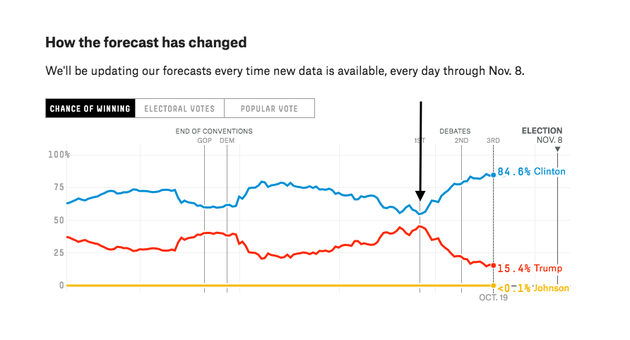
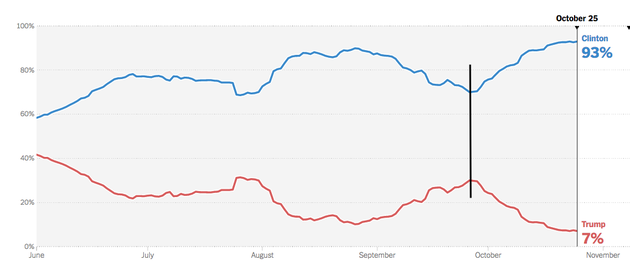
Maybe they’ll say something different when this year’s results are in. At face value, it certainly appears that the first Clinton-Trump debate—a month ago today—marked a clear shift in Hillary Clinton’s favor and against Donald Trump.
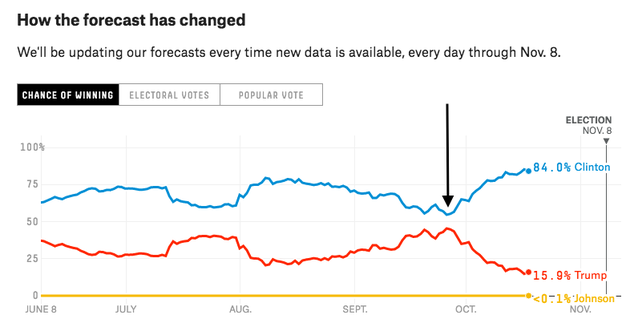
Below is a screenshot of the timeline for the “polls-plus” prediction of the election’s outcome, from FiveThirtyEight. I’ve added the big black arrow to mark the first debate. The thinner vertical lines to the right are the other two debates, each one of which went badly for Trump and, from this chart, seemed to reinforce Clinton’s lead.
As a reminder: debate #2 was the town hall, in which Trump loomed up behind Clinton like a lurker, and #3 was the debate of “such a nasty woman” and “keep you in suspense” (about accepting election outcome).
The screenshot below from the NYT’s“Who Will Be President” tracker shows something similar. Again, the black bar marks the first debate.
***
For one more way to look at this question, which is less immediately obvious in graphic terms but cumulatively more convincing, please check out this recent tweet-storm by the U. Michigan economist Justin Wolfers.
He tested the debates-matter hypothesis in an ingenious way, by tracking the movement of financial and futures markets while the first debate was actually underway. As the debate wore on, Wolfers found, a wide variety of markets quickly adjusted to the levels they would have if Hillary Clinton became president. For instance, during the debate the Mexican peso rose sharply in value, based on the declining likelihood that U.S.-Mexico trade would be disrupted by a Wall or other limits under a President Trump.
The point of the study, again, was that the back-and-forth of the debate, in itself, convinced people placing financial bets that Donald Trump was not going to become president. They adjusted their financial bets accordingly.
Prediction markets are obviously fallible; in the most famous recent case, they missed the Brexit vote. And financial markets as a whole tend to overreact to short-term news. But together with the longer-term polling trends, Wolfers’s study may reinforce the hypothesis I mentioned a week ago: that this time, the debates really have mattered.
"Who's that, behind me? Oh, it is you again, Mr. Trump!" The candidate with some employees at his golf course, yesterday in Florida. Jonathan Ernst / Reuters
Yesterday, in installment #148 of the time capsules, I contrasted circa-2008 videos of a (comparatively) thoughtful-sounding Donald Trump with the splenetic buffoon we see today, and asked, What happened?
Readers offer three hypotheses.
1) You’re fooling yourself. There’s no change. From a reader in California:
I differ with your take on Trump’s comments about the movie. (Caveat: I have a serious problem watching film at all.) I’m not interested in cinematography, never mind Trump’s views of same. However, your statement, “For any rich person to say these things about the movie would be something,” is simply mistaken. Trump isn’t saying anything about “the movie.” He’s riffing on his own self-absorbed impressions of wealth, women, and personal relationships. He makes one bland remark about the camera’s emphasis on the extent of the table ...
In sum, “this other Trump” is not by a stretch another Trump. He’s the same Trump, but at the time one who wasn’t running for POTUS.
FWIW, what struck me about Trump’s “Rosebud” comments was not his assessment of Citizen Kane as a film itself but rather his allusions to the distancing effects of wealth. Through the past year, we’ve heard him say “I’m really rich!” (or used to, back in the “self-funding” days). We still hear him say “I’m so smart” and “I have the greatest temperament.” It’s a different tone in these clips.
***
2) It’s a change, but on purpose. From another reader:
What happened? This has been my theory from day one: Trump the movie critic, the wheeler-dealer, as well as the X-rated media guru, is the genuine article, while Trump the religious, pro-life, GOP conservative, redneck, Tea Partier ... is fake.
An act. A stunt. A last gasp for something big before its too late ... that somehow won a primary ... then two ... then the nomination.
Nobody was more shocked than he was.
He is a lifelong New Yorker, city slicker, playboy, Democrat ... now playing a character from rural Mississippi(?) ... or West Virginia. Other days he’s Archie Bunker, in a one-man play, on stage. The crowd loves him!
He’s done enough of these stump speeches that he can probably do them in his sleep. But the pro-gun (bwaahaha!) Trump is kinda like me singing in the shower: not my real voice, out of tune, probably haven’t really studied the lyrics.
More proof for my theory: Go back and look at the stuff that leaked out after his meeting with the New York Times editorial board. He basically said, “Can you guys believe this? I’ve got them eating out of my hands!” (And “Oh, and about those illegal immigrants, meh. Whatever. We’ll figure something out later.”)
***
3) It’s a change, and not on purpose. An assessment that is downbeat in a different way:
The answer, I suspect, to your question in #148 is ... age.
I’ve become increasingly suspicious of opinion that doesn’t take this into account. We would all like lives lived to four score and ten without any diminishment, and that happens regularly now, but those who remain acute and fully engaged for six score or more are rare no matter how much we would all like to join the club.
The increasingly demented things that Trump says are, er, well, demented and do not come from the hormone-ridden enthusiasms of an uncontrolled 30 year old; they come from a 70 year old. He remembers what the 30 year old was like, believes he is the same incarnate, and wants to make his mark on history as the end approaches. It is clear he now has no control of his expression on a stage where his (putative) wealth and its implied authority and a very long time before the public eye can have disastrous consequences.
Take your pick; elements of truth in all of these, I think. Also, on the “Rosebud” question in the conventional sense, of what makes Trump the way he is, please check out this fascinating NYT piece by Michael Barbaro on Trump’s longstanding and powerful dread of public humiliation or loss of status. (And ironically enough, the result of this campaign ... )
Twelve days and some hours to go. Tax returns still not released. Paul Ryan and Reince Priebus still on board, saying Make This Man POTUS!
Details from online Oxford University astrophysics course, showing how a supernova puffs itself up into a giant fireball before it explodes and dies. Hmmm, why does this image come to mind? (Oxford)
Over the past three days, as the Trump campaign has condensed into a tight ball of fury, recklessness, and recrimination, I’ve again been away from the Time Capsule beat. Partly this has been because of some unexpected last-minute article-writing duties. (Be on the lookout for our December issue! And before that, the new November one, just out now. And with the holiday season ahead, subscriptions make a great gift!) Partly it has been because of a planned and unexpectedly fascinating immersion with members of the Purpose Built Community network, this week at their national conference here in Birmingham, Alabama (where long ago I celebrated my 19th birthday while working as a reporter for The Southern Courier).
Some catch-up notes before tonight’s final debate:
1) Death with Dignity. Tim Miller, who was communications director for Jeb Bush’s doomed presidential campaign and has worked for other Republicans, has a wonderful essay in The Ringer called “Donald Trump is on a Presidential Death March We’ve Never Seen Before.” It addresses a part of politics that is vastly more agonizing for participants than it seems from outside: losing, in public, in a way that has no real counterpart.
When a baseball batter strikes out in a crucial bases-loaded, two-outs situation, or a basketball player misses a free throw or a quarterback throws an interception, it hurts. But there’s always the next game or the next season, and anyway you’re getting paid. When an actor misses out on an Oscar or Emmy—hey, you’re breaking my heart.
But when a politician loses a race, most of all for the presidency, it is all-out public failure on the biggest possible stage, leaving a mark that never really goes away. (The hoary joke on this theme was that after his 1984 landslide loss to Ronald Reagan, the 100 percent admirable Walter Mondale asked George McGovern “when does it stop hurting?”, referring to McGovern’s landslide loss to Richard Nixon 12 years earlier. “I’ll let you know,” the also-admirable McGovern is said to have replied.) And in a race for the White House, it’s an all-or-nothing outcome. On one side, four years with Air Force One and the attention of the world. On the other, four years of working off campaign debts and traversing the country for second-tier forums.
Bearing defeat is all the harder when you can see it coming, as McGovern and Mondale did, and as now seems very likely for Trump. And hardest of all if you have the emotional maturity of a child. Tim Miller’s piece does an excellent job of explaining why political defeat is an ordeal for anyone, and why impending defeat is bringing out even-worse aspects of Trump. (Also, please read Max Boot’s “What the Hell Happened to My Republican Party?” in Foreign Policy as an important complement.)
3) Do debates matter? In my October-issue piece on the debates, I mention the tut-tutting caution about debates from political scientists. When journalists discuss “influential” moments in past debates—the contrast in physical appearance between the sweaty Richard Nixon and the debonair John Kennedy in 1960, Ronald Reagan’s ease on the stage in 1980 and Jimmy Carter’s tenseness—scholars are quick to say there’s no hard testable proof that the debates really affected the outcome. So many other forces were at play; reaction to debates is to hard to quantify; etc. (My own view is that even if debates don’t provably determine who wins and loses the race, they still matter, as a lot of other intangibles do—convention speeches, ad campaigns, the good- or bad-breaks of unexpected news, etc. You can read more about the dispute in the piece.)
When this campaign is over, I’ll be interested to hear what the political scientists have to say. Because at the moment it certainly appears that the first Clinton-Trump debate had some effect. Here’s a screen shot of the “polls-plus” forecast of election odds, from Nate Silver’s 538 site. The blue and red trend lines are from 538. I’ve added the black arrow. See if you can guess which event the arrow indicates.
“Polls-plus” forecast from 538. The first Clinton-Trump debate was on September 26, the date indicated by the black arrow.
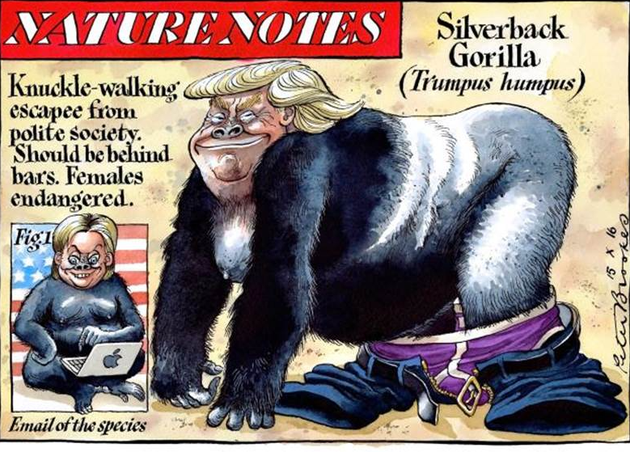
4) The prescience of Jane Goodall, cont. In my debate piece, I quoted the famous primatologist on the resemblances between Trump’s on-stage mannerisms and the dominance rituals of chimpanzees. Then installment #137 looked at the way Trump had actually put these dominant moves into effect when he was free to roam the stage in the second, town hall-style debate. His lurking and looming behind Clinton led to the famous recent SNL routine, and to the (admiring!) comment by his UK counterpart Nigel Farage that Trump resembled a “silverback gorilla.”
To close the loop, a reader in the UK sent a newspaper cartoon that illustrates what Jane Goodall was talking about. Who would have guessed that her eminence and insight extends into the realm of modern American politics?
From a reader in the UK
***
One more debate to watch. 20 days to go. And—lest we forget—the Speaker of the House, the Majority Leader of the Senate, and most members of the Republican party still say: let’s make this man president.
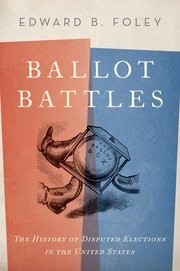
Earlier this year I read Edward B. Foley’s excellent history of disputed elections in America, Ballot Battles. The book is fascinating on many levels and alarming in its descriptions of the weaknesses in America’s electoral institutions. But I want to focus on one particular election featured in the book: the 1960 presidential contest between Nixon and Kennedy.
It’s now generally accepted that Chicago Democrats manipulated the vote totals in the 1960 election in an attempt to help Kennedy carry Illinois. There is also substantial evidence that Lyndon B. Johnson’s political machine in Texas manipulated the vote total in Kennedy’s favor. If Nixon was, in fact, cheated out of those two states and their electoral votes, then he was cheated out of the presidency in 1960.
Political partisans had their suspicions even at the time. After Nixon’s initial concession to Kennedy, his supporters urged him to seek recounts in both Illinois and Texas. But Nixon was convinced that there was no way for him to get a truly fair recount from Texas state officials. And at the time, the Supreme Court's policy was to avoid federal intervention in this type of dispute.
So let’s take a step back and consider this situation. Here we have a politician who is just out of reach of the White House. He has a reasonable belief that the vote totals in two key states were rigged against him, and that the recount process in one of those states would also be rigged against him. On top of everything else, this politician is Richard Nixon, a man whose name has become a shorthand for political dirty tricks. So what does he do?
Incredibly, Nixon did nothing.
He did not seek a recount in Texas. He did not denounce the vote counting process and recount process in Texas as “rigged.” He didn’t even seek a recount in Illinois, since Illinois by itself could not provide him the additional electoral votes needed to win.
Nixon later explained his reasoning for this inaction in his 1962 book, Six Crises. He worried that, “The bitterness that would be engendered by such a [recount] maneuver . . . would, in my opinion, have done incalculable and lasting damage throughout the country.” He also wrote that, “It is difficult enough to get defeated candidates in some of the newly independent countries to abide by the verdict of the electorate. If we could not continue to set a good example in this respect in the United States, I could see that there would be open-season for shooting at the validity of free elections throughout the world.”
The problems with the 1960 election and recount process are so manifest that Edward Foley concludes that “the 1960 presidential election must be viewed as a failure of American government to operate a well-functioning democracy.” The fact that this view is not widely shared should be attributed to the selfless act of a man who is otherwise (and not without cause!) pilloried for his subversion of American democratic ideals.
And that brings us back to Trump. Whereas Nixon had actual grounds to suspect vote-rigging, Trump has none. Whereas Nixon declined to challenge the election results after his supporters raised legitimate concerns, Trump is now spreading disinformation before the votes have even been counted. And whereas Nixon would not press his legitimate grievances for fear of dividing the country, Trump is using his lies to lay the groundwork for possible violence.
Nixon did more damage to the presidency and the popular image of American government than any other politician in the 20th Century. Trump hasn’t even been elected president, and yet he may have already done more damage than Nixon.
It’s worth noting one of the strongest ties between Nixon and Trump: Roger Stone. Stone is a Nixon acolyte—complete with a large tattoo of the president on his back—known for his “dirty tricks” on behalf of Nixon’s reelection campaign in 1972. In his 2014 book Nixon’s Secrets, Stone forcefully argues that Kennedy stole the 1960 election:
During this primary season, Stone was one of Trump’s close advisors and henchmen (you probably remember him as the guy who threatened to send Trump supporters to the hotel rooms of RNC delegates) and he reportedly remains in close contact with Trump’s team. It would be no surprise if Stone’s deep resentment over the 1960 election is fueling the “rigged” rhetoric coming out of the Trump campaign right now.