Reporter's Notebook

Deep Archive
Show Newer Notes
Associated Press

On this day in 1868, William Edward Burghardt Du Bois was born in Great Barrington, Massachusetts. The famed scholar and co-founder of the NAACP contributed to our magazine in the late 19th and early 20th centuries. Here’s an excerpt from his 1897 essay “Strivings of the Negro People,” two years after becoming the first African American to earn a Ph.D. from Harvard:

After the Egyptian and Indian, the Greek and Roman, the Teuton and Mongolian, the Negro is a sort of seventh son, born with a veil, and gifted with second-sight in this American world,—a world which yields him no self-consciousness, but only lets him see himself through the revelation of the other world. It is a peculiar sensation, this double-consciousness, this sense of always looking at one’s self through the eyes of others, of measuring one’s soul by the tape of a world that looks on in amused contempt and pity. One feels his two-ness,—an American, a Negro; two souls, two thoughts, two unreconciled strivings; two warring ideals in one dark body, whose dogged strength alone keeps it from being torn asunder.

The history of the American Negro is the history of this strife,—this longing to attain self-conscious manhood, to merge his double self into a better and truer self. In this merging he wishes neither of the older selves to be lost. He does not wish to Africanize America, for America has too much to teach the world and Africa; he does not with to bleach his Negro blood in a flood of white Americanism, for he believes—foolishly, perhaps, but fervently—that Negro blood has yet a message for the world. He simply wishes to make it possible for a man to be both a Negro and an American without being cursed and spit upon by his fellows, without losing the opportunity of self-development.

Two years later he wrote “A Negro Schoolmaster in the South” for our January 1899 issue. His personal essay ends this way:

My journey was done, and behind me lay hill and dale, and Life and Death. How shall man measure Progress there where the dark-faced Josie lies? How many heartfuls of sorrow shall balance a bushel of wheat? How hard a thing is life to the lowly, and yet how human and real! And all this life and love and strife and failure,—is it the twilight of nightfall or the flush of some faint-dawning day?

Thus sadly musing, I rode to Nashville in the Jim Crow car.

Du Bois went on to write three more pieces for The Atlantic:

  • The Freedmen’s Bureau” (March 1901): He surveys the successes and failures of post-Civil War efforts to aid the freed slaves.
  • Of the Training of Black Men” (September 1902): He argues that blacks should fully develop their talents and should have the opportunity to earn college degrees.
  • The African Roots of War” (May 1915): After Belgium, France, and Britain carved up Africa among themselves, Germany felt the need to catch up. Du Bois saw this competition for colonies as an underlying cause of the war. (Full essay in PDF form)

Six months before Du Bois’s death in Accra, Ghana, on August 27, 1963, Ralph McGill, the anti-segregationist editor and publisher of the Atlanta Constitution, spoke with Du Bois at length. McGill wrote about the encounter for our November 1965 issue:

The frail body of the ninety-five-year-old man lay stretched on a sofa. He wore trousers, a soft white shirt, and socks and slippers. His mustache and goatee were carefully trimmed. He had been asleep when we arrived. We had waited perhaps half an hour for him to awaken and then be dressed. Neither illness nor a prostate operation in a London hospital some months before, where Ghana’s president, Kwame Nkrumah, had insisted he go, had reduced the fire of his mind, though he said his memory was not as quick as before.

There was a lot of history in the slender, sick, and slowly dying man. At ninety-four he had become a citizen of Ghana, where he had resided since 1960. Three years before, he had requested membership in the Communist Party, because he had ceased to believe, he stated, that any other system, would produce the sort of world he wanted. But in keeping with his controversial past, he denounced the U.S. Communist program to set up an all-Negro state somewhere in the South. The idea was repellent to him.

Always the fiercely independent, sensitive intellectual, he had been for more than fifty years a passionate fighter for full civil rights and equality of citizenship for the Negro. This placed him in opposition to Booker T. Washington well before the turn of the century. He had helped found the NAACP but had broken with it in 1948 because of its “timidity” and his own growing obsession with Communist causes and ideology. …

[Du Bois died on the eve of] the march on Washington, the largest demonstration for civil rights ever held. One could not help experiencing a feeling of destiny linking both events. The man who for many years had spoken with the loudest and most articulate voice was now silent while his objectives were being realized.
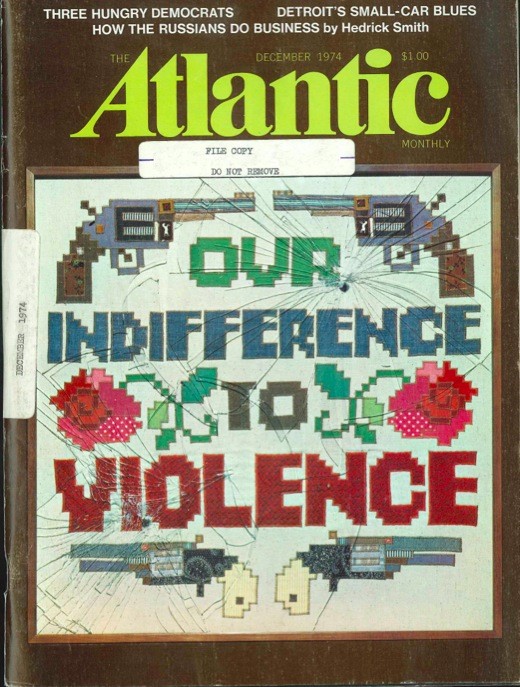
This afternoon, flipping through Atlantic cover art from decades past, I stumbled across a chilling image. In big letters, framed by folksy illustrated guns: Our Indifference to Violence. This was the cover of the magazine 41 years ago this month:

The story is about Charles Starkweather and his girlfriend Caril Fuguate and the murder spree they went on in Nebraska in 1958. More broadly, the piece is about how fear can grip a community and what happens to people when it does. In Lincoln, Nebraska, people decided to arm themselves. Here’s an excerpt:

The pair filed into the living room, smelling of beer and brandishing loaded rifles; they had shotguns in the car. And pistols. Gene’s buddy wore his pistol concealed, strapped in a holster to his sturdy chest. His pockets bulged with shells. They’d volunteered to join Sheriff Karnopp, who was broadcasting openly for a posse. The sheriff gathered, Gene told us later, every local lush from every bar in downtown Lincoln. Some had never held a gun before. The sheriff armed them all; he had to.

The writer, Marilyn Coffey, finds herself some years later watching a film adaptation of the 1958 murders: Terrence Malick’s Badlands. Coffey concludes:

Our view of violence is as unemotional as the neat, round, clean, cinematic bullet holes left by Charlie’s gun. The movie successfully shields us from the impact of those days. Like our news media, it ultimately supports our indifference to violence. At last, indeed, we are entertained by it.

Parks with Dr. Martin Luther King Jr. in 1955 (Ebony Magazine via Wikimedia)

For most of elementary school I learned about Rosa Parks as if she only existed on December 1, 1955. Every February in some Black History Month poster or presentation: Parks sitting on a bus, alongside MLK’s dream and George Washington Carver’s peanuts. Her life cooled into one day. Rather, one moment: the passive and accidental revolution in Parks’s refusal to give up her bus seat to a white man because she was too tired to stand. Pictures of her mugshot and fingerprints from an arrest were mummified with her day-long life, along with that shot of her staring out of bus window. I remember it all collected into her very quiet rebellion.

Jeanne Theoharis contends with this collective misremembering in The Washington Post today, on the anniversary of Parks’s 1955 arrest. Theoharis, a Parks biographer, describes how that tired refusal on the bus 60 years ago was not an incongruous burst in the life of a meek Parks.

She was an activist for black women, especially victims of sexual violence at the hands of white men. This historical truth is encapsulated in a line from Danielle McGuire’s book on the historic role of black women in the Civil Rights Movement: “The Montgomery bus boycott was the baptism, not the birth, of that struggle.”

You can hear about the day directly from Parks here, in a 1956 interview with Sydney Rogers. And on the boycott her arrest catalyzed—organized by another black female activist, Jo Ann Robinson—read Benjamin E. Hays in the December 1960 issue of The Atlantic:

For a year Negroes boycotted the buses in Montgomery, Alabama, and finally the buses were desegregated by federal decree, although the atmosphere was tense and there was fear of race riots. The Montgomery boycott resounded around the world; and no one could mistake what the Negroes in Montgomery were saying.

Below are some quotes from Atlantic Monthly essays published many, many decades ago. The identities of the authors are hidden within the links, which take you to the full essays. Can you guess the right author for each quote?

1) “While theorists are still searching for the causes of the depression, and politicians remain at loggerheads in their effort to conjure up remedies, I am tempted to think that the perplexed businessman might discover a possible solution of his troubles if he would just spend a few days in his wife’s kitchen.”

A. Eleanor Roosevelt
B. James Thurber
C. Helen Keller
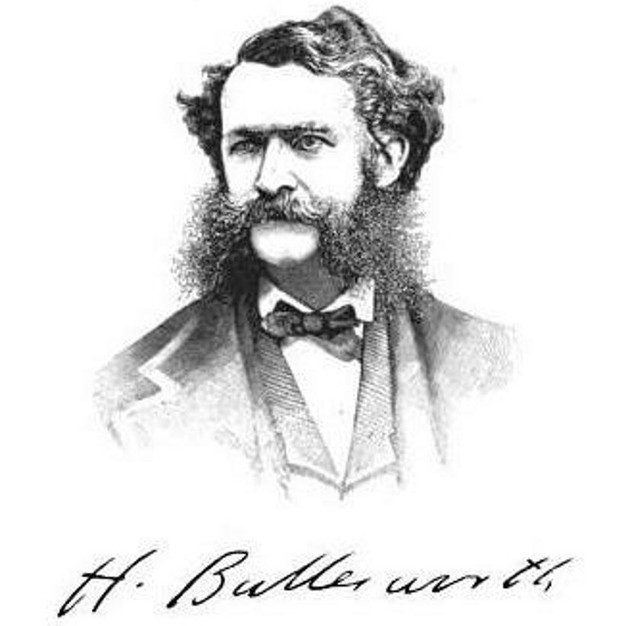
D. Hezekiah Butterworth

(Answer here)

2) “There was a window in the room, but he could not seem to get it open, and he was afraid to call the bellboy (what queer eyes that kid had!), and he was afraid to leave the hotel, for what if he got lost? and if he got lost, even a little, then he would be lost altogether.”

A. John Steinbeck
B. Truman Capote
C. Joyce Carol Oates
D. Hezekiah Butterworth

(Answer here)

3) “Many times, when I have got upon the cars, expecting to be magnetized into an hour or two of blissful reverie, my thoughts shaken up by the vibrations into all sorts of new and pleasing patterns, arranging themselves in curves and nodal points, like the grains of sand in Chladni's famous experiment,—fresh ideas coming up to the surface, as the kernels do when a measure of corn is jolted in a farmer’s wagon,—all this without volition, the mechanical impulse alone keeping the thoughts in motion, as the mere act of carrying certain watches in the pocket keeps them wound up,—many times, I say, just as my brain was beginning to creep and hum with this delicious locomotive intoxication, some dear detestable friend, cordial, intelligent, social, radiant, has come up and sat down by me and opened a conversation which has broken my day-dream, unharnessed the flying horses that were whirling along my fancies and hitched on the old weary omnibus-team of every-day associations, fatigued my hearing and attention, exhausted my voice, and milked the breasts of my thought dry during the hour when they should have been filling themselves full of fresh juices.”

A. Ernest Hemingway
B. Gertrude Stein
C. Oliver Wendell Holmes
D. Hezekiah Butterworth

(Answer here)

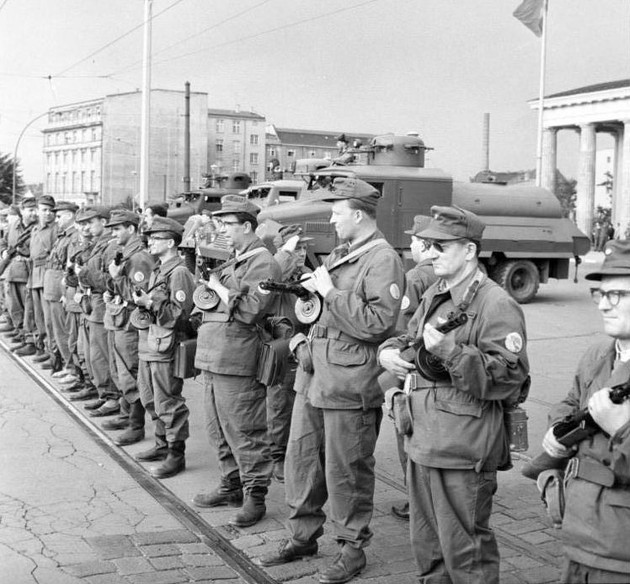
East German Combat Groups of the Working Class close the border on August 13, 1961 in preparation for the Berlin Wall construction. (Wikimedia)

Back in 1961, when Germany was at its most fiercely divided, The Atlantic published a collection of interviews with East Germans called “Why We Crossed Over.” “Dieter S.,” a 21-year-old hospital orderly, explained how he found himself on the government blacklist:

[The police] said that they knew that I had been going frequently into West Berlin to see my aunt. They knew also that I had many friends in West Berlin and that I had been seen riding on a motor scooter with a decadent girl from West Berlin who had long hair, like Brigitte Bardot’s. All of this was true enough ... That night I crossed the frontier into West Berlin and knocked on my aunt’s door.

After decades of Cold War thrillers, a story like Dieter’s sounds oddly low-key. But this was just before the completion of the Berlin Wall, and it was sometimes surprisingly easy for East Germans to get out of the country.

“Ursula F.,” described as a pretty 25-year-old with auburn hair, got into trouble with the police after she refused to report on some journalist friends. The day before she was supposed to report for “political education,” she writes, “I took a train to East Berlin, walked to the nearest border checkpoint, and said to the guard: ‘I just want to buy a copy of the Frankfurter Allgemeine.’ He smiled and let me through.”

Another interviewee, a state-employed cabinetmaker identified as “Hans R.,” had a more dramatic tale. He’d endangered his family by secretly doing work for private clients; after a co-worker filed an incriminating report about him, he came home one day to discover that his wife had been arrested. He decided to flee the country, leaving his son with a grandmother and his wife in prison. “It is not easy to do such a thing,” he said. “I can only hope that the situation will not last forever.”

It didn’t. Today is the 25th anniversary of German reunification.

My colleague Cari wrote a fascinating piece yesterday about the unique “microbe aura” that hangs in the air around our bodies:

Once you leave a room, this signature, as unique as fingerprints, can offer clues to whoever comes afterwards about who you are and where you’ve been. Past research has shown that it’s possible to lift someone’s microbiome from surfaces they’ve touched, sequencing the DNA of bacteria left on kitchen counters, floors, and bathrooms for clues about the person who left them there. ... In a small study published today in the journal PeerJ, researchers from the University of Oregon and the Santa Fe Institute found further support for the idea that this signature might be able to identified by sampling only the air in a room.

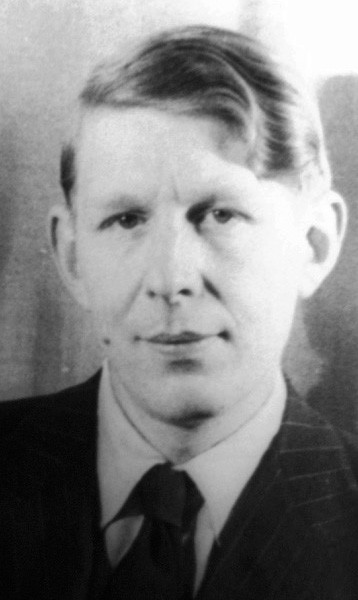
The poet W. H. Auden would have been excited to hear about this. In 1969, having learned from Scientific American that his skin, like all human skin, was covered in microbes, he wrote “A New Year Greeting” to his body’s microscopic colonists—wishing them a happy new year, apologizing for any inconveniences, requesting that they “behave as good guests should” and not give him acne. Delightfully, Auden considers their mythology:

By what myths would your priests account
        for the hurricanes that come
    twice every twenty-four hours,
        each time I dress or undress,
    when, clinging to keratin rafts,
        whole cities are swept away
    to perish in space, or the Flood
        that scalds to death when I bathe?

(Wikimedia)

Auden imagines his microbes as his guests, himself as host and planet and god. And he wonders what will happen to them when he dies. Despite the teeming life on his skin and the world he so vibrantly imagines, apocalypse will come for his microbes; their world will turn suddenly cold, and Auden himself will be nothing but “a Past, subject to Judgement.”

It’s a bleak turn for a whimsical poem to take. To me, though, Cari’s piece offers a kind of consolation. Life moves in the air around us; there are traces of our identities lingering in the spaces we leave. And in Auden’s case, my colleague Adam Chandler coincidentally lived in that space for a year—inhabiting Auden’s Past. Adam shares his Judgment:

The only thing rarer than Auden’s talent might be the lightning flash of real-estate luck that allowed me to live in his former apartment in Brooklyn Heights for a year. It was on the top floor of a five-story walk-up and it had beautiful molding, dark hardwood floors, and a roof with a tiny view of the Manhattan skyline and the East River.  Auden lived there 70 years before me, but his ethereal “Yeasts, Bacteria, and Viruses” were nowhere to be found.  

For a while, my roommate and I were convinced we had some special access to his ghost; it was always eerily quiet in the apartment until a huge gust of wind came up from the river or a garbage truck came barreling down the street at 5 AM.  “Evil is unspectacular,” he once noted. If anything, Auden's remaining traces were on the street, where a plaque on the building brought admirers of him and his microbes, conflicted as they were, to the sidewalk outside from all over the world. I was just dumb enough to pay rent.

You can listen to Auden’s ghost reading “A New Year Greeting” here.

Police break up an 1874 protest of 7,000 unemployed laborers in New York's Tompkins Square Park. (Library of Congress)

In hindsight, Jack London probably wasn’t quite the right fit for The Atlantic. When he sent his first submission in 1899, the editors called his writing “vigorous” and “essentially healthy.” But they took issue with his byline. “We venture to suggest the use of the more frequent form of the Christian name,” they wrote to him. Jack refused to become John, and after that, The Atlantic rejected three of his short stories—including his now-legendary “The Law of Life,” which they called “forbidding” and “depressing.”

London’s final contribution to The Atlantic, published in January 1904, was “The Scab,” an essay denouncing capitalism and defending violent labor uprisings:

When a striker kills with a brick the man who has taken his place, he has no sense of wrong-doing. In the deepest holds of his being, though he does not reason the impulse, he has an ethical sanction … Terrorism is a well-defined and eminently successful policy of the labor unions. It has probably won them more strikes than all the rest of the weapons in their arsenal.

The editors published “The Scab” with a cautious note at the top, calling it “an interesting contribution, from a radical point of view.” A few months later, they wrote London a Dear John letter, explaining that his passionate editorials weren’t quite the right “style of address” for The Atlantic. London responded graciously: “Thank you for your kind rejection of May 25. Now this is not sarcastic at all, and I am thanking you for the best and most genuine rejection I ever received in all my life.”

Here’s a back-to-school story about frat life in 1916. Back then, there were no late-night co-ed parties and no crude welcome banners. The biggest problem facing a naive freshman was pledging a Jewish fraternity by mistake. That’s what happened to the author of this century-old Atlantic essay. When he realized what he’d done, he was so mortified that he ran away from school:

“You're sixteen years old,” she scolded. “You’ve got a fair amount of brains. My God, boy, do you mean to tell me you don’t know a Jew when you see one? Look at them, idiot; look at them. They have noses, hair, eyes, features, mouths, all different from anybody else. Can you honestly tell me you don't know that ___ is a Jew?” And then the melancholy catalogue began. One by one we ran through the list of every member of my fraternity. They were all, it seemed, Jews.

More Notes From The Atlantic
  • Notes Home