Reporter's Notebook

Deep Archive
Show Newer Notes

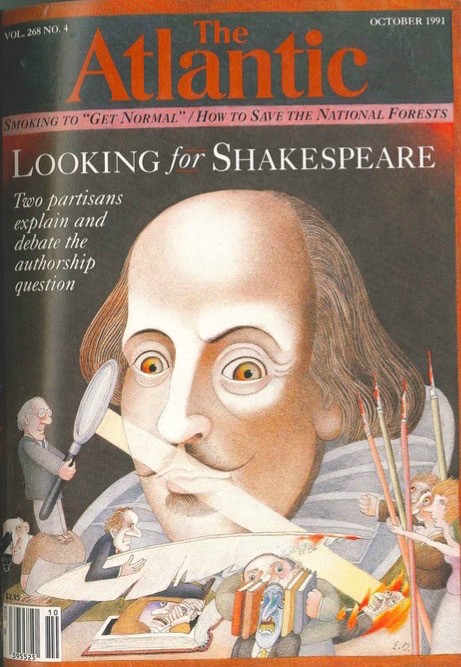
Today marks 400 years since the death of William Shakespeare—or at least, the man we think of as Shakespeare. The best-loved and most-mythologized author in the English language is also one of the most mysterious and controversial; as Irvin Matus noted in our October 1991 issue, “No fewer than fifty-eight claimants to that title [of True Author] have been put forward.”

That October issue featured a heated debate on the subject, between Matus, taking the side of Shakespeare the actor from Stratford, and Tom Bethell, taking the side of the better-read, better-traveled Edward de Vere, the 17th earl of Oxford. Both scholars build meticulous cases for their candidates, and both read convincingly enough to make for a puzzling problem indeed. As Twelfth Night puts it, “One face, one voice, one habit, and two persons! … How have you made division of yourself?”

But, well, what’s in a name? The thing is, I don’t think Shakespeare himself would have minded all this controversy. Whoever he was, it’s safe to say that no one loved a good case of mistaken identity more than he did.

As Megan recently wrote, Shakespeare was “an inveterate punster,” piling meaning on meaning in every phrase so that even his words have double identities. What’s more, his plays are filled with masks and mix-ups, double agents and disguises, lookalikes and false appearances. The effects are often tragic: Hamlet mistakenly stabs Polonius from behind a curtain; two-faced Iago goads Othello to murder Desdemona; Romeo dies because to all appearances, Juliet looks dead.
But there are comic confusions too, and those are sometimes the most illuminating. When we watch the mixed-up lovers of A Midsummer Night’s Dream trade desires for a night, we discover how our own desires shape who we are. Or take Twelfth Night, a play whose gender-bending love triangles fascinate scholars of gender and sexuality today. Shipwrecked twins Viola and Sebastian are separated, each believing the other has drowned. They end up on an island, where Viola for safety disguises herself as a man, Cesario. Beneath her disguise, she loves a duke, who loves a woman, who loves Cesario, who gets confused with Sebastian, whose reappearance seemingly brings both twins back from the dead. Pretty straightforward, right? If you’re dizzy, that’s the point: What the play drives home is that identity can shift and transform, even from moment to moment.

Or take Much Ado About Nothing. Hero and Claudio are about to be married, but Claudio calls off the wedding when he thinks he’s seen her with another man. Hero’s family puts out the news that she has died of shame. Eventually, Claudio realizes his mistake, performs a funeral rite for Hero, and guiltily agrees to marry her cousin. When the time comes, the “cousin” takes off her mask and reveals that she is Hero after all, telling Claudio:

When I lived, I was your other wife
And when you loved, you were my other husband. …
One Hero died defiled, but I do live,
And surely as I live, I am a maid.

Don Pedro: The former Hero! Hero that is dead!

Leonato: She died, my lord, but whiles her slander lived.

There’s a lot that’s admittedly weird about this resolution, not least the fact that Hero is willing to take that credulous jerk Claudio back. But it comes down to the power of story—the fact that the myths around someone’s life become as vivid and real as the true events, the fact that one’s identity is as much created as it is lived. That’s true for Viola, who builds herself a new identity as Cesario. And it’s true for Shakespeare, the actor-turned-author whose impact upon literature is so large that people speculate endlessly about who he was and what shaped him.

The scene also hints at another truth of Shakespeare’s work: that people cannot be a single story. Sweet Hero, as everyone calls her, “dies” when Claudio’s accusations and an inflexible moral code destroy her reputation of purity. Similarly, Othello’s obsession with his ideal of a completely pure and devoted Desdemona ends up literally suffocating her—and destroying him as well. But once we bury Hero the pure, we get the true Hero back.

Simply put, people are complicated. To present them as otherwise would be a failure of art. And Shakespeare knew that well, as Matus in The Atlantic observes:

After all, Shakespeare’s theater, unlike that of his contemporaries, is a theater of characters, a world on the stage, richly populated with humanity in all its variety. … Shakespeare’s creations have a spontaneity and a mutability that may seem puzzling on the printed page but that assume a vividness on the stage. It is from these characters that Shakespeare’s plays take their form and come to life.

These lifelike characters, too, assure the reputation of their creator, so that four centuries after the death of the man from Stratford, Shakespeare cannot die. He, and his characters, and all their many identities, are reborn into their stories, over and over again.
Library of Congress

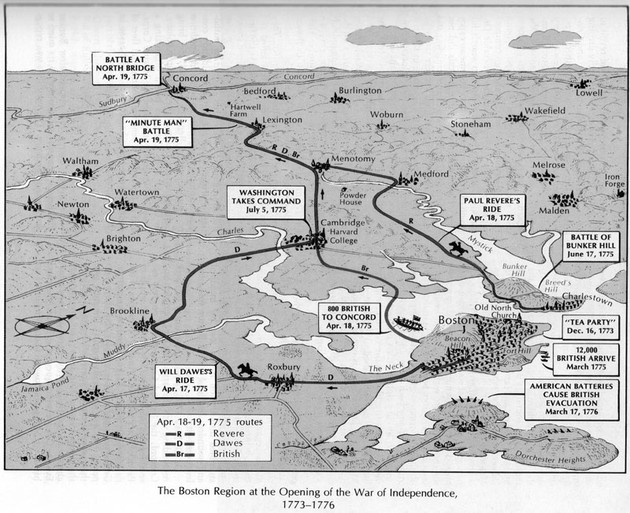
Today is the day of the Boston Marathon, but it’s also a big anniversary for the United States. I’ll let Henry Wadsworth Longfellow describe it:

Listen, my children, and you shall hear
Of the midnight ride of Paul Revere,
On the eighteenth of April, in Seventy-five:
Hardly a man is now alive
Who remembers that famous day and year.

“Paul Revere” by J.S. Copley (Wikimedia)

That’s April 18, 1775, exactly 241 years ago. Longfellow was writing in the January 1861 issue of The Atlantic, and the poem, “Paul Revere’s Ride,” is how I first learned the story—which my first-grade teacher had in picture-book form—of the Boston silversmith who rode all night to warn local militias that British troops were coming to seize their military stores. By the morning of April 19, the patriots were assembled on Lexington Green, ready to fire the first shots of the American Revolution.

It’s a tale that looms large in American culture, and that’s where the Boston Marathon comes in. As Yoni wrote three years ago, the first version of the race was partly intended as a retracing of the path Revere and his countrymen took:

The runners in that 1897 race, fifteen young amateurs, bore little outward resemblance to the minutemen whose journey they symbolically retraced. But alongside each runner rode a uniformed militiaman, providing lemons, water, and wet handkerchiefs, as he followed the paths used more than a century before by militia converging on Boston.

I like the thought of that convergence—in space, in time. Maybe the runners, tiring, imagined themselves as heroes rushing to battle. Maybe they heard the hoofbeats beside them and pictured Revere at a gallop. Here’s Longfellow again:

A hurry of hoofs in a village-street,
A shape in the moonlight, a bulk in the dark,
And beneath from the pebbles, in passing, a spark
Struck out by a steed that flies fearless and fleet:
That was all! And yet, through the gloom and the light,
The fate of a nation was riding that night;
And the spark struck out by that steed, in his flight,
Kindled the land into flame with its heat.

The meaning in itself is exciting, but reader, look at those rhymes: They repeat, but not quite in an even pattern. Like Revere with the British, you know they’re coming, but you can’t be sure when, and in that way Longfellow drives the poem forward in a rhythm that pushes steadily on without turning rote. It’s a galloping horse, running footsteps—a gasp, a stumble—another step forward. It’s urgency and inevitability, the push toward the finish line, the race to a future and a freedom that you deeply believe in.

Incidentally, another famous poet to commemorate Lexington and Concord was Ralph Waldo Emerson, one of the founders of The Atlantic. Some of his writing for the magazine is here, but what’s probably his best-known work is his 1837 poem “Concord Hymn,” written for the dedication of a monument at the Revolutionary battlefield:

By the rude bridge that arched the flood,
Their flag to April’s breeze unfurled,
Here once the embattled farmers stood
And fired the shot heard round the world.

I have family near Concord, and when I go to visit, we’ll sometimes stand by that monument—“on this green bank, by this soft stream,” as Emerson put it. It’s quiet there, surprisingly so for a tourist spot. And what runs through my mind is Emerson’s whispery second stanza:

The foe long since in silence slept,
Alike the conquerer silent sleeps,
And time the ruined bridge has swept
Down the dark stream which seaward creeps.

The contemplative tone (and yes, the rhyme scheme) couldn’t be more different from Longfellow’s urgency. But both poets are writing of history—not just their subject matter, but the way time creeps and gallops onward. In our American dreams of manifest destiny, upward mobility, and a race toward freedom, there’s a sense that history is left behind—that we move on, always, to something better. Yet that forward movement often means retracing old paths, and maybe that’s for the better. Back to Yoni:

The Boston Marathon doesn’t distract from the events it commemorates. It has, instead, come to embody our long march toward greater freedom. The Athenian victory that first inspired it preserved liberty, but only for a privileged elite. The battles at Lexington and Concord that it honors gave birth to a new republic, but one marred by slavery. The Civil War it commemorates turned slaves into citizens, but for women, equality remained elusive.

Like the runners navigating the hills of the race’s course, we have made uneven progress, and our pace has sometimes faltered. We should not be so consumed by the task at hand, though, that we fail to look back to the starting line and recognize how far we have come.

One of the most historic pieces to ever appear in the pages of The Atlantic is MLK’s “Letter From Birmingham Jail,” published in our August 1963 issue. Dr. King had released it a few months earlier, on April 16—53 years ago today. The open letter was in response to a public statement from eight Alabama clergymen who were largely sympathetic to ending segregation but wanted King and others to pursue it gradually through the courts, not public demonstrations, which they said were “unwise and untimely” and “led in part by outsiders” like King. An Atlantic reader offers context for those eight men:

The lives of the eight clergymen were deeply influenced by the times and the Letter itself. (Though none of those eight ever actually received the Letter, and King did not know any of them at the time of writing.) Their stories add perspective and depth to the discussion of the Letter.

My father was one of the eight clergymen. A piece of our story, as well as the recollections of others in Birmingham in 1963, are on this website. Take a look.

It may be surprising to many to learn that some of those clergymen took a public stand against segregation, and they and their families became targets for violent segregationists as well as integrationists who thought they were moving too slowly. Jonathan Bass’ fine book, Blessed are the Peacemakers, presents the stories and research on who actually wrote and contributed to the Letter. It’s worth reading.

Worth watching is the above CSPAN segment featuring Bass, a history professor at Birmingham’s Samford University who provides a lot of rich detail to April 1963.

Library of Congress

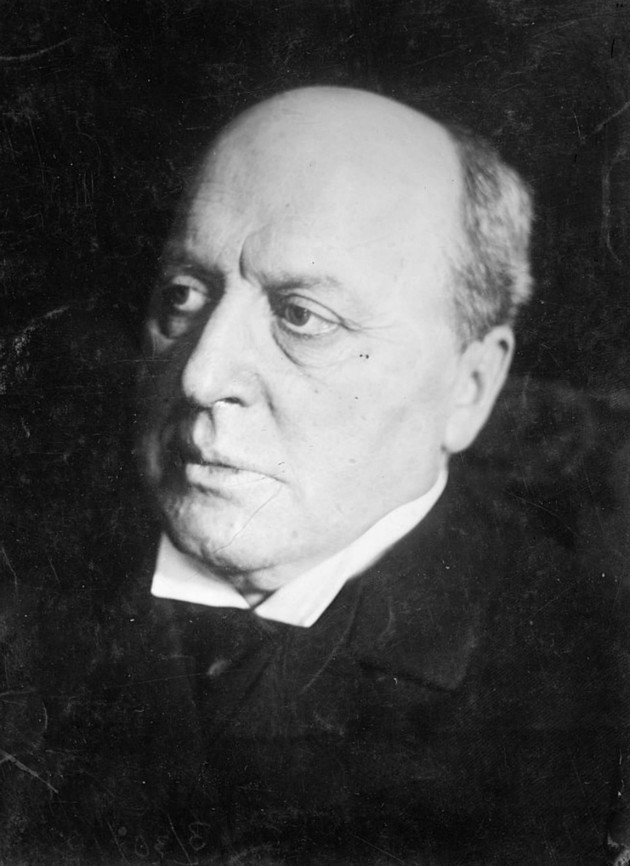
Today is the birthday of Henry James, the expatriate American novelist best known for his books about the gaps and clashes between European and American culture. James, who was born in 1843, is difficult to read; especially as he got older, he was prone to lengthy, complicated sentences that were inaccessible in spite of—or perhaps because of—their being so carefully crafted.

But he’s worth it: The other hallmark of his work is a deep attention to his characters’ psychology. Here’s how a review of his work published in our January 1882 issue summed up his style:

What is all this but saying that in the process of Mr. James’s art the suggestion always seems to come from within, and to work outward? We recognize the people to whom he introduces us, not by any external signs, but by the private information which we have regarding their souls.

That review centered on The Portrait of a Lady, which had been serialized in The Atlantic beginning in November 1880 (the first installment is here). By that time, James already had a long relationship with The Atlantic, which had published one of his earliest short stories, “The Story of a Year,” when he was only 21. That March 1865 story seems to foreshadow some of the plot elements in Portrait. Though the novel is set in continental Europe and the story during the American Civil War, both narratives involve an innocent young woman, a conflict between love and duty, and an ultimate choice that seems to go against both love and logic. Both stories end with a closing door—literal and metaphorical, as if shutting the reader out of the characters’ inner lives.

That’s a harsh sensation. Not only is the reality of James’s fiction immersive, it’s a very self-contained world. As the 1882 Atlantic review noted:

The characters, the situations, the incidents, are all true to the law of their own being, but that law runs parallel with the law which governs life, instead of being identical with it. … So complete is the isolation of the book that the characters acquire a strange access of reality when they talk about each other.

Consider this passage from the first installment of The Portrait of a Lady, where a character talks about meeting Isabel Archer, the title character:

“She didn’t know she was bored, but when I told her, she seemed very grateful for the hint. You may say I shouldn’t have told her—I should have let her alone. There is a good deal in that; but I acted conscientiously; I thought she was meant for something better. … If you want to know, I thought she would do me credit. I like to be well thought of, and for a woman of my age there’s no more becoming ornament than an attractive niece.”

Speeches like this one, introspective and semi-confessional, seem to take over the narrator’s role as they describe their own personalities. Self-consciously, they predict how their listeners will react, and try to justify themselves—even as they admit details that reflect upon them poorly. It’s as if their inner realities, even the things they don’t quite admit to themselves, have been exposed to everyone around them—and they know it.

That’s what struck me the most when I studied The Portrait of a Lady in a class taught by Nicholas Dames, who coincidentally has an essay in our most recent issue, “The New Fiction of Solitude.”

Dames writes of a recent trend in novel writing: Instead of immersing the reader in a cast of realistic characters, thus encouraging empathy, its authors are devoted to chronicling the thoughts of a single narrator, “a ruminative first-person voice given to self-expression more than to distinct characterization.” In some ways, these narrators sound like the self-revealing characters of Portrait. They engage, Dames writes, in “relentlessly self-conscious self-exposure”; they are “prone to obsessions and to a performative brand of revelation perhaps better called testimony than confession.”

Yet where James’s characters are constantly aware of their social position—always wondering what other people think of them, always bringing the thoughts and feelings and voices of their listeners into their own—the narrators of solitude are “aloof from social demands and roles.” They speak “from a voice that distrusts, or disbelieves in, the possibility of communication; an exhibition of a perspective that is true by virtue of being not knowable by anyone else.” That’s James at another extreme: precisely the kind of voice that’s ultimately denied to Isabel Archer, who becomes stifled by the relentless judgements of the society she inhabits even as she declares, “I don’t know whether I succeed in expressing myself, but I know that nothing else expresses me.”

What seems to trouble James’s self-revealing, self-conscious characters is the struggle for accurate self-expression—the possibility that among all their observers, none might ever understand precisely what they mean to say. Dames—who suggested in his comments on my term paper that the Jamesian mode of self-exposure sounded a lot like posts on Facebook—describes the fiction of solitude as a kind of haven in a world that’s overwhelmed with the thoughts of others, where awareness of an audience is constantly with us, where it feels “we’re … at risk of losing an awareness of our identities as protean and separate.” When we read the voice of a narrator who insists so completely on her individuality,

The experience offers a reminder of what the world looks like without a constant awareness of the perspectives of others, whether consoling or besieging. Such reading makes possible a recovery of solitude.

But then, what of the empathy missing in the fiction of solitude? My colleague Megan found an answer in social media posts:

They turn formerly silent thoughts into readable text. They turn “characters” into “people.” The tweet may be about the weather; the insta may depict dinner; regardless, each status update and post and snap is an invitation not just to judgment, but to understanding. Each one challenges its viewer or reader or listener to see the person on the other end as much more than they might seem.

To the extent that we share ourselves, we resemble James’s characters more than ever. We are more exposed yet more isolated in front of an audience, and more likely to be misunderstood. Even so, we still snap and tweet and talk and write, almost compulsively, and the voice that distrusts communication writes a novel anyway. It’s somehow reassuring that for all the risks and anxieties that come with expression, we still attempt to speak ourselves. We attempt to be understood.

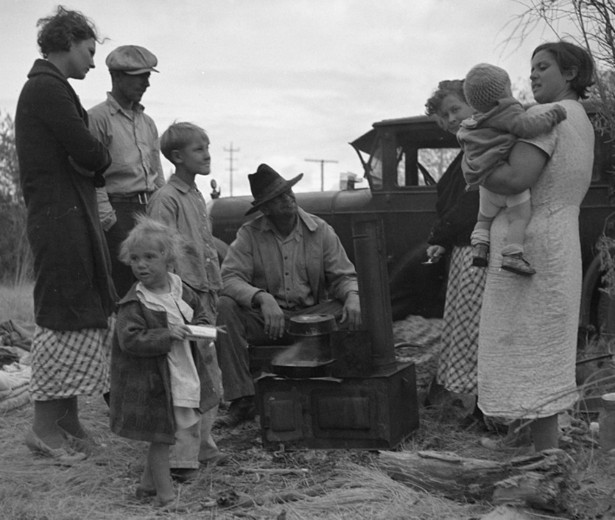
Dorothea Lange / Library of Congress

The Grapes of Wrath, John Steinbeck’s Pulitzer-Prize-winning novel, was published on this day in 1939. Steinbeck’s story, which follows the struggling Joad family out of the Dust Bowl to California, took its title from Julia Ward Howe’s “Battle Hymn of the Republic”—which begins, as Jeff Goldberg noted in 2012, with “the most famous 12 words ever published in the pages of The Atlantic”:

Mine eyes have seen the glory of the coming of the Lord:
He is trampling out the vintage where the grapes of wrath are stored;
He hath loosed the fateful lightning of his terrible swift sword:
His truth is marching on.

Published in November 1862, the poem was an abolitionist battle cry, summing up the best causes that spurred the Union to civil war. As Jeff wrote, the line about the grapes of wrath “promises vengeance against the enemies of freedom”:

Vengeance is effective motivation. But a different sort of motivation is also found in the lesser-known fifth stanza: the draw of transfiguring martyrdom. As Christ died “to make men holy,” Howe wrote, “let us die to make men free.”

To Howe, wrath is a force not just of vengeance but of purity and certainty. It propels “His truth” and “righteous sentence”: “a fiery gospel writ in burnished rows of steel,” and proclaimed by “the trumpet that shall never call retreat.” What’s more, that moral certainty comes with “a glory … that transfigures you and me.”

But the transformations of wrath in Steinbeck’s novel are darker, and more ambivalent.

The novel is deeply concerned with fertility, what the earth and people can produce, which makes the grapes of wrath an apt metaphor for an anger that’s fed and cultivated by hardship and hurt. Here is how Steinbeck describes the cultivation of grapes:

Grape blossoms shed their tiny petals and the hard little beads become green buttons, and the buttons grow heavy. … The year is heavy with produce. And men are proud, for of their knowledge they can make the year heavy. They have transformed the world with their knowledge.

All growth is transformation, but for the farmers of The Grapes of Wrath, sharecroppers and landowners alike, the power to grow is closely coupled with their sense of self. Which makes it doubly painful when the abundant fruits of their labor are destroyed in order to drive prices up:

The people come with nets to fish for potatoes in the river, and the guards hold them back; they come in rattling cars to get the dumped oranges, but the kerosene is sprayed. And they stand still and watch the potatoes float by, listen to the screaming pigs being killed in a ditch and covered with quicklime, watch the mountains of oranges slop down to a putrefying ooze; and in the eyes of the people there is a failure; and in the eyes of the hungry there is a growing wrath. In the souls of the people the grapes of wrath are filling and growing heavy, growing heavy for the vintage.

Here the grapes of wrath become part of a system of perversion, an agriculture that produces violence and decay instead of fruit. There’s death where life should have been: the corn choked by dust; the soil stripped of nitrogen; and the stillborn baby of Rosasharn, the Joads’ eldest daughter, dead in the womb from malnutrition. When the family can’t bear to bury it, they send the body downriver in an apple box, to “go down in the street an’ rot an’ tell ’em that way” what great human wrong has been done.

Meanwhile, wrath works its own transformations on the people, bringing deep divisions between the hungry migrant workers and people in the towns:

They splashed out … to beg for food, to cringe and beg for food, to beg for relief, to try to steal, to lie. And under the begging, and under the cringing, a hopeless anger began to smolder. And in the little towns pity for the sodden men changed to anger, and anger at the hungry people changed to fear of them. ...

The women watched the men, watched to see whether the break had come at last. … And where a number of men gathered together, the fear went from their faces, and anger took its place. And the women sighed with relief, for they knew it was all right—the break had not yet come; and the break would never come as long as fear could turn to wrath.

Wrath is a symptom of fear and a symbol of endurance, but it isn’t always righteous; it’s simply all that’s left. After all, decay and death are difficult to kill.

I’m rereading The Grapes of Wrath for the first time in several years. It strikes home in this U.S. election cycle, when wrath is animating both ends of the political spectrum. This country is angry at banks and at government, at insiders and immigrants, at entitled young people and complacent old people and people on both ends of a policeman’s gun. Bernie delivers his fiery gospel, Trump sounds forth his unretreating trumpet, and both are celebrated for their ability to “tell it like it is,” which in practice is the ability to feel wrath and show it.

It’s hard to say whether the Joads and their cohort, if voting today, would rally behind the Democratic outsider or the Republican one. On the one hand, the Okies and Arkies of Steinbeck’s novel support a socialist vision of shared resources, of all folks helping other folks; they have deep, tragic, tangible grievances with big business, and they’re getting ready to unionize. But on the other hand, they share traditions connected to Trump’s rise: the tendency “to stress sharply differentiated gender roles, to prize aggressiveness, and to disdain weakness,” as my colleague Yoni puts it, and to match “strong familial loyalty … with a clannish suspicion of outsiders.”

Most of all, they are men who have lost what’s theirs and want it back. Ma Joad’s cry—“They was the time when we was on the lan.’ We had a boundary then”—has parallels to Trump’s wall and his righteous slogan, “Make America Great Again.”

But even that is a call for transformation, similar to Bernie’s call for political revolution, and the call to make men free. Wrath can be, and is, a force behind change, and that may be the task ahead: to make our wrath bear wholesome fruit.

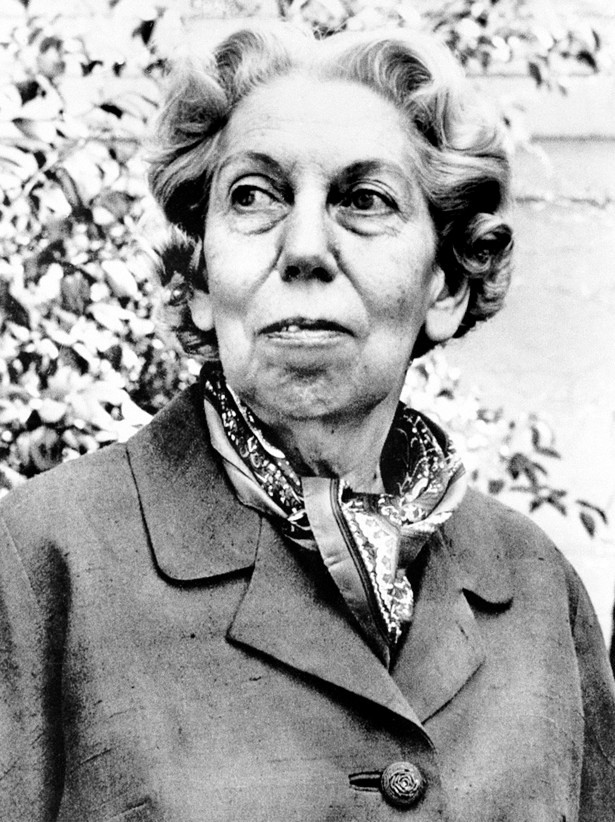
The Pulitzer-winning Southern writer, a master of the short story, would have been 107 years old today. Welty was the author of nearly 20 books, a skilled photographer, and an avid gardener. Humanities magazine has a compelling sketch of her work:

AP

Her three avocations—gardening, current events, and photography—were, like her writing, deeply informed by a desire to secure fragile moments as objects of art. … She appears to see the people in her pictures as objects of affection, not abstract political points. … What Welty seems to say, without quite saying so, is that the best pictures and stories cannot simply reduce the creatures within their spell to specimens. True engagement requires a durable sympathy with the world.

I haven’t read much of Welty’s writing yet, but based on her essay “The Reading and Writing of Short Stories”—published in the February and March 1949 issues of The Atlantic—I have a feeling I should. The complete essay hasn’t been digitized, but you can read an excerpt here. Among her snippets of wisdom:

  • “Every good story has mystery—not the puzzle kind, but the mystery of allurement.”
  • “The great stories of the world are the ones that seem new to their readers on and on, always new because they keep their power of revealing something.”
  • “Beware of tidiness.”
  • “Beauty comes from form, from development of idea, from after-effect. It often comes from carefulness, lack of confusion, elimination of waste—and yes, those are the rules.”

But don’t follow the rules too closely. To quote Welty again: “Sometimes spontaneity is the most sparkling kind of beauty.” She put those ideas into practice in more than a dozen stories for The Atlantic, but because of copyright, only one of them is digitized thus far: “A Worn Path,” from our February 1941 issue. It’s a short story about an elderly African-American woman who travels down a country road to retrieve medicine for her grandson.

Nora details today how public health officials “have joined the political fight over emergency funding for efforts to stop the [Zika] virus.” In a press conference Monday, Anthony Fauci, the director of the National Institute of Allergy and Infectious Diseases, told reporters, “I don’t have what I need right now.”

As researchers scramble to develop a vaccine for the Zika virus, today marks an important anniversary in vaccine history: On April 12, 1955, researchers announced a vaccine for polio that was “safe, effective, and potent. Here’s a “News of the Day” clip from that day, posted by March of Dimes:

That vaccine, developed by Jonas Salk, led to the decline and the eventual eradication of the disease in the U.S. As the CDC notes, “the number of cases of paralytic poliomyelitis reported annually declined from more than 20,000 cases in 1952 to fewer than 100 cases in the mid-1960s.”

For the February 1957 issue of The Atlantic, Dr. David D. Rutstein, a professor at Harvard Medical School, analyzed the success of the Salk vaccine. He was careful not to overestimate its impact:

Summarizing the evidence through the autumn of 1956, we can draw the following conclusions:

The modified polio vaccine manufactured and distributed after November, 1955, has been safe for all practical purposes, but varies from batch to batch in its ability to produce protective substances.

The failure of this vaccine to prevent disease and at times death in certain vaccinated individuals and its apparent inability to reduce the number of carriers clearly indicate that polio will not be “wiped out” by this vaccine.

It is impossible to tell how much of the 1956 decrease in reported cases of polio in the United States is due to polio vaccination, but it is likely that some of it is due to the vaccine.

Rutstein pushed for more research:

Ann Hill “registers a startled expression”
upon receiving one of the first vaccine shots,
on April 18, 1955. (AP)

1. The polio immunization program should be expanded and continued as long as there is a continuing decrease in the number of reported cases of paralytic polio in the United States.

2. Any upswing in the number of such cases must demand a complete revaluation of the entire program.

3. To maintain a high level of protection in those successfully immunized with the present polio vaccine, it is imperative to determine when booster doses of vaccine will be necessary.

4. Lack of uniform potency of the present vaccine demands its improvement or the development of better “killed” or “living virus” vaccines.

We must maintain an objective attitude in the interpretation of results; we must not relinquish opportunities to improve on present methods and to utilize other means which may prove to be more effective in the conquest of polio.

Researchers went on to develop a more sophisticated vaccine, and today polio is far less of a threat worldwide: “The last case of wild-virus polio acquired in the United States was in 1979, and global polio eradication may be achieved within this decade,” according to the CDC.

Here’s hoping the fight to stop Zika has a similar conclusion.

Nonfiction writer Gay Talese recently caused controversy by struggling to name which female writers have most inspired him. On Friday, New York’s Ann Friedman responded by listing “one good piece of nonfiction by a different woman writer published in every year since 1960, the year Esquire first published Talese.” Her list includes three Atlantic pieces:

  • Martha Gellhorn’s “The Arabs of Palestine” from our October 1961 issue. (Several more of her Atlantic stories are compiled here.)

  • Elizabeth Vorenberg’s “The Biggest Pimp of All” from our January 1977 issue. (The byline was shared with her husband, James.)

  • Penny Wolfson’s “Moonrise” from our December 2001 issue.

Friedman’s list also includes essays by Susan Orlean (“Figures in a Mall”), Samantha Power (“Dying in Darfur”), and Hanna Rosin (“The Madness of Speaker Newt”), all of whom have contributed to The Atlantic as well. For our May 2003 issue, Orlean wrote “Carbonaro and Primavera,” a travel piece about Cuba. For our September 2001 issue, Power wrote “Bystanders to Genocide,” based on a series of interviews about the Rwandan massacres, which begin 22 years ago last week. Rosin, our long-time national correspondent, has written dozens of articles for The Atlantic, most recently our December 2015 cover story, “The Silicon Valley Suicides.”

Friedman’s list started in 1960, so we thought we’d take a look at our deep archive for some notable nonfiction works by women:

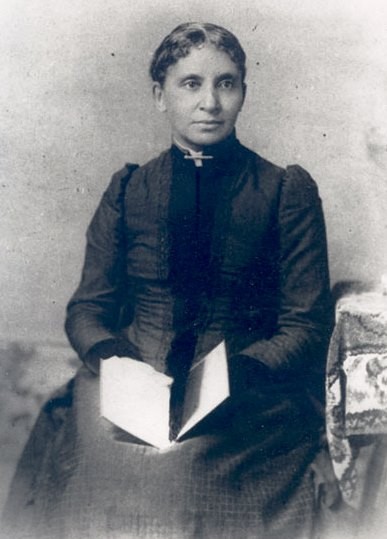
  • Charlotte Forten (Wikimedia)

    Charlotte Forten’s “Life on the Sea IslandsA young black woman describes her experience teaching freed slaves (May 1864)

  • Eudora Clark’s “Hospital Memories I & IIMemories from a war-time hospital (Aug and Sep 1867)  

  • Harriet Beecher Stowe’s “The True Story of Lady Byron’s Life” ‘She has not spoken at all; her story has never been told’ (Sep 1869)

  • Ida M. Tarbell’s “A Little Look at the People” (May 1917)

  • Pearl S. Buck’s “In China, TooReflections on the social and cultural changes transforming China’s young people (Jan 1923)

  • Helen Keller’s “Put Your Husband in the Kitchen” (Aug 1932)

  • Rebecca West’s “Black Lamb and Grey Falcon: Part IExploring the Balkans to see for herself why the fate of the Continent and of England has so often been threatened by the Powderkeg of Europe. (Jan 1941)

  • Helen Hill Miller’s “Science: Careers for WomenSome of the work being done in science both by single women and by those who successfully combine marriage and a career (Oct 1957)

Most of our writings before 1960 have yet to be digitized, but thanks to Sage Stossel—our cartoonist, contributing editor, and general keeper of Atlantic archival knowledge—we know about many other early contributors of nonfiction, including food writer M.F.K Fisher, playwright and screenwriter Lillian Hellman, aviator and Gift from the Sea author Anne Morrow Lindbergh, second-wave feminist pioneer Germaine Greer, and the choreographer and dancer Agnes de Mille (whom we recently noted for International Women’s Day).

As Friedman says for her list, ours is just a start. So in the coming weeks, we’re planning to dig into our post-1960 archive to surface and digitize some of our best nonfiction writing by female writers and take a closer look at its diversity or lack thereof. If you’re a long-time Atlantic reader and have any favorite pieces that left a big impression on you, please let us know: [email protected].

You probably already heard about the death of country music legend Merle Haggard. (Update: David just posted a tribute.) When I saw the NYT news alert this afternoon, I immediately thought of my grandfather, a huge country-western fan in general and of Haggard in particular. So I emailed Pop to see what his favorite Haggard song is and he replied with two: “All My Friends are Gonna Be Strangers” and “I Think I’ll Just Sit Here and Drink.” I went with the latter because it’s nearly happy hour, just in time for my grandfather’s vodka gimlet.

For more on Haggard, check out the essay Tony Scherman wrote for us back in August 1996 detailing how “Merle Haggard’s sandblasted truth has been eclipsed by the twinkly perfection of today’s country music”—more twinkly than ever today, two decades later. Here’s Scherman:

Before he stiff-armed the counterculture in 1969 with his hippie-baiting anthem “Okie From Muskogee,” Haggard was on his way to an unlikely apotheosis.

Rolling Stone critics lionized him as an auteur and an unlettered poet transcending the limits of a trashy genre. The genre itself fascinated hippies. The Grand Ole Opry, Goo-Goo Clusters, Tammy Wynette—wow! To the children of affluence, this was surreal kitsch, exotic yet on native ground. Dennis Hopper and Peter Fonda rode out to discover America in Easy Rider. Merle Haggard was the son of Dust Bowl refugees and sang about it; he was an ex-con and sang about that, too. “I turned twenty-one in prison / Doin' life without parole.” So what if the fellow wasn't a murderer? He was the real thing—ten times as real as Bob Dylan, that middle-class renegade.

But the real thing got nasty and bit the counterculture’s hand. Whether or not Haggard wrote “Okie” as a joke (he's never been very clear about this), it showed the hippies where his heart lay: with the hardhats. With the crackers who blew Hopper and Fonda away. With white working-class America, not romanticized à la Marcuse but in its red, white, and hippie-stomping blue. With the crowds of crew-cut flag-wavers who cheered Merle on all across America, in the autumn of 1969: "We don't smoke marijuana in Muskogeeee . . . "

Recoiling, the longhairs vilified Haggard (“the Spiro Agnew of music,” one critic called him) and then forgot about him. Haggard shrugged and went on his way, singing for his faithful fans and slowly building what Down Every Road confirms is country music's greatest body of work since that of Hank Williams Sr.

Read the rest here.

(Track of the Day archive here. Access it through Spotify here. Submit via hello@)

Today is the birthday of our founding president, Dr. Booker T. Washington. To learn more about his legacy, visit http://ow.ly/10jfyp

A photo posted by Tuskegee University (@tuskegeeuniversity) on

Washington was born on April 5, 1856. “My earliest recollection is of a small one-room log hut on a large slave plantation in Virginia,” he wrote nearly 120 years ago, for the September 1896 issue of our magazine. Here’s a long excerpt from that piece—“The Awakening of the Negro”:

After the close of the war, while working in the coal-mines of West Virginia for the support of my mother, I heard in some accidental way of the Hampton Institute. When I learned that it was an institution where a black boy could study, could have a chance to work for his board, and at the same time be taught how to work and to realize the dignity of labor, I resolved to go there.

Bidding my mother good-by, I started out one morning to find my way to Hampton, though I was almost penniless and had no definite idea where Hampton was. By walking, begging rides, and paying for a portion of the journey on the steam-cars, I finally succeeded in reaching the city of Richmond, Virginia. I was without money or friends. I slept under a sidewalk, and by working on a vessel next day I earned money to continue my way to the institute, where I arrived with a surplus of fifty cents.

At Hampton I found the opportunity -- in the way of buildings, teachers, and industries provided by the generous -- to get training in the class-room and by practical touch with industrial life, to learn thrift, economy, and push. I was surrounded by an atmosphere of business, Christian influence, and a spirit of self-help that seemed to have awakened every faculty in me, and caused me for the first time to realize what it meant to be a man instead of a piece of property.

While there I resolved that when I had finished the course of training I would go into the far South, into the Black Belt of the South, and give my life to providing the same kind of opportunity for self-reliance and self-awakening that I had found provided for me at Hampton. My work began at Tuskegee, Alabama, in 1881, in a small shanty and church, with one teacher and thirty students, without a dollar’s worth of property. The spirit of work and of industrial thrift, with aid from the State and generosity from the North, has enabled us to develop an institution of eight hundred students gathered from nineteen States, with seventy-nine instructors, fourteen hundred acres of land, and thirty buildings, including large and small; in all, property valued at $280,000.

Washington goes on to describe the work of the Tuskegee Institute, which he led for 34 years: “It would be easy for me to fill many pages describing the influence of the Tuskegee graduates in every part of the South,” he writes, advocating for a broader “Tuskegee system”:

Friction between the races will pass away in proportion as the black man, by reason of his skill, intelligence, and character, can produce something that the white man wants or respects in the commercial world. This is another reason why at Tuskegee we push the industrial training.

But his reluctance to push for political enfranchisement put him at intellectual odds with W.E.B. Du Bois, the other leading African American thinker of that time. Here’s a glimpse of that rivalry:

A rundown of Atlantic writings by Du Bois can be found here. And here are the other pieces from Washington published in our magazine:

Washington, who died in 1915, would’ve been 160 today. He is buried on the campus of Tuskegee University.

President Reagan waves, then looks up before being shoved into Presidential limousine by Secret Service agents after being shot outside a Washington hotel. AP

Thirty-five years ago today, on March 30, 1981, John W. Hinckley, Jr. shot President Ronald Reagan outside the Washington Hilton Hotel. Of the six bullets fired by Hinckley, one hit the president in the chest. Here’s ABC News first airing the dramatic footage that day:

When news reached the White House, Reagan’s crisis-management team met in the Situation Room. National Security Advisor Richard V. Allen recorded audio of that meeting on his personal tape recorder. The “previously undisclosed transcripts of the deliberations” were published in the April 2001 issue of The Atlantic. Here’s Allen:

All we knew in the first hour was that the President had been shot. We had virtually no information about the assailant or his motives, or about whether he had acted alone. Vice President Bush was in the air over Texas. … The first assessments by the Pentagon revealed that more Soviet submarines than usual were off the East Coast.

AP      

In the transcript, various members of the president’s security team discuss the location of the “football” (“a briefcase containing the nuclear release-code sequences that is always at the President's side”), the location of a Soviet submarine (“two minutes closer than normal”), and infamous line-of-succession gaffe by Secretary of State Alexander Haig (“Constitutionally, gentlemen, you have the President, the Vice President, and the Secretary of State, in that order...”—nope, the #3 spot is for the House Speaker).

Allen concludes by reflecting on a job well done:

It is important to point out that, despite brief flare-ups and distractions, the crisis-management team in the Situation Room worked together well. The congressional leadership was kept informed, and governments around the world were notified and reassured.

Elsewhere in the Atlantic archive, just months before the assassination attempt, James Conaway profiled then-candidate Reagan and his wife Nancy for our October 1980 issue, in which Conaway wondered, “Why can’t an actor be as good a President as a peanut warehouseman, a hustling attorney, a schoolteacher? It all depends upon the quality of his fantasies between takes …”

Speaking of Reagan’s acting career, check out the fascinating footage seen below, published for the first time by The Atlantic in 2010. It shows Reagan in an episode of General Electric Theater that aired live on December 12, 1954. This time, Reagan has a (fake) gun pointed at him—by James Dean:

Reagan eventually passed away of natural causes in 2004 at the ripe old age of 93. (Marina covered his wife’s death earlier this month.) James Brady—the White House press secretary shot during the attack and the subsequent namesake of the Brady Handgun Violence Prevention Act—died in 2014 of complications reportedly related to the 1981 shooting; his death was ruled a homicide.

Finally, did you know that in 2012, someone tried to auction a vial of blood allegedly taken from Reagan in the aftermath of the shooting? Creepy. But the auction was cancelled and the vial was donated to the Ronald Reagan Presidential Foundation.

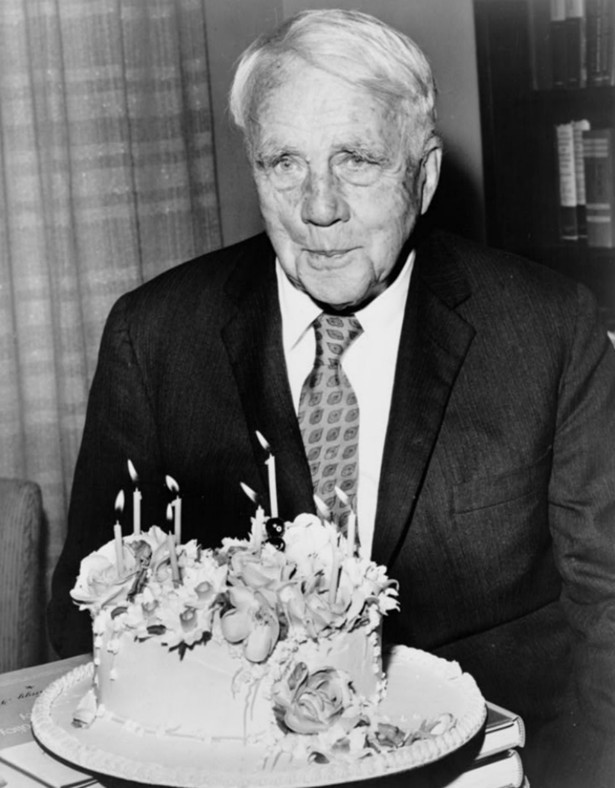
Robert Frost on his 85th birthday (Wikimedia)

The timeless American poet was born 142 years ago today. Frost was plainspoken, pastoral, coolly melancholy, and as easy to misread as he is to quote. He shares these attributes with A.E. Housman, an English poet also born on March 26. And they’re in good company: It’s also the birthday of Sandra Day O’Connor, Diana Ross, and Leonard Nimoy, among other illustrious folks. If any day’s events were to make me believe in astrology, it would be the birthdays of March 26.

But back to Frost. He was born in 1874 in San Francisco and suffered an unstable childhood and young adulthood marked by depression, frustration, and loss: the death of a father, the death of a child. As James Dickey writes in our November 1966 issue, he “settle[d] on poetry as a way of salvation” and pursued it “with a great deal of tenacity and courage but also with a sullen self-righteousness with which one can have but very little sympathy.”

In 1912, Frost submitted some of his early poems to The Atlantic, which rejected them. According to Peter Davison in our April 1996 issue, that “ambiguous snub rankled in Frost’s memory.” (You can read “Reluctance,” one of the rejected poems, here.)

In 1915, however, the English critic Edward Garnett came across Frost’s collection “North of Boston” and became convinced “that this poet was destined to take a permanent place in American literature.” In our August 1915 issue, Garnett praised Frost’s “quiet passion and spiritual tenderness”:

He is a master of his exacting medium, blank verse—a new master. The reader must pause and pause again before he can judge him, so unobtrusive and quiet are these effects, so subtle the appeal of the whole. One can, indeed, return to his poems again and again without exhausting their quiet imaginative spell. … The poet has known how to seize and present the mysterious force and essence of living nature.

Three of Frost’s best-known poems—“The Road Not Taken,” “Birches,” and “The Sound of Trees”—appeared for the first time alongside Garnett’s essay, and Frost’s American career (he had been living and working in England when he published his first two collections) took off soon after that.

But the Frost poem that feels most relevant to Atlantic readers today is “Mending Wall.”

Back in 1915, Garnett declared it “stamped with the magic of style, of a style that obeys its own laws of grace and beauty and inner harmony.” A hundred years later, Frost’s wall seems to embody the “vindictive protectiveness” that Greg Lukianoff and Jonathan Haidt object to in our September cover story “The Coddling of the American Mind.” It’s a structure built to protect, but it creates apparently needless divisions, assuming harm—and maybe doing it—where there was no real danger to begin with.

The poem’s narrator, who has met his neighbor to repair the wall that divides their properties, is unsettled by the lack of trust the wall implies: “My apple trees will never get across / And eat the cones under his pines, I tell him.” He’s worried not just about lack of openness, but also about ignorance; he doesn’t even “know / What I was walling in or walling out / And to whom I was like to give offense.”

Meanwhile the neighbor, who sticks to an old saying that “good fences make good neighbors,” “moves in darkness” because he refuses to reexamine his beliefs. And this refusal is described in a way that implies what the harshest critics of “coddled” students have: a lack of personal growth or development. Indeed, unenlightened and unevolved, he’s compared to “an old-stone savage” (a word that yes, does trigger my defenses). As if the wall surrounds his attitudes, “he will not go beyond.”

This feels like a moral. Yet as a Daily Dish reader put it in 2010, “A poem can be simply wrought while not being simple, and that is one of the things that makes Frost's work so beautiful.” And I can’t help but think that in “Mending Wall” there is something more going on than a plain condemnation of fearful barriers. Writes Mark Van Doren, in our June 1951 cover story:

Good fences make good neighbors—each knows where he is and what confines him. Without a wall between them, each would confuse himself with the other and cease to exist; or if there were fighting, it would be too close—a mere scramble, in which neither party could be made out. Distance is a good thing, and so is admitted difference, even when it sounds like hostility. For there can be a harmony of separate sounds that seem to be at war with another, but one sound is like no sound at all, or else it is like death.

Frost died in January 1963, and that October, John F. Kennedy spoke to honor Frost’s place in America’s history and future. (The president himself died a month later.) Kennedy’s remarks, published in our February 1964 issue, likewise turned to the value of a certain degree of isolation, the importance of protecting individual vision and judgment:

When power corrupts, poetry cleanses, for art establishes the basic human truths which must serve as the touchstones of our judgement. The artist, however faithful to his personal vision of reality, becomes the last champion of the individual mind and sensibility against an intrusive society and an officious state. The great artist is thus a solitary figure. He has, as Frost said, “a lover’s quarrel with the world.”

Perhaps this is the best description for the wall—a lover’s quarrel, the place where isolation and intimacy come to mean nearly the same thing. And perhaps the wall, like many students’ efforts toward social justice, is less “vindictive protectiveness” than a more productive form of conflict: an acknowledgment of barriers that attempts to reach across them too.

After all, the poem’s central task is one of mending, and Frost’s neighbors come together for the work. They repair the damage done to the wall by winter’s chill and the violent recklessness of hunters. They cajole the boulders—“There, stay where you are … !”—and cradle them in their arms. They don’t shy from pain; they “wear [their] fingers rough” on the burdens that have fallen to them, making from scattered unwieldy pieces something that marks out who and where they are.

They build selves, in other words; they come to know where they meet, what divides them. And in this work they share there is something human and healing, something of care.

More Notes From The Atlantic
  • Notes Home