January 1967
In This Issue
Explore the January 1967 print edition below. Or to discover more writing from the pages of The Atlantic, browse the full archive.
Articles
The Other Tiger and the Craft That Createth a Semblance
Benares
Any Number Can Eat
The Great Mail Crisis of Norfolk, Illinois
JORDAN CRITTENDEN is a graduate of Kansas University now living in Laguna Beach, California. His first novel, BALLOONS ARE AVAILABLE, will be published this month by Atheneum.
The Earrings
The survivor of many Washington dinners, DEAN ACHESON became an expert on their pecking order and how to cope with it.
The Museum of Comparative Zoology
Bailiffscourt
Le Véritable Maurice
The Peripatetic Reviewer
Reader's Choice
Indonesia
Potpourri
The Sudan
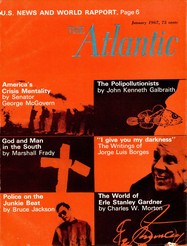
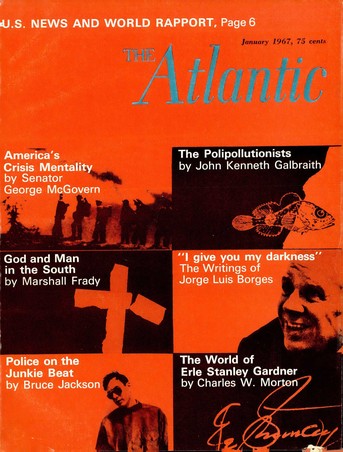
God and Man in the South
Marshall Frady has covered the Bible Belt for Georgia newspapers and for Newsweek a correspondent based in Atlanta. He was born in South Carolina twenty-six years ago, the son of a Baptist minister, and grew up and went to school in South Carolina and Georgia.
Reapers of the Water
Exiles From the American Dream: "The Junkie and the Cop"
In theory, drug addicts and narcotics detectives are bitter antagonists, but they move in the same covert milieus, work the same hours, speak the same language, and form a peculiar partnership in the way both are outcasts from the American mainstream. Mr. Jackson, a Junior Fellow at Harvard, spent several months observing their symbiotic relationship at firsthand. His “White-Collar Pill Parly" appeared in the August ATLANTIC.
The Polipollutionists
Some have observed, through the smog, facets of a new crusade, but it is for Mr. Galbraith, the Harvard economist and former ambassador, to assemble the facts into this report on a growing movement in America.
Reading Late, in Winter
Foreign Policy and the Crisis Mentality
This comment by the junior senator from South Dakota inaugurates a new ATLANTIC feature.
The Setting of the Sun King
The Gallic society of Versailles was divided into three parts, each of them here limned by ATLANTICcritic Louis Kronenberger.
Washington
The Condor Passes
I Southern writer who manages in her fiction to combine realism and symbolism with a touch of the poet, Shirley Ann Grau has been regarded as an author of considerable talent and brilliance since the publication of her first book of stories in 1955. The characters in the following story will appear in the new novel on which she is working, but the story is not a part of that novel.
Pornography and the New Expression
An atavistic, cohesive, and participatory “revolution of the flesh" is the new expression, and in the view of Richard Schechner, volatile editor of the TULANE DRAMA REVIEW,this revolution threatens to transform our theater, politics, literature, and virtually all other forms of cultural expression. The author studied at Cornell and Johns Hopkins before accepting a teaching and editing post at Tulane University.
The World of Erie Stanley Gardner
was krle Stanley Gardner, the world’s most widely read living mystery writer, a Chinese in an earlier incarnation? This and other aspects of the life and times of Mr. Cardner are here presented in amiable detail by the ATLANTIC’S associate editor.
The Eagles of Kazakhstan
As cultural counselor in the United States Embassy in Moscow from 1961 to 1964, Mr. Staples had considerable opportunity to travel and observe in the Soviet Union. He is now an associate director of the Ford Foundation.
A Visit With Argentina's Borges
The works of Argentina’s Jorge Luis Borges were known to but a few in North America when, five years ago, he won with Samuel Beckett the Formentor Prix International des Editeurs. Since then his fame has grown; four collections of his poetry and fiction have been published in English, and his genius is accepted even by many who have not read him. John Gurther tells about Borges as he visited him in Buenos Aires in preparation of the newest Gunther book, INSIDE SOUTH AMERICA, to be published at the end of this month by Harper Row. Keith Botsford, the author of five novels and the director of the National Translation Center in Austin, Texas, discusses the origins and the meaning of the sixty-seven-year-old poet, critic, and fantasist.
The Writings of Jorge Luis Borges