The Eagles of Kazakhstan
As cultural counselor in the United States Embassy in Moscow from 1961 to 1964, Mr. Staples had considerable opportunity to travel and observe in the Soviet Union. He is now an associate director of the Ford Foundation.
by Eugene S. Staples
WALK by the Volga in the heat of early summer. The meadowlands are carpeted with blue and yellow wild flowers. Where birch groves rim the quiet inlets, reflected trees dance gravely and blend in the water with the banks and the sky and the clouds: green, blue, gray, then green again.“Zelyennaya pora,” murmur the Russians, “the green time.” In the heart of the afternoon, peasants stretch out face down on the cool grass, or turn toward the sun and reach up as though to pull it down to the meadow.
Narrow your eyes against the sun and listen. Through the breeze you can almost hear and see Mongol horsemen cutting across the meadow on their shaggy ponies. They laugh and shout in triumph in their cruel language. They raise their swords and strike. How good to shed blood in the bright sun! How satisfying to tread the neck of the vanquished!
What dreams, what racial memories have formed the Russians? Against an immensity of Steppe, forests, and marsh, they appear late in history, rough, black figures plodding toward a destiny that, like a golden dome caught in the flat light of the Northern sunset, gleams on a far horizon. Their way has been like no other: it is a wedding of the Byzantine Christ, an Asiatic court, a French style, the German philosophy.
“Moskva, Moskva,” cry Chekhov’s heroines, like women evoking the names of their lovers. In the old capital, ruined churches along the Moscow River recall the magnificent semi-Asiatic Czars, returning from battle against Mongols or Poles, brilliant in red velvet, black furs, green jade, mounted on white horses. Behold the Caesar of all the Russians!
In Pushkin’s St. Petersburg, stone palaces and bridges are suspended in the misty air and water. Pushkin wrote: “Before the young capital, old Moscow faded, like a widow in mourning before a new Czarina ... I love you, creation of Peter, I love your thoughtful nights.” The Baltic, the Neva, and the sky become indivisible in the white nights, infused with light. Hollow-cheeked ballerinas leap exquisitely as, breathless in admiration, time pauses. Beneath the pilings and the stone molders the dust of uncounted serfs who died building Peter’s dream. Utopia is not a new concept among the Russians.
A classic Ideal, a Purpose, a teleology dominate Russian history, Abram Tertz (Andrei Sinyavsky) observed in his essay “On Socialist Realism.” Comparing the nineteenth-century “negative” hero of Russian literature with the “positive” hero of the eighteenth century and the twentieth-century Communists, he quotes an eighteenth-century poet, Derzhavin:
To the exploits of these Russians.
People, know and understand,
Believe that, aided by His hand
A single Russian can defeat
All your abysmal evil forces. . . .
A contemporary Soviet poet, Alexander Prokofiev:
No flowers grow as bright as ours,
Great is our people, free and deathless,
Our proud, eternal Russian people. . . .
They made Russia and they raised her
To heights of stars and crests of time.
The Russians in history have pursued not happiness, but perfection. The Czars who enthralled Russia’s heart were those who demanded the highest degree in perfection, the ultimate in sacrifice. Ivan and Peter each killed his own son. Stalin, who killed his millions, is moved now from the honored place beside Lenin to lie in less hallowed ground below the Kremlin wall. But the peasants and workers who stand silently and gaze at Stalin’s grave know why they are there. They wall not thus pay homage to a Khrushchev or a Brezhnev.
1825
Soviet Communists like to trace revolutionary roots back to the Decembrists, army officers inspired by the French Revolution who, upon Nicholas I’s accession to the throne after Alexander I’s death, rebelled unsuccessfully in St. Petersburg. A current Soviet version of Griboedov’s nineteenthcentury comedy Gore ot Uma, Woe From Wit, which describes the disastrous consequences of a Western education in St. Petersburg society, superimposes a tableau vivant of the Decembrists, gazing toward the sunrise, as prologue and epilogue. The sunrise is bad Soviet art; it is sound propaganda.
Visiting Russia in 1839, the Marquis de Custine quoted in his journal an eyewitness account of the aftermath of the Decembrist plot: “The Emperor Nicholas condemned the five principal leaders of the plot to death. It was decided to hang them at two o’clock in the morning on the glacis of the citadel at the edge of a twenty-five-foot moat. The condemned men were stationed on a bench a few feet high under the gallows. All preparations for the punishment finished, Count Tchernichev, charged by his master with presiding at the execution, began his function as chief of the executioners by giving the agreed signal. The drums beat, and the bench was withdrawn from under the feet of the criminals. Instantly three of the ropes break; two of the released victims fall to the bottom of the moat, the third is stopped on the bluff. The people who had been permitted to watch this lugubrious scene are excited; their hearts beat with joy and gratitude in thinking that the Emperor had taken this means of reconciling the rights of humanity with the obligations of policy. But Count Tchernichev has the roll of the drums continue. The executioners descend to the moat, pick up two of the victims, one of whom has his legs broken and the other his jawbone shattered. They assist the prisoners in resuming their places under the gallows and reattach the ropes around their necks. But while the third criminal, having remained intact, submits to the same operation, this doomed man collects all his forces, and with heroic fury, cries out in such a manner as to make himself heard in spite of the drums: ‘Unhappy land where they do not even know how to hang a man.’ He had been the soul of the conspiracy; his name was Pestel.”
1924
It is commonly assumed in the West that Hitler and Stalin invented the modern concentration camp. But as Mihajlo Mihajlov, the Yugoslav writer, pointed out in his book A Moscow Summer, it is the Russian Bolsheviks under Lenin who deserve this distinction. The difference is a significant one. All the post-Stalin rulers of Russia claim Stalin’s camps to have been a perversion of Leninism. For his accuracy, Mihajlov was sentenced to imprisonment by a Yugoslav court.
Life and death in the early Soviet camps near Archangel are described in a little-known book, Letters From Russian Prisons, published in 1925 by Albert and Charles Boni. An American diplomat, Peter Bridges, writing about this book recently in the Foreign Service Journal, recalled that its sponsors, the International Committee for Political Prisoners, included Jane Addams, Clarence Darrow, Felix Frankfurter, Norman Thomas, Eugene V. Debs, W. E. B. DuBois, and Elizabeth Gurley Flynn.
Among the political prisoners at the Solovetsky Monastery in the White Sea were Kronstadt men, the flower of Lenin’s revolutionary navy. At the Kronstadt fortress in the Gulf of Finland in 1921, the garrison rose bloodily and unsuccessfully against Lenin’s dictatorial rule, on their lips a cry for a democratic Soviet system. Of 5000 Kronstadt sailors in the Archangel camps, 1500 had survived after a year. There were other prisoners at the Solovetsky Monastery of course: White Russian soldiers from Wrangel’s army, and some Cheka agents following their victims to a living death.
A Solovetsky prisoner wrote in 1924: “The spirit of old Asiatic Muscovy reigned here from the very beginning . . . amid altogether different surroundings. But it is the same spirit. The crosses were removed from the church steeples, the walls of the church were denuded, the icons painted over; in place of saints, portraits of Lenin, Trotsky, and Marx were drawn; and instead of texts from the Bible, the mottoes of the Russian Communist Party appeared. . . . The old monastery, which served as an atrocious prison in former days, has now become altogether an inferno. The prisoners live in the most intolerable conditions, amidst terrible crowding, hunger, cold, and are forced to do hard labor. . . . The emaciated, exhausted, halfstarved men are unable to complete their tasks. Then their rations are cut down and they are . . . condemned to slow death. . . .”
1966
“We did not want salvation for ourselves,” wrote Tertz, “but for all of humanity. Instead of sentimental sighs, individual perfection, and amateur dramatics for the benefit of the hungry, we set about to correct the universe according to the best of models, the shining model of the Purpose which we approached ever more closely.
“So that prisons should vanish forever, we built new prisons. So that all frontiers should fall, we surrounded ourselves with a Chinese Wall. So that work should become a rest and a pleasure, we introduced forced labor. So that not one drop of blood be shed anymore, we killed and killed and killed. . . .
“O Lord, O Lord — pardon us our sins.”
While Tertz was on trial in Moscow, before being sentenced to seven years at hard labor in a prison camp, he is reported to have said, “In the whole history of literature, I know of no criminal trial like this one, even of authors who also published abroad, and in a sharply critical way at that. I do not wish to make any comparisons between my case and those of other people, but am I right in believing that Soviet citizens are supposed to be equal before the law?”
MOUNTAINS floated in an Asiatic sky. The sun retreated, achingly far away. A Kazakh herdsman, booted and jacketed in sheepskin, wild as his animals, stopped me, and in barely intelligible Russian asked where the market was. I walked him a block toward the square.
Sun-warmed in black cotton-quilt coats and breeches, happy Kazakhs shouted and pummeled each other in the ancient confusion of the marketplace, paved now prosaically with crumbling Soviet concrete. Their coats smelled of the orange dust of the desert. An acrid, heady scent of dried peppers pricked delightfully inside one’s nose. The herdsman grunted and left without ceremony.
Earlier, I had eaten the ceremonial apples with the mayor. A city, Communist, bureaucrat, successful, politician Kazakh, the mayor looked at me with distaste and said: “No, we have not had any trouble on the Chinese border.”
“Even Pravda in Moscow has written about the border problems.”
“Ah, yes,” he said. “But there are no problems with the Kazakhs.” The mayor was short and tough. He had black hair, brown skin, high cheekbones, slant eyes. In addition to knowing nothing about the Chinese border, he said he knew nothing about horses.
“Kazakhs still ride horses, do they not?” I demanded. “We had hoped to see horses out here. In America we think of Kazakhs as great horsemen.” The mayor laughed without amusement.
“Back there,” he said, languidly waving a stubby hand toward the mountains. “Please have an apple.” The great red apples were piled in glass bowls on the green felt table.
“Do you know that ‘Alma-Ata’ means ‘Father of Apples’?” he asked. I said I knew, I really could not eat any more apples. They were a foot in diameter.
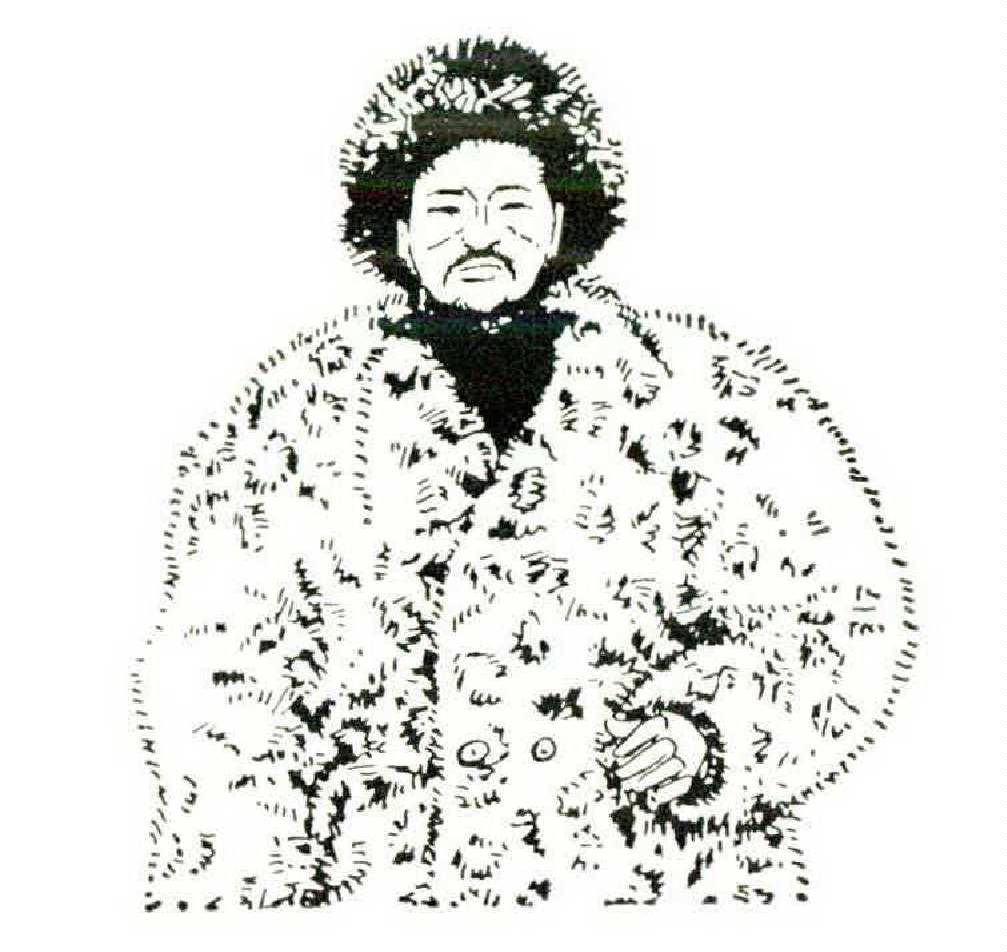
I had in fact seen some horsemen the day before in the mountains outside the city where a road winds up from Alma-Ata along a wooded ridge. Larches and aspen were turning red and gold in the Dionysian air. A stream splashed far below us. Up the road came three Kazakh horsemen, the only ones I saw in Kazakhstan. They wore fur hats, sheepskin jackets, and boots, and their saddle bags bulged with supplies. They went by at a slow trot up the mountain toward China.
Kazakhs rode with Genghis Khan. They were extraordinarily fine horsemen. Later, when they fought the Kalmucks over grazing land, they abducted so many Kalmuck women that Kazakhs today look Mongolian rather than Turkic. For centuries the Kazakhs fought the Russians. During Stalin’s collectivization, so many Kazakhs died that the Kazakh population fell from 3,717,000 in 1926 to 3,098,764 in 1939. Slavs became the dominant race in Kazakhstan.
The Kazakhs never believed much in towns, and Alma-Ata is Russian, a frontier post built in 1854 in the valley under the great semicircle of the Lien Shan Range. It is a pleasant town —the old part — wide, regular streets with low, cool houses set back from the dust of the street. One looks at Tashkent and Alma-Ata and Poona and Delhi and remembers how Russian and British imperial power flowed in a slow, high tide across Central Asia a hundred years ago. The frontier towns of the foreign conquerors were remarkably alike, although the British provided more luxury. The British are gone now from Central Asia. The Soviet Russians remain, imperial heirs of an imperial past, a mixed blessing.
The Soviets have ringed old Alma-Ata with huge tasteless apartment blocks. As in every capital of a Soviet Republic, they have erected an opera house — where the only opera in the Kazakh language is painfully performed before giggling Kazakhs and incredulous foreigners—a university, and a Park of Rest and Culture.
At the park entrance a poster said that “Great Durov” would show his trained animals at the zoo at three o’clock. The Alma-Ata Zoo is on a wooded hill in the park: below it, open to the sky, is a small arena with benches for spectators. I sat down with a dozen or so impassive Kazakhs and a quartet of Russian soldiers and their girls.
Shortly after three, a wild-looking blond youth bounded through the arena doors, and in response to shouts from behind the door, arranged the props. A sweet-faced Russian woman peered out, surveyed the audience, and disappeared. A loudspeaker assailed our ears with a march. Durov the Great entered.
Durov was what Russians call plolny—“solid like a beam.” He wore striped blue trousers, a dirty red coat with gold epaulets and loops, and black leather boots. His long hair and mustache had been blond. He sprang to the center of the ring, bowed deeply, regarded us with glittering eyes, and began:
“Dear friends,” he said, using the classical druzhyia rather than the Soviet tovarischi (“comrades”), “you are about to see a demonstration of the magic of the spirit. The bear will lie down with the lamb. The goat will walk with the wolf. The chicken will know its brother the fox. When love rules the world, all living beings are brothers.”
Durov danced ponderously around the ring half speaking, half chanting, bending his back and slowly raising and lowering his paws like a great blond bear.
The door opened, and a fox fled in. It popped up on a stand. The sweet-faced woman brought in a chicken and set it down on the stand; it hopped twice and jumped on the fox’s back.
“Behold the power of the spirit,” cried Durov, dancing around the animals.
And fears among animals no other,
Then man can hope that peace will rule.
In spite of his propensity to be a fool.
Durov, chanting about duraki (“fools”), was speaking in verse. He swayed and sang his way, mad and sinister, about the ring, which gradually filled with parakeets, a donkey, squirrels, a goat, a horse, a wolf, and finally, an enormous and fearsome bear. Durov’s animals had achieved the state of brotherly love so prized in the Soviet Union: they lived in terror of Durov.
“Aaaarrrh,”growled Durov. “ This is the fiercest of them all. The most dangerous animal in the world — the great Russian brown bear.” The mighty beast rumbled and shambled toward Durov, who snarled back and cuffed the bear lightly. “Watch him lie down with the lamb.” The woman brought the lamb, and the bear and the lamb lay down together in the sand.
We lolled half-hypnotized in the delicate autumn sunlight. 1 had an irrelevant feeling the Kazakhs would have eaten all the animals, including the horse. The Russian soldiers concentrated on making their girls.
Durov sang his farewell poem and dismissed both animals and us. We clapped dispiritedly and left. Purple light spilled over the peaks of the Tien Shan. A chilly wind blew down from the high snowfields. I walked idly toward the exit. Through my musings I started awake to an urgent small screaming issuing from a row of cages.
I turned the corner and came face to face with the eagles of Kazakhstan. Six cages full, an awful flock, these ferocious birds that soar the mountain thermals of Asia from Sinkiang to the Caspian had fallen into captivity. It was feeding time. Into the eagles’ cages the keepers had just loosed the day’s portion of live rabbits.
The great birds, beaks and claws bloodied, stood glaring into nothing. White rabbits crouched in the corners of the cramped cages twitching and eating clover. Whenever a rabbit strayed from the corner, an eagle half leaped, half swooped across the cage and caught the rabbit with a nonchalant fist. The screaming began as the eagle clenched its fists to squeeze the tiny body, then began to pluck the fur. Occasionally, an eagle became bored or distracted. Then his half-dead prey flopped screaming, crippled and bloody, across the cage.
As we watched in the magenta light, a young Russian seized a rabbit that had escaped from the cage, petted it, and stuffed it back through the bars. A girl began to weep loudly. Her companion, cigarette dangling from his lips, said: “Shto ty?” (”You, what’s the matter with you?”). The girl said, in tears, “But how can they do this?”
A man came up suddenly behind us. Raising his arms like an angry prophet, he shouted:
“Ah, shto Vyi, shto Yyi! A Vyi tozhe plakali kagda nas dushili” (“Ah, you, what’s the matter with you! And did you also cry when they were strangling us? ) It was Durov, the mad animal trainer. He waited while a rabbit shrieked, his eyes staring without seeing, and strode off. I watched a moment longer, then wandered off after Durov into the bloody sunset.
Mother Russia, sanguinary Russia, Holy Russia, land of tears. Did you weep, cried Durov? Did you weep when they were strangling us?