God and Man in the South
Marshall Frady has covered the Bible Belt for Georgia newspapers and for Newsweek a correspondent based in Atlanta. He was born in South Carolina twenty-six years ago, the son of a Baptist minister, and grew up and went to school in South Carolina and Georgia.
Throughout the anguished course of the Negro revolution in the South, one would frequently open the Monday morning paper to find a picture of a dozen or so funereal-faced deacons standing shoulder to shoulder on the steps of some small brick church, all of them bareheaded, squinting a little in the Sunday morning sunshine, mouths clamped tightly shut, arms unanimously folded (usually hiding their hands), their blank gazes fixed just an inch or two over the heads of a small delegation of Negroes clustered on the sidewalk below them. It was one of the more curious spectacles produced by the most profound domestic moral crisis of our time.
The South, the most thoroughly churched corner of our country, is a humid gospel region largely under the cultivation of the Southern Baptist Convention; with 34,000 churches and more than 10.5 million members, it is the nation’s largest Protestant denomination. Here in the South the moral challenge of the post-1954 civil rights movement was mounted — and here it was for the most part ignored, sidestepped, and in some cases opposed by the churches of the Southern Baptist Convention.
Perhaps it would be adventurous to suggest that the massive failure of the church to respond to that challenge directly precipitated the racial alienation in the movement today, an alienation dramatized by the new clash of black power and white backlash. But it is legitimate to ask of the South now not only the question, Whatever became of the moderates? but also, Where was the spirit of Christian brotherhood? Where was the Southern Baptist Convention?
True, the new black-power point of view suggests a basic deterioration of the moral terms of the movement itself — weary, bitter acceptance of the human condition as one of hopeless racial estrangement. Bui that disillusionment didn’t spring full-born from the brow of Stokely Carmichael; it was a product of events. The dynamic of the movement during its classic decade was the moral presumption that there exists, however dimly, in every man, white or black, be he Bull Connor or Hoss Manucy or Sheriff Jim Clark, a certain sense of community with all other men. And therefore, this presumption held, no man can brutalize another without eventually wounding himself; indeed, a man can be vitally touched and even redeemed as a human being when his violence is met with love. The new strategy indicates a cynicism about the results of that experiment. And this disenchantment with the ethic of nonviolence arises directly out of the movement’s experience in the South during the past ten years.
Throughout the civil rights struggle, the Southern church had rather the air of God in James Joyce’s Portrait of the Artist As a Young Man: “. . . within or behind or beyond his handiwork, invisible, refined out of existence, indifferent, paring his fingernails.” As one Southern-born civil rights worker put it, “It was like trying to strike a match on a wet windowpane.”
Of course, civil rights workers sometimes encountered more spirited moods in the church than just that of inertia. In Tuskegee, Alabama, on a fine Sabbath morning in the summer of 1965, a handful of young Negroes from Tuskegee Institute tried to climb the front steps of a venerable sanctuary on the square and were bulled back down to the sidewalk by a squad of deacons in a furious, silent skirmish which caused a minimum of static during the hymn-singing inside but left a number of the students bloodied.
More characteristic of the predominantly passive role of the Southern church in the ordeal of the last ten years has been the Americus, Georgia, experience. A litter of antique, homely buildings in the piny flatlands of southwest Georgia, Americus has long been noted for the special wickedness and durability of its racial strife. It began in 1958, with a ferocious series of fire-bombings and shotgunnings at an interracial farm on the outskirts, and they seemed to set a style of vicious directness that came to be called the “Americus approach.” There is even a quaintness in Americus with regard to the standard civic sins: landlords of the Negro neighborhood are given to converting chicken sheds into five-unit apartment complexes, for which they charge four dollars a unit per week, offer no more elaborate toilet facilities than the yard out back, and simply remove the front door from a tenant’s house when he falls behind in his rent.
Not surprisingly, Americus has been convulsed by a succession of civil rights demonstrations, the most serious coming in the summer of 1965. With what had become a finely honed community knack for instant outrage, a Negro woman who was a token candidate for justice of the peace was seized with three of her Campaign workers while standing in a “white women only” voting line and clapped into jail for nine days. As Americus reeled through a delirium of demonstrations and blunderbuss arrests, a white youth was shot to death one evening as he stood on a street corner.
Typically, it was not the local church which finally emerged as the conscience of the town, but a solitary white layman — Warren Fortson, a member of the country club, a former member of the board of education, a county attorney, director of the Rotary Club, Sunday school superintendent; a hulking rumpled small-town lawyer whose brother was Georgia’s secretary of state. But Fortson had long seemed a trifle gamy to residents of Americus; for one thing, he had defended Negro clients. Now, after the slaying of the white youth, he mounted an obviously hopeless campaign for the formation of a biracial council. He kept insisting, “I believe that the average person wants to be kind rather than unkind. I just believe it.”
Fortson and his family found themselves isolated by the community within a week. Fortson’s law practice withered away before his eyes. “All of a sudden,” his wife remembers, “we were invisible.” Before the end of the summer, he felt obliged to move to Atlanta.
Fortson’s notion that “the average person wants to be kind rather than unkind” was perhaps the most Christian sentiment heard in Americus in years. But he was afforded little company or comfort by the church. In fact, the church had a discreet hand in the ostracism of Fortson. He was dismissed, abruptly and without explanation, as a Sunday school teacher. And when a petition began circulating through the community demanding that Fortson be fired as county attorney, a little band of his friends mustered a petition asking that he be retained — but Fortson’s minister refused to sign it.
About the only other way the church in Americus involved itself, from the violence at the interracial farm to the exile of Warren Fortson, was to turn away integrated delegations of whites and Negroes each time they appeared for Sunday worship.
At the leading Baptist church one Sunday morning during the 1965 summer demonstrations, while the minister inside was delivering himself of a sermon on grace and the need “for God’s love to come into the hearts of all men,” his deacons were poised on the steps outside in that stylized tableau barring an integrated group from the church. One of these deacons later assured friends, “We had what it took to keep them out.” Whether he meant artillery or simply the number of deacons is uncertain, but one citizen who was at the church that morning said afterward, “I bet it was mighty uncomfortable, coming inside after they got those niggers to leave and having to sit down in the pews with those hard things in their hip pockets — and having to go down real slow so there wouldn’t be a clunk.” The rationale most popular throughout the South for all those Sunday morning church-step confrontations was “ Those people didn’t come to worship; they came to demonstrate.”
Not far from Americus, there is one of those dwarfish wooden crosses with its apocalyptic warning seen along the highways of the South — tilted at the edge of red-clay ditches, mud-spattered among rusting soft-drink signs. These crosses, with a word lettered on each of their four sections, read “Get Right With God.” Only someone or something has whacked off one arm of the cross near Americas, so that it now reads:
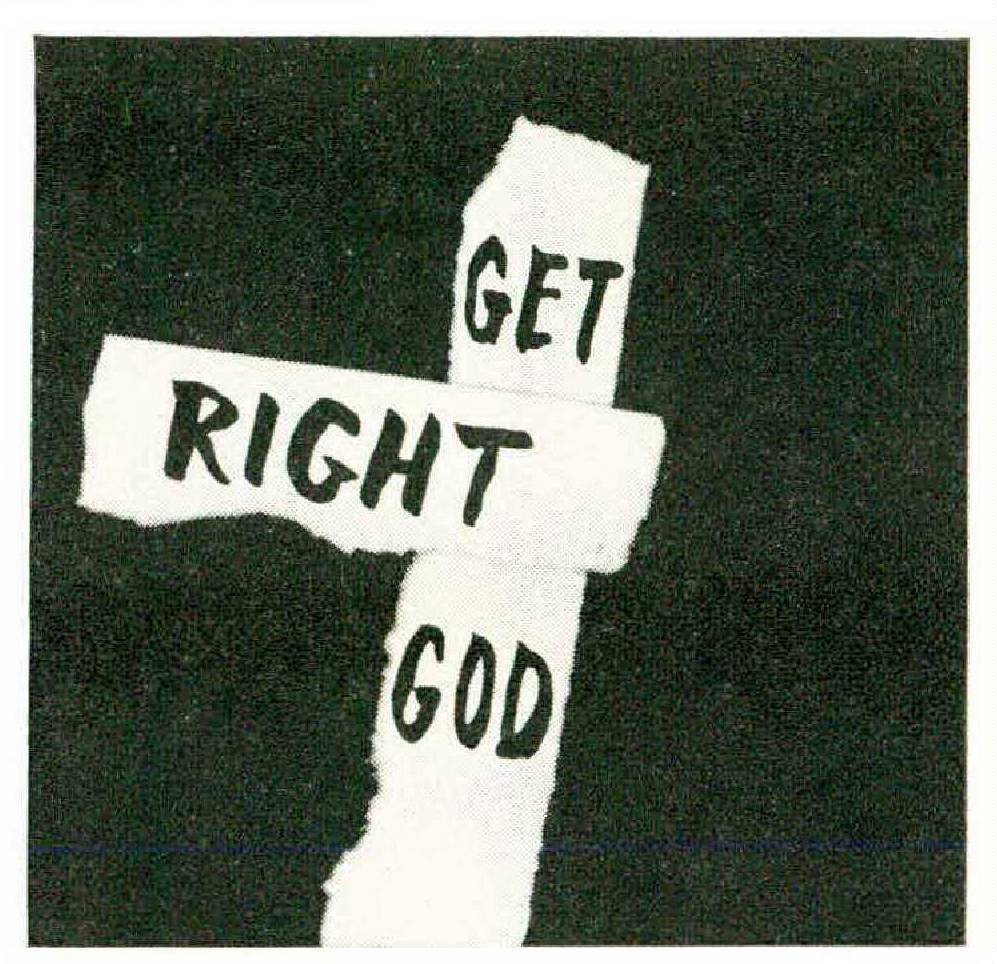
The Southern Baptist Convention exists as the folk church of the white South. This is so not only because of its pervasiveness, but because in most communities the Baptist congregations taken together usually make up a more democratic assembly than the congregations of the other churches — sun-scorched farm families, mild, dowdy bespectacled grocers, florid-faced used-car dealers, silent families of textile workers, the women thin and solemn, a few prosperous druggists, perhaps a couple of bank executives, and a doctor or two. The quarter of a Southern community where the Klan mentally flourishes— the quarter of tin roofs and dishwater-sour dirt yards and chinaberry trees and pigeon coops and power lines and pool halls and auto repair garages — is generally tilled by the gaunt, hard plow of the Pentecostal groups.
For an aspiring Southern politician to have been born a Baptist is considered one of those providential blessings like being horn with a grits-and-gravy drawl; if he was born anything else, even Methodist or Presbyterian, he simply doesn’t talk about it much — the political import of the other denominations ranges from irrelevant to ominous. But as dapper and urbane a politician as Georgia’s exgovernor Carl Sanders has become the South’s most conspicuous Baptist layman — he delivers sermons in his home church in Augusta.
Most Negro Baptists in the South belong either to the National Baptists Incorporated or to the National Baptists Unincorporated. Dr. Martin Luther King, who still insists he feels most comfortable as a Baptist because “there is a tradition of the creative use of protest and dissent in establishing right, and a principle of freedom, a lack of authoritarianism, that gives the church a self-corrective power,” is an American Baptist. So negligible, in fact, is the number of Negroes who are Southern Baptists that the Convention has not even bothered to keep any statistics on them. “Negroes used to have membership,” allows a Southern Baptist official, “but they started setting up their own churches over a period of time from 1875 to 1900. It was their idea — but, of course, the convention didn’t discourage them.”
Any indictment, then, of Christianity’s posture in the South during the last ten years of moral crisis is inevitably an indictment of the Southern Baptist Church. The fact is that by its very structure — or studious lack of it, which is part of its character as a folk church — the Southern Baptist Convention has had the effect of reflecting and confirming local prejudices rather than challenging them. “Many prominent Baptist church, members are still the owners of squalid shacks in which Negroes make their home and pay through the nose for the privilege,” says one young Baptist minister in South Carolina. “Obviously, these people see no relationship between their faith and their treatment of their fellowmen. And few are the pulpits that are going to risk an honest attempt to show this relationship.”
Invariably, those few ministers who take the risk are toppled from their pulpits. Last summer in Macon, Georgia, a Southern Baptist church located on the edge of Mercer University, a Southern Baptist campus, threw up one of those front-step blockades when some Negro students tried to enter for morning worship. The church’s pastor, outraged, protested the ugly business and urged the church to adopt an open-door policy; the deacons promptly urged the church to dismiss the pastor. The Sunday morning in September when the vote was to be taken, a Ghanaian student at Mercer who had been converted by Southern Baptist missionaries was put in police custody by the deacons for seeking admittance to the morning service — and the congregation then voted to boot the minister.
The Southern Baptist “Convention” itself is not so much an organization as an event. It exists only while it is in session; the rest of the year, it is given up to a state of genial cooperative chaos. The assorted convention programs to which each church contributes — missions, publications, the seminary system — are administered by a small headquarters in Nashville, Tennessee, which is the only manifestation of a central convention structure that does not vanish after one furious, flaring week of life each year. Exercising more power than the general convention are the Baptist state conventions: for one thing, they are simply closer to the peculiar passions and paranoias of die individual churches. They also run the fifty-four Baptist colleges, which process, by way of the seminaries, the pastors to service those churches — earnest, affable young men who come off the farms and out of small towns and the mill villages of the textile cities. But authority in the Southern Baptist Convention, in an extension of the fond Baptist tenet of the priesthood of every believer, ultimately rests with the individual church, and “nobody,” sighs a Nashville official, “can tell ‘em anything.”
Actually, the cantankerous, institutionalized disarray of the Southern Baptist Church is offered both as an apology for its sluggishness in social involvement and as its genius and grandeur. “Of course, we can’t operate as quickly and emphatically as authoritarian groups with central control,” says a prominent Baptist figure in Atlanta, “but we operate more effectively, because we bring the people with us.” More often, though, the people haul the church along with them. What could pass for the Southern Baptist establishment —the officials of its seminaries, the pastors of some of its largest churches, the headquarters in Nashville —is modestly assertive in its concern about the affairs of the world outside the sanctuary. It has managed, in the past, to provoke a certain amount of eloquent floundering at general convention sessions, with some sporting resolutions about justice and brotherhood, that vaguely resembled conscience-wrestling. But, since their convention resolutions amount to no more than simple expressions of opinion, binding on no congregation, those flounderings have been academic, and they usually end in a kind of compounded impotence, with the rejection of the resolution anyway.
The church’s detachment has been both structural and doctrinal. “When you come right down to it,” a minister in a small South Carolina town told his congregation one Sunday morning recently, “there are only five things we Southern Baptists believe in. Number one, we believe in God as Father. Number two, the lordship of Christ. Number three, salvation through Christ. Number four, the Bible as our sole authority. And number five, the separation of church and state.” That enumeration of beliefs is probably as close as one could come to defining the common interest that holds the 34,000 independent churches of the Southern Baptist Convention together, and why they have acted during the past decade as if the Negro revolution didn’t really have anything to do with them.
If the Southern Baptist Convention serves as the folk church of the South, then the South’s folk preacher would have to be Dr. Billy Graham, one of whose own pronouncements on the matter is “The church should not answer questions the people aren’t asking. We’ve become advisers, social engineers, foreign policy experts, when we should be answering the questions of the soul. Christ taught that man must first be born again. That priority is found in the Great Commandment. We can’t get away from the Bible, or we’re doomed.” Former Southern Baptist Convention president Dr. Wayne Dehoney — who presides over one of the two First Baptist churches in Jackson, Tennessee, the other First Baptist Church being Negro— echoes this sentiment. “It has to be remembered that Jesus said, ‘Ye must be born again!’ This is the basic issue.”
Nothing in the life of Jesus matters to the Southerner quite like his suffering and his death; it is perfectly matched to the Southern mystique, to the Southerner’s tragic sentimentality. Religion to the Southern Baptist is a kind of romance surrounding Jesus. Christ is, in this religious sensibility, a figure of melancholy sweetness, with a tragic bearded face strikingly like those thin doomed faces of young Confederate officers that peer out of flecked tintypes. The poignancy of Jesus to the Southerner is that He consented to become human, that from the moment of His birth He was divinity crucified on a cross of flesh, and that He did all this —oh, unbearable sweetness!—for the sake “of a wretch like me.” Nowhere is the Southern Jesus so clearly defined as in the simple theory and melodrama of the old hymns that most Southerners, and certainly most Southern Baptists, have heard in their youth at many a tent revival on the weedy outskirts of town: “I need Thee, O, I need Thee; every hour I need Thee . . . ! What can wash away my sins? Nothing but the blood of Jesus. What can make me whole again? Nothing but the blood of Jesus. Oh, precious is the flow that makes me white as snow; no other fount I know. ... I come to the garden alone, while the dew is still on the roses, and the voice I hear, falling on my ear, the son of God discloses. And He walks with me, and He talks with me, and He tells me I am his own. . . . Oh, how I love Jesus, oh, how I love Jeeessusss! Oh, how I love Jesus, because He first loved me. . . .”
IT HAS been suggested that beginning with slavery, the Southern white man has over the centuries shown a particular weakness for being dehumanized by his property, that he is congenitally and irredeemably, in Faulkner’s terms, Snopesian. Indeed, this indictment was delivered in general terms on a spring day two years ago in Jackson, Mississippi, by a bespectacled young Negro named Robert Moses, who had been the saintly genius of the Student Non-Violent Coordinating Committee back in its earnest nonviolent days. Moses was paying a visit to an old friend, the Reverend Edward King, white chaplain at interracial Tougaloo College on the outskirts. He took the position that the white race as a whole was exhausted, that the values and vitality of white society were bankrupt, and that therefore the Negro had nothing to gain from integration into white society; that white civilization would cave in on itself in twenty or thirty years; and that, finally, this would be the last conversation with a white man in which he would ever engage. And in fact, Moses’ portrait of the white race suggests Faulkner’s description of Ab Snopes in “Barn Burning”: “without depth — a shape flat and bloodless as though cut from tin . . . harsh like tin and without heat like tin.” The notion, not a new one in principle, is that having accumulated land and buildings and cars and leases and cash, and having invested so much energy and will and hope and calculation in that accumulation, and in the protection and increasing of it, the Southern white has actually become all those things. He is, in this interpretation, only the husk of a human being, he is possessed by his possessions: he has come to smell faintly of brass, of rust, of machine oil. Quite possibly, all peoples become Snopesian at a certain point in their cultural transition from the earth to the city, and the Southerner has simply been stranded at that point longer than most. The notion also holds that the Negro for all those centuries has had nothing but air and earth and water and the seasons, and himself and his kind; he has simply had nothing else to relate to or identify with, and he therefore knows, more intimately and immediately and nakedly, what being human means — what laughter and love and terror and pain and struggle mean.
Nowhere has the speculation about the death of God provoked more anxiety than in the Snopesian South. In Sunday morning sermons, in ripsnorting gospel messages on the radio, in the brief little television devotionals on weekday mornings, in ministers’ addresses to grave civic club luncheons, in the religious columns in the Saturday newspapers, the disappearance of God is being debated with a fretful persistence, a preoccupation that approaches a kind of vast morbid twittering.
IRONICALLY, the civil rights movement was not only a profound moral experience but a dramatically religious one. What is happening today is something like the tidal ebbing of faith in Matthew Arnold’s “Dover Beach,” a withdrawal to the naked shingles of anger. The prophets now scuttling over those shingles are the young activists like the leaders of SNCC — sardonic, implacable, believing in mute, pure, unequivocal action and in creating crises in which they may beautifully and sacredly act. They are empirical and inductive and spontaneous, essentially adolescent, somewhat nihilistic, with a furious impatience with systems and theories and abstractions in general — and a contempt for words, which is why they usually come off so badly on television interviews. Though they are ruthlessly moral, they have become significant at a moment when the movement seems less moral than mechanistic. But even such activists as James Foreman and Stokely Carmichael admit that for the Negro masses in the South religion has been a necessary context for the movement.
Of course, the great, charismatic leader of the Negro revolution during its classic stage was Dr. Martin Luther King, most eminently a Southern Negro minister — as are his five horsemen, Williams, Bevel, Vivian, Shuttlesworth, and Abernathy. The whole sequence, from the bus boycott of Montgomery to the march on Selma, was conducted with the air of a revival camp meeting. If during the classic days of the movement, there was one classic occasion (already, a certain nostalgia is setting in about those days), it was the mass meeting. It would commence just after nightfall in a bleak wooden Mississippi church with light coming through its cracks like a shuttered lantern, a cluster of cars and pickup trucks parked quietly in a grove of scrub oaks outside, and a sound of singing in the darkness. Inside in the hot sanctuary would be a crowd of Negroes, some of the men still wearing the faded khakis and clay-caked brogans of their day in the fields behind their mules, the women in Sunday dresses, one or two wearing enameled straw hats with sprigs of starched organdy daisies. All the windows would be open to the sweet chirp of crickets outside, and paper fans would flutter over the rapt polished faces of cooks and tenant farmers and maids and sawmill hands and janitors, the dull wooden floor thumping under them like the heartheat of their hope as they stomped and clapped and sang their way through new translations of the ancient yearning Negro spirituals.
The Reverend C. T. Vivian, one of King’s aides, told me, “If you want to know the truth, brother, the movement has made a heap more Christians during the past ten years than the churches have.” Actually, there were to be found at the edges of the Negro revolution in the South a number of young white Southerners who had been studying to become pastors before the South’s racial anguish became so climactic, and whose consciences simply could not endure their churches’ detachment. Usually associating themselves with foundations and government programs, they had the air of refugees: they tended to be profane and disheveled, and their tempers were ragged and raw. One of them, a bright, congenial young man who had studied for the Southern Baptist ministry at Wake Forest and earned his divinity degree, but who finally said farewell to the pulpit and joined a government program in Mississippi, explained last summer, “Sure I feel like an apostate. There isn’t a Southern Baptist church now that would have me, I know. But I consider myself still in the ministry, God damn it. This is my ministry as a Southern Baptist, I don’t care what anybody says.” Still in the ministry, God damn it: the loss of these earnest young men is one sobering toll exacted on the Southern church for its deafness to the moral appeal of the Negro struggle, for its decision to abstain from the moral conflict mounting about it.
WITH the while Southern church paralyzed during these ten years of deep urgency, it was inevitable that other religious parties would move into the vacuum. Selma, as magnificent a moment as it was, still was an aberration, sudden, accidental, and fleeting — and it is doubtful that there were ten ministers there from Southern churches. More persistent, in a way, has been the Delta Ministry, an expedition of solemn, moral-minded young theology students from the North who tend to think of their presence among Mississippi’s Negroes in theological terms—“Man’s relation to God, man’s relation to man, it’s all a theological problem.” Something of a curiosity in the primitiveness of the Delta setting, the Ministry’s young theologians, supported by the National Council of Churches, have been lingering there like mosquitoes of conscience since 1964, never quite able to strike up the rapport with local Negroes that most SNCC and Mississippi Freedom Democratic Party partisans enjoy, but trying hard anyway, for which they instantly became an object of acute suspicion by the white community of Mississippi.
Fred Lowry, thirty-one, a Yale Divinity graduate, explained to me last summer: “This is the gospel approach, isn’t it — identification with the despised? It was Christ’s approach, that’s for sure, in the process of which he earned the alienation and hostility of the Pharisees. If people are dealing with vital matters of gospel, they just better go all the way. This is not a structural, institutionalized ministry, but a charismatic one. And that, after all, is how Christianity got started.”
Finally, of course, there are those white ministers of conscience who remained in the Southern Baptist Church, and for them the past decade has been another kind of anguish —perhaps the loneliest kind. Isolated from civil rights workers in their communities, with a genuine and even passionate private identification with the Negro struggle, they have been men without a country, trying Sunday after Sunday to smuggle into the hearts of their congregations some sort of racial compassion, some sense of outrage and pity like their own, with an endless series of sermons about brotherhood and God’s universal love for mankind, aware all the time that the instant they drop their abstractions, they will most certainly lose their pulpits. In fact, the past ten years for them have been a kind of long unavailing ordeal of abstractions. Except for the quiet, timid, but dogged ministry of these men — and there are more of them in the South than one can estimate with any precision —• the movement could have met with a lot more mayhem than it did. A Baptist minister in South Carolina said to me, “It’s the only way I know of to reach these people. They can’t be abandoned by everybody — somebody’s got to stay with them, to try and get them to see it for themselves. And this is the only way I know how to do that.”
There are now signs that leaders of the Southern church are coming to recognize that the final price of the church’s indifference to the domestic crisis of our time will be a growing sense of irrelevancy. One Georgia Baptist leader laments what he calls a crisis of identity within his church: “We used to carry around the Baptist covenant in the back of all our hymnbooks, but I doubt if one Baptist out of a hundred could even find the thing for you now, much less tell you what it says.” The pastor of the First Baptist Church in Augusta, Georgia, declares that his people have become “doctrinally illiterate.” And a young South Carolina Baptist minister says that all “Southern Baptist” means to the average Baptist layman is “I ain’t Catholic.”
The irrelevancy of the Southern church during the Negro revolution has left a legacy of despair not only among Southern Baptists. John Morris heads the Episcopal Society for Cultural and Racial Unity, a wildcat social action group within his church which has been only thinly tolerated by most Southern Episcopalians, and he frankly admits to “an ultimate pessimism” about the church’s capacity to survive, much less lead, social change. Beefy, but with the fastidious air of an aristocrat embattled by vulgarity, Morris accompanied the body of one of his charges, Jonathan Daniels, back to Daniels’ home in New Hampshire after the young seminarian was shotgunned to death two summers ago by a part-time deputy sheriff in Hayneville, Alabama. He remarked not long ago, “I’d just as soon see it all go down the drain, really. The reformation spirit is passé in the church; there’s this hopeless gap of impotency between the pulpit and the pew.” And, as Morris says, no matter how many motions and resolutions of concern are now passed by denominational bodies, it won’t matter much anymore. “With the sword of Damocles hanging over us, maybe we’ll start getting together more and more, doing more and more — but it’ll always be too late.”