September 1966
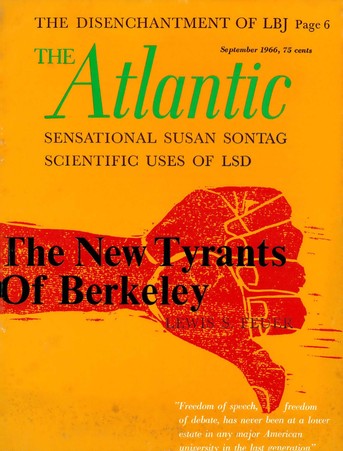
In This Issue
Explore the September 1966 print edition below. Or to discover more writing from the pages of The Atlantic, browse the full archive.
Articles
LSD and the Third Eye
The science of psychedelic experience
Mrs. Beneker
Although she has worked as a newspaper reporter and written a travel book and two children’s books, Violet Weingarten attempts fiction for the first time in this story about a woman who is wiser than she knows. The author was born in San Francisco, grew up in New York, graduated from Cornell, and now lives in a New York suburb.
The Necklace
Kelp Forests of the Pacific
“I can only compare these great aquatic forests with the terrestrial ones in the inter-tropical regions ,” Charles Darwin once wrote of the giant kelp growths off the Pacific Coast. Rich in delights and trophies for the skin diver as well as potash for industry, the undersea forests are menaced by the eating habits of the spiny purple sea urchin. Mr. Marx, a California free-lance writer, here tells of the mysteries and values of the forests that astonished Darwin.
Literary Biography: Art or Archaeology?
Writers about writers this month engage the attention of ATLANTIC critic Louis Kronenberger. He illuminates the literary biographer’s problem in deciding whether to write about a man who wrote books or about the books a man wrote.
The Case for Grump
Mead
British writer MARGERY SHARP gained a reputation in the United States with her novel THE NUTMEG TREE in 1937. This is her first appearance in the ATLANTIC.
Decapitation Revisited (All Tumbrils Are Go)
JOHN H. SLATE,a New York lawyer, reflects upon the days when decapitation was in flower.
The Entrapment of John Alden, or We Paint the Lily, We Beard Mr. Longfellow
The Witches of 1966
The Perfect Pet
“Serpents make perfect urban pets — or so say the numerous New Yorkers who own them. NEW YORK TIMES MAGAZINE
Barber, the Bard, and the Barge
The Peripatetic Reviewer
Reader's Choice
Potpourri
De Gaulle in the u.s.s.r
Illinois
Middle East Arms Race
Crime, Confessions, and the Court
“Coddling criminals” and “handcuffing the police” are the latest bitter charges aimed at the Supreme Court. In fact, the stormy course the Court has followed through its Escobedo and Miranda decisions is much simpler, if subtler, than most of its critics realize. Mr. Cipes, a lawyer, former federal prosecutor, and now attached to the Georgetown University Institute of Criminal Law and Procedure, charts the Court’s wary but determined progress toward guaranteeing the rights of the accused in the police interrogation room. The article is drawn from Mr. Cipes’s book THE CRIME WAR, to be published by New American Library in January.
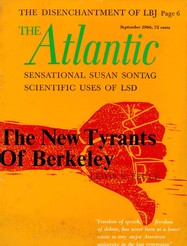
The Sensational Susan Sontag
Mrs. Ellmann has taught at Wellesley and Roosevelt University and has written for ENCOUNTER, COMMENTARY, and THE NATION.She now lives in Evanston, Illinois, and is at work on a book about “the peerless capacity of the novel for the reiteration of stereotypes, particularly stereotypes of women,” to be published by Harcourt, Brace & World.
Washington
The Heat of the Sun
This new narrative by one of today’s classic storytellers will appear in a collection of stories and tales entitled THE HEAT OF THE SUN,being published this month by Atlantic - Little, Brown.
The Rise of Nopanaceism
In the name of common sense, says C. W. Griffin, defenders of the status quo argue successfully against any form of progress. The author, a New York structural engineer and journalist, has published essays in several periodicals. This is his first appearance in the ATLANTIC.
The Decline of Freedom at Berkeley
by Lewis S. Feuer After nine years of teaching philosophy and social science at the University of California at Berkeley, Professor Feuer will leave to become professor of sociology at the University of Toronto. His angry appraisal of the “free speech “ explosion at Berkeley and its aftermath is both compelling and provocative, and the ATLANTIC is inviting others who are concerned over the implications of the Berkeley experience to comment on Professor Feuer’s analysis. The author of SPINOZA AND THE RISE OF LIBERALISMand THE SCIENTIFIC INTELLECTUAL, Professor Feuer was an Exchange Scholar at the Soviet Institute of Philosophy in Moscow for four and a half months in 1963.
For Garden Country: Rally on the Right
This study of the right wing in caucus assembled teas prepared for the ATLANTIC by a twenty-five-year-old Ph.D. candidate in Harvard’s department of English literature. Miss Rascoe, who graduated from Stanford University in 1962, studied and taught for two years in England under a Fulbright grant.
Dismantling a Rhine Barge
Few campus writing programs in America rival the Writers Workshop at the University of Iowa, where Paul Engle has for many years presided over a rich seedbed of prizewinning poets and novelists. The ATLANTIC has selected from among the current crop of Iowa poets three young men whose work gives special promise of distinction. James Tate has just won the competition for the Yale Series of Younger Poets.
Loneliness of a Sailor in Jersey City
What Happened
Last Letter From Old Kampoukos
The Thorntons of Mississippi: Peonage on the Plantation
Tens of thousands of Southern Negroes have been left social and economic cripples by a modernizing cotton industry that has simply dropped them by the wayside. The oppressive circumstances of one such Negro family are described for the ATLANTIC by Paul Good, a free-lance writer and former television newscaster now at work on two books about the con temporary South.