The Case for Grump
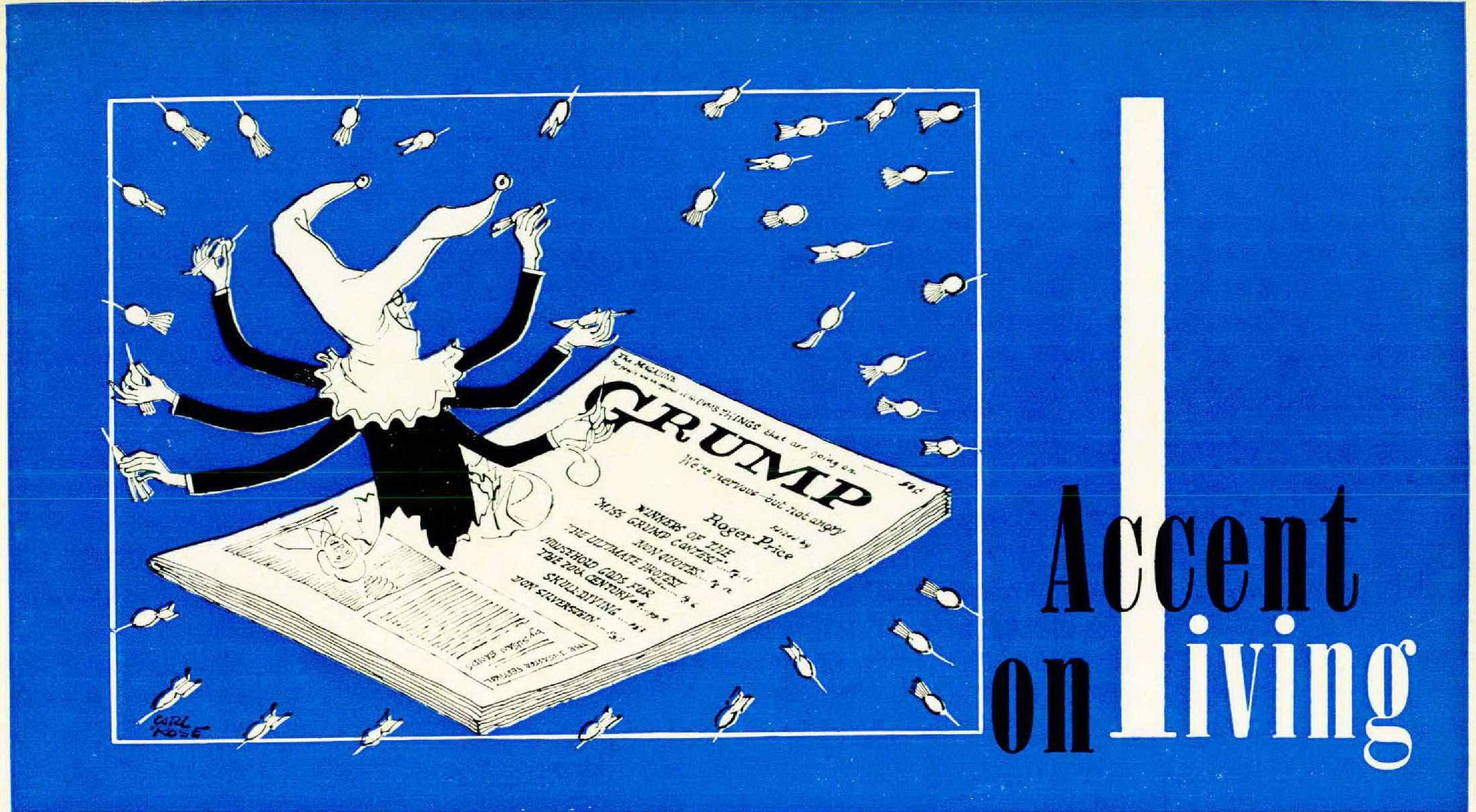
Crump, which calls itself a humor magazine and is published bimonthly, was a year old at this writing, and its first anniversary issue included selections from those preceding it. Humor is a treacherous word to play with, especially to take unto oneself, when it usually means that the taker is out to make the reader laugh even if it kills them both. But Grump proves to be a valuable exception to this generalization: its anniversary issue ($1.00) seemed to me well worth the money and very funny indeed.
For the past fifteen years or more the United States has had no counterpart of such a publication as Punch, today a literate, edgy review stocked with sharp criticism, light prose and foolery, and what for my taste is a variety of the best comic art currently in print. (I qualify these opinions as my own and no more, for I keep in my desk a multipanel drawing, in color, by Punch’s Bill Tidy, which I count among the funniest and most wildly original I have seen, and many friends to whom I have shown it don’t think it’s funny at all.) It would be a fine thing if some new magazine were to do as well for us as Punch does for the British, but we continue to lack Punch’s counterpart. Mad, in its nine-issues-a-year appearances, and now Grump, if all goes well, offer a kind of comedy more or less unobtainable in Britain, although Mad’s British edition, which seems to be a selection of listings from the American edition which the editors hope will be intelligible to the British reader, has a block of customers in England.
Now in its second decade, Mad continues to offer its own sledgehammer kind of commentary on life in the United States, entirely pictorial and with what seems to me more — too many more — long, multipage subjects in the comicstrip style than it used to carry (see “The Case for Mad,” September, 1963, Atlantic). Its visual wallop is still formidable, and it ventures boldly into controversial areas ignored by other publications. Its content is thoroughly up to date, always with a surprise or two and much that is funny. Mad’s Alfred E. Neuman covers have lost none of their distinctive absurdity over the years, but it is nonetheless good to find in Grump a generous assortment of prose — parodies, burlesques, and criticism, the best of it written by young newcomers, or unsigned and presumably the work of Roger Price, the editor of Grump, who will be remembered as the originator of the pictorial scheme known as Droodles. I append a few items from Grump’s anniversary issue.
An example of Mr. Price’s editorial style, commenting on what he calls The New People (those under twenty-five): “In rejecting the theology of Christianity they have also, to a large extent, rejected its ethics. Many of them have concluded that if Jonah wasn’t swallowed by the whale then it’s okay to steal.”
An underplayed and very funny parody of the cliche-ridden kind of view-with-alarm article written by some plodding hack who has interviewed various supposed authorities in order to document his warnings. This one is written by Judith Rascoe, who is otherwise a student at the Harvard Graduate School, and it is titled “Creeping Heterosexuality - America’s Number One Social Problem.”
A superior one-page assault on the weasel words, so cravenly enacted by Congress at the bidding of the tobacco companies, that “smoking may be hazardous to your health.” A couple of Grump’s parallel examples: “Caution: This Italian Suit May Make You Look Like a Jerk,” and “Caution: Buying This TV Set May Cause Your Children’s Brains to Turn to Oatmeal.”
A rhetorical question: “Does Atheism Pose a Threat to Organized Bingo?”
A conversation between a husband, wife, and their son and the Registrar at Harvard, by Bill Majeski, titled “Any Old Sport in a Dorm,” which succeeds in being funny on the subject of sex with nary a leer. Another bright and successful bit is a short tirade by Alice K. Turner against male exhibitionists, whose “naïve” behavior she deplores with these words, “It’s evident these men are simply not aware 49% of the human race are structured similarly to themselves.”
Grump carries no advertising, and advertising-procurement costs for a new magazine can be almost prohibitive, but it would do the space buyers for some of the big institutional accounts no great harm to loosen up and give a lift to Mr. Price’s undertaking. For all I know, he might refuse it, but it’s just as well to be invited to the party even if one doesn’t want to go. In any case, I wish him and his young contributors success, with the hope that Price’s Law, so frequently applied in the democratic process of 1966, will exempt Grump from its strictures.
Price’s Law: If everybody doesn’t want it — nobody gets it.