Kelp Forests of the Pacific
“I can only compare these great aquatic forests with the terrestrial ones in the inter-tropical regions ,” Charles Darwin once wrote of the giant kelp growths off the Pacific Coast. Rich in delights and trophies for the skin diver as well as potash for industry, the undersea forests are menaced by the eating habits of the spiny purple sea urchin. Mr. Marx, a California free-lance writer, here tells of the mysteries and values of the forests that astonished Darwin.
by Wesley Marx
WHEN I enter a forest on land, I feel like an intruder, crunching dead twigs and dry leaves underfoot, sending deer and birds into flight. But there is a sense of privilege in descending quietly into a sea forest. If my air tank brushes a frond, it continues to sway, and the inhabitants of a sea forest — from darting perch to rockbound starfish — remain unperturbed. A seal may speed torpedo-like toward me, only to arc away in a playful somersault as if he were bounding off a trampoline. Here I feel tolerated, not resented, free to glide through a wilderness which hides nothing from a visitor.
While native to coastlines throughout the southern hemisphere, these sea forests of giant kelp fringe only one coastline in the northern hemisphere, an exception generally credited to the Ice Age. Kelp abhors tepid water, and the Ice Age is believed to have provided the chilly water that enabled kelp from the western coast of South America to bound across the equator and colonize the western coast of North America. Along southern California, where advanced technology reigns supreme in both recreation and industry, the North American sea forests have been explored, enjoyed, harvested, exploited, and desecrated in a manner that conforms with their remarkable bounty and their convenient offshore location.
To most beach visitors a clump of drift kelp, which manages to sport a black halo of swarming flies, merits the attention only of beach clean-up crews. Not until the emergence of scuba-diving technology did I discover that kelp in its proper environment can be as fascinating as that popular symbol of ocean charm, the coral bed. Because kelp grows in water no deeper than 100 feet, the sea forests off southern California lie within reach of anyone willing to swim through the breaker zone. Once beyond the thunder of the surf, the swimmer can emplace his face mask and look below. Here, inside the sea, the kelp unfurls, rising from a bottom anchorage of holdfast to the ocean surface in long leafy vines called fronds. Once at the surface, the fronds spread over the water like ivy to form a thick brown canopy. The three-foot-long leaves — “blades” — extend like streamers from the frond. A frond can measure over 200 feet, and as many as 100 fronds will rise from just one kelp plant. The odd bulbs I once popped on the seashore serve as floats which buoy up the rangy fronds. Kelp plants grow six feet apart, and a sea forest of kelp plants can cover up to eight square miles in area.
Anyone who underestimates the hazard of the dense foliage does so at considerable risk. I have before me a Los Angeles Times newsclip that describes how a thirty-five-year-old man, equipped with only a snorkel (surface) breathing device, became entangled in kelp fronds on a short dive below the surface. He thrashed about desperately to reach a breath of air just ten feet above him. A companion diver, his girlfriend, tried frantically to break the grip of the fronds. The clip is headlined “MESH OF KELP BRINGS DEATH TO SKINDIVER.” A second newsclip, dated a month before the first, details how another skin diver became entrapped as irrevocably as an insect in a spider web.
LIFE in a sea forest rises toward the top in sharp gradations of movement. Brittle stars, purple sea fans, lavender sponges, ostrich-plume hydroids, flowery sea anemones, and lobsterlike crayfish ring the rockbound holdfast. Above this almost immobile layer of life cruise small sand sharks and rays flapping their robelike wings resembling finny Draculas. Above them, schools of shimmering sardines pass like rain showers, and bass, sheepshead, spiny sculpin, and dainty senoritas dart about busily. On the outskirts of the forest, bonita, barracuda, and albacore sprint like animated steel arrows, and above the surface, the seabird swirls, occasionally lighting on the brown canopy.
In a sea forest, survival rushes up and down a sixty-foot column of water like a busy elevator. The seabird dive-bombs bass exposed by an opening in the canopy, while the bonita and barracuda pounce on bass that stray out of the sea forest. Inside the forest, a bass may saunter by with a perch fin wriggling between his jaws. The perch, meanwhile, fattens up on bottom shrimp and scallops, and nibbles on kelp blades.
The color of marine life in a sea forest comes in understatements, like so much of nature. The fish and bottom creatures adopt the shades of the forest: mottled browns, light blues, dark yellows, dusky oranges, rocky grays. Occasionally, a garabaldi, an oversize goldfish, will spurt around like a flame in search of a fire, but such ostentation is the exception. The blend of color explains why I prefer kelp forests to the more popular coral beds. Although the coral beds of the tropical seas daunt a dazzling array of colors, like rainbows shattered into a million broken glints, they appear to be the creation not of nature but of a precocious child or Walt Disney. The kelp forest unfolds as a natural wilderness, marine-style.
The prize game in this wilderness is the black bass, which can weigh over 400 pounds. The black bass hunter uses a spear gun six feet in length. This gun springs a six-inch steel shaft attached to 150 feet of high-test nylon line. When the bass glides within range (eight yards), the hunter triggers the silent gun, and the shaft leaps the gap. Landing a bull’s-eye shot at the backbone behind the gills is only part of the job. To shake loose the steel shaft, the bass will tow the hunter on a frantic underwater ride. If the hunter’s supply of air holds out, and if he can steer the bass into a mesh of kelp that weighs down the 400-pound prey without becoming entangled himself, he can then stick his hands in the bass’s gills to obstruct breathing. Recovery of a suffocated giant lying prostrate on the door of a sea forest posed somewhat of a problem until someone decided to attach an inflatable life jacket to the nylon line. When the gun is triggered, the life jacket springs to the surface as a marker for surface craft. Once the black bass hunter has his prey, he looks for enough friends on whom to pawn off 400 pounds of fish meat.
For underwater hunters interested in less arduous activities, the sea forests provide abalone. This giant of the snail family consists of a meaty white “foot” encased in a lead-colored shell up to a foot in diameter. Abalone will cover a submarine cliff like a coat of mail, the foot gripping tenaciously to the cliff. The abalone hunter uses a tire iron to pry the abalone from his vertical perch. The rubbery foot is tenderized with a wooden mallet and fried in butter, and the shell, which has a mother-of-pearl sheen, can be used as a decorative ashtray. (Indians in California preferred to embed the shells in the shoulder bone of a whale. Thus decorated, the bone served as a funeral bier.) California takes its abalone resource so seriously that out-of-state shipments are prohibited to conserve the supply.
The abundance and variety of life encountered in a sea forest are founded on the kelp’s “biomass” capability. Biomass is the amount of living matter per unit of area. A kelp plant, with its multitude of fronds, injects far more living matter into a given area than the ocean’s tiny current-driven plankton. Kelp concentrates marine life, while plankton, which drifts about the ocean in pasturesized clumps, disperses life.
The key to this biomass capability is that kelp is the fastest-growing plant on this planet and one of the largest and most prolific. This stature has been achieved without the aid of chemical fertilizers, pesticides, and agricultural extension services. Since the kelp’s prime source of energy is photosynthesis, the fronds that bud from the holdfast virtually race to reach the sunlit ocean surface. They can grow two feet in a day and double their length in fourteen days. The holdfast, meanwhile, must expand its rootlike grip on the bottom to withstand the pull of the waves and of the floats that buoy up the fronds. This balancing act forces kelp to grow in rocky bottom areas. The fronds would uproot the plant from a sand anchorage.
Once at the top, the frond creeps over the ocean surface to bask in the sun. The corrugated shape of the frond’s lanky blades increases sun exposure. These blades also filter and store iodine, potassium, and other mineral nutrients from the ocean. The thick brown canopy that results shuts off the young bottom fronds from life-nourishing sunlight. To overcome this blackout, the adult surface fronds pass down their energy to the young lower fronds in a process called translocation, a nutritional selfsacrifice which causes the frond to live for about seven months. Then it shrivels up, sloughs off from the canopy, drifts in to a beach, there to be despised by bathers.
The thick surface vegetation not only drives most other marine plant life from a kelp-dominated area but impedes the kelp’s own reproductive capacity as well. Since germinating kelp spores must find a place on the bottom where sunlight can penetrate, those that are able to survive and grow usually drift to the periphery of the forest where the canopy is not so lush. A kelp plant emits a constant stream of seeds, up to seventy trillion annually, to ensure that enough seeds find a place to grow.
THE kelp industry emerged after a heated diplomatic exchange. In 1910 Germany had a world monopoly on potash deposits, an important fertilizer and an ingredient in the manufacture of munitions. When Germany replied sharply to an American accusation that potash prices were being rigged, the U.S. Congress authorized the Department of Agriculture to uncover potential domestic sources of potash. The search ended in the forests off southern California, and a dozen prospective kelp-harvesting companies sprang up. In a year’s period during World War I, 3500 tons of potash were recovered from 305,000 tons of kelp. After the end of the war, the industry underwent a recession but revived when algin, another kelp derivative, proved successful as a preservative in the packaging of premixed medicines and synthetic products. Today, algin suspends, stabilizes, gelproduces, and emulsifies laxatives, penicillin, candy, babies’ rubber pants, and 200 other products.
Besides being among the first to exploit the ocean for commercial gain, the kelp industry has pioneered in ocean conservation. The industry has volunteered to pay increased fees to the California Fish and Game Department, which leases the forests as a property of the state, to underwrite the enforcing of harvesting regulations. The mechanized barges that sweep through the kelp like hay reapers are allowed to cut only to a depth of four feet so that the forests can quickly regenerate. Since kelp has difficulty surviving in warm water and dies when the water temperature goes above seventy-five degrees, harvesting is restricted during critical warm spells.
The reproductive capacity of the kelp, the foresight of the industry, and the prized recreational allure of the forests would seem to preclude destruction. Yet for the last fifteen years, the sea forests off southern California have been faced with just such a prospect. The kelp degeneration began in the late 1940s when harvesters found they had to make longer and more costly runs to reach healthy kelp stands. By the late 1950s, the Palos Verdes forest off Los Angeles, which once embraced three square miles, was a virtual marine desert. The Point Loma forest off San Diego, originally six square miles in size, shriveled to a .61-square-mile patch. In a visit to these once flourishing areas, I found myself roaming through a ghost forest, strangely somnolent except for stray perch or a clutch of leafless, stringy fronds. Charles Darwin’s century-old vision of chain destruction was now reality. “I can only compare these great aquatic forests with the terrestrial ones in the inter-tropical regions,” he noted in The Voyage of the Beagle. “Yet if in any country a forest was destroyed, I do not believe nearly so many species of animals would perish as would here, from the destruction of the kelp. Amidst the leaves of this plant numerous species of fish live, which nowhere else could find food or shelter; with their destruction the many cormorants and other fishing birds, the otters, seals, and porpoises, would soon perish also. . . .”
In 1958, the state of California initiated a fiveyear investigation into the kelp decline. Dr. Wheeler North of Scripps Institute of Oceanography, a soft-spoken, well-tanned scuba-diving biologist, was appointed project officer. To scientific sea rangers, kelp poses its own peculiar problems. Studying a kelp plant, Dr. North has noted, is like “studying a Sequoia tree.” Seven days are consumed in laying out a kelp plant on the beach and then studying, measuring, and analyzing the 200-foot-long specimen. The fact that the kelp decline occurred off coastal cities led to suspicions that sewage outfalls were undermining the health of kelp with effluent, oil-field brine, soda ash, dyestuffs, starch acids, and other urban excretions. Suspended sewage particles floated about like dust in the dying forests. But in the laboratory, Dr. Kenneth Clendenning of Scripps found that kelp actually flourished in sewage water.
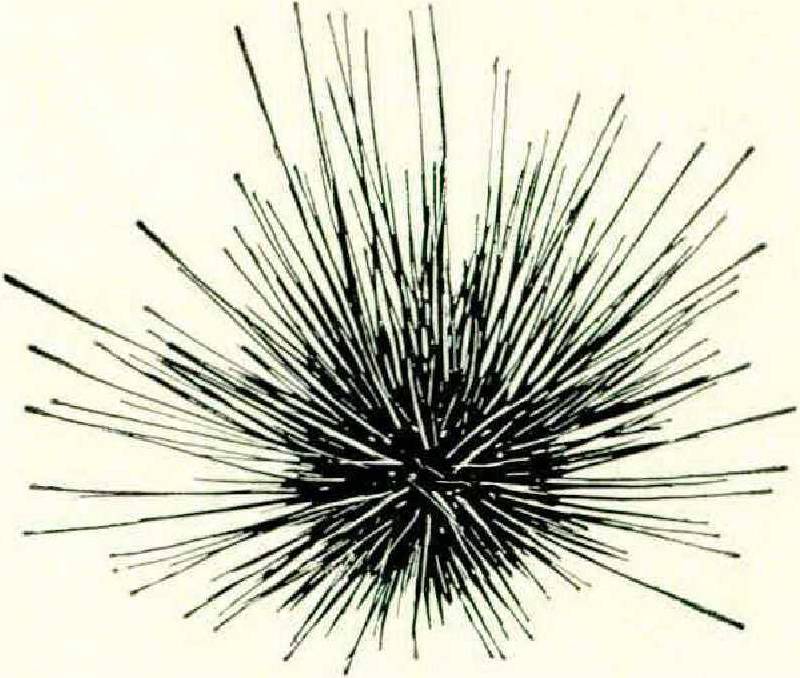
Dr. North spent days wandering through dying beds in search of further clues. He observed only one creature in any abundance, the bottom-hugging sea urchin, which resembles a purple pincushion full of pins, or spines, which can puncture a man’s flesh.
The presence of these urchins perplexed Dr. North. Equipped with five microscopic teeth, an urchin can set a kelp plant adrift by supping on its holdfast anchorage. One urchin would not pose much of a problem to a bountiful sea forest, but urchins, like locusts, move in “fronts,” up to 100 urchins per square yard. Only because these fronts move on at about a yard a day does a sea forest have a chance to regenerate. Yet Dr. North was observing sedentary urchins by the millions within the confines of dying forests. Urchins can survive for a year by supping on the tissues of their reproductive organs, but such survival stamina did not entirely explain such a populous presence. Were these urchins feeding on sewage particles and scum algae spawned by the sewage? As sewagesubsidized feeders, the sedentary urchins would deprive the kelp in the area of any chance to regenerate.
The aftermath of a shipwreck lent support to Dr. North’s theory of unbalanced ecology. In 1957, the tanker Tampico was stranded off a rocky cove in Baja California, disgorging its cargo of refined oil. The oil spill spread over an area characterized by an abundance of urchins and a paucity of kelp plants. In a year’s time, however, the oil had apparently exterminated the urchins, thus liberating the regenerative power of the kelp.
Dr. North decided to experiment with urchin purges off southern California, but he lacked an agent of extermination. Fur hunters had long since purged the cublike sea otter, the one major predator able to stomach the urchin’s spiny exterior. France controls urchin populations by consuming urchin gonads as a delicacy, but the American palate is not prepared for this. Fencing off urchins from sea forests is ineffective because urchins can climb. One day, Dr. North and a squad of scuba divers descended upon one urchin-infested forest with hammers. Instead of squashing out urchins, the men surfaced with spines in their hands.
While Dr. North was extracting the spines from his hand, a colleague, Dr. David Leighton, read how quicklime was used to exterminate starfish gorging on commercial oyster beds on the Eastern seaboard. In the laboratory, quicklime proved just as effective on urchins. At the same time, perch, bass, crayfish, and kelp remained immune to it.
In the initial experiment, a dose of quicklime cleared urchins out of a half acre of the Palos Verdes forest off Los Angeles. Three months later, kelp fronds began wriggling up from new plants. But six months thereafter the kelp colony was gone. Dr. North’s first quicklime purge had been frustrated by the ability of nearby urchins to scent young kelp.
Dr. North decided that an urchin purge over a wider area might prove more permanent. But by this time, five years had passed, and the state of California had stopped funding the kelp investigation. A kelp-harvesting company, Kelco, agreed to provide funding and a kelp barge to sow the quicklime. Forty tons of quicklime descended like a snowfall on a five-acre area in the Point Loma forest. Urchins by the thousands perished, kelp began sprouting, and then an odd thing happened. Neighboring urchins migrating toward the budding forest stopped short at the periphery. Dr. North concluded that the urchins were cooperating with his experiment but only because bottom drift kelp from the revived forest met their food needs. In March of 1964, twenty-seven more acres in the Point Loma forest were treated. Last year, Kelco harvested the forest for the first time in seven years and collected 11,000 tons of kelp.
Today, Dr. North, an associate professor of environmental health engineering at the California Institute of Technology, experimentally transplants kelp to barren areas. Einar Anderson, a research assistant, cultures kelp seedlings on nylon rope in the laboratory and then sets the rope on a rocky seabed, where the seedlings can take hold.
The combination of kelp’s remarkable fecundity and man’s ingenuity may well herald future submarine forestation programs. Whereas coral beds require centuries and land forests decades, transplanted sea forests will spring up in a year’s time. Kelp’s biomass ability to concentrate marine life may make such forestation programs a necessity, yet the fact that the kelp decline in southern California is still far from resolved suggests the difficulties that such programs would face. Dr. North has recently revived another urchin-infested kelp forest off San Diego through liming; meanwhile, kelp harvesters note with chagrin the appearance of tiny urchins in the treated Point Loma forest. These are the offspring of the adult urchins that surround the forest and monopolize the drift kelp. The revived forest has thus served to foster an urchin population explosion, and this could lead to a feverish cycle of liming and reliming.
Current laboratory and field tests sponsored by the U.S. Public Health Service and conducted by Dr. North and Dr. Leighton indicate that urchins, rather than subsisting directly on sewage, subsist on small marine plants nourished by the sewage. That sewage discharges may undercut the balance of marine nature through a nutritional as well as a toxic impact only adds to the problem of redressing this balance. (Each day, coastal cities in southern California discharge half a million gallons of sewage, or “fertilizer,” into offshore waters.) This snarling up of nature, of course, has a long history on land. At this point one wonders if in the future a swimmer in California will be able to descend into a sea forest by simply venturing beyond the cresting surf waves.