May 1966
In This Issue
Explore the May 1966 print edition below. Or to discover more writing from the pages of The Atlantic, browse the full archive.
Articles
The New Color-Styles for Men
The Cornflake Syndrome
SUSAN FULLER is a writer and foreign correspondent, and is now spending some time in West Africa.
Mother, Being Partial
Three Cheers for When
A regular contributor to PUNCH of light articles and literary criticism, R. G. G. PRICE lives in Sussex and writes for the ATLANTIC on a variety of subjects.
Snapshots of the Four Grandchildren
New Hampshire Out of Season
Requiem for Potheen
Who's What?
Music of Our Time
Ghana
The Peripatetic Reviewer
Reader's Choice
Potpourri
Coming in the June Atlantic
Washington
Geneva
Alabama
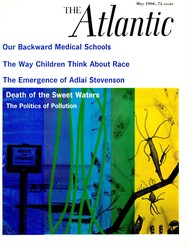
Flaming Arrows to the Sky: A Memoir of Adiai Stevenson
As one of the closest friends and advisers of the late Adlai Stevenson, George Ball was intimately involved in the Illinoian’s early New Deal days, in his decision to run for the presidency, in his campaigns of 1952 and 1956, in his reluctant try for the nomination that went to John Kennedy in 1960. In this memoir, one of several in the book AS WE KNEW ADLAI to be published this month by Harper & Row, the Undersecretary of State and recently appointed director of the Administration’s new intragovernmental machinery for coordinating foreign affairs tells of the qualities that made Stevenson perhaps the most successful unsuccessful politician in American history.
The Destroyer
Our Backward Medical Schools
“Our doctor shortage has developed out of an obsolete system of medical education” that tyrannizes those who submit to it and discourages many others from trying. Here is one doctor’s view of the problem. The author, a twenty-seven-year-old graduate of a large medical school in the Western United States, is now serving as surgeon in an infantry unit in Europe.
A Prescription
The Finding of Reasons
The Best Man
A diligent accumulation of saloon know-how nourishes Mr. Maloney’s writings about booze and bars and the characters who frequent same. The author attended Harvard, served in the Merchant Marine, in the Army, and on Madison Avenue before turning to writing. The Atlantic Monthly Press will soon, publish his light novel about the great days of bootlegging.
The Great Comet of 1965
Dr. Gingerich is an astrophysicist and historian of astronomy at the Smithsonian Astrophysical Observatory in Cambridge, Massachusetts. Among his responsibilities is the task of directing the Central Bureau for Astronomical Telegrams, the world clearinghouse for comets, sponsored by the International Astronomical Union. From this vantage point he kept a day-to-day watch on the progress of the Great Comet of 1965.
A Weaver of Carpets
The ATLANTIC’S door is always open to promising new writers, and twice a year pages are set aside for poets who have come to deserve a hearing. This spring’s Young Poets section introduces five fresh talents to ATLANTIC readers.
The Sanatorium, Le Grau-Du-Roi
All-Night Diner
The Statue of Eve
In the Sea
A beautiful woman who is pleasing to men is good only for frightening fish when she falls into the water.
In the Stream
Two monks, a Hindu and a Zen, came to a stream. The Hindu started to walk on the water. The Zen cried out: Come back! Come back! That is not the way to cross a stream.
The Perfect University
“Since the presence of young women on the campus is upsetting to young men, the perfect university will admit men only.” This and other puckish deliberations on the state of university education are offered by one of America’s most venerable humorists, now emeritus Kappa Alpha Professor of Romance Languages at Cornell.
When I Draw the Lord He'll Be a Real Big Man
Warmth and understanding frequently do not combine with clinical objectivity in the study of human relations, but they come to a rare blending in the works of Dr. Coles, a young research psychiatrist in the Harvard University Health Services, who for several years has been studying the effects of desegregation in the South. This essay will form a part of his Atlantic-Little, Brown book, COURAGE AND FEAR IN THE SOUTH, to be published in 1967.
The Boom in Art Books
This spring, ATLANTIC critic Louis Kronenberger’s fancy turns to books on and about art, a whim that carried him through the prose and color pages of three dozen volumes.
The Peaceable Kingdom
What Makes the Wheels Go Round
The heretofore little known, impact (on the wage-price structure) of the mother-in-law who does not know she is a mother-in-law is here recounted, together with other data of life and times in the 1920s, by Arnold Gingrich. He was first editor of ESQUIRE and since 1952 has been its publisher. This remembrance is drawn from his forthcoming memoir, TOYS OF A LIFETIME,to be published next fall by Knopf.
The Story of Jorkel Hayforks
A graduate in English of Edinburgh University, Mr. Brown lives and works in the Orkney Islands. His third book of poems, THE YEAR OF THE WHALE,was published in England last summer, and a book of short stories is scheduled to appear this year.
The Gift
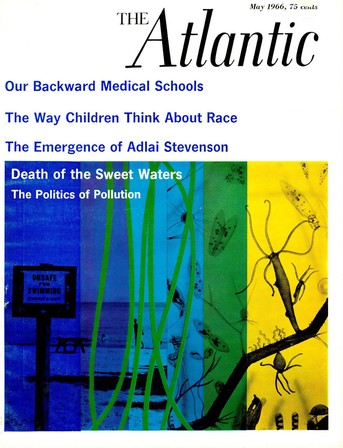
Death of the Sweet Waters: The Politics of Pollution
The greatest threat to America’s water supply lies in public and private indifference to the systematic pollution of our rivers and lakes by industry, faulty sewage-disposal systems, and agencies of the federal government. Most efforts to protect our dwindling clean water reserves have been blocked by political self-interest, and the results are potentially disastrous, not only for America’s large cities but for farmlands and recreation areas as well. These and other disturbing truths are recorded here by Donald E. Carr, a veteran research chemist whose book DEATH OF THE SWEET WATERS will be published later this month by Norton.