When I Draw the Lord He'll Be a Real Big Man
Warmth and understanding frequently do not combine with clinical objectivity in the study of human relations, but they come to a rare blending in the works of Dr. Coles, a young research psychiatrist in the Harvard University Health Services, who for several years has been studying the effects of desegregation in the South. This essay will form a part of his Atlantic-Little, Brown book, COURAGE AND FEAR IN THE SOUTH, to be published in 1967.
by ROBERT COLES, M.D.
IN RECENT years child psychiatrists have steadily increased their ability to understand what is happening in the minds of even their youngest or only remotely communicative patients. Those who treat children not only have to find out what they can, but so reach and affect the child’s mind that he no longer ails. The child must be helped to comprehend what bothers him, and he must then settle the problem so decisively that he no longer feels upset or, indeed, shows any signs to the ever watchful clinician that he may still be troubled “deep down.”
Before I ever started my work in the South I had been interested in what the children I treated would tell me with crayons and paints — and chalk, for I always kept a blackboard in my office, and often a child would suddenly want to use it, then just as quickly apply the eraser to it. Because of my own interests, I made a point of asking children whether they would like to sketch whatever came to mind. Some did so eagerly, some reluctantly; some would have no part of my schemes for a long while, though in the course of treatment those who refused invariably changed their minds, as if they recognized that now they were able to let me know something once unmentionable.
I took my files with me when I went south; essentially they were a stack of drawings made by the middle-class children who make up the major population of a child guidance clinic and a child psychiatrist’s private practice. When I started visiting the four little girls in New Orleans whose entry into the first grades of two white schools occasioned the strenuous objection of mobs and a boycott by most white children, I carried with me paper and crayons. From the very beginning I made a point of asking those girls to draw pictures for me: of their school, their teacher or friends, anything they wanted to draw. I also took an interest in the art work they did in school, always a favorite activity for children in elementary school. They learned that I was interested in their sketches, and without exception they furnished me with an increasing abundance of them over the years.
That same school year, 1960-1961, a few white children trickled back to the boycotted schools, in spite of tenacious mobs that in varying strengths constantly besieged the two buildings. I began going to the homes of those children, too, and I encouraged those children to draw as well as play games and talk with me. (There were five children from three homes.) During the second year of desegregation, from 1961 to 1962, I continued my studies in New Orleans and expanded them, just as the city itself, by coming to some terms with its unruly elements, enabled its harassed schools a gradual return to normal. I started interviewing the eight Negro children who were added to the roster of “pioneers”; they went into three additional elementary schools. All in all I was following twelve Negro children and twelve white children that second year, as against the four Negro and five white children who in the first year were the entire population of two schools.
In addition, I traveled widely in the South, spending a week or two in other villages, towns, or cities where young Negro children were initiating (and white children were experiencing) school desegregation. I lived for a while in Burnsville, North Carolina, a small rural mountain village, and nearby Asheville, its metropolis. I spent several weeks in Memphis, and later I worked in Birmingham. Finally, in 1964, I divided three months’ time between Jackson, Mississippi, and the little farming community of Harmony, near Carthage, Mississippi. In all these instances, I tried to gain some impression of how children other than those I knew in New Orleans were managing the social and personal trials of desegregation. These children found it easier to draw than to talk; in fact, I came to see that they expected me to ask them to do something, to test them in some way.
Television reaches across the barriers of race and caste, class and neighborhood, bringing our preoccupation with knowing and measuring the “normal” and “timely” in the child’s growth and development into cabins and tenements otherwise far removed from our national life. For example, I was astonished to find the mother of a six-year-old boy in an isolated Mississippi town relax visibly when I took crayons from my pocket, placed them on the paper of my clipboard, and asked her whether her son and I might draw pictures together.
“Son, the doctor is going to learn about you and find out how good your thinking is, like they say it has to be done on TV,” she told the boy, and they both seemed able, finally, to comprehend my purposes. David drew eagerly, as if taking an examination at school, and his mother no longer worried so openly about just what the white doctor had in mind.
In New Orleans, as the months passed by, a firm relationship between the children and me developed, so that our drawing and painting exercises became more enthusiastic and personal. I encouraged the children to draw whatever they wished. The troubles and joys of their lives gradually took form and color, and so did their shifting feelings toward me. At times I tried tO direct their attention toward one or another concern I had; how they regarded themselves, how they felt they were managing at school, what skin color meant to them and to others in their neighborhood or the city, why the mobs formed and to what purpose, how they saw themselves getting along with their white or black classmates, how they viewed their teachers, and how they thought their teachers felt toward them as children, or as representatives of a race or a group of people. One white child brought me up short at the very beginning of my work by telling me she thought her teacher prejudiced toward her: “She wishes my daddy made more money, so I could dress better. She always talks about the nice kids she used to teach in the Garden District, and how good they behaved. I think she minds me as bad as the nigra girl.”
RUBY and I started talking, playing, and drawing together when she was six years old and braving daily mobs to attend an almost empty school building in New Orleans. Upon our first meeting I told her of my interest in drawings, and she showed me some she had done at school and brought home to keep. Over the years she has drawn and painted during most of our talks, so that I now have more than two hundred of her productions.
Many of the topics were her choice, while other pictures were started in response to my specific suggestion. I would ask her to draw a picture of her school or of her teacher. I would ask her to paint a picture of anyone she knew or wanted to portray. I might ask her one day to try putting herself, her brother, or her sister on paper, while on another occasion I might ask her to sketch a particular classmate of hers. (For many months there were only two or three of them, the children of the few whites who defied the boycott. We both knew them, and each of us knew that the other spent time with them, Ruby at school, and I in their homes.)
For a long time — four months, in fact — Ruby never used brown or black except to indicate soil or the ground; even then she always made sure to draw over the lines with a solid covering of green grass. It was not simply on my account that she abstained from these colors; her school drawings showed a similar pattern. She did, however, distinguish between white and Negro people. She drew white people larger and more lifelike. Negroes were smaller, their bodies less complete. A white girl we both knew to be her own size appeared several times taller. While Ruby’s own face lacked an eye in one drawing, an ear in another, the white girl never lacked any features. Moreover, Ruby drew hands and legs carefully, always making sure that they had the proper number of fingers and toes. Not so with her own limbs, or those of any other Negro children she chose, or was asked, to picture. A thumb or forefinger might be missing, or a whole set of toes.
There were other interesting features to her drawings. The ears of Negroes appeared larger than those of white people. She might draw a Negro with only one ear, and that one very large indeed. In contrast, quite often she drew a Negro with no mouth; whereas a white child or adult would be likely to have lips, teeth, and a full, wideopen mouth. With regard to the nose, Ruby as often as not omitted it in both races, though when it did appear, it was as a thin orange line in her white classmates.
Hair color and texture presented Ruby with the same kind of challenge that skin color did. So long as she kept away from brown and black crayons or paints, she had to be very careful about the hair she drew. She put yellow hair on white children, or would make their hair the same orange that outlined their face. Many people of both races had no hair. No Negro child had blond hair.
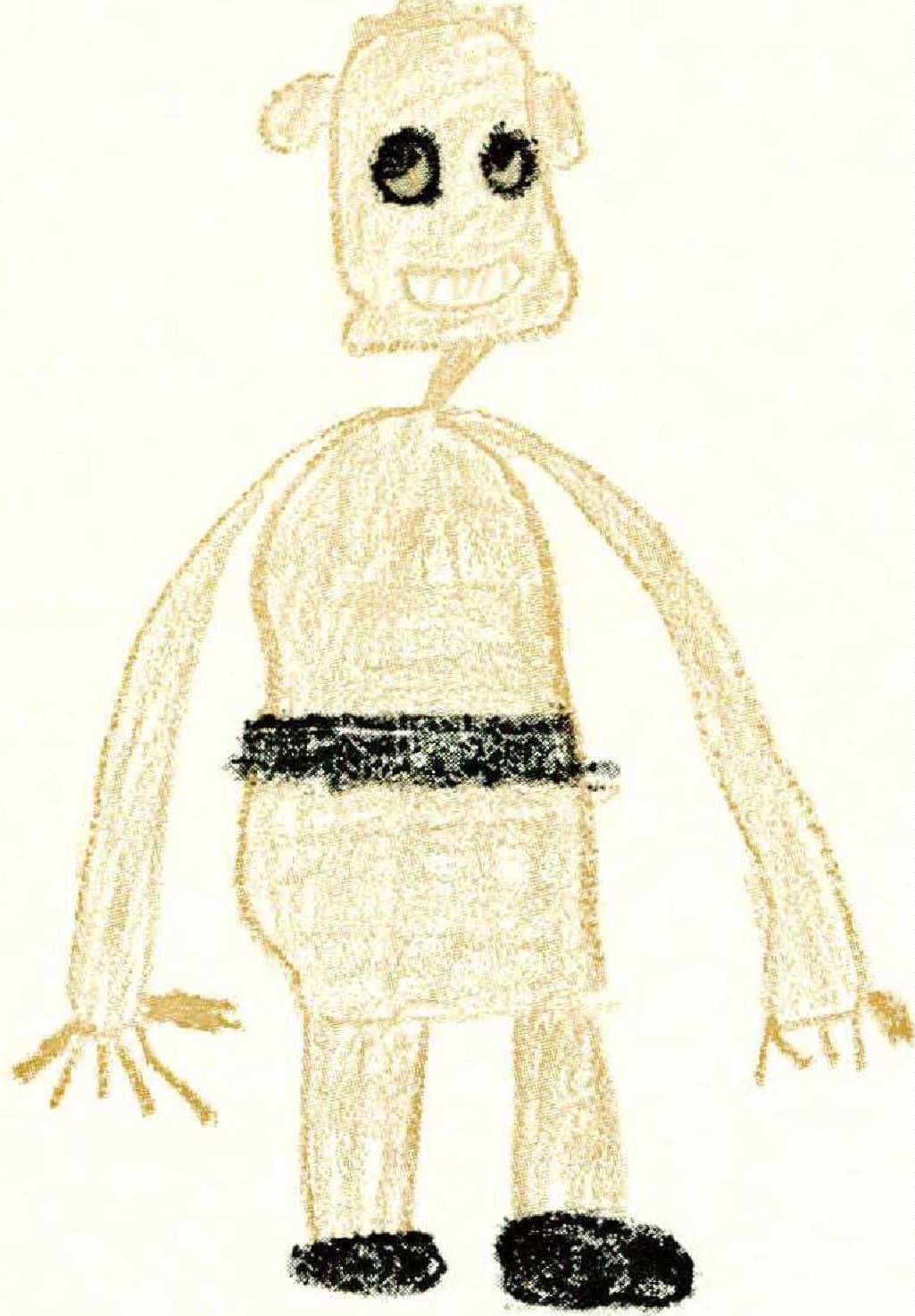
The first change in all this came when Ruby asked me whether she might draw her grandfather, her mother’s father, who has a farm in the Mississippi Delta. It was not new for her to ask my permission to draw a particular picture, though this was the first time she had chosen someone living outside New Orleans. With enthusiasm and determination she drew an enormous Negro, his frame taking up, quite unusually, almost the entire sheet of paper. Every inch of him was brown except for a ring of thick black surrounding the brown irises. His mouth was large, and it showed fine yellow-colored teeth. The cars were normal in size. The arms were long, stretching to the feet, ending in oversize hands; the left one had its normal complement of fingers, but the right was blessed with six. The legs were thick, and ended in heavily sketched black boots, a noticeable shift from the frayed shoes or bare feet which she had drawn hitherto.
Ruby worked intently right to the end, then instantly told me what her grandfather was doing. “That’s my momma’s daddy, and he has a farm that’s his and no one else’s; and he has just come home to have his supper. He is tired, but he feels real good, and soon he is going to have a big supper and then go to bed.”
Ruby’s father at that time was unemployed. It was not the first time, though never before had he been fired simply because his daughter was going to one school rather than another. He tended to be morose at home. He sat looking at television, or he sat on the front steps of the house carving a piece of wood. He also suffered a noticeable loss of appetite — the entire family knew about it and talked about it. The children tried to coax their father to cat. His wife cooked especially tasty chicken or ribs. I was asked for an appetite stimulant and prescribed a tonic made up of vitamins and some Dexamyl for his moodiness. I gave him a few sleeping pills because he would toss about by the hour and smoke incessantly. (In a house where eight people slept in two adjoining bedrooms with no door between them, it seemed essential for him to get some sleep, not only for his sake but for the children’s.)
I asked Ruby whether there was any particular reason why she decided to draw her grandfather that day. She told me she had none by shaking her head. She smiled, then picked up the crayons and started drawing again, this time doing a pastoral landscape. Brown and black were used appropriately and freely. When it was finished, she took some of her Coke and a cookie, then spoke: “I like it here, but I wish we could live on a farm too; and Momma says if it gets real bad we can always go there. She says her daddy is the strongest man you can find. She says his arm’s as wide as I am, and he can lick anyone and his brother together. She says not to worry, we have a hiding place, and I should remember it every day.”
She was not having a particularly bad time of it, but she was rather tired that day. By then she also knew me long enough to talk about her fears, her periods of exhaustion, her wish for refuge or escape. Only once before had Ruby mentioned her impatience with the mobs, her weariness at their persistence: “They don’t seem to be getting tired, the way we thought. Maybe it’ll have to be a race, and I hope we win. Some people sometimes think we won’t, and maybe I believe them, but not for too long.”
It took Ruby several more months to be able to draw or paint a Negro without hesitation or distortion. From the beginning I wondered whether it was all my fault, whether she was in some way intimidated by the strange white doctor who visited her, with his games and crayons, his persistent curiosity about how she was getting along. Though in fact I am sure she was, there is reason to believe that the pictures she drew reflected a larger truth about her feelings than the undeniable one of my somewhat formidable presence. Her mother had saved many of the drawings she did in Sunday school (all-Negro) before either desegregation or strange visitors came into her life, and the same pattern was to be found in them: whites drawn larger and more intact than Negroes; brown and black used with great restraint, just enough to indicate the person’s race but no more. It was as if Ruby started drawing all people as white, then turned some of them into Negroes by depriving them of a limb or coloring a section of their skin, on the shoulder or the stomach, brown.
It seemed to me, then, that on my account Ruby had merely tightened up a pre-existing inclination to be confounded and troubled at the representation of racial differences, not to mention the implications those differences had for how people lived. Eventually I asked her why she thought twice about how much brown she would give to a colored child. She was then eight, and we had known one another for two years. She replied directly: “When I draw a white girl, I know she’ll be OK, but with the colored it’s not so OK. So I try to give the colored as even a chance as I can, even if that’s not the way it will end up being.”
Two years later Ruby and I could talk even more openly. At ten she was still the outgoing, winning girl she always was, though of course each time I saw her she was taller, thinner, a bit more composed, a little less the child. She wasn’t very much interested in drawing anymore. She preferred to talk. She and I looked over many of her drawings, and at various intervals she made comments about them, much as if she were a colleague of mine. Almost in that vein I commented that her most recent work was least prolific but very accomplished indeed: “You didn’t draw much this past year, but when you did, the people were really alive and very accurately shown, and the buildings look as real as can be.”
She smiled and answered quickly: “I guess when you grow older you can see better, and so you can draw better. My teacher told me last week that my handwriting was getting better, too.”
A few minutes went by, and I decided to persist with my comments on her art work, this time with a bluntness I can only justify as feeling quite “right” and appropriate at the time: “Ruby, you know my wife and I were looking at your drawings last night, and we both noticed how differently you draw Negro people now in contrast to the way you did years ago when we first started coming to see you. Do you think there’s any reason for that, apart from the fact that you’re now a better artist in every way?”
She paused longer than usual, and I began to feel nervous about having asked the question. I was scurrying about in my mind for a remark that would change the subject without doing so too abruptly when she looked right at me and spoke out: “Maybe because of all the trouble going to school in the beginning I learned more about my people. Maybe I would have anyway; because when you get older you see yourself and the white kids; and you find out the difference. You try to forget it, and say there is none; and if there is you won’t say what it be. Then you say it’s my own people, and so I can be proud of them instead of ashamed.” She smiled, as if she had delivered a hard speech and was relieved to have it done.
I didn’t know what to say. On the one hand she was still the Ruby I had known all those years; yet she now seemed grown up. Her arms were folded quietly in her lap; her language was so clear, so pointed; and she somehow seemed both content with herself as she was and determined to make something of herself in the future.
RUBY had a classmate for several years named Jimmie, a lively, agile, particularly freckled boy whose blond hair tended to fall over his forehead. When I first asked Ruby to draw a picture of any school chum she wished (there were only three at the time), she obliged with a picture of Jimmie. “He is a good boy, sometimes,” she commented, adding the last word of qualification after a genuine moment of hesitancy. In point of fact, Jimmie’s behavior troubled her. One minute he would be attentive and generous, anxious to play games or even share food with her. Yet in a flash he could turn on her, and not just as one child will do with another. Ruby knew why, and could put it into words: “Jimmie plays with me OK, but then he remembers that I’m colored, so he gets bad.”
I asked whether he was “bad” at other times — fresh or spiteful simply out of a moment’s impulse. She handled my question rather forthrightly, even with a touch of impatience: “Well, he’s bad sometimes when he wants things his own way and someone won’t let him get it; but I mean it’s different when he gets bad because I’m colored. He can be mv friend and play real nice with me, and suddenly he just turns and says bad things, and he even gets scared of me and says he’s going to leave; but he comes back. He forgets, and then he remembers again.”
Jimmie’s parents had it no easier. Like him they could not establish in their minds a clearcut set of attitudes toward colored people. When riots made their son’s school attendance dangerous, they kept him home. As the mobs achieved their purpose, a near-total boycott, the noise they made and the terror they inspired in passersby gradually subsided. A few white families sent their children back to the schools involved, some in direct defiance of the small crowds that persisted, others rather quietly, almost secretly, through rear doors or side doors. Jimmie’s parents sent him back as soon as it was safe to do so. When I saw him come to the school, neatly dressed, carrying his lunch box, I thought the very spirit of sanity resided in him, and with him was returning to the deserted halls and classrooms of the building he so casually and confidently entered. There was something very open and calm about him as he walked along, and I guessed something refreshing, something unsullied also.
As I came to know Jimmie and his family I realized how unfair I had been to the boy when I first saw him. I pictured him as Ruby’s hope. In fact, he returned to school in spite of Ruby because his parents did not want him to waste months of time learning nothing. When he first met Ruby, he told her the facts rather explicitly: “My mother told me to stay away from you.” Ruby told me what he had said, then informed me that Jimmie had contradicted his own words only seconds later by asking her to join him in a game. “So I did” was her way of letting the matter drop.
When Jimmie and I started drawing together, he made his feelings about Negroes rather clear: either they were in some fashion related to animals, or the color of their skin proved that if they were human they were certainly dirty human beings — dangerous, too. I don’t think Ruby ever knew the fear she inspired in Jimmie, nor did Jimmie have any idea how very much Ruby strived to portray herself with his features and coloring, as if then she could be less afraid of him.
For a while Jimmie drew pictures of his home, his parents, his friends, and himself. He was particularly fond of landscapes, and once did eight of them in two weeks, each surprisingly different, though all dwelling upon trees, grass, and water. When I first asked him to draw a picture of Ruby, he looked at me quite in dismay and said he couldn’t. I asked why. He now appeared cross: “Because I don’t know what she looks like. I don’t look at her close if I can help it.”
I asked him whether sometimes he couldn’t help noticing her. “Accidents happen sometimes, Jimmie; even when we try to do as we feel we should.” He nodded, and allowed that he had managed a few glimpses at Ruby, and would try to draw her. He started to do so rather furtively, then somehow lost his nervousness, so that by the end he was the confident and scrupulously attentive craftsman and landscapist he always was — except, that is, for what he had done to Ruby. It was almost as if he had suddenly embraced surrealism. In the midst of a stretch of grass he abruptly placed her, without feet, legs inserted in a piece of land left strangely sandy and barren in contrast to what surrounded it. He made Ruby small, though her arms were larger proportionately than those he usually drew. She had the thinnest line of a mouth and pinpoint eyes. Her hair was frizzy black, yet curiously and inappropriately long. She was brown-black, much more strikingly so than Ruby’s medium brown complexion justified.
After a while Jimmie was able to develop on paper the various conflicting feelings he had toward Ruby and her race. He drew Ruby many times, at intervals upon my request and often because he wanted to do so, or felt that I wished him to do so. Jimmie had obvious trouble picturing her at all. He hesitated as he did at no other time. For many weeks she appeared only as a speck of brown, or in caricature. He told me that he didn’t know what she looked like: “She’s funny. She’s not like us, so I can’t draw her like my friends. Besides, she hides a lot from us.” When I asked him where she hid, he said, “She doesn’t really hide. I mean she stays away sometimes; but if I say something, she answers me all right.”
I wanted to know whether he had any idea why Ruby might be keeping her distance from him and the others. He knew exactly why: “Well, she’s colored, that’s why.” I reminded Jimmie that colored children lived nearby, and often played with white children. In New Orleans large areas of the city are thoroughly mixed racially, and have been for generations. He knew that, too: “That’s different. It’s on the street, not in school. My daddy says that on the street it’s for everybody, but inside is where you have to be careful.”
When I asked him whether he would draw a picture of Ruby at school, he readily obliged, though invariably he put Ruby in the play area outside the building. Finally I mentioned what I saw him doing, and he scarcely hesitated before replying; “The teacher said it won’t be long before we go back to normal. She said that if most kids still stay home and the people still make all the noise in front of the school, then they’ll send Ruby away and the trouble will be over; she said Ruby still isn’t a regular member of the school, but that we have to be polite, anyway.” The yard, for him, was like a waiting room, and in one drawing he put a bench in it — in actuality there was none — and he put Ruby on the bench.
In time Jimmie took Ruby into the building he drew, and in time he regularly came to see her as an individual. Amorphous spots and smudges of brown slowly took on form and structure. Ruby began to look human every time, rather than, say, like a rodent or a fallen leaf one day and a rather deformed human being the next. Eventually she gained eyes and well-formed ears. It took more time for her to obtain a normal mouth; and only after a year of knowing her would Jimmie credit her with the pretty clothes he often gave to other girls. In describing Ruby’s speech after he had finished his pictures, Jimmie for a long time tried his best to render his version of a Negro dialect. His parents began enjoying such performances, and also hearing from him how “the nigra” was doing in school. They were changing, too — from calling Ruby a “nigger” to calling her a “nigra,” and from wanting no mention of her at home to insisting upon information about her schoolwork and her general behavior. By the middle of our second year’s talks Jimmie was forgetting himself and telling me in his own words and accent what Ruby might be saying in one of his productions.
Jimmie may have tried to ignore Ruby, he may have consigned her to anonymity, even to the indignity of a dot, or an animal-like appearance, but he never really overlooked the difference her presence made to his school. He showed how embattled it was by a policeman here, a picket with a sign there. The demonstrators were drawn big and openmouthed, their arms unusually beefy, their hands prominent indeed, a child’s view of the shrill, stifling, clutching power they exercised over the school’s population. As they gradually lost that power and began to disband, Jimmie pictured them smaller.
The school building itself took on a variety of shapes in Jimmie’s mind and on his paper. At first it was a confusing, almost ramshackle building, its walls as flimsy and unreliable as the school’s future seemed at the time. Slowly, though, Jimmie realized that, as he put it, “We’re going to make it.” Quite casually, without self-consciousness, he showed that he meant what he said. His school grew in size, each time looking sounder and more attractive for all the wear it was taking from its assailants. Eventually he allowed the building to dominate everything around it, from the shrubbery to the crowd of human beings who once impressed both him and Ruby with their persistence and assertiveness.
What both Ruby and Jimmie chose to draw or paint reflected the particular lives each of them lived. I once asked Jimmie whether he thought his friends saw things the way he did — whether, for instance, any of them might draw his school, his teacher, his classmate Ruby as he did. Once and for all he cautioned me against whatever inclinations I might have to generalize: “I don’t know. Which one of them do you mean?”
In all I spent four years getting to know twoscore children like Jimmie and Ruby in New Orleans and other Southern cities. Though each child had his own life, including his own quality of artistic interest and ability, there were certain trends in what these children chose to draw. Thus, Jimmie’s drawings and Ruby’s drawings resemble one another in the way all children’s drawings do — the style, the sense of proportion, the preoccupations that change from year to year. If they also differ because Jimmie and Ruby are different artists and different human beings, the racial crisis they both witnessed served to bring them together by giving them a common experience; they shared a number of difficult times together. Eventually that crisis influenced not only what they thought but what they drew. Other children in their school and their city and all over the South have been similarly aroused and affected.
For the many I have known there can be no question that in the beginning they fear their whiteskinned or dark-skinned classmates. Nor can there be any question of the very hard struggle they must contend with inside their minds as they try to sort out the hate and envy they have come prepared to feel toward one another, the curiosity, the interest, the confusion over the whole matter of black and white, bad and good, wrong and right.
Some of the children I have come to know were three years old when I first started talking with them; they were the nursery school brothers, sisters, and cousins of the older children I was visiting. All in all, these children lived in cities, towns, and the countryside. They ranged in age from three to ten. They lived in rather comfortable homes or in very poor ones. They were both white and Negro children, both boys and girls. What they all have in common is their American citizenship, their Southern residence and ancestry.
Negro children of elementary school age have not had enough time to set themselves straight about “why” they are colored and what that “fact” will mean for them in the future. Often they will try to deny the fact, or they will accept it so extravagantly that it is clear they are yet confused and troubled. For a long while I assumed that my middle-class, professional whiteness in some way made these children reluctant to color themselves brown or made them exceptionally anxious to color everyone brown. When I compared drawings done by the children for me with those they did at Sunday school, at home, in Negro schools, or at the request of their older brothers and sisters or parents, I learned that what I found significant and revealing in their drawings had a consistency and persistence quite its own, quite independent of my presence.
Is IT true, then, that the words “Negro” and “white” help distinguish the dreams and fantasies of children? Do children of each race draw themselves and those of the other race quite differently? At two and three have they very different ideas about who they are, who they will be, all based on a budding sense of racial identity? I would say yes.
Before lie is born, the Negro child’s parents are greatly concerned about his color. By the second year of life the child is asking questions that ultimately will include one about his own skin color. A mother of five children in Jackson, Mississippi, described it to me rather explicitly: “When they asks all the questions, they ask about their color, too. They more than not will see a white boy or girl, and it makes them stop and think. They gets to wondering, and then first thing you know, they want to know this and that about it, and I never have known what to say, except that the Lord likes everyone because He makes everyone, and nothing is so good it can satisfy Him completely, so He made many kinds of people, and they’re all equal before Him. Well, that doesn’t always satisfy them; not completely it doesn’t. So I have to go on. I tell them that no matter what it’s like around us, it may make us feel bad, but it’s not the whole picture, because we don’t make ourselves. It’s up to God, and He can have an idea that will fool us all.”
I asked her when she found such conversation necessary. “I’d say about two or two and a half,” she answered rather quickly. A bit deferentially she turned to me and asked: “Do you think that’s too early for children to know?” I said no, I didn’t. I said that what she told me confirmed some of my own observations.
She smiled, a little proud but still a little nervous. She wanted to pursue the matter further: “I know I’m right on the age; I’ve gone through it with too many to forget when it happens. But to tell the truth I never have been certain what to say. That’s why I try to talk about God. No one knows what color He is. I tell the children that it’s a confusing world, and they have to get used to it. You have to try to overcome it, but you can’t hide it from the kids. When they ask me why colored people aren’t as good as whites, I tell them it’s not that they’re not as good; it’s that they’re not as rich. Then I tell them that they should separate being poor and being bad, and not get them mixed up. I read to them from the Bible, and remind them that the Lord is a mighty big man, and what He thinks is not the same as what white folks do, or even black folks. He’s bigger than all of us, I tell them, and I hope that makes them feel satisfied, so they don’t dislike themselves. That’s bad, not liking your own self.”
Sometimes I erred by becoming too much the investigator. When I did so, when I emphasized racial matters too hard, when I seemed to be forcing a point here and there, the child or his mother often managed to bring me up short. One five-year-old colored boy had been unusually explicit in both his talk and pictures: he wished he were white, and that was that. He said so, and he drew himself so. When I asked him whether he thought he was so, he said no, he was colored, but there was little harm in wishing otherwise. I asked him whether he thought all colored children shared his views: “I don’t know, I only know the ones I play with. We all say let’s turn white, then we pretend it’s done. But we know it isn’t all the while. And a white boy, he told me in school one time that he plays ‘nigger’ sometimes with his friends, and they say they’re black and pretend, and then turn back to being white.”
That there is anger and spite toward white people at work underneath is also discernible, though by no means are such emotions easily conveyed. One Negro mother put rather well the feelings I have heard many others express: “I guess we all don’t like white people too much deep inside. You could hardly expect us to, after what’s happened all these years. It’s in our bones to be afraid of them, and bones have a way of staying around even when everything else is gone. . . . White people are a real danger to us until we learn how to live with them. So if you want your kids to live long, they have to grow up scared of whites; and the way they get scared is through us; and that’s why I don’t let my kids get fresh about the white man even in their own house.”
The task, then, is one of making sure the child is afraid: of whites, and of the punishment his parents nervously inflict upon him whenever he fails to follow their fear of whites. The child’s bravado must be curbed. In my experience, even twoand three-year-old Negro children have already learned the indirection, the guile needed for survival. They have also learned their relative weakness, their need to be ready to run fast, to be alert and watchful. They have learned that white children, as well as adults, are big, strong, and powerful; and that such power is specifically related to the colored man’s defenselessness.
Ruby and Jimmie and all the boys and girls I have known these past years have learned to identify themselves, somewhat, by their skin color, have learned so during the first two or three years of life. What they have learned about their skin has been only the beginning of what they will learn. Yet, when they finally know what color they possess and what color they lack, they know something about their future. As one little Negro girl in Mississippi said after she had drawn a picture of herself: “That’s me, and the Lord made me, but I must always remember that He did it, and it’s His idea. So when I draw the Lord He’ll be a real big man. He has to be to explain about the way things are.”