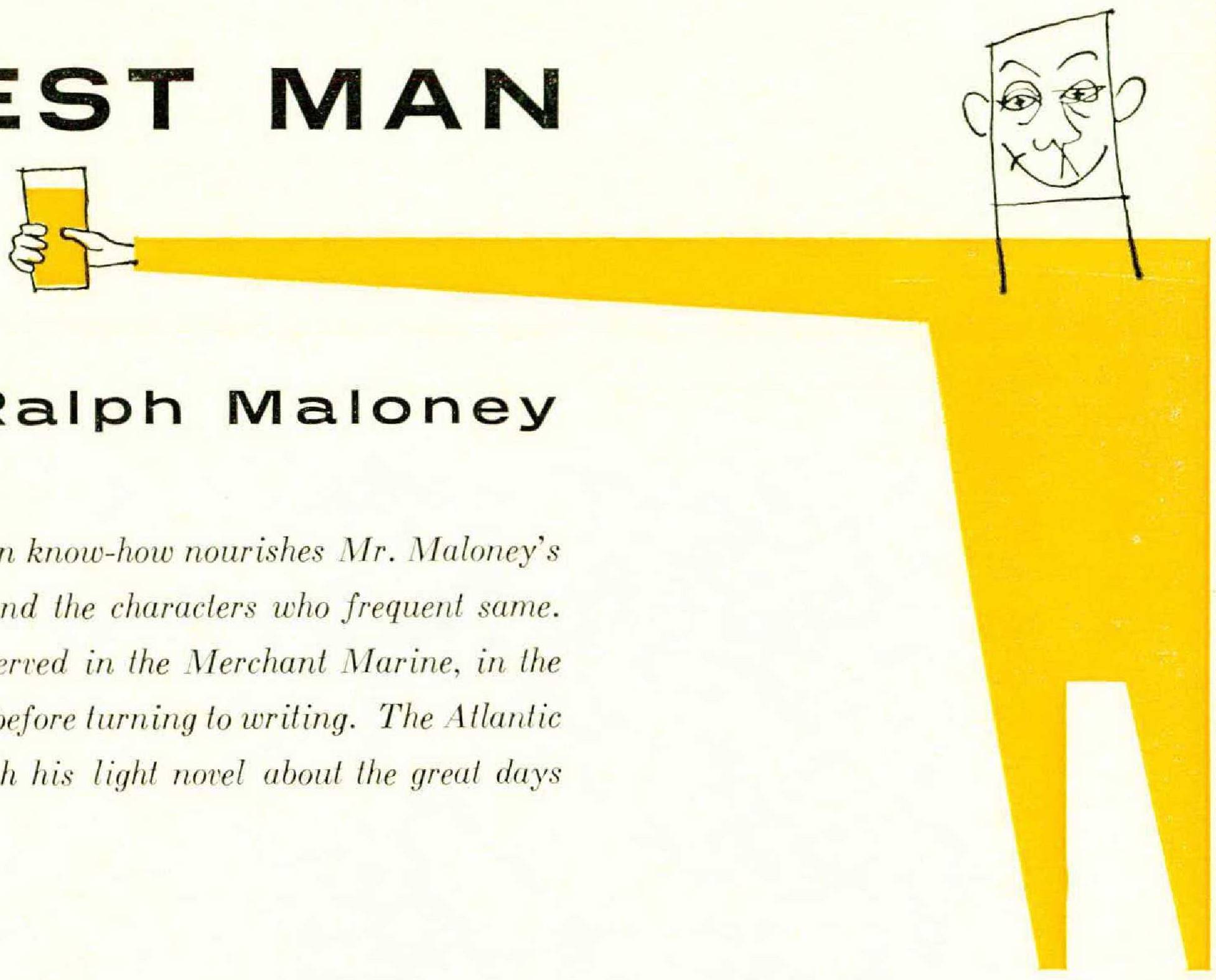
The Best Man
A diligent accumulation of saloon know-how nourishes Mr. Maloney’s writings about booze and bars and the characters who frequent same. The author attended Harvard, served in the Merchant Marine, in the Army, and on Madison Avenue before turning to writing. The Atlantic Monthly Press will soon, publish his light novel about the great days of bootlegging.
A Story by Ralph Maloney
Two records, “A Cottage For Sale” and “None but the Lonely Heart,” had to be removed from the jukebox at Gogarty’s because Soldier Gruen cried so hard conducting them. Soldier was easily moved to tears when his head was wet, which, so far as I knew him, was always. One afternoon, when I was off in the corner of the bedroom of a hotel suite, out of the gaggle and smoke of the party in the sitting room, Soldier descended on me and an impossibly engaging man named Peter Calnan. He shook my hand, then shook Peter’s and hugged Peter to him. Peter suffered awhile with a vague, pasted-on smile, then by way of getting free, said, “Good to see you, Soldier. Been a long time.” Soldier’s eyes welled with tears. He grimaced violently in a heroic effort to master himself, so great was his emotion or so wet his head. At length, he released Peter and stood back. “How is she?” he cried. Peter smiled pleasantly, without comprehension. “How is she?” Soldier cried again, voice skittering up. “That great, loyal, lovable, sweet girl, so good to you and so crazy about you?” Tears were nearing the collar of Soldier’s custom-made shirt.
“Who?” Peter said, genuinely interested. “Who?”
“Your wife!” Soldier fairly shrieked. “Judy! How is she?”
“Oh, Joan,” Peter said, let down terribly. “She’s in Rome, straightening out the Pope.”
“We’re going to call her,” Soldier announced firmly. He set himself into several kinds of motion — walking to the telephone between the twin beds, pulling out a handkerchief and mopping his tears, taking a telephone credit card from his wallet. He sat on a bed, lifted the phone, and said briskly to Peter, “The Excelsior?” Peter nodded.
“For a moment there, just a moment, mind you, he looked like a Man Who Gets Things Done,” I said to Peter while Soldier shouted orders at the operator.
“Oh, he is,” Peter said, looking at Soldier and back to me, “— or sometimes he is. Thirty years ago he came here from the Coast with nothing left but his thirst. He put himself on the wagon, went out to Jersey, and built that company from scratch.”
“It’s hard to believe, tell you the truth,” I said. “I only see him when he’s like this.”
“Probably just as well. He’s a pretty hard guy when he’s dried out. All business. Slow to hire, quick to fire. That kind of thing.”
“He spends money like he found it in the street.”
“Not when he’s on the wagon.” Peter looked at me with his head abruptly cocked in surprise. “You know, kid, if you’re going to keep on emptying all those bottles, you oughta find out what’s in them. See Soldier when he’s off sauce six months, then you’ll learn what this whiskey stuff is all about —”
Peter stopped, interrupted by a wet, guttering sob, rather like an elephant emptying a bathtub at one draft. We both turned to watch Soldier, whose face was again contorted in an effort at mastery. “Oh, you dear, sweet, darling girl!” Soldier cried at the phone, “If only we had met thirty years ago! If only there were girls like you around today . . .” He could say no more, and lowered the phone to his lap, frankly weeping.
Peter handed me his drink, a soda with lemon twist. “Hold this for me a minute, will you? I want to rescue my wife.” I took his glass and went to the window to give the appearance, at least, of minding my own business. Soldier was back on the phone sobbing endearments as Peter asked repeatedly to speak to his wife. When an altogether uncharacteristic edge of impatience entered Peter’s voice, I turned to look.
“Oh, you darling, sweet, lovable girl! You’re so good to me!” Soldier cried.
“Now come on, Soldier, damnit. Let me talk to my wife.”
Soldier lifted a face of purest anguish. He bit his lip nearly through for control. “It’s not your wife,” he sobbed, tears coursing. “It’s the overseas operator.”
I turned again, fast, to study the window. Peter said, “Oh, for Chrissakes,” and arrived at my side instantly, taking his soda from my hand. He held the drink to his lips, then rejected it. “Let’s go put something in this glass. He’s going to be all night.” We walked together to the sitting room and the party. I was not laughing, a tribute to my manners and personal discipline, but my mouth was desperately screwed up, as though filled with raw lime. To my knowledge, Peter didn’t look at my face; he simply sensed the state I was in. “Ah,
1 guess so,” he said, “I guess so,” and he laughed mildly, acquiescing to something, and led me by the shoulder to the bar.
With big glasses dark with Scotch in our hands, we toasted briefly. “To your darling, sweet, lovable, overseas operator Judy,” I said.
Peter held his glass up in a spare, steady hand. “Oh, hell. Soldier’s a good man. But sooner or later, one way or another, booze can get anybody. Even the best. Booze wins. Don’t kid yourself.” He touched the glass fondly to his cheek, winked at me, and took a deep drink.
THE party in the hotel suite was one of several given by and for a young saloon couple prior to their marriage and in lieu of the customary reception to follow. They decided to have many small receptions, get married, and go away somewhere for a few days. It was, almost by definition, not the first marriage for either of them. The arrangement seemed so splendidly reasonable to Peter Calnan that when the couple, now Dan and Lydia Stark, asked him to be best man, Peter could only hedge. Sick as he was of ceremony, a memberof-the-wedding perhaps fifty times, he could only evade. “At my age I’d look better giving the bride away,” he said. But the Starks were totally solemn, and Peter quickly agreed to be best man, before the solemnity turned to hurt.
“We would have asked you weeks ago but we couldn’t find you,” Dan said. He looked to Lydia for confirmation, and she nodded earnestly at Peter. She talks very little, which must be a great boon around the house.
“I was in the hospital for ten days,” Peter said, and was immediately taken by a most unusual embarrassment. He looked brightly at me as though he had just asked a most interesting question, nicely phrased.
“What was wrong?” Dan Stark asked, eager to share the pain. Lydia’s eyes implored Peter to complain.
“Peter slipped a disk,” I said, because Peter was waiting for me to say something. “His disks are wafer-thin.” I had had very little sleep for some days.
Dan and Lydia Stark looked at me and back at Peter precisely in unison and with identical degrees of annoyance. I suspected then that they would be married a long time. But with whatever loss of esteem, I had given Peter an out.
“I had only just delivered my wife to Alitalia, when I decided ginger ale would no longer do it,” Peter began, sloshing his lemon and soda. “In the course of a long visit to the Brass Rail Bar at Kennedy Airport, I fell in with a group of Irish football players. I bought them a round of drinks because I had on my hip three hundred and some dollars, the difference between first-class round trip to Rome and tourist-class round trip to Rome. My wife wanted to travel with her friends, and all of her friends, in their thrift, had decided that a pilgrimage made first-class would do their souls no good — ”
Peter paused to collect some laughter, which was his due, and my wonder, which was also due him. I knew, because we discussed such things often and freely, that Peter had spent the ten days in a vitamin-B ward, drying out. It was his way of taking a vacation. Among people more his age he made no secret of it; indeed, he was proud of this device and respected for it. But the Starks were young and would certainly misunderstand. Hence Peter’s sudden embarrassment and hence the story, which was about to run off with him in the telling.
“At any rate, with all that extra money in my pocket, I thought it might be nice to buy those big Irish football chaps a drink, since they had obviously dissipated their savings having their front teeth removed, in whole or in part . . .
“They were nice boys, and grateful, but the conversation took an unfortunate turn when one of them, much the largest, queried me on the enormous amounts of equipment and tape American football players require before they will run into an opponent. I, of course, explained that contact in American football was far more savage than in its ancestor games, and injuries tended to be much more crippling. In evidence, I cited my left leg, virtually removed at the knee in the fall of ‘32 by a cross-body block. To a man, they found it intolerably amusing that a man as slight as myself should ever have played football. I sulked, having no more violent alternative, until they offered to buy me a drink, which cheered me so that I invited them all outside to see the devastating cross-body block at firsthand.” Peter moved a saltcellar behind his glass, and pointing at the glass, said, “I chose as my object a litter basket on the curb, little knowing there was a hydrant behind it. At the urging of that crew of gap-toothed hooligans, I hurled myself at the litter basket, taking it completely out of the play, and impaled myself on the hydrant. While I was sitting on the curb, trying to breathe or at the very least to move a leg again, one of the football players said, ‘Oh, bejays now, that is a tough game!’”
Peter simply ran down and stopped. The Starks laughed delightedly. I clapped, as is more appropriate to a tour de force.
Peter Calnan was a salesman, which, we all know, made him a tragedy of American business life. He didn’t give anybody the law, he didn’t put a nut to a bolt. He was just out there in the blue, riding on a smile and a shoeshine, banking forty, fifty grand a year. Like Willie Loman, it was not enough for Peter to be liked: he had to be wellliked; otherwise he would have to give up the place in Westchester or the place in Lauderdale, or at least stop commuting between the two at whim. Peter sold paper. Paper is a basic industry, like steel, where price and quality are pretty much uniform and competitive bidding largely a formality. Often the order goes to the salesman the purchasing agent likes best. Peter did very well.
In a sense, Peter was in the entertainment business, with the paper industry somewhere in the background, which means he drank a lot. He weighed perhaps a hundred and thirty-seven pounds with a guest on the scale, and had a low tolerance for alcohol. Not that he got drunk — Peter was always the man who drove everybody home — but after several days or a week of entertaining, booze did to him what it does to everybody, sooner or later. He tired easily and became emotionated over senseless things, and his nerves got so he would have been irascible had he not been blessed with a splendid nature. When that time came, Peter exercised control. He put himself on lemon and soda and three huge meals a day if business were pressing; if things were slow, he enrolled in a tenday B-12 and protein course at Lenox Hill Hospital.
I liked Peter for his control, much as I like rich people for their money. With little or no external authority directing him and despite the quantities of liquor he was frequently compelled to carry around, he maintained himself with dignity, remained responsible, behaved as a man rightly should. His control pervaded his life. He was, for example, an excellent golfer, and he played billiards brilliantly, both games in which you don’t really need an opponent, since you conquer or lose to yourself. In thirty-five years of driving, he had not had an accident, or even a moving violation.
For contrast, there was Soldier Gruen. He was as slender as Peter, although much taller, and was equally vulnerable to alcohol. Vet in the absence of external authority, Soldier had no personal discipline to fall back on, which just possibly might explain his curious nickname. He dried out when a judge made him dry out or when his wife had him committed, never on his own. He stayed on the wagon for months and years at a time, but that is continence, the melancholy perversion, and not control. He had the gift of personal aggression, so he played blackjack and shot craps at immense profit. His license to drive restricted him to abandoned airstrips in Nevada.
THE last of the many small receptions for Dan and Lydia Stark’s wedding took place on a Sunday afternoon in the back room of Gogarty’s. It was a curious gathering, with the Starks’ saloon friends conspicuous by their age among the smart-youngmarrieds who were the Starks’ contemporaries. The atmosphere was that of a pediatrics clinic where someone had slipped gin in the water cooler. The girls who were not pregnant looked wan and recently delivered. Older heads mingled with the young people like executives at an office party. It was a charming gathering with a gay, illicit air. (This was the first “second marriage" of their set.) I enjoyed myself thoroughly, for all that one of the young men kept addressing me as “Sir,” and I don’t know how long Peter Calnan was out of the room before I noticed his absence. I excused myself and went out to the front bar to look for him. Peter, black in the face, banged into me at the swinging doors. I caught and held him with one arm. No wonder those Irish brutes laughed when he said he had played football. “You don’t want to go in there like that, Peter,” I said.
He was in such a rage that it took him a few seconds to recognize me and a few more seconds to understand what I had said. Then his face altered strangely, rather like Mr. Hyde’s as the drug wears off. It took him forever to smile, but when he did smile, it was thin and apologetic and intolerably engaging. Style, like noise or pain, cannot be described in its own terms, but if my wife ever ran off with Peter Calnan, I would understand.
“They don’t have any place to get married,” Peter said. “They don’t have a priest or a judge or a certified public accountant, for Chrissakes.”
“Did you try The Little Church Around the Corner?”
“I go to the movies, too. I called them first. They’re booked till Christmas.” Peter took a ballpoint pen from an inside pocket and chewed on the button, fighting tobacco. He wore a crisply pressed dark-blue suit and a silvery striped tie. A carnation was attached to his lapel so that no one would ever see the pin. He was, and dangerously for him, the only person who took the proceedings seriously.
“You called around, of course,” I said.
“Every vestry of every sect.”
“Did you try the Yellow Pages?”
Peter took the pen from his mouth and stowed it in his pocket. “What can we lose?” he said, already walking toward the directories. “We’ll look under Rent-A-Priest.”
We looked under “Justices of the Peace.” There were four, all in Yonkers, the southernmost intrusion of Westchester County into New York County, where there are no justices of the peace. They were all about forty minutes’ drive from Gogarty’s. Peter got on the phone at once and made arrangements. He came out of the phone booth restored — poised, organized, elated, and back in control.
Peter took my arm up high and pressed me through the doors into the back room. “I think I shall award myself a jar of nut-brown Scotch,” he said. “That kind of thing bothers me more than it should.” We pushed our way toward the Starks’ table, Peter gabbing at me. He was relieved now, if not relaxed, and prepared to have a fine time, with at least the rudiments of a marriage ceremony settled. I hoped then for the Starks’ sake that they sincerely wanted to get married, because like it or not, they were going to be married that afternoon.
Peter had made an appointment with the JP for six o’clock. At five exactly, he clinked a fork against his glass until he had the attention of the room, and announced that the wedding party had to leave at once. He invited those who did not have a long drive before them to come to Yonkers for the ceremony, issuing the invitation in such a pleasantly negative way that only a few estrogen victims decided to come along. “If you’re all set, Dan and Lydia,” he concluded, “I think we ought to get going.” He walked across the room without haste and stood at the door smiling and at ease. Lydia, however, decided to make a tour of the room to say good-bye to all her friends. Dan followed her, shaking hands and sipping drinks, not docilely, for he is not that way at all, but unhurriedly, because he was off to get married again, and who hurries that?
The tour of the room had taken ten minutes and was scarcely begun when I decided to get a bottle from the bar in the event we took a wrong turning. Peter and Soldier Gruen stood together at the left of the door, Soldier staring darkly at the room in a haughty carriage he had decided to adopt, Peter at ease and smiling. Only when I stood next to him did I see that the expanding band of his wristwatch was pulled down over his hand and the watch in his fist, quite wet. “Do you know which one of these children is the matron of honor?” he asked.
“All social drinkers look alike to me.”
“Why don’t you get into my car. That’ll be one out of the way,” Peter said, still smiling.
“I was on my way to get a bottle at the bar —” I began, when Soldier blew the room apart. “Dan ! Lydia! Let’s go! Into Pete’s car! Right now! Rest of you get in the limousine behind it. Come on. Now!”
They jumped. Soldier was every inch the oberleutnant. It was impossible not to obey the rasping commands; it was impossible not to be just a little frightened of the gaunt, resolute, hollowed-out face; it was impossible to believe Soldier Gruen wept copiously conducting phonograph records.
We drove up Madison Avenue to the bridge and north on the expressway, a caravan of four cars: Peter’s Volvo, Soldier’s rented limousine, and two cars jammed with people who wanted to see a wedding. The Yankees were out of town, and when we passed the stadium in the dusk with the light bulbs saying “5:48,” it seemed to me that getting married in the late afternoon was a terrible idea. I was in the front seat of Peter’s car with Peter driving and Dan and Lydia in the back, staring out of opposite windows like strangers sharing a cab. I opened and passed the bottle of Scotch to stave off the depression that was about to smother me, and Peter sang in a sad afternoon voice an exceedingly ribald ballad that went, in part,
For the forty-seventh time.
Brother Ralph has been deported
For a strange, sadistic crime.
The song and the Scotch buoyed me through the wedding, which, in fact, was a lot of fun. Soldier announced on the sidewalk that the whole thing was a tragic mismatch and refused to have anything to do with the ceremony. He sulked in his car with the chauffeur. The JP noted the shape we were all in and made a speech on the solemnity of the occasion in a Jesus Saves baritone. I accompanied him, whistling “Sister Sue has been aborted . . .” through my teeth, and Peter, of all people, broke up. Two of the young men lost interest and strayed out to a kind of sun porch to watch TV with the justice’s children.
But later, driving downtown, we passed empty Yankee Stadium again, and the depression got so bad I had trouble breathing. Everybody was so bloody jolly, honking horns and singing, that good cheer fitted over my head and shoulders like a plastic bag. At the Starks’ hotel, when I said I was going to get on a train and go home, there were only polite protests. It was a wedding party, after all, and who needed that long face around?
I CAME back to town early Tuesday and went directly to Gogarty’s to do the books and the stealing. Jimmy Gibbs, the head porter, told me that the phone had been ringing since five in the morning, and that I was to call Dan Stark at his hotel. I said I would when I had time and thanked Jimmy, and we both went to work. Less than an hour later, Jimmy came back to the bar and helped himself to a drink. We run a tight ship. He sipped it with his toothpick still in the corner of his mouth and said, “Y’know R’aff, if I was you, I’d call that friend. He sound like he needed you.”
“I don’t know if I should call him, Jimmy. He just got married the other day.”
“Well, maybe he needs some help.”
We both laughed, and I took a dime from the register and called Dan’s hotel. The operator rang his room ten, twelve times, and when Dan’s voice, drugged with sleep, answered, I was thoroughly embarrassed. “Dan? This is Ralph. Look, I’m sorry to wake you, but there were messages here —”
“’Kay,” he said, a guarantee he was drunk. “Lissen. Come on over here, canya? I mean canya?”
“Well, gee, Dan, no. I mean I’ve got —”
“Peter’s here. Been here straight through. We got great news. Come on over, canya?”
His voice had an unbecoming adolescent whine to it, and I was about to beg off when I saw Soldier Gruen at the front window, smiling a fawning, obscene smile designed to get him in before opening time. “I’ll be there in half an hour or so. Warm up the ice.”
“’Kay. Terrific,” Dan said.
I hung up and went to the door, where with great secret delight I told Soldier he would have to come back when the bartenders had arrived. He wove off down the street scattering pedestrians, but he was wearing a three-hundred-dollar suit, and would have no trouble with the police.
When Lloyd, the early bartender, came in, I put on my coat and left, saying I’d be back in an hour. I walked to the hotel by way of a favorite block of mine. It’s a play street, closed to traffic at both ends, that serves as playground for an expensive elementary boys’ school. Recess was in full, screaming swing when I got to the middle of the block. Nuns howled for order and were splendidly ignored. I stopped to watch the kids play — actually, I wanted to pick one of them up and smell him, but I knew where that would get me — until one of the nuns started eyeing me, hard. She had spotted me for some kind of screwball, and since she was quite right at the time, I walked on down the block and around the corner to Dan’s hotel.
The Starks lived in a good, second-level residence hotel on Park Avenue, where transients were scarce and all the help knew all the guests. When 1 asked for Dan’s room number, the desk clerk gave it to me with a look meant to make me feel like suet. I could feel the eyes of the idle bellhops on my back. The elevator woman got to her feet reluctantly and sauntered before me into the car. When we got to Dan’s floor, she said “Sixteen” exactly as a niece of mine says “Serves you right.” With all that for preface, contemplating the various outrages I might now confront, I started trembling as I walked down the corridor. Nothing we are taught to do anywhere prepares us for this kind of thing, I thought. Whoever is in charge of training, there is a hell of a gap in the curriculum.
Dan’s door was ajar, so I rapped on it and pushed it open in one gesture. The room was about what I had expected — thick with smoke and heavy with booze. A serving table on wheels was covered with steak remnants and ground-out cigarettes and empty ice buckets. There was a forest of empty Scotch bottles and dirty glasses in a corner. Exactly in the center of the room, however, was a tray with a sparkling clean napkin on it, holding a full ice bucket, several clean glasses, and a brand-new bottle of Dewar’s. The room was no longer sordid.
Seated in facing armchairs, surrounding the tray and looking up at me, were two of the best-groomed men I’ve ever seen. Both had just shaved and carefully combed their hair; both had put on clean shirts and shined their shoes. I felt positively slovenly in their company. They got to their feet as I came in, unsteadily to be sure, and taking their cues from one another, made my greeting lavish and courtly. “Let me get you a chair,” Dan said. ”Oh, let me get you a chair!” He hurled himself at the straight chair before the desk. “Won’t do. Not good enough,” Peter said, dusting his armchair with a foulard ornament from his breast pocket. “Sit here,” he offered with a wave. I went to help Dan with the straight chair before he hurt himself, but he would have none of my help. He placed the chair equidistant with the armchairs from the Scotch tray, turned it around, and straddled it. “Sit in my chair!” Dan begged. “Please, please sit in my chair!” I sat and Peter sat, adjusting the handkerchief in his breast pocket. There was a silence as we all three stared at the bottle and the glasses and the ice. “Forgive, oh, forgive, the appearance of the room,” Dan cried. “The maid is afraid to come in.” At the same time, Peter inquired politely, “Have you had breakfast?” I said I took only coffee, and I had had that on the train. “Splendid!” Peter said, and he knelt quickly, alertly, before the tray. He plunked ice into glasses. “Not too early for you, is it, Dan?”
“A pale one, perhaps.”
Peter made murderous drinks for the three of us and handed them around. I took a deep drink. “Where’s Lydia?”
“She’s sleeping,” Dan said, pointing toward the bedroom.
“Poor thing’s exhausted,” Peter added.
“Of course she’s exhausted. She’s been crying nonstop for twenty-four hours.”
“I can’t say I blame her for crying,” I said. “This can’t be her idea of a honeymoon.”
Dan raised his voice to be heard in the bedroom. “No. She’s crying ‘cause she can’t come with us.” From the far room was an answering cry of pain.
I looked to Peter for some inkling. He shook his head. “She’d be in a different ward, anyway,” he said, as though that explained everything.
“What ward?”
“Peter and I are going to the hospital to dry out as soon as this bottle is empty,” Dan said. “Lydia wants to come, but she can’t.” Another wail from the far room.
“She’d be in a different ward, anyway.”
“It’s Peter’s last trip. So I’m going in with him. Isn’t it, Peter?”
Peter knelt and fixed three drinks in fresh glasses. “Booze wins,” he said, pouring three monumental Scotches. He took one glass for himself, stood, rocked, and plunked back into his chair. “It was a grand party, and now it is over, that’s all. I’m already homesick for bars. I miss my friends now.” He was moved, but contained himself. Dan’s freshly barbered cheeks were awash with tears.
The bedroom door banged back, and Lydia stood on the threshold, her fists clenched at her sides. She looked horrid. Booze is tougher on women than on men, and she had been crying for twenty-four hours. “It’s not fair!” she shrieked. “It’s just not fair!”
“You can’t come to our ward, you can’t come to our ward,” Dan chanted until Lydia stormed back into the bedroom, slamming the door.
When the bottle was empty, I escorted the two men to the hospital and enrolled them. An attendant brought three manila envelopes for our valuables. When I said I wasn’t joining my friends, he shrugged as if to say, “I don’t know why not.” Wise guy. I left my charges, reeling and immaculate, at the door of an elevator big as a cattle car. They were in marvelous spirits, Dan because he was off on a new adventure and Peter because this time he had company.
I see Dan Stark regularly. We’ve become quite close, in fact. He is still married to Lydia, which means he most probably always will be. He didn’t enjoy his hospital cure because of the needles, which he abhorred, and the fourth day, when withdrawal is severe enough to make one hallucinate. He will never go back.
Peter will never go back, either. I ran into him as he was coming out of a cleaner’s shop on East Forty-fourth Street and took him around the corner to Costello’s. We sat in a booth, not at the bar, so Peter could order coffee. He asked after the people and places he had known, and I told him. He was like a boy on a troopship who has found somebody from home. The proprietor of the cleaning shop around the corner was in the Murray Hill chapter of AA. Peter stopped in every day to drink tea and talk, he was that lonely.
“Will we be seeing you uptown again, do you think?” I asked. My speech was slurred, although I had had only a couple of drinks. Peter’s utter, alien sobriety made me self-conscious, and I had trouble with my tongue.
“No,” he said.
“Booze wins?”
“Sooner or later, one way or another, it can ruin the best,” Peter said. He slid out of the booth and stood. “I’ve got to get along now. The thirst is on me, and I’ve got to get out of here.”
We shook hands and made vague promises to get together somehow, and Peter turned to go. His raincoat was draped over his right arm exactly as a raincoat should be draped; his left hand was in his trouser pocket, the flare of the caught-up jacket precisely correct. An immensely stylish man with casual grace to his step and all the warmth and wit in the world in his face. A marvelous-looking man. As sometimes happens when a strange and beautiful woman passes, I was hooked by a sudden and irrational sadness. He was a complete stranger, and I would never know him.