Borscht-Belt Trombone: The Great Jazz Trombonist Roswell Rudd Makes Music in the Catskills
by Francis Davis
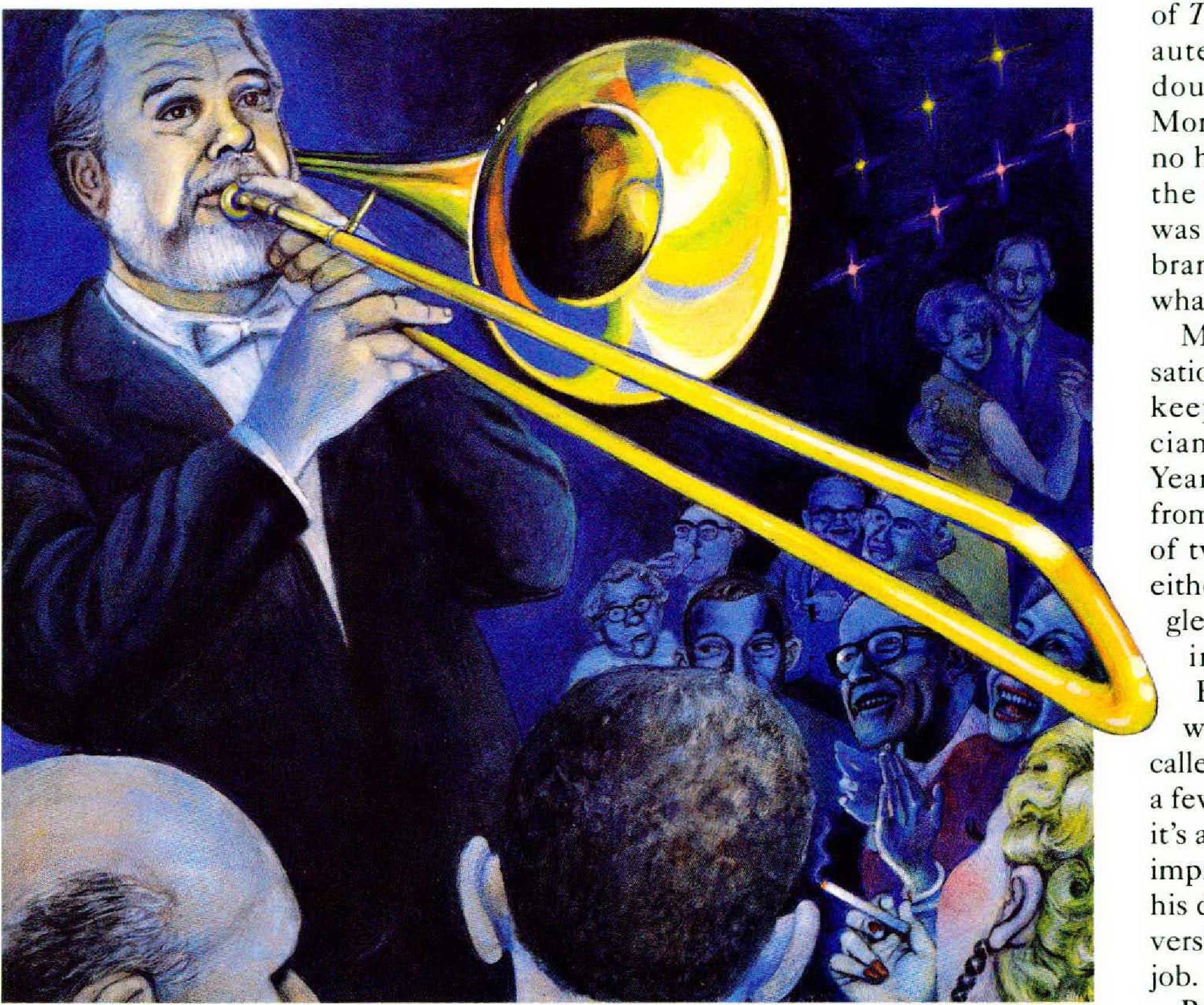
ROSWELL RUDD, a trombonist now in his late fifties, will, regardless of what he accomplishes or fails to in his remaining years, always be identified with the jazz avant-garde of the 1960s, so indelible was his mark on it and its on him. Last summer I heard him sing “The Beer-Barrel Polka” as a member of a show band in a Borscht Belt resort and sound as though he was having a good time doing it. It would heighten the incongruity if I could say that I just walked in on this. But I didn’t. I was looking for Rudd, and I knew exactly where to find him, thanks to Down Beat.
Toward the back of each issue that music magazine runs a feature called “Pro Session,” in which a recorded improvisation is transcribed and analyzed for the edification of readers who are themselves musicians. The subject of “Pro Session” in December, 1990, was the pianist Herbie Nichols’s 1955 recording of his own “Furthermore.” The transcription and analysis were supplied by Rudd, who was identified as “a trombonist currently working in the Catskill Mountains at the Granit Hotel [in] Kerhonkson, N.Y.”
There was no mention of Rudd’s having thrice been voted best trombonist in the magazine’s own International Jazz Critics Poll (in 1975, 1978, and 1979), or of his having finished no worse than seventh as recently as 1987, strictly on reputation: his last New York concert had been in 1983, and he hadn’t been featured on a new jazz release since his appearance on one track of That’s the Way I Feel Now (1984), the auteur record producer Hal Wilner’s double album of novel Thelonious Monk interpretations. And there was no hint of how long Rudd had been in the Catskills—the last I’d heard, he was teaching in Augusta, Maine, at a branch of the state university—or of what on earth he was doing there.
Much of the romance of jazz improvisation is in its evanescence, and as if in keeping with that quality, jazz musicians themselves tend to disappear. Years ago when a musician vanished from the scene, it was usually for one of two reasons: drugs, or steady work either making TV-ad soundtracks (“jingles”) in the recording studio or playing in the orchestras for films or Broadway shows, depending on which coast the person in question called home. Today when someone goes a few years between records or concerts, it’s assumed that he has grown weary of improvising an income for himself and his dependents and has accepted a university teaching position or taken a day job.
But few musicians ever disappear completely or put their horns away for good, even after learning the hard way that there’s very little chance for a big payoff in jazz. Pop musicians and their fans are often puzzled by this, for the same reason that screenwriters, even unproduced screenwriters, are puzzled by novelists, and even more by poets (at least a novel is of some value as a “property”). Publication is almost anticlimactic for most poets. They just have to write. It’s the same with most jazz musicians. For the best of them, jazz isn’t just a craft; it’s a calling, and one that they can never completely stop heeding.
What about those of us who merely listen to jazz? Like serial monogamists, most of us find ourselves drawn to a certain type. Mine seems to be the Missing Person—the great player who has dropped out of sight. Browsing in record stores these days, or listening to many of the bland new releases sent to me to review, I feel as many voters say they do when forced to choose between candidates for whom they have little enthusiasm: there must be something better than this. That’s when I begin to think of musicians like Roswell Rudd, unforgettable but apparently forgotten, and wonder what on earth has become of them.
I T WASN’T difficult to talk my woman friend into spending a weekend in the mountains. When we pulled into the parking lot of the Granit Hotel and Country Club, at around three o’clock in the afternoon one Saturday last July, a band we later identified as the Sherri Orchestra—not the band with Rudd—was playing “Tea for Two” as a cha-cha next to the outdoor swimming pool.
As we rounded the lobby on our way into the Golden Tiara Nite Club for pre-dinner cocktails, we heard a bossa nova above the chatter of those already helping themselves to hors d’oeuvres. It was Burt Bacharach’s “The Look of Love,” being played (we surmised) by David Winograd and the Granit Orchestra, the seven-piece combo that would be backing the comedian Nipsey Russell and the singer Karen Saunders at the Tiara’s “Broadway Showtime” in just a few hours. Before we could spot the musicians, a trombonist broke free of the ensemble just long enough to let loose three staccato blats. He then smeared Bacharach’s melody into a lopsided glissando before blending back into the other horns.
I think I would have recognized that sound anywhere, and the absurdity of the setting only intensified my delight. It should have bothered me that nobody else was paying Rudd much attention. But sometimes it’s better that way—anybody who loves jazz so much that he has become somewhat possessive about it (and somewhat resigned to other people’s hearing it as background music) will know what I mean. I didn’t even mind when, during the band’s version of Kool and the Gang’s “Celebration,” an alter kocker doing an awkward lindy hop in front of the tuxedoed musicians admonished “No, no, rock-and-roll,” clapping his hands on the wrong beat as Rudd stretched the funk rhythm slightly out of shape. More important, Rudd didn’t seem to mind either.
THIRTY YEARS ago, when Rudd was a new face in jazz, the critic Martin Williams praised him for combining “the robust earthiness of a Kid Ory plus all the refinements jazz trombone has been through since and including some of the latest developments in [jazz] as a whole.” The comparison to Ory—the trombonist in Louis Armstrong’s Hot Five and Jelly Roll Morton’s Red Hot Peppers, and a rallied-around figure in the Dixieland revival of the 1940s—was no idle hyperbole. Rudd, while still an undergraduate at Yale, had recorded two albums of Dixieland as a member of a ragtag collegiate outfit called Eli’s Chosen Six. This was before he obtained citizenship in the New York avantgarde through his association with Steve Lacy, Archie Shepp, Bill Dixon, and Cecil Taylor. An ironic consequence of Rudd’s apprenticeship as an Ivy Leaguer playing Dixieland, a style that demands of its horn players a vocalized approach, was that he became the first (and, until the emergence of George Lewis, Ray Anderson, Craig Harris, and several Europeans in the seventies and eighties, the only) trombonist capable of matching split tones and glossal outbursts with saxophonists who were bidding their horns to speak in tongues.
This is how innovation usually spreads in jazz: one or two or as many as three or four players make breakthroughs on their horns, and the rank and file play catch-up. In that fashion J. J. Johnson became the ne plus ultra of bebop trombonists by negotiating Charlie Parker’s and Dizzy Gillespie’s harmonic abstractions and fleet eighthnote runs with his slide. (His West Coast counterpart was the sadly overlooked Frank Rosolino.) In the case of many of Johnson’s less imaginative followers, though, as in the case of those who sought to emulate Tommy Dorsey’s unperturbed lyricism, this meant ignoring the trombone’s potential for mirth. Zipping around on their horns as though the instrument were a darkertoned and only slightly unwieldy trumpet, they sounded like fat men running up stairs with huge bundles. They were ill suited to free improvisation, although many of them tried their hand at it.
Rudd achieved his primacy in free jazz without sounding as though he were consciously emulating Ornette Coleman, John Coltrane, Albert Aylcr, Archie Shepp, or any of the other pacesetting saxophonists of the 1960s. He simply reversed the process begun by Johnson, reacquainting the horn with the whoops and hollers, the horselaughs and elephant snorts, that had been part of its jocular vocabulary before bebop.
Thanks to his sprung time and his knack for locating dissonances between positions on his slide, he was able to do this without sounding like an old-timer who had wandered into the wrong gig. Even on dirges (his forte, as such composers as Michael Mantler and Carla Bley quickly realized) he often sounded as if he were shouting or laughing or cursing on his horn, with or without a plunger stuck in its bell to facilitate such vocal effects.
The other keepsake of his Dixieland experience which made Rudd such a valuable asset in free jazz was his commitment to collective improvisation. The problem with much bebop is that the musicians playing it are simply blowing on the chord changes rather than taking full advantage of the melody and rhythm. The problem with free jazz is that even though the chord changes have been dispensed with, the musicians are still just blowing. The New York Art Quartet, the band Rudd led with the saxophonist John Tchicai for a short time in the 1960s, was notable for many virtues, not the least of them the contrapuntal chatter that Rudd and Tchicai kept up behind each other’s solos. Rudd’s presence in a band of more than four or five pieces practically guaranteed attention to color and dynamics. It also guaranteed levity. He brought a touch of John Philip Sousa to one of Archie Shepp’s best small groups in the late 1960s and, a decade or so later, gleefully played the ham in the midsize ensemble led by Carla Bley, a composer who doesn’t so much select musicians as cast them to type.
Rudd’s sense of himself as first and foremost an ensemble member was so unshakable that when an Italian label invited him to make a solo album, he chose to overdub himself singing and playing piano, bass, drums, and even extra trombone parts. That was in 1979, on The Definitive Roswell Rudd, an eccentric tour de force that proved to be his last opportunity to date to record an album of his own compositions. Three years later he made Regeneration, featuring three pieces by Thelonious Monk and three by Herbie Nichols, for another Italian label. It was his last complete album.
THE PEOPLE seated next to us at dinner turned out to be Catskills regulars, a couple in their early fifties, who informed us that the Granit was strictly Grade B, right down to the entertainment, “The Concord gets Paul Anka, the Granit gets Robert Merrill,” the wife complained. “If you don’t have to ask if somebody’s still living, they’re too big for the Granit.”
Maybe so, but I doubt that any other Catskills resort boasts a band capable of jamming so euphorically on “Mack the Knife.” To my surprise, Rudd wasn’t the only musician in the band with impressive credentials: the lineup also included Bobby Johnson, about whose trumpet solo on Erskine Hawkins’s 1945 recording of “Tippin’ In,” Gunther Schuller wrote (in his landmark book, The Swing Era|) that it was “so admirably conceived and executed” that “one assumes the presence of one of the great trumpet stars of the period.” Johnson sang a few numbers in a swaggering voice reminiscent of Jimmy Rushing’s and still played with effortless grace, despite appearing to be in his early seventies.
I actually enjoyed the show. Karen Saunders, a fine young singer whom I had never heard of, sang a convincing “The Man I Love,” with Rudd supplying a virile plunger obbligato on the slow intro. And Nipsey Russell broke up the band with a joke about a bygone Harlem jazz club where “they had an intermission every twenty minutes, to wheel out the dead and injured.”
Rudd is closer to average in height and build than the yawp of his horn would lead you to expect. A caricature of him would emphasize his watery hazel eyes and his auburn-and-gray beard. He was born in Sharon, Connecticut, in 1935. Despite his Hotchkiss and Yale education, he doesn’t come from money. A small inheritance from his mother was all that enabled him and his wife to relocate to the Catskills in 1982, two years after Rudd was denied tenure by the University of Maine. Both Rudd’s parents were teachers in private schools, and his father—a record collector and an avocational drummer— introduced him to jazz. One of his father’s records made an especially vivid impression on him: the Woody Herman Orchestra’s recording of “Everywhere,”featuring the tune’s composer, Bill Harris, on trombone.
“It just killed me,” Rudd told me. “I think a lot of it had to do with it being his own composition. It wasn’t like he had to bring his musical personality to bear on somebody else’s form. The song was his, and I knew that right away.” (Rudd later reinterpreted Harris’s ballad—half smoldering romantic reverie, half drunken Army reveille— as the title track on his first LP, in 1966.) The other family member who helped to steer Rudd toward music was his grandmother, “a Methodist church lady who was the director of her choir and who, on the out chorus of the hymns, would improvise a descant in a high, pneumatic voice and just soar over the whole choir.”
Rudd spoke with excitement about his grandmother (whom he once compared to the trumpeter Cat Anderson, the high-note specialist in Duke Ellington’s band) and a number of other musical topics, including the marching bands in which he played French horn as a teenager (“Your section was integrated into the other sections . . . almost a Wagnerian kind of thing”), Greenwich Village jam sessions in the early sixties (“There would be as many as ten horns up there, and as a guy would be soloing, the other horns would be riffing behind him, harmonizing the riffs, and it would be like Duke Ellington used to do, only happening spontaneously”), and a love for battered upright pianos, with their weird overtones, which he inherited from Herbie Nichols, the maverick pianist who was a mentor of sorts to him (“The last one I had, in Maine in 1982, just collapsed from the tension of the strings on a rotten frame”).
Rudd’s talk about music—which is probably all he would ever talk about if he had his choice—made it obvious that he wasn’t burned out on jazz and merely going through the motions. After talking with him. I still don’t know the complete answer to how he got where he is. The long and the short of it is that jazz brought him little fortune and only marginal fame. As tastes in jazz became more conservative, he found himself stigmatized, despite his consummate musicianship, as an avantgardist supposedly incapable of doing anything but making noise on his horn. He was already teaching part-time at Bard and working on and off for the folklorist Alan Lomax when the offer came to join the faculty at Maine, in 1976. In Augusta his efforts to integrate raga and other improvisational world music forms into a jazz curriculum displeased his department head, who, one assumes, wanted a real teacher, not a gifted eccentric. After relocating to the Catskills, where a friend had a handyman’s special for sale, he worked sporadically in area clubs for a few years before successfully auditioning for David Winograd at the Granit, in 1986.
REDDE’S WIFE, Moselle Galbraith, likes to joke that he’s too “white bread" for the Catskills. But even though the only stretch of green visible from the Granit’s lobby is the golf course, Kerhonkson itself is rural, and Rudd says he has always felt most at home in rural settings (his fondest memory of Maine is its green summers, which he says “just raged with life”). A self-described “WASP: White AngloSaxon Pythagorean,” Rudd is the sort of easygoing bohemian who gets along just fine with people of any race or nationality. He was one of very few whites welcomed into the inner circle of militant black musicians amid the tumult of the 1960s. “At that time, in New York, a major topic of discussion was the reality of being black and playing this music versus the reality of being white and attempting to play it from a black perspective,” Bill Dixon, a black trumpeter and composer now tenured at Bennington, recalled during a recent conversation we had about Rudd. “But Roz fit right in because of his musicianship and, I would have to say, his personality.”
Told how Rudd was now making his living, Dixon said, “It just proves that being a wonderful musician isn’t enough anymore. But you know, in one sense he’s fortunate.” Dixon meant that Rudd could be driving a cab or painting houses or working as a plumber, a carpenter, or a camp counselor—all jobs that Rudd has held at one time or another.
In some ways he is a better musician now than he was before. His sight-reading has improved, and he and his six bandmates have had a lot of practice in paring down big-band arrangements that some of the Granit’s headliners bring along with them. He has come to place a higher value on showmanship. “No matter how tired they might be, or how few people are in the audience, the performers here go on stage and deliver,” he told me admiringly.
The drawbacks to the job begin with the nagging feeling that a musician of Rudd’s stature belongs somewhere else, doing something better. As the last member of Winograd’s band to have been hired, he is the first to be laid off when business at the hotel is slow, as it was this past winter. A number of prominent musicians live in Woodstock or other nearby towns, but there is no local jazz scene to speak of—unfortunately for Rudd, whose essentially passive nature makes him one of those musicians able to blend easily into an existing scene but unable to start one around themselves. Bandleaders he worked with years ago still call him occasionally with offers to go to Europe for a few weeks, but because he is reluctant to leave his job unprotected and his wife uncared for (she is often ill), he routinely turns them down. He has said no so often that some musicians have wrongly concluded he’s just not interested.
This June, however, Rudd surprised everybody—possibly including himself —by accepting an offer to bring a quintet to Italy, for the Verona Jazz Festival. (His travel costs were defrayed by Arts International, an organization that provides assistance to American performers invited to participate in festivals overseas.) Rudd was scheduled to play outdoors, but rain forced his concert into an auditorium with no amplification. Nevertheless, Rudd returned in excellent spirits. “It was beautiful to play some music,” he told me, implying a distinction between what he had performed at the festival—several of his own recent compositions, plus his arrangements of a few of Herbie Nichols’s tunes and Kid Ory’s “Creole Trombone”—and his nightly fare at the hotel.
He also said something that struck me as trivial at first but that I later realized summed up the unaccustomed elbow room on the trip: “At the hotel, I’m sitting behind a music stand all night. It felt good to stand up, to do my little dance as I played. I have the set on video. It’ll be a chance to see myself in flight.”
One gig hardly amounts to a comeback, but there might soon be others, including a foreign tour by the reassembled New York Art Quartet, featuring Rudd, John Tchicai, the drummer Milford Graves, and the bassist Reggie Workman. In the meantime, Rudd is at least playing music, even if it’s only “The Look of Love.”