The Book on Miles
In his autobiography, the trumpeter Miles Davis proves to be his own most perceptive critic.

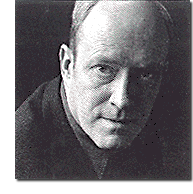 "If I go to a concert and I'm supposed to be reviewing it, and I'm taking notes, I sometimes wind up jotting down as much about the audience as I do about the performers," Francis Davis told The Atlantic in an online interview. "I'm interested in what music means to people: what does it signify to them?" A contributing editor to The Atlantic since 1992, Davis's interest in the social and intellectual significance of jazz, musical theater, pop, and blues brought a unique depth to his career as a music critic and historian.
Davis's writing career began to take form in the scripts he wrote for a Philadelphia public-radio show (which he also produced and hosted) that specialized in playing out-of-print jazz. When his scripts evolved into more sophisticated jazz criticism, he started submitting them for publication and became a staff writer at a small New Jersey newspaper. Since his first article for The Atlantic, "The Loss of Count Basie" (August 1984), he has authored seven books: In the Moment (1986), Outcats (1990), The History of the Blues: The Roots, the Music, the People From Charley Patton to Robert Cray (1995), Bebop and Nothingness: Jazz and Pop at the End of the Century (1996), Like Young (2001), Afterglow: A Last Conversation with Pauline Kael (2002), and Jazz and Its Discontents: A Francis Davis Reader (2004)
Davis wrote for a variety of publications, including The Village Voice, The Philadelphia Inquirer, and Stereo Review. A 1994 Pew Fellow in the Arts, he taught a course in jazz, blues, and folklore at the University of Pennsylvania and was working on a biography of John Coltrane and a history of jazz.
In his autobiography, the trumpeter Miles Davis proves to be his own most perceptive critic.
All of a sudden everybody wants to be a jazz singer—and a few are actually good at it
The pianist Matthew Shipp is the star of the latter-day free-jazz scene—the only scene in jazz right now with younger faces in the audience
Even though the saxophonist and composer Wayne Shorter never went away, his two recent albums are being hailed as a major comeback
Johnny Cash was a Christian who didn't cast stones, a patriot who wasn't a bully
Directors of today's war movies, with their insistence on graphic bloodletting and happy endings, should look at the original World War II movies, which were subtly subversive
Bill Frisell draws from a wide spectrum of music identified with the American experience&mdashand country music is a persistent echo.
Despite seeing on television news what used to be confined to action movies, audiences have been flocking to them, perhaps eager for the illusion of control they offer
Savvy enough about rhythm
Willfully unaware of the facts of her professional life, listeners persist in thinking that Billie Holiday felt their pain.