Okefenokee Romp: Paddling Through a Place Where the Alligators Grow as Big as Canoes
by Roy Blount Jr.
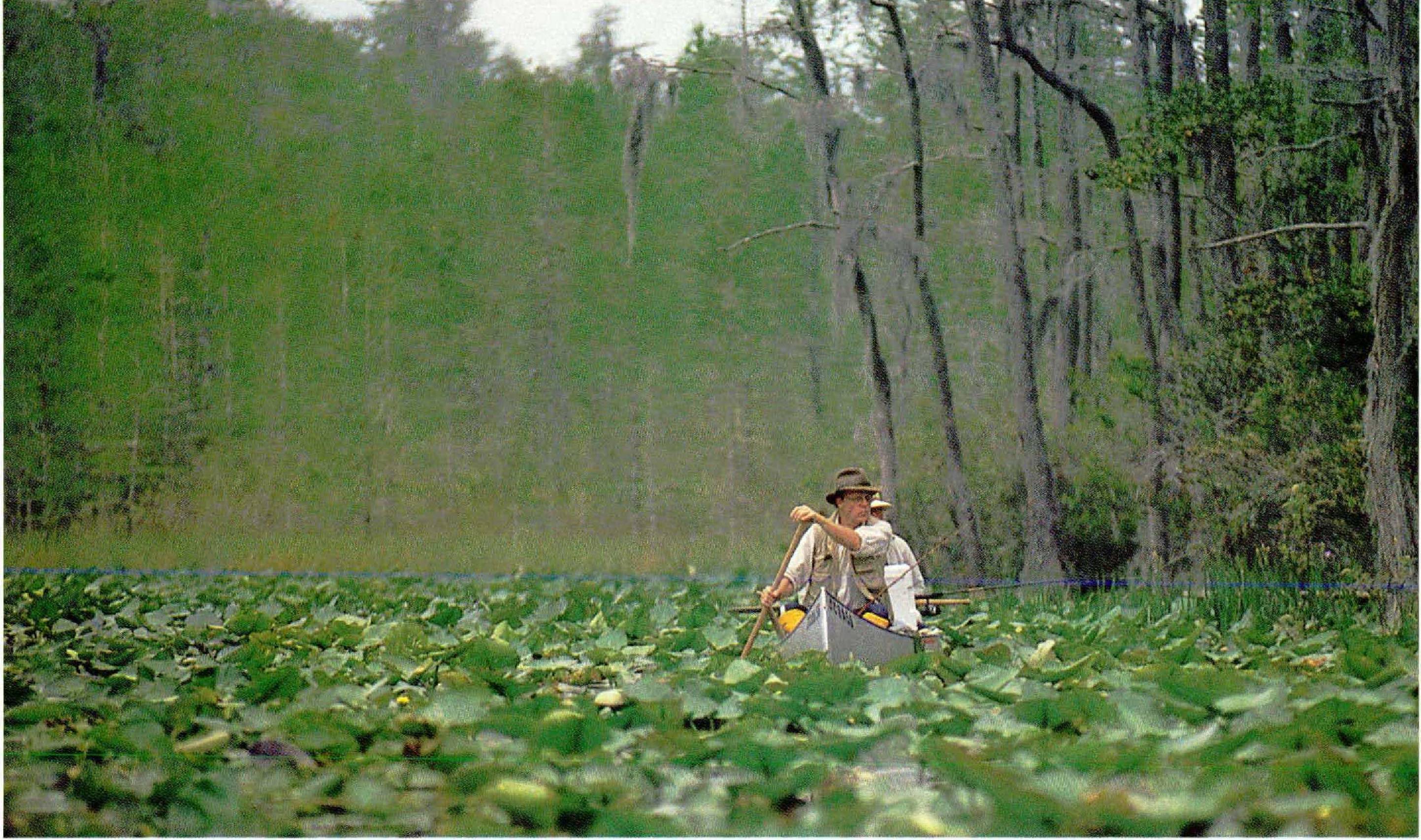
I SHOULDN’T say this, because it puts me on shaky legal ground, but I like to think an alligator ate my notes. Ate the small pocket notebook, that is, in which I recorded many of the impressions and travel tips that came to me as my friends Vereen, Slick, and Hal and I canoed, this past April, through the Okefenokee, whose name derives from the Creek for “Land of the Trembling Earth.”
Certainly my notebook was not without food value, because the last time I remember writing something down in it was right after I had scaled and gutted a string of bluegills, stumpknockers, and catfish that we had caught on red wigglers and an artificial bug called a Yellow Sally, and you know how your hands get when you clean fish. Wherever I had touched the paper, it wouldn’t take ink at all well. I wasn’t about to wash my hands in the black, unripply, vividly reflective water off the side of the shelter, because we knew for a fact that down there lurked an alligator, six or seven feet long, named either George or Georgette.
Most of the shelters along the Okefenokee canoe trails are roofed wooden platforms set on piles. They are among the few surfaces in the swamp that don’t quiver or give. The Okefenokee, which occupies almost seven hundred largely unspoiled square miles in southeast Georgia and north Florida, is generally referred to as a swamp but strictly speaking is not one, because it is too far above sea level and because a swamp is stagnant. Water flows constantly, though very slowly and circuitously, through various channels in the Okefenokee, which is Pogo’s home and which is way down upon the Suwannee River. The water looks black from above (a sample in a clear bottle is tea-colored; the fish that live in it are sepia), and tastes slightly like Scotch whisky, because the Okefenokee is a peat bog. The clumps of soil from which huge cypress trees grow (also the hooded pitcher plant, the golden trumpet, the bonnet lily, the neverwet, the sweet pepper bush, and the lather leaf, or poor man’s soap) are in fact islands of peat that float above the sandy bottom.
The platforms are spaced along the trails so that canoe parties can spend the night on them. Each of these shelters has a logbook in which parties have left their comments. I wrote many of these comments down in my notebook. Some I recall roughly as follows:
At the Maul Hammock shelter, “This place is yellow-fly hell.” Followed by: “The flies live here. We are visitors. We come to see all the inhabitants, not just the cute ones.”
At Maul Hammock, “We are making this trip with two over-sixties people. We don’t recommend this.”
At the Big Water shelter (the next night), “The ‘over-sixties’ are hanging in there.”
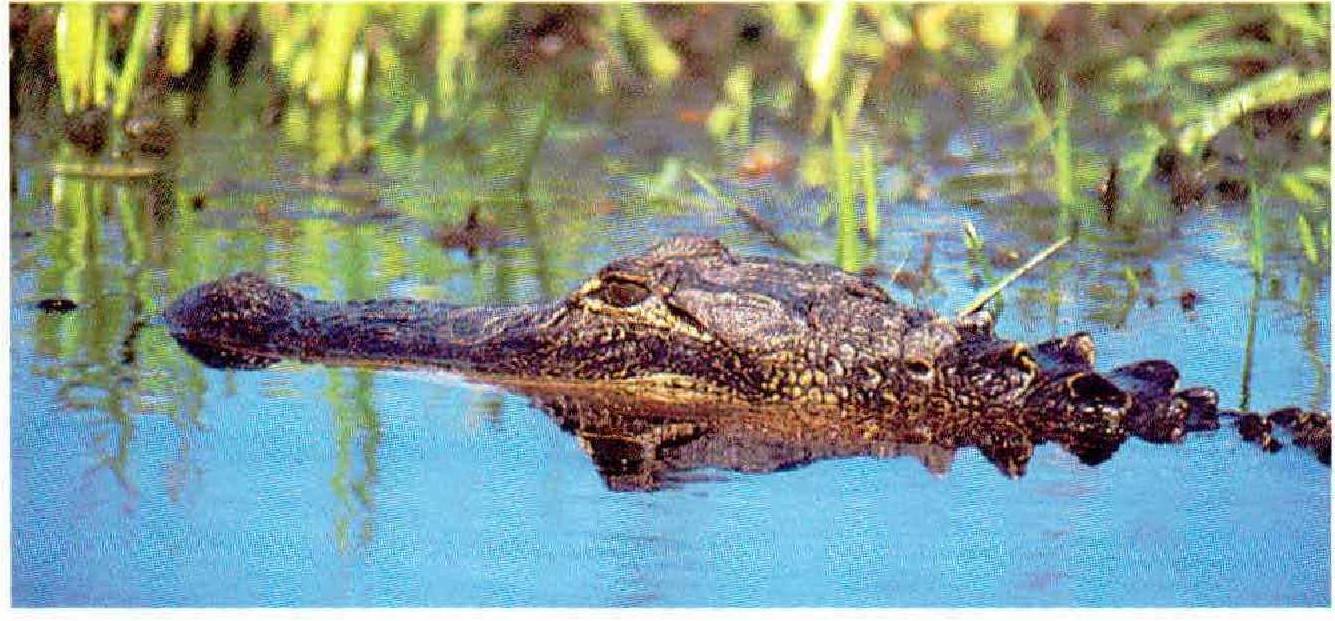
Big Water was where George or Georgette lived. It seems to be a tradition that male commenters call him George, female ones Georgette. It is a violation of federal law to feed Okefenokee alligators. And I dare say it is bad practice to encourage them to look to human beings for sustenance. As Slick put it at the Maul Hammock shelter, “If an alligator can climb on a log, an alligator can climb up here in our sleep.”
“-ing bags,” Hal added.
But I halfway accidentally let George or Georgette get a catfish head. I couldn’t help myself—he or she begged and begged. Later a local man advised us that alligators lie around with their mouths wide open “in lieu of perspiring.” They lack sweat glands, so that’s how they cool off, by gaping. But George or Georgette gaped in an extremely insistent way, resting his head on the edge of the shelter and looking up at us with her good eye. There could be little doubt that he or she had figured out what campers find appealing.
IT WASN’T George/-ette who got my notebook, because I still had it the next morning when we set off on the last leg of our thirty-one-mile trip through what would be, if it were a swamp, the largest freshwater swamp in America. The notes disappeared in the confusion after Slick’s and my canoe rammed the log another alligator was lying on. Slick, in the back, was trying to take this alligator’s picture, and I—in the front, and therefore some fifteen inches from the alligator when we hit the log—evidently did not do the right thing with my paddle.
In fact, this trip was the first time I had been in a canoe without falling out. I mention this because I don’t want you to get the idea that you have to be a crack outdoorsman to get back up into some of the most unusual country you can see in America.
There are seven different twoto five-day Okefenokee canoe routes. Unless you love sweaty, buggy nights, this is not the time to take any of them. It is time, however, to make plans for the fall. November, when the cypress needles will be turning golden and the sweet-gum leaves red, is one of the two best months of the year. (April, when I went, is the other; March is nearly as popular.) To make a fall trip, you will have to start applying for a permit soon.
Here’s how that works. You call the Okefenokee National Wildlife Refuge, near Folkston, Georgia, and tell Karen, the cordial person who answers, that you want to canoe the Okefenokee. She will tell you that you’re welcome if your party is no larger than twenty people and ten canoes. (Five dollars per person per night. You can rent canoes and camping equipment inexpensively at the Suwannee Canal Recreational Concession, near Folkston.) But if you want to embark on, say, November 1, you must call for a reservation first thing in the morning exactly sixty days ahead of that date. First thing in the morning means 7:00 A.M. And, as Karen warns you, a lot of other people will be calling then too. You ask her if it makes any difference that you’re planning to write a story about the experience for a prominent national magazine. She says no. She says she has congressmen asking her whether it makes any difference that they are congressmen, and no is what she tells them. First come first served.
So you and all the other members of your party who can speak intelligibly at that time of day will have to start dialing at 6:59 EST, with fingers crossed. (If you think this is awkward, wait until you have to make a pit stop in terrain where the only place to stand is either your canoe or a patch of mush and roots.) The Okefenokee National Wildlife Refuge does not have call waiting. You will get a great many busy signals, and when you finally get through, you will most likely be told that all the trails are taken for that day. So you’ll have to try again the next day, for November 2. We were lucky to get the trail we wanted—“the red trail,” Kingfisher Landing to Maul Hammock, Big Water, and Stephen Foster State Park—on the third day of calling.
Yes, there are simpler ways to see a bit of the Okefenokee, year-round. You can visit Okefenokee Swamp Park, near Waycross, Georgia, which features interesting wildlife exhibits, including a canoe-sized stuffed alligator with a sign next to it that says,
OLD ROY. He is here to touch and feel and to pose with you for pictures. When Roy died in the summer of 1972 of old age he was about 90 yrs old and had lived in Okefenokee Swamp Park for almost 20 yrs. He had been placed in captivity because he had developed the habit of attacking the boats of fishermen and helping himself to their strings of fish. Roy was 12’10” long, weighed approximately 650 lbs and had a girth of 70 inches. Named for Roy Moore, manager of Okefenokee National Wildlife Refuge from 1951 to 1955.
Also at the Waycross site you can line up for brief tour-boat excursions with rote commentary. (“Do any of y’all know who Oscar is besides Oscar the Grouch, Oscar Mayer Wiener, and Oscar de la Renta? He’s Oscar the alligator, and sometimes you can see him just around the corner here . . . maybe not this time.”)
More to be recommended are the guided boat tours out of the Suwannee Canal Recreational Concession, which take you far enough to see lots of gators and birds. Two of these tours, by reservation only, go out at night. You can also rent motorboats there and take them eleven or twelve miles up into the swamp—and make a lot of noise, and incur the disdain of us deep-swamp canoeists who are returning from way back up in there where we could entertain the notion that we might conceivably never get back out again.
I’VE BEEN fascinated by the Okefenokee since I was a boy, partly because of Pogo and partly because of the movie Swamp Water, which was directed by Jean Renoir in 1941 and starred Walter Brennan and was remade in 1952 as Lure of the Wilderness, again starring Walter Brennan. The movies were based on the novel Swamp Water, by Vereen Bell Sr., the father of my fellow explorer Vereen. In the movies the swamp is a fearful thing that only a few swampwise souls dare venture into. One false step and you’re swallowed by quicksand.
As it happens, the quicksand was a Hollywood concoction: the Okefenokee footing never goes so far as to suck you down. And when I asked Jim Petty, one of the concession’s guides, whether people still get lost forever in the swamp, he said, “That’s just something you read about.”
But you do feel when you paddle back up in there that the world as you know it has disappeared. There are stretches where you have to fight your way through lily pads, and there are stretches where you glide over water that looks like black glass with trees and flowers laid onto it by some kind of photographic process, and you dip your paddle and its blade disappears as the flora’s mirror images swirl around the handle. And there is the cypress-lined Big Water, which feels a bit like a cathedral, only less busy.
To get into all that, you have to go through Karen. Because the reservations system keeps the trails strictly apportioned, your party won’t see anybody for the whole trip but yourselves —and turtles and sandhill cranes and egrets and great blue herons and white ibises and anhingas (also known as water turkeys). And occasional water moccasins, but they flee canoeists: if anything, you’ll wish you could get better glimpses of them. Furthermore, the Okefenokee alligators have never been known to cat people; they prefer turtles, frogs, and fishy travel notes.
Late at night you can hear them grunting, though. Alligators and frogs. G’nuh. Big old bull alligator. Gunk. Maybe an alligator, maybe a frog. Pweep pweep. Frogs.
I recommend it.