When You Fire Him
In this article, CLARENCE RANDALL, formerly the president of Inland Steel, confronts one of the most sensitive situations in business, the necessity of discharging an employee who has been too long on the payroll. When does a company move too fast in such crises, when too slowly?
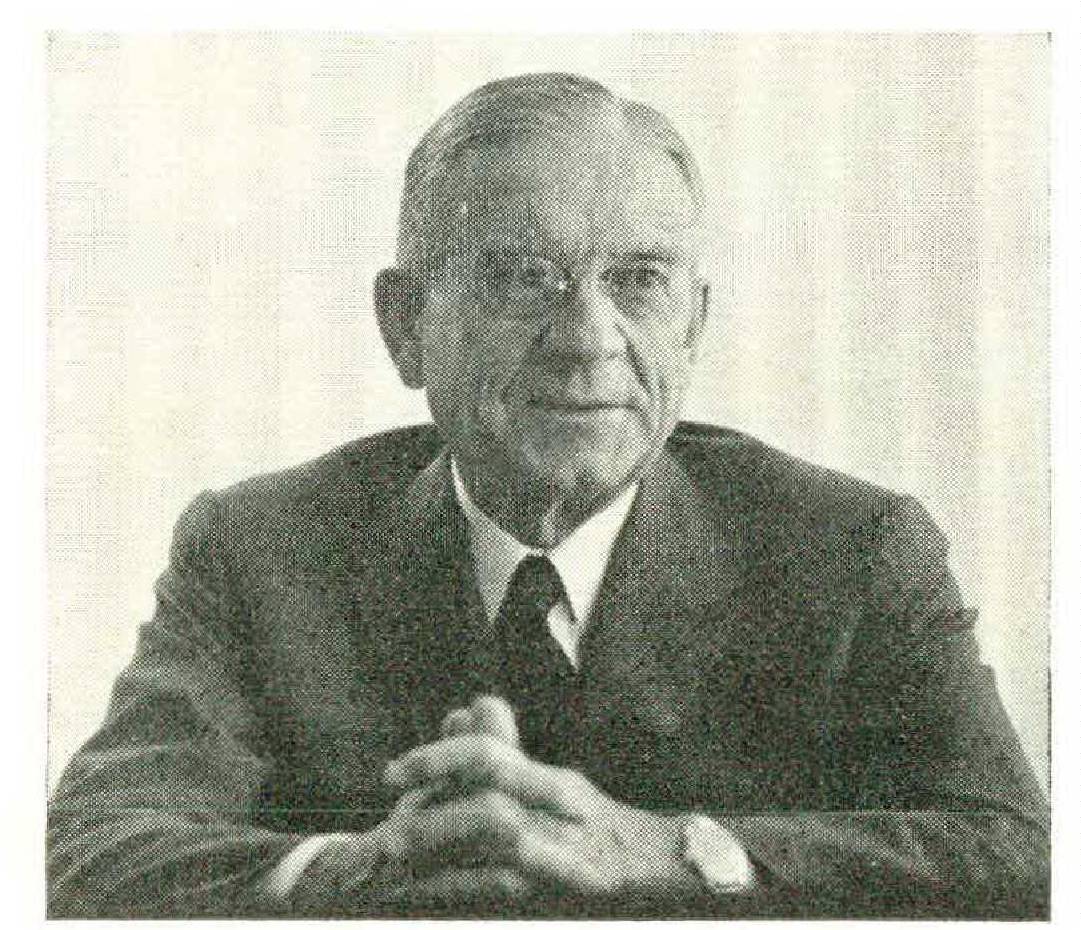
MANAGEMENT is rapidly being overtaken by methodology. Practices and programs which we of the senior generation had to master in the school of experience can now be learned from textbooks. And this is good.
There are still problems, however, which every executive must face at some time in his career where he will be strictly on his own, with no background of theory to guide him. There are still crises so personal, so intimately involved in the whole welfare of the corporation that no outside analyst, brilliant though he may be, can safely offer a solution. A man must fight his own way through, relying on nothing but his instinct for the right, his courage, and his own intelligence. Of all such experiences, there is none more poignant, none that calls for greater staunchness of character than that required in the discharge of an employee who has been on the payroll for a long time.
Whether the employee whose service clearly must be terminated be an attractive misfit or the senior vice president, the man who bears the ultimate responsibility for making the decision has a lonely task. There are none to help him. The better qualified he is as an executive, in terms of sensitivity to human values, the greater will be his anguish when at long last he decides that the firing simply must be done. The night before he will have no sleep. And when his own career ends, and he enters into retirement, he will say to his wife, “Well, at any rate, I shall never have to do that again.”
Our forebears were not so squeamish. They fired men right and left, for good reason or out of animosity or for no reason at all, thus, by their callousness, setting in motion the forces that have hastened our own increasing social maturity. Through their shortcomings we have been brought to see that human values must be weighed against the dollar values before the drastic step of severance is taken.
When a man is fired, it is not only he who is discharged, but his family as well. In a good company the employee’s wife and children are known to many of the other workers or officials — not as numbers on the files of the personnel office, but as human beings. Their welfare is properly a matter of concern for management. Possibly the wife has a lingering illness which is making a heavy drain on the family budget, and her treatments must be continued or her recovery will be endangered. Perhaps the oldest daughter is just about to enter college, or the final payment is due on the home of which they are all so proud. Every such consideration must be brought into play in the mind of the responsible officer and evaluated against the welfare of the institution as a whole, before he makes his decision.
Weighed, also, must be the question of what the impact of the discharge will be upon the man himself, what will be the consequences in terms of his usefulness to society during the remaining years of his life.
We have all known men who have boasted that their success began from the day they were fired, and who insisted that they were grateful to the man who discharged them. And it is certain that this totally unexpected event can bring an individual up short in a salutary way. It can so shake him out of complacency, so challenge his whole way of life that the turnabout which his friends have so long hoped for begins at that point.
On the other hand, there have been men who, upon being fired, have walked straight out of the boss’s office and committed suicide. They were so overcome with shame that they could not bring themselves to face their families and friends. More common are the experiences of those who never again secure steady employment. For years they drift from job to job, gradually turning to alcohol as they seek escape from frustration and chagrin.
Thus, the conscientious executive may find himself at grips with a problem that is almost too big for him. Some men move swiftly and impulsively and suffer later for their errors; others temporize, putting off what they know they ought to do, hoping vainly for a miracle. It is never easy.
The catalogue of the reasons why employees are discharged is long. There is the man who refuses to carry out instructions. He thinks he knows better than the boss. Occasionally he may be right. But an order must be obeyed or there is no management. He must either comply or leave.
There is the man who is never on time. He punches the clock late every day or invariably is the last to return from lunch. Because he is a team member, his conduct reduces the efficiency of others, and if he ignores repeated warnings, he must be removed.
Then there is the man who so constantly annoys everyone around him that group morale is seriously affected. His language is too coarse for decency, his barbed remarks hurt, he “bears false witness against his neighbors,” he lacks respect for the women on the staff, or is an inveterate practical joker. Here again, a reprimand is the first step, but if the abuse is chronic, it must be stopped.
More subtle to detect, and more baffling to deal with, are the psychological problems — the alcoholic, for example. The problem of alcoholism may take the form of drunkenness on the job, which is dangerous, or it may consist in the constant dulling of the senses from quiet, solitary slugs. Parallel in effect are the deeply disturbing emotional experiences — the secretary whose engagement of long standing has been broken, or the husband whose wife has just deserted him and the children. Here the responsible officer may need both medical and psychiatric advice, but in the end he alone must make the decision as to when the limit of tolerance has been reached.
ABOVE these are the crises in discharge which come once or twice in a man’s business career and which test him to the very limit.
These fall into two main categories: the first, a serious breach of trust, and the second, incurable incompetence. Worst of all, the agony is usually compounded by the fact that the employee involved has for years been the close associate of the executive. Strangely enough, our behavior is not the same in both these circumstances. We tend to move swiftly and in anger for dishonesty, and to procrastinate for proven lack of ability.
My views will be thought unorthodox, but I believe that our prevailing practice should be reversed. I think that we should move more slowly than we do when confronted by dishonor, and more rapidly with respect to incompetence.
Breach of trust may take many forms, ranging all the way from the falsification of records to crass venality, but let us take the embezzlement of funds as an example. What do we do at such a time? Nothing more simple! The man who robs the till is fired immediately upon discovery of the theft. Within the hour he is gone; thereafter he will be seen only in the courtroom.
Our reaction is exactly the same as that which causes a man to strike a snake with a stick. No thought whatever is given to the man’s future, or to whether it is part of our obligation to society to help rehabilitate him and restore him to useful living. Who else will do it? We cast him from us at the one time in his life when he most needs our help. He had capacity or he would not have held that job at all, and now those abilities will be forever wasted, for without our backing he cannot possibly have a decent second chance, no matter how penitent he may be.
Yet, in situations where breach of trust is involved, the actual injury to the corporation is seldom significant in terms of its overall operations. If it is, management itself is usually vulnerable for having so long permitted an unwholesome situation to continue without investigation. Ordinarily, too, the money loss is covered by insurance. Seldom is the forward progress of the company even noticeably endangered. Morally the circumstances are spectacular, but economically they may be negligible, and we should display more balanced judgment. In terms of company policy, human considerations should be the controlling ones, unless we honestly believe that the welfare of the institution itself is seriously threatened.
Discharge for incompetence, however, is an altogether different matter. There the ultimate success of the venture may already be at stake. When, through the glacial pressure of seniority, or nepotism, or any similar cause, a man of insufficient capacity comes to a position of substantial responsibility, forward progress is blocked. His mediocrity settles down over his range of authority like a thick fog. Perhaps he is bold, but solely because he lacks the sensitivity to foresee the consequences of his actions; perhaps he is wise, but weak; perhaps he is kindly, but dull. Whatever the reason, his incapacity must not be permitted to block the progress of the company. The man must be removed.
Once the situation is fully recognized, there should be no delay whatever. Immediate surgery shows the greatest mercy for all concerned. By hypothesis, there is no reasonable prospect of improvement, and the welfare of the individual has to yield to that of the institution as a whole.
Nor is the potential damage to the man as great as in a case where dishonor is involved. Since no moral stigma is attached to his leaving, there is always a reasonable chance that he can re-establish himself in some other calling.
The corporation must, of course, deal generously with him, particularly if his service has been long and conscientious, which is nearly always true in the really tough cases. A good formula is to set up for him a pension equal to the median between what is due him as of the time of the discharge and what would have been due him had he gone all the way through to retirement. That is little enough burden for the corporation to bear as a penalty for its own neglect in permitting the intolerable situation to develop.
The supreme crisis occurs, of course, when it is the chief executive himself whose mediocrity and indecisiveness so blanket the affairs of the company that initiative and creative effort are thwarted at every level. The situation can then be saved only by the board of directors, and that calls for industrial courage of the highest order. Most of the directors are there because he nominated them. If it is an inside board, composed only of company officers, the case is completely hopeless. Their own jobs are at stake if they should organize a palace revolution and lose. But even if the majority are from the outside, their interest in the company is so nominal that only a man of exceptional fortitude will face up to his old friend and tell him that he must resign. Usually nothing is done, and the company gradually withers away.
There is only one answer. We must so improve our methods of selection and training that mediocrity will be detected before it is permitted to ripen into authority.