The Peripatetic Reviewer
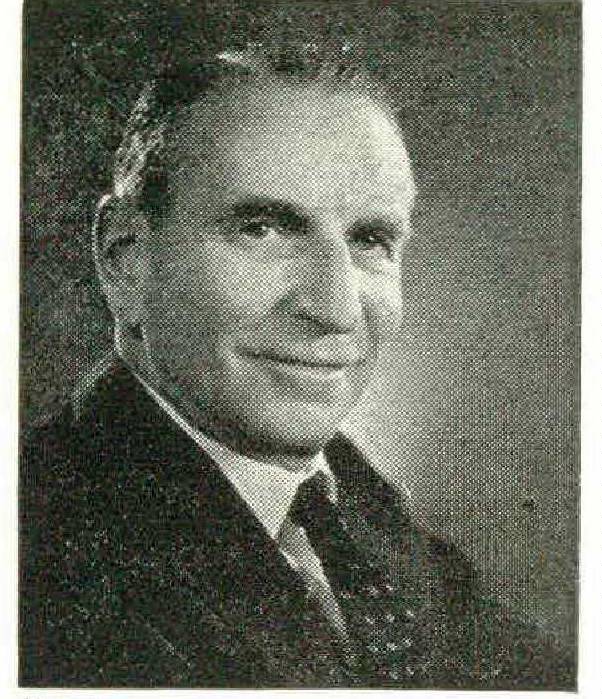
ONE of the ordeals of my young life was having to play golf with my father-in-law. All during my boyhood on the Jersey coast I had been a tennis fan, not tall enough to be a winner at singles, but fast and accurate enough to get my share of silverware in doubles. Then I married into a golfing family: my wife had been taught by Jim Barnes, and early in our courtship I watched her make a hole in one; my brother-in-law hit the ball a country mile; and Unkie, my father-in-law. who had never taken up the game until he had passed fifty, was unbeatable. Unkie played left-handed with a gentle swing and no more pivot than was necessary to hit the ball 150 yards. He was short but straight; his approaches frequently saved him a putt, and on the tee or green he was imperturbable. Because he was hard of hearing, he was impervious to the teasing or overpraise which was thrown at me. (This was long before the days of Stephen Potter, but my in-laws were already masters of some of the more famous ploys, such as, “Why do you keep on doing that?” “What?” “You keep lifting your head just before you hit it.” “Oh!”)
My golf was anything but imperturbable. I used the driver as if I were going to kill the ball, finishing my stroke on the tips of my toes and with the ball slicing away at a sharp angle over the rough and into the trees. I was a congenital threeputter. And I always lost my temper. Everything that was quick and fiery in my tennis temperament unfitted me for my contests with Unkie, and he knew it. He always arranged the handicaps the night before over the martinis, and invariably he stung my pride, so that instead of playing him even, I gave him two strokes, sometimes three, on the long holes. While the martinis were flowing I never realized what a mental hazard this would be. But come the day when I would be struggling so hard for my five and Unkie patting his straight way along for a six, the pressure would be on, and as I hacked my way up to the sevens and eights, the fury of exasperation would complete my downfall.
The crisis came one Christmas Eve when we were opening presents after a sumptuous dinner with the in-laws. Unkie had been given a putting set so he could practice on the library rug, and this prompted him to do a takeoff on Ted playing golf. Very funny, very funny. But the bile did not subside. And when I got back to Boston, I asked my friend Jim White if he knew of any professional who gave lessons in the winter. He did, and so in the late afternoons after work I went to school before a mirror and under the instruction of a soft-spoken Scot named Thomson. “It’s like playing a violin, laddie,” he’d say. (Motions of playing a violin.) “See, the same rhythm, slow back on your right heel, and dinna slug it as you come down.” All through that February and March and up until the links were open, I tried to follow that Scotch persuasion.
In my three decades of golfing I have seen some rare sights: I have seen Gene Sarazen sink a 3-iron for a two on a 536-yard hole, and the same Sarazen take an eight on Myopia’s seventeenth when he drove into the rough by the stone wall. I have seen Johnny Farrell sink a forty-footer that had to go in to win and Arnold Palmer come through with those magnificent birdies in a closing rush. I have even seen E. Weeks make a hole in one. But the finest sight in my experience occurred at Eastward Ho, that once-faraous course on Cape Cod, where Unkie and I had our first match after my schooling. We had gone through the usual preliminaries the night before, and over the martinis I had conceded him strokes on the three longest holes. “Vengeance is mine; I will repay, saith the Lord.” I got my par four on the first hole, which was accepted as a fluke; a bogey five at the second, which was good enough in the wind; another par; and when I hit a spoon shot ten feet from the cup on the fourth, Unkie, who had been watching my swing, broke down. “What in God’s name has happened to you!” he shouted across the fairway, and the praise was so grudging that I wished I could have had it framed. It was one of those dream rounds, and of course at the nineteenth hole I had my triumph before the handicap went up. I owe a good deal to that kindly Scot who gave me my adult education on the driving range, but the most priceless thing he taught me was never — well, hardly ever — to lose my temper.
Afterword. Years later, when the fierceness of our feud had abated and Unkie’s pat shots had shortened to less than a hundred yards, so that he couldn’t carry across the water holes at Pine Valley (the club wag, instead of betting Unkie that he couldn’t break 100, bet him that he couldn’t even finish the course. And he didn’t), I happened to notice that Unkie was carrying sixteen irons in his bag. “Good Lord, Unkie,” I said. “What do you want with all that hardware?”
“Weeksie,” he answered, with one of his rare, sweet smiles, “haven’t you realized that one of the pleasures of life is always having more possibilities than you can enjoy?”
SUCH EXQUISITE TORTURE
What makes golf such exquisite torture is the long delay between shots and the realization, so tense in tournament play, that you must get up close to that pin or lose the hole. The fierce concentration with which a master like Arnold Palmer recovers from the rough and goes down in one putt is not always appreciated by the spectator. England’s best writer on golf was Bernard Darwin, grandson of the famous evolutionist, who wrote for the London Times and who played well enough to be a member of a Walker Cup team. His American counterpart is CHARLES PRICE, whose superbly illustrated, dramatically written THE WORLD OF GOLF (Random House, $12.50) will be relished this Christmas season by pro and hacker alike.
His book begins, as it should, with the establishment of golf on the moors of Scotland. I love the old pictures — the earliest photograph of St. Andrews goes back to 1858; the description of the early caddies, who doubled as valets and pimps; and the stories about Old Tom and Young Tom Morris, both of whom won the British Open, the son four in a row by the time he was twenty-one. Then the game was exported to America, and the first course laid out in a cow pasture in Yonkers. Newport and Shinnecock Hills got into the act, and as the play moved north or west the irascible Charlie Macdonald was consulted for the new layouts. Mr. Price’s lively record of the American pioneers is complete save for one glaring omission: he seems never to have heard of the Myopia links at South Hamilton, Massachusetts, on which were played three of our first ten Open Championships.
The author is at his best in his character portraits: take, for instance, his profile of Walter J. Travis. Travis never swung a club until he was thirty-five; he never hit the ball far, but he was a deadly putter. In four years he won the National Amateur, and four years after that became the first American to win the British Amateur. The account of his treatment throughout that tournament makes the blood run cold. Thus began the American supremacy which was to be upheld by young Francis Ouimet, by those two great pros Walter Hagen and Gene Sarazen, by the incomparable Bobby Jones, by the “Hawk,” nickname for the machinelike Ben Hogan, and today by Arnold Palmer. The pages on Bobby Jones are, I think, the finest in the book, and not least because of what he did after his retirement, both as the inspiration for the Masters and by his design of the steel-shafted matched irons. For its action writing and photography, this book will delight anyone who has suffered through the exquisite torture of golf.
YEAR’S END
Browsing at the year’s end I came on LONDON PERCEIVED, the text by V. S. PRITCHETT, the photographs in color and halftone by EVELYN HOFER (Harcourt, Brace & World, $15.00). A handsome and illuminating book if there ever was one, it will be the pride and envy of every amateur photographer. Mr. Pritchett takes his text from the entry Henry James made in his notebooks when he had decided to give up Boston. London, he wrote, “is not a pleasant place; it is not agreeable, or cheerful, or easy. . . . You may call it dreary, heavy, stupid, dull, inhuman, vulgar at heart and tiresome in form. . . . But . . . for one who takes it as I take it, London is on the whole the most possible form of life.”
With that as his cue, he pokes into the pubs and clubs, the palaces and markets, the parks and a hundred private spots where London is in character. His comments are witty, astringent, and knowledgeable, and he has been blessed with an artist who catches the very spirit of the place, the gaiety, the gloom, the humor and beauty of a great capital.
Ever since his articles first appeared in the New Yorker, A. J. LIEBLING has ranked in my mind as one of the most informed and penetrating critics of the American press. In his new and surprising essays, BETWEEN MEALS (Simon and Schuster, $3.95), I find him in the fresh and mellow mood of a bon vivant. He calls his book An Appetite for Paris; he has been wining and dining there since the heroic age of the First World War; and his account of his companions at the table, gourmets as insatiable as M. Mirande or M. Perès, his descriptions of the restaurants they visited, of the incredible meals they gloated over, and of the actors or pretty women whom they still had strength to appreciate afterward are so succulent and ineluctably Parisian and so funny that I urge them on others even when the taste buds are overworked.
Good short stories have been in scant supply recently, and for those who like them I recommend TALE FOR THE MIRROR by HORTENSE CALISHER (Little, Brown, $5.50), who is writing about our world of today with what seems to me a remarkably true feeling for people. Her stories are, many of them, centered in New York and in the suburbs nearby. She is very good with her transplanted Southerners, as witness her leading story, “The Rehabilitation of Ginevra Leake”; she touches the heart with her young lovers in that poignant piece “The Night Club in the Woods”; she is very acute in her family relationships; and she has a way of tucking into her scenes a description of character or a comment on life so telling, so beautifully compressed that it lights up the whole page and we must reread it.
MIODRAG BULATOVIC is a thirty-two-year-old Montenegrin whose chance for a formal education was blasted by the war but who has managed nonetheless to assert himself as the most promising of the young novelists in Yugoslavia. His latest book, THE RED COCK FLIES TO HEAVEN (Bernard Geis, $4.95), has been published in several foreign editions and has now been translated into English by E. D. Goy. Mr. Bulatović is a morbid Brueghel. To the broad humor and coarse vitality of the peasant world he adds an undertone of violence and a symbolism sometimes clear and sometimes murky. This story of a Balkan wedding is told in a series of vignettes; the 220-pound bride and her scared little mouse of a husband, whom she threatens to squash, are minor characters in the drunken brawl. The commanding figure here is old Elija, the uncle of the bridegroom and a well-todo farmer who has arranged the affair and who, under the fumes of the brandy, lapses into a strange and powerful confession. Tramps, gravediggers, a defiled corpse, the village idiot, and a pathetic little consumptive with the symbolic red bird under his arm wander in and out of the merriment like the stray thoughts of Salvador Dali, but there are earthy, even plaintive scenes here which are drawn from life.