Pakistan Post Office
After a recent lecture assignment at the University of Karachi, ALEX PAGE returned to the University of Massachusetts, where he is teaching English literature.
I took a stack of letters to a mailbox in Karachi one morning. As I dropped them into the airmail slot, there was loud, happy laughter from six or seven Pakistanis lounging near the box, and I even heard a Pakistani Bronx cheer or two. Armed with hindsight, I see why.
None of those letters ever reached its destination. No doubt, any one of those delighted spectators could have foretold that fate; one may, indeed, have had a hand in it. If you deposit a letter with an uncanceled stamp in a mailbox — especially an airmail stamp — the chances are absolutely first-rate that the stamps will be removed and other uses found for the letter’s remains. After all, the postal carrier who empties the mailbox makes a pitiful wage (about $12 a month), and an uncanceled stamp has a certain stated value. If the carrier should, despite his better judgment, carry the letters in their inviolate state to the post office, the man charged with canceling them there would regard a definite percentage as his supplemental income.
All this took me a little time to discover. Then 1 began to do what everyone else did — take the letters to the post office in person and witness their cancellation coram populo. It was still disconcerting to find a huge pot of glue stationed at every window. The glue was used to affix those stamps that had somehow lost their gum in their brief lives. One could not help speculating on the number of previous owners those stamps could boast. And there was the picture of one such previous owner chiding his friends for taking no heed of his letters — chiding them in vain, for his follow-ups would bite the dust the same way.
I confess to an indignant citizen’s rage when I first discovered this state of affairs. I then thought of composing a sharp letter of protest to the postal complaint department. But it was made clear to me that such letters also have a way of not reaching their destination, albeit for different reasons.
So I faithfully took all letters to the post office. I stopped there once a day for thirty minutes, rarely less. I don’t mean to sound peevish, for there was a kind of pleasure in that half hour. I became an old customer; my business was the same day after day.
If the letters I took to the window were already stamped, they were closely examined both by the official immediately in charge and by the supervisor. This was routine. The letters usually said “U.S.A.” The employee invariably asked, “Is to America, yes?” Then he set to canceling the stamps, in direct line with my vision.
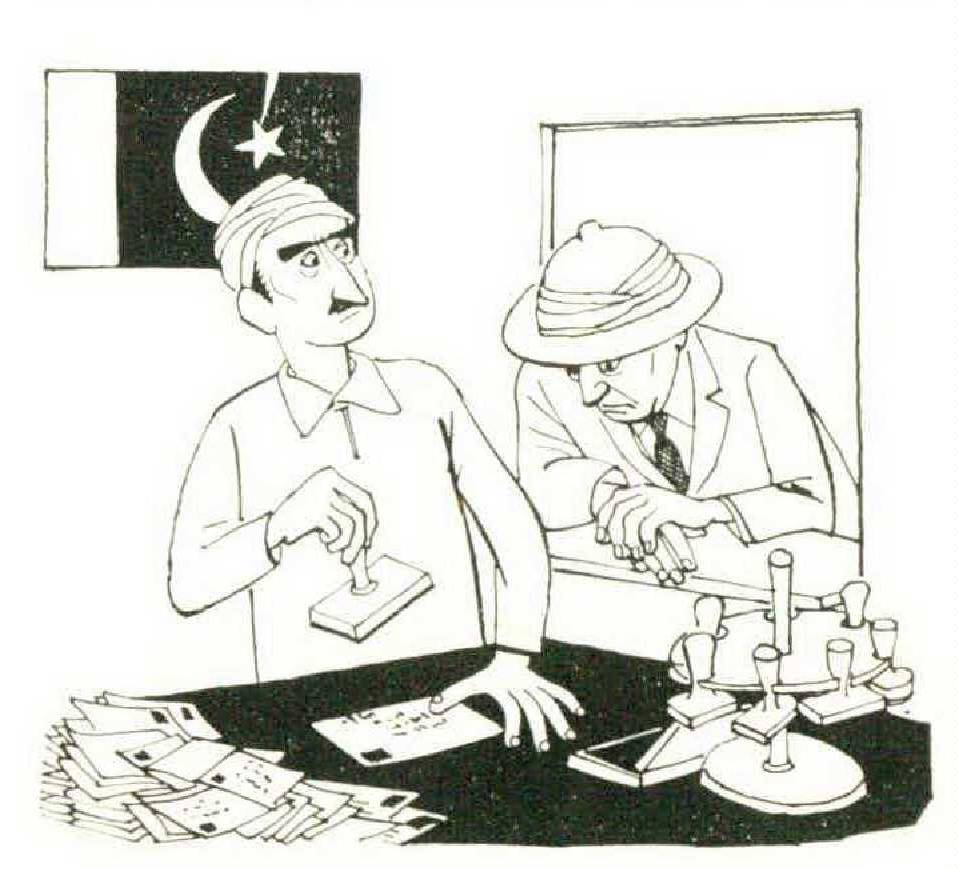
Now, he knew perfectly well why he had to do this publicly, and knew that he knew. Yet this air suffused with heavy suspicion was somehow perfumed by his artistry in placing the cancellation stamps just right. This could take time. He had to aim, reconsider his aim, decide on the most economical placement of each throw, and yet, under my steely glance, make sure that each stamp was canceled, including any embedded in the center of a cluster. As I say, it took time.
Once the stamps were all canceled, the letter was casually thrown on a pile of similarly treated letters. The understanding was that, since the stamps were no longer marketable, normal postal processes might take effect. This was an assumption not lightly to be made. People said that if your glance was too steely, if suspicion oozed in too-heavy globs, or if you had been too fussy over getting the right change, the affronted official might discard the letter anyway, on principle, and not for mere pelf. The human element ranked high. Trust did not exist, but one had to be genial about its lack.
The plot was compounded whenever I had to make purchases of stamps or air letters, or do anything that involved a monetary transaction. Let me quote from the Ready Reckoner, put out by Pakistan’s Ministry of Finance to assist people in making swift calculations on the three currencies more or less in simultaneous use: “The exact equivalent should be worked out at the rate of 100 paisa to 1 rupee or 16 annas or 64 pice or 192 pies.” If I point out that “paisa,” “pice,” and “pies” are pronounced almost exactly alike, if I allude to the historical fact that a certain government official (now self-employed) caused coins to be stamped “pice” when they should have been stamped “paisa,” and if I add that there were then in circulation some twenty coins differing in size, shape, edging, and color, will it not be called a marvel that I tarried as little at the post office as I did? That, indeed, anything fiduciary ever happened?
The Ready Reckoner was available, but it was not used. Whatever occurred occurred in the mind of the postal employee. And some strange things did.