Recordings: English or Not?
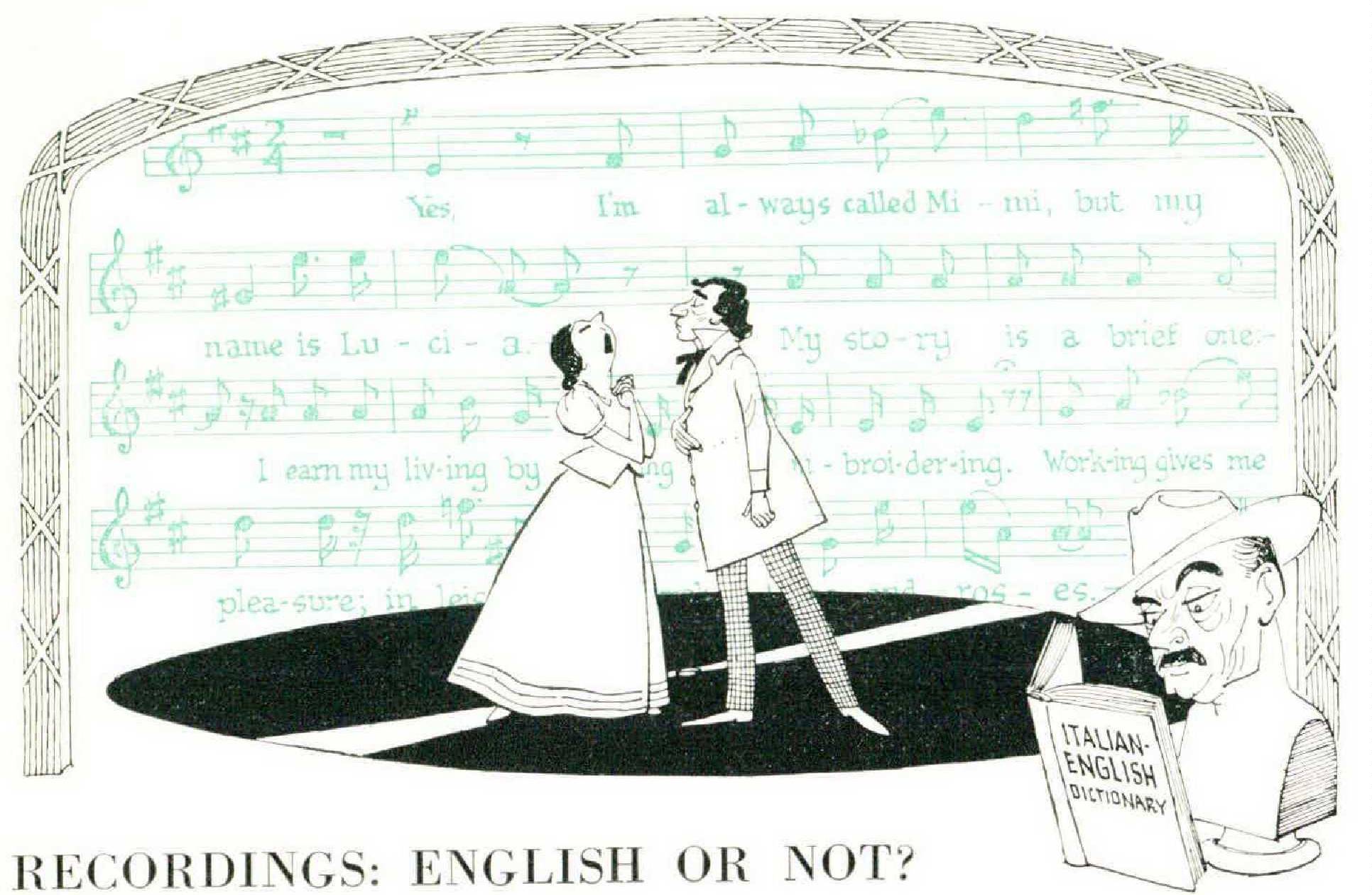
Aside from the question of whether it ought to be given at all, the most perennial of all operatic controversies is whether opera ought to be given in English. It may not be quite true that the ancient Britons, painted blue, used to debate the matter while listening in the hills to the Roman legionaries singing songs around their campfires. But the issue has recurred through the centuries with remarkable persistency. It cropped up in the early 1700s when Joseph Addison, writing in the Spectator about the Italian opera which had newly come to London, dryly observed that “there is no question but our great-grandchildren will be very curious to know the reason why their forefathers used to sit together like an audience of foreigners in their own country, and to hear whole plays acted before them in a tongue which they did not understand.” It had a pretty good airing in 1960 at the Metropolitan Opera, when the management, stung by criticisms of its Marriage of Figaro production, polled the audience on what language it wanted to hear the opera in (6129 voted for the original Italian, 2952 for English translation, while 22 staged a write-in vote for German). And it comes up again in the face of two new recordings which are presented with style, skill, and success in their original tongues — and which might have been of even greater moment had they been performed in English.
The first of these is Puccini’s opera La Bohème. sung in Italian by an allAmerican cast — Anna Moffo, Richard Tucker, Mary Costa, Robert Merrill, and Giorgio Tozzi — and directed by a thoroughly Americanized conductor, Erich Leinsdorf. The only Italian home flavor is provided by the Rome Opera House Orchestra and Chorus (RCA Victor LSC 6095, stereo; LM 6095, monaural: two records).
If this were the only recording of La Bohème, or one of a handful, no one would dream of suggesting the possibility of a change of language. In point of fact, though, it is at least the tenth recording — all of them in Italian, and nearly all of substantial merit.
In many ways the oldest of all La Bohème recordings still reigns supreme, for the incomparable fifteenyear-old performance directed by Arturo Toscanini, with Licia Albanese and Jan Peerce in the leading roles, remains a uniquely incandescent experience. And yet the newly issued Leinsdorf recording, which is conducted almost as briskly, sung almost as glowingly, and engineered with far more fidelity, is very satisfying to hear. It has a feeling of freshness, lightness, and youthfulness that is a tribute to both Leinsdorf’s skills and those of his American-born and -trained singers. Indeed, it is while listening to these prevailingly young voices, performing with musical tastefulness and dramatic restraint, that one is tempted to ask, “Why not in English?”
When the question was put, this baldly, to George R. Marek, vice president and general manager of the RCA Victor Record Division, the answer was, “Because it is indefensible artistically and because there is no evidence that translated opera would have any commercial success.” Refutation of the second point is difficult to offer, except to note that French and German audiences respond to Italian opera recordings in their own languages — even when the German translation of Rodolfo’s “Che gelida manina” in La Bohème is “Wie eis-kalt ist dies Händchen.”
The most celebrated effort to give La Bohème in English was that made by the Metropolitan Opera in 1952, when it introduced an English version by Howard Dietz in which “Che gelida manina” was rendered as “I’ll hold your hand in my hand.” It was not a success, perhaps because its atmosphere smacked more of uptown Broadway than of Thirtyninth Street, and it was soon dropped.
A somewhat similar attempt to drive an entering wedge for recordings of Italian opera in English is being made by Angel, with its release of a one-record set of highlights from Madame Butterfly (or should one say Mrs. Butterfly?) as presented by a cast from the Sadler’s Wells Opera of England conducted by Bryan Balkwill, with Marie Collier, soprano; Charles Craig, tenor; and Gwyn Griffiths, baritone (Angel S-35902, stereo; 35902, monaural). The recording falls short on two counts. The translation employed is an example of stilted librettese, 1907 vintage, and the singers, while of reasonable competence, lack starcaliber appeal. Yet, despite these shortcomings, it is a revelatory experience to listen in complete comprehension to the opening dialogue between the concupiscent and carefree naval lieutenant and the American consul who is trying to talk him out of a sham marriage with an innocent Japanese girl, or to observe the dramatic nuances of a “One fine day,” which becomes for once not only a soaring melody but an understandable expression of human hope and heartbreak. And one is tempted to wonder whether record audiences would be completely unresponsive to a full-length Butterfly in a tasteful translation — or whether they would ignore a Tucker-MoffoMerrill Bohène in English, in favor of the nine others in Italian.
If anything, the arguments in favor of an English-language recording of Bach’s Passion According to St. Matthew would seem even more compelling, for its original German text goes snugly into English with very little change of musical contours or dramatic stress, the English translation for the most part being that of the King James Version, with all its majesty and sonority. Yet of nine existing recordings of the St. Matthew Passion, all cling to the German text, except for a single outdated and inferior version, released chiefly because one of the participants was the late, much-admired contralto, Kathleen Ferrier.
The newest St. Matthew Passion — once again, in German — is issued by Angel (S-3599E/L, stereo; 3599E/L, monaural: five records) and is conducted by Otto Klemperer, with Dietrich Fischer-Dieskau, baritone; Peter Pears and Nicolai Gedda, tenors; Elisabeth Schwarzkopf, soprano; Christa Ludwig, mezzo-soprano; Walter Berry, bass: and the Philharmonia Orchestra and Choir. Klemperer’s concept of this work is of a slowly moving musical arc, giving the effect more of a stately memorial service than a mov - ing human drama. It is beautiful, but it also is somewhat ponderous and static, and might have gained power and emotion from translation — especially since most of the singers on Klemperer’s roster happen to be well acquainted with English. Bach, after all, once said that he wrote his music for the glory of God and the edification of his neighbors. Surely neither cause would suffer from the judicious use of translation.
Fortunately, fanciers of recordings in English do not have to depend upon translations for their supply. The belated, and still far from universal, discovery by the record industry that Handel wrote other vocal masterpieces besides Messiah has opened up new possibilities, as is witnessed by a stirring new recording of Saul, in its original English, by Mogens Wöldike, conducting the Copenhagen Boys Choir and Vienna Symphony Orchestra, with a cast headed by Thomas Hemsley, bass, as Saul: Helen Watts, alto, as David; and Herbert Handt, tenor, as Jonathan (Vanguard BGS 5054/6, stereo; BG 642/4, monaural: three records).
Although Saul has been virtually ignored by the record makers until now (the only previous effort was a truncated German version issued ten years ago), it is a work of boldness and imagination, with human figures who come poignantly to life in their music and powerful choruses that emphasize the universality of the biblical story. The Copenhagen Boys Choir performs admirably (“boys” is to be understood in a convivial rather than a chronological sense, judging by the number of well-matured bassos on hand), and the soloists handle their roles with style, if not consummate ease. And their words are understandable, which is not invariably true of the choir.
The oldest of all English musical masterpieces still to hold the stage probably is Purcell’s opera Dido and Aeneas, which is the subject of a new recording by Janet Baker, soprano, and Raimund Herincx, bass, with the St. Anthony Singers and English Chamber Orchestra conducted by Anthony Lewis (London L’OiseauLyre SOL 60047, stereo; Ok 50216, monaural). The libretto of Dido, which was written originally to be played at a girls’ boarding school, is no literary masterpiece, being filled with those “Away, away!”—“No, no, I’ll stay!” passages which help impede the acceptance of opera in any language. But it is a terse, compact, and musically vivid work, culminating in one of the English language’s great musical laments, Dido’s “When I am laid in earth.” This is a well-recorded performance that lays particular emphasis upon ensemble quality. It also happens to be the only readily available version of the opera, since the famous old HMV recording with Kirsten Flagstad and Elisabeth Schwarzkopf is no longer active in Victor’s catalogue.
John Gay’s The Beggar’s Opera, which was first played in London in 1728 and killed off Italian opera in England for a generation, is known most widely nowadays as the spiritual and musical progenitor of Kurt Weill and Bertolt Brecht’s modern satiric masterpiece The Threepenny Opera. The most complete and authentic recording of the original Beggar’s Opera ever made has been issued by the Library of Recorded Masterpieces (BO 1/2, stereo or monaural: two records). Concurrent with the release of the record album is the publication, by Argonaut Books, Inc., of Larchmont, New York, of a handsome facsimile of the 1729 London edition of the words and music.
To make his recording. Max Goberman, director of the Library of Recorded Masterpieces, utilized this original edition and assembled a cast headed by William McAlpine, tenor, as Macheath, and Mary Thomas and Doreen Murray, sopranos, as Polly Peachum and Lucy Lockit. The spoken dialogue is included, being recorded, if anything, a shade too loudly. Most of the singing is smooth and breezy; Gay’s “opera" was a compilation of popular airs of the time (including the “Lillibullero" beloved of Uncle Toby in Tristram Shandy), and they tend to wear thin after a while. But The Beggar’s Obera remains a lively, lusty work after nearly 250 years, and it is unlikely to have a more faithful or friendly performance than this.
The most significant of recent English language recordings, however, stems not from the eighteenth century but the twentieth. This is a coupling of two compositions by Igor Stravinsky, Les Noces and Renard, (Columbia MS-6372, stereo; ML-5772, monaural). Both of these are vocal works whose vocalism, to put it mildly, assumes unusual forms. Both are translated into English, which means that the explosively rhythmic wedding ritual of Les Noces and the wily barnyard shenanigans of Renard are presented with the fullest possible comprehensibility.
All questions of language aside, the release strikes this listener as one of the great Stravinsky records. The instrumental scoring of Les Noces is for percussion battery and four pianos, and the pianists in this recording are lour American composers, Samuel Barber, Aaron Copland, Lukas Foss, and Roger Sessions, gathered together in homage to the old master. The singers involved (Mildred Allen, soprano; Regina Sarfaty, mezzo-soprano; Loren Driscoll, tenor; and Robert Oliver, bass) perform with tremendous gusto and spirit. And the English language, as used in this recording, demonstrates a flexibility and an expressiveness that would seem to entitle it to take on further musical challenges.
There was a time when it would have been as unthinkable to record Stravinsky without using French or Russian as to record Puccini out of Italian. The success of this recording raises the possibility that listeners who are just about sated with the tenth Bohème or the ninth Butterfly or even the eighth Marriage of Figaro might conceivably find new stimulation in listening to such works sung by first-class artists in English. To traditionalists within the industry the idea may seem unthinkable. But, other times, other customs. And, one may hope, customers.