A Few Words for the Sponsor
ROBERT FONTAINE is the author of books, a play, and many light articles for the ATLANTIC and other magazines.
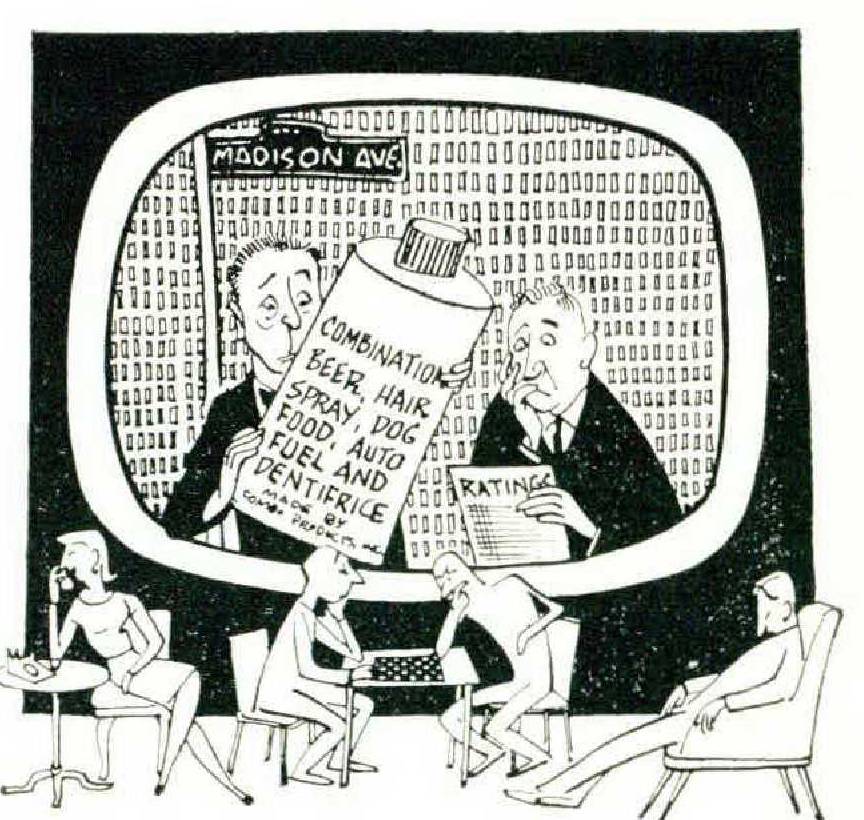
I am often confronted with television polls that claim fifty-six million people were watching this show and forty-eight million people were watching that show. I don’t believe it. I have gone into this thing pretty thoroughly and scientifically, and from my efforts I have deduced that almost no one is watching any program.
As everyone knows, most of the surveys check on two or three hundred people and ask them what they are watching. These people are not watching anything, but they hate to be caught at it. It lowers their status. So they say the first thing that pops into their heads, like Ed Sullivan or Dinah Shore.
To show you how wrong a survey can be, I once discovered that all thirty-six people I contacted were watching the same thing, a local algebra lesson. This was because they were all in a bar and the television set could only get the one station. By extension, this would indicate that one hundred million people in America were watching an algebra lesson.
Now, we all know that television belongs to the people; it is an educational medium. It is intended to educate us as to the correct beer, shaving cream, deodorant, and cigarettes to buy. My fieldwork shows that not only is television being watched by just a few thousand people, but even those people do not know what they are watching or who is sponsoring the program.
I will cite examples sworn to before a notary public to prove these revolutionary points. My surveys were conducted mostly among my family and friends, because I could trust them and I knew when they were trying to put something over on me. For instance, if I called my son-in-law, John Kurtz, and he said he was watching Leonard Bernstein, I knew immediately that he was just showing off. If he was watching anything, it was a buxom blonde displaying a weather map. I know my son-in-law. Those other pollsters do not.
I called my father one night and said, “Is your TV set on?”
My father said, “My TV set is always on. You know that. We use it for a night-light.”
“What are you watching?”
“I’m not watching anything. I’m out on the porch getting some fresh air.”
“If some real survey called you, Papa, what would you say you were watching?”
My father thought a moment. “I’d say I was watching I Love Lucy”
“That’s off the air.”
“I don’t care. I still like it.”
My father-in-law is a little different. His TV set is always on, too, because he likes to sleep in front of it. After dinner he yawns, settles down in a chair, turns on the television, and sleeps through four hours of shows. If any pollster awakened him, he could tell immediately what he was sleeping through, a factor that would certainly throw off the final figures.
In my wife’s case, she seldom watches anything, but she is always going to watch something. She turns on the set in time for Alfred Hitchcock, and then she remembers she has not called Ann in weeks. She telephones for two hours, and if, when she hung up, she were asked what she had watched, she would say Alfred Hitchcock because that’s what she intended to watch.
What it amounts to is that there are millions of TV sets turned on all over the country, and nobody is watching them. The people who turned them on are out on the patio drinking beer, or are in the swimming pool, or have gone to the movies. They do know, by heart, what programs are on, and if you ask them later what they watched, they will think of something just to please whoever bothered to ask them.
It is like reading books. Pick any book off the top of the best-seller lists and ask anybody if he has read it. You will hunt far and wide to find a single person in America who has not read it — or, that is, who does not claim to have read it. I never met a living soul over eleven who did not insist he had read Lolita, for example. The same snobbishness prevails on television. People who are really playing poker all night will unabashedly insist they watched Ed Sullivan last night.
But, to make things worse, not only does hardly anyone watch television; hardly a soul among those who do watch knows who sponsors the program. As everyone knows, millions of dollars are spent by television advertisers to impress a product on people. But you can ride a day’s journey on an Arab stallion before you can find anyone who remembers who sponsors the program he watches all the time.
If I ask my father who sponsors some show, he will say, “I don’t know. Some kind of beer, I think.”
“What kind of beer?”
“I don’t know, and I don’t care. I drink Bass Ale, myself. What’s it to me what the sponsor drinks? He ought to be glad I watch his show.”
I have even asked relatives who sponsors the U.S. Steel Hour or the Alcoa Hour. They had not the slightest idea. They would not even guess. Nor did they know who put up the money for the Telephone Hour. One person said Tasty Yeast, and two others said Standard Oil of New Jersey.
My mother, for a fine example, believes that all the programs she actually watches are sponsored by Finnegan’s Pharmacy, which is a small drugstore at the corner of the street where she lives. She often wonders where Finnegan gets the money to pay for such stars as Fred Astaire and Red Skelton.
This proves that my mother is one of the handful of people in America who pay any attention whatever to the commercials. She watches the ones at the station break. Finnegan always comes in before every big show and just after the station identification and announces that all his drugs are pure, his white coat is fresh every day, and he is open until 9 P.M. on Sundays. Naturally, my mother believes he sponsors the program. She can identify with Finnegan. She sees him every day. While the big commercials are on, she takes a shower, makes an egg salad sandwich, washes my father’s hair, or does some of her ironing.
It would be useless to go into this any further. If what I have said is taken to heart, it may completely revolutionize advertising. It will be bound to do it when I state my final discovery. My relatives and friends can only identify the sponsor with the utmost conviction when the show is terrible. They feel so annoyed that they wait patiently for the commercial, and then they concentrate and carefully memorize the name. Thereafter, they avoid the product like the plague.