Toyland Revisited
CHARLES EINSTEIN is the author of many articles and three novels. He lives in Ardsley, New York, where he devotes his full time to writing.
by CHARLES FINSTEIN
THERE’S a new principle afoot in the multimillion-dollar shopping centers that celebrate our post-war suburban landscapes: that not competition, but cross-competition, is the lifeblood of trade. The idea in leasing out store space in the new shopping centers is that there will be no more than one store of a kind, but that though there be only one cigar store, one drug store, and one grocery, you can get cigarettes, toothpaste, and ice cream at all three. You can get your wife a pair of stockings at the milliner’s, haberdasher’s, beauty shop, drug store, five-and-ten, supermarket, and stationer’s. The luncheonette sells bolts for the mounting of license plates, and the gas station sells PepsiCola. And everybody sells toys.
This isn’t bad enough, far cry though it be from yesteryear, when the marketing of toys was limited to department stores, five-and-tens, confectioners’ shops, and the newsstands in railroad stations, where you could buy little candy beads packaged in a glass locomotive. Today’s bright new shopping center feat ures not only toys in almost all the stores (the man who runs the cigar store in our little town told me recently he spent more money on toys in one year than on all his other merchandise and his store rent combined): it features also the Toy Store.
I suppose it is a secret wish of all young boys to grow up and be fathers so that they can buy toys. Now I have four children, and there is a fantastic toy store in a nearby shopping center, and I’m miserable. I don’t like the man who runs the toy store and he doesn’t like me. I go in and say, “I’m looking for something for a baby girl who’s got a brother who’s two who’s got a brother who’s four who’s got a brother who’s seven, so it should be something they don’t have and it shouldn’t be breakable.” He looks at me as if I had just stepped out of a jar.
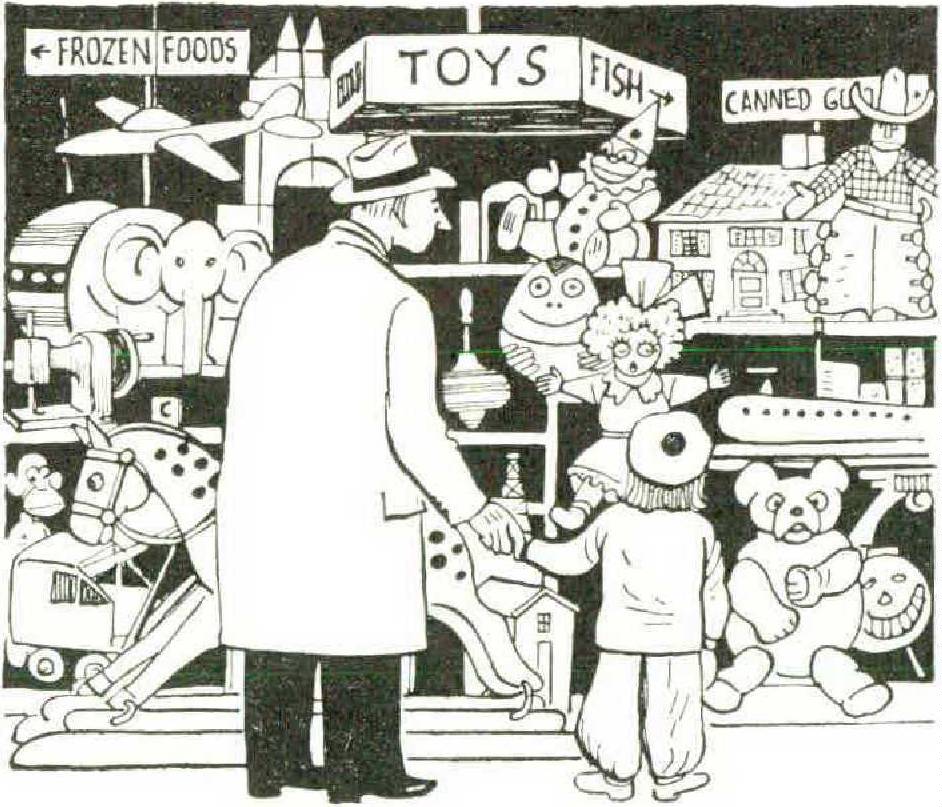
I don’t know whose fault it is. First time I went in, it was to buy some clay. I said, “I’m looking for some . . . and that was as far as I got. The toy-store man held up a hand. “First,” he said, “let’s find out something about the child.”
Stop here for a minute and think about what he said. This budding young psychiatrist assumes, to begin with, that you only have one kid, known, in the true temper of Freud, Brill, and Magnus Hirschfeld, as “The Child.” If you had the kid with you, the salesman might be able to get some idea of what he wants to know, but all modern toy stores have a bevy of coin-operated horses, automobiles, and rocket ships outside the front door — their only purpose, as far as I can see, being to keep the kids outside while you buy the toys.
“You don’t have to know anything about the child,” I said. “All I . . .”
“What is the child’s ETA?”
“His ETA? What do you think he is? ADC-7?”
“Educational Toy Age,” the toystore man said, a trifle scornfully. “You find it reflected in the home environment. Children are people, you know. They have needs.”
“Mine have needs for some clay,” I said. “I thought that . . .”
“I beg your pardon. Did you say clay?”
“Yes,” I said. “You know — you make things.”I talk with my hands anyway, and the impulse here was overwhelming.
The toy-store man gave me a look of deep pity. “No,” he said, when I had feebly done, “we found clay too unsanitary.”
I brooded about this for a time; finally I said, “Do you have anything like clay?”
“Of course.”
“What do you call it?”
“Elastic plastic.”
You can furnish your own blackout curtain for that one. Personally, I blundered out of the store, observing through my teeth that it would be a dank day before any body ever wished any elastic plastic on me.
The case of the elastic plastic typifies the new mode in toys. You cannot go into a toy store to buy blocks
—good, old-fashioned, wood, oblong blocks, with some arches to make tunnels — without making the tacit confession that you are the father of the village idiot. The old-fashioned blocks are still there, but they come in a box that has the names of twelve doctors, fourteen educators, and seventeen child guidance centers on the out side.
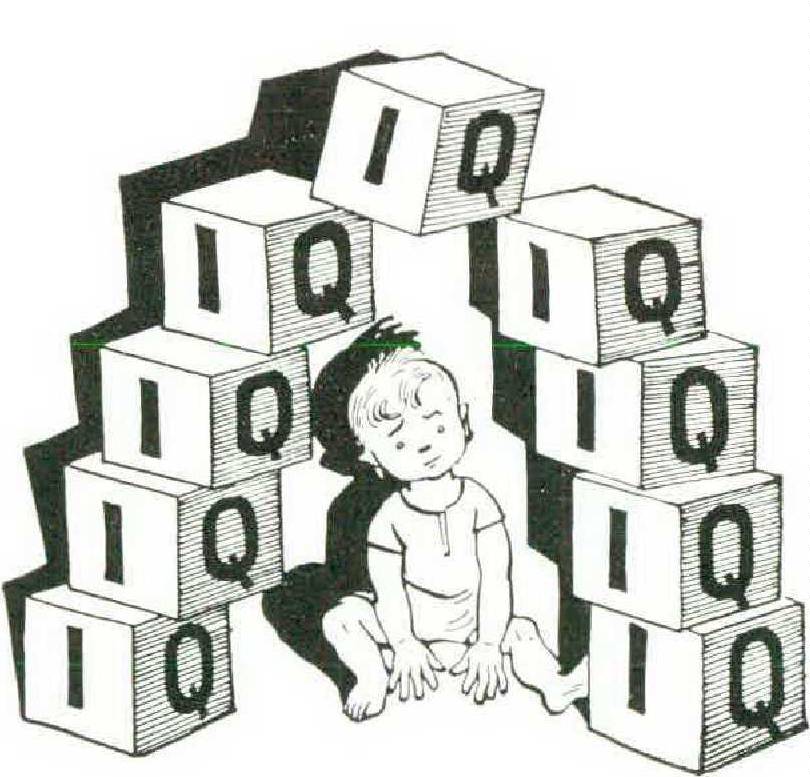
Alphabet blocks are even worse. I always thought the purpose of alphabet blocks was to pile them up till they fell down. The new thing is to pile them so that they fall down. This gives the kid release. So you find the new alphabet blocks made of rubber and equipped with little tinkling things inside, and when you knock them over they all bounce and ring bells. On top of that, the old catchas-catch-can theory of lettering alphabet blocks has gone by the boards. The old six-sided cube would have a couple of B’s and maybe an M and a Q and an F and a piet ure of a sheep or something. Now each letter has its own block— block A, with a big A, a small a, and four pictures of things beginning with A. You might think that under such a triumph of pure reason, the blocks would come twentysix to a set. No. Eight. The alphabet , according to t he most popular set of alphabet blocks at our new toy store, goes A B H 7 L S 9 V. When you get through making Shlavb 79 you go back and buy another set of blocks.
It is of value, before setting out to the toy store, to be able to recognize, too, the language spoken. A brief lexicon illustrates: —
Unbreakable—melts at body tempera t ure
Durable—falls apart when you look at it
Long-lasting — forty minutes at the outside
Lifetime guarantee — so complicated you can’t put it together Replaceable—the factory is in Vancouver
Warranted — the factory in Vancouver just went out of business Precision-built— has sharp edges
Precision-tooled — has sharp jagged edges
Fan for grownups too— kids want no part of it
Resists corrosion — this gun shoots hydrochloric acid
Mystery mechanism — works on a flashlight battery
Wonder mechanism — works on two flashlight batteries
Comes complete — the flashlight batteries are extra
Just like Dad’s — this genuine handtooled leather wallet has nothing in it
Underwriters’ Laboratory Approved — powerful enough to blow up the house
Plug in anywhere — not Underwriters’ Laboratory Approved
Hours of en joyment — this jigsaw nuzzle has 10,000 pieces
Endless variations—this jigsaw puzzle has 9098 pieces
Caveat emptor — wrap it up. The hell with it.