Marta the Dog-Lover
This is the third and regrettably the last account of Marta, the great irordseramblcr. hy JOSEPH HENRY JACKSON, whose death earlier this year ended, his long and distinguished, career as literary editor of the San Francisco Chronicle.
by JOSEPH HENRY J. ICKSON
WE HAD several reasons for believing, when Marta first came, that we had acquired what in the oldfashioned way my mother-in-law had always called a treasure. Her pleasantly ruddy complexion, her neat graying hair, her bright blue eyes these spoke for themselves. Her former employers had written in the highest terms, and my wife liked the fact that Marta had kept the letters tidily, in clean envelopes. A few questions showed that she knew her way around a kitchen, and she said easily that one five-year-old was no trouble.
What settled things, really, was the wav our cat, after one tentative look, jumped into Marta’s lap and lay there purring. At the time, my wife took this for evidence that Marta loved cats; we did not know, though we learned, that this was not exactly true. Marta’s was a kind of generalized affection, expressing itself in warmth toward cats to be sure, but extending beyond this in many directions, some unexpected.
From the first, her way with a meal was magical. There was the first breakfast she served: the eggs scrambled soft enough, and accompanied by bacon she had grizzled in her own special way, she told us. There were the buttermilk pancakes on another memorable morning, feather-light, though this was not altogether why Maria liked to make them. What interested her was the buttermilk itself. It was good for you, Marta explained; it changed the flora and fauna in your stomach. She had learned this, she told us, from the magazine put out by the Commuters’ Union.
It was in her third week with us that our cat wandered away and did not come back, and our child was disconsolate. There was talk of finding a new one; for a time guppies were discussed, and there were muttarings about a dog. Marta had brightened at the mention of dogs, but we thought nothing special of that until she came back from shopping with the puppy.
She had felt in her bones that it would rain, she told my wife; the weather had been sulky all morning. So she had gone to the supermarket, which shared a coöperative parking lot with some other stores, and when she came back to the car after getting the parking-ticket violated, there was the pup, damp and miserable, cowering under the radiator, and Marta just scooped it up she said, a wet dog looks so bed-raggled.
“I just had to bring him home,” she explained, “or I’d never of regretted it.”
She told us immediately that she would take care of the puppy herself. It was healthy, she said. Anybody could see that; the whites of its eyes were as clear as a bell. Moreover, she understood about dogs; the people for whom she had worked in Southern California — a family named Trott — had been true dog-lovers. To be sure, a dog could be a lot of trouble, but Marta assured us she had mauled the whole thing over in her mind and would bear the blunt of it. And a puppy like t his could never be half the work of the dog the Trotts had, an enormous Gray Dane so clumsy it had knocked over and broken a little statue of St. Venus de Milo. (The Trotts, Marta said, were really artistic people; Mrs. Trott had even hired a man to make a bust of her daughter’s foot.)
A dog could easily be trained, Marla said, and she knew how. And with a young puppy you had a chance to begin from the beginning; you could start from scraps. She had learned all about it from a man who understood both dogs and horses; she had got to know him well when she took Mrs. Trott’s little girl each week for her lesson at the Riding McCavity.
As the weeks passed, our house grew stranger all the time. There was a box with a blanket in the kitchen, and papers were strategically placed in each room. You had to have a system, Marta said; you couldn’t go at it half-hazardly. Once she went to a movie made from a story by Albert Payson Terhune; she might learn something about dogs from it, she felt. But she came home in a bad humor. She explained that she should have known better. The mot ies were bound to spoil a story they made from a good book: they always gave them a twinge to jeeper them up.
Inevitably the puppy came down with something — though since it rapidly got well again, we never learned what. One of the troubles with dogs, Marta observed, was they couldn’t tell you what was wrong with them. That, she felt, was the flaw in the ointment. And of course when a dog got really sick — well, you never knew; it could get a virex pneumonia, just like a person. Marta’s sister’s boy had told her all about it; he was studying medicine at Mark Hopkins, and he knew.
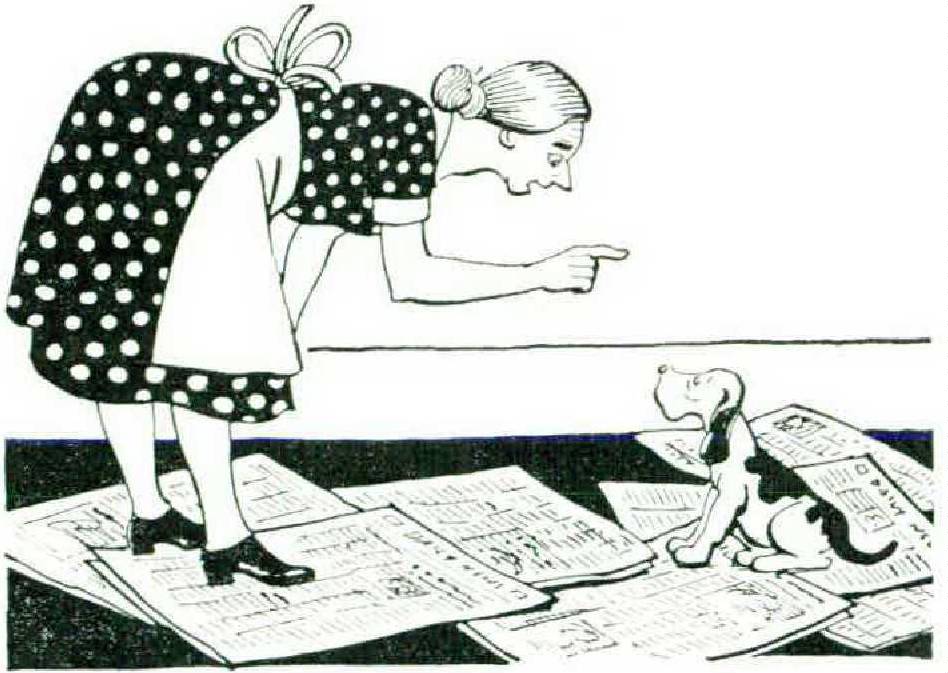
Hut the first glow of Marla’s enthusiasm soon began to wane. Once our child reported, wide-eyed, that Marta had paddled the puppy with a rolled-up newspaper; on that occasion we looked up to see Marta in the doorway, her face flushed as she said indignantly that she hadn’t thought a little girl would act the stew-pigeon. What it came to, Marta admitted to my wife, was that small dogs were really more trouble than large ones. Moreover, this puppy had been started wrong by somebody, and you couldn’t teach a dog that had been spoiled; the cards were slagged against you.
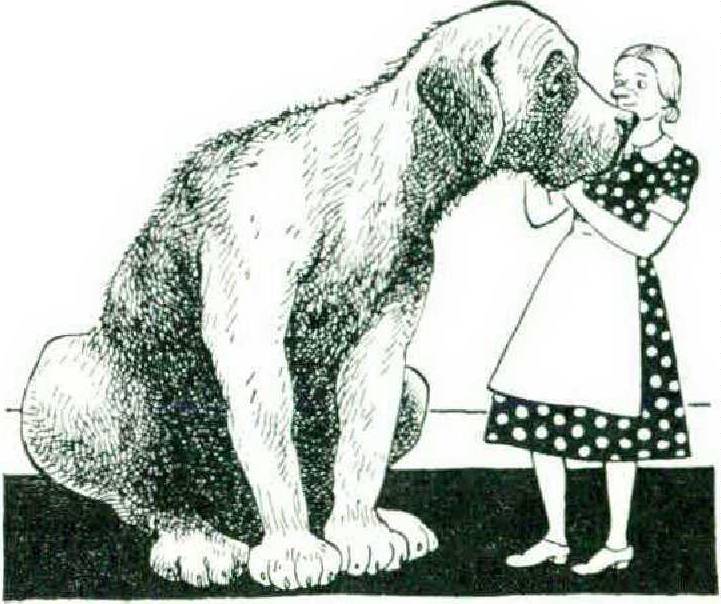
It was not long after this that. Marta came back from a downtown excursion without the puppy. As the cat had done, she said — and her round blue eyes were all gentle innocence—it had wandered off while she was in the supermarket. It was too bad, but anyway small dogs were more trouble than worth it. She must have known that we were in no mood for another dog, but she tried. Her look was almost wistful as she recalled her time at the Trotts and how their big dogs no nasty little puppies — had been such good company. “A full-size dog,” she said, “is so friendly. Like, for instance, a lovely great big Sarah Bernard!”