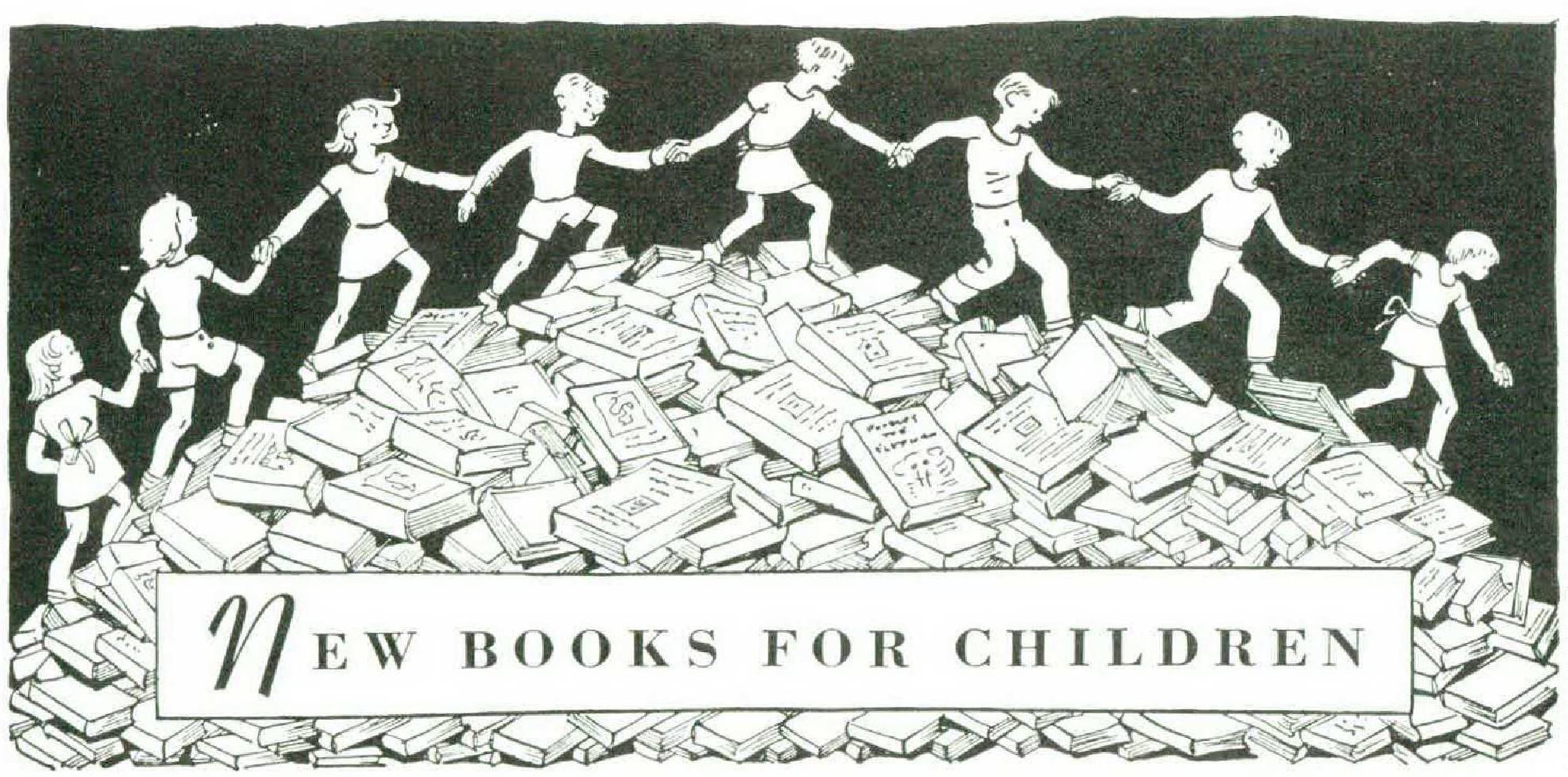
New Books for Children
MARGARET FORD KIERAN was Children’s Page Editor of the Boston Herald for twentythree years. She is the author of a juvenile, David and the Magic Powder, and coauthor with her husband, John Kieran, of John James Audubon.
by MARGARET FORD KIERAN
WHEN Christmastime nears, it is fun to walk away from the three hundred or more new books for young people I have been exposed to, so that I can see which few linger in my memory and why. I am doing this now, as I type in our little cabin high in the Berkshire hills, and I am not surprised to find that the picture books for the very young almost shout: “Don’t forget ME!”
This would be true of Theodore Turtle by Ellen MacGregor (Whit— tlesey House), so I was glad when I found that my friend Lindsay Ann Crouse (aged six, I believe) concurred with my judgment. Your heart will bleed for poor Theodore, who has the devil’s own time trying to get his daily life organized because he keeps forgetting where he puts things; rubbers, teapot, ax, garden hose—well, just everything. The illustrations by Paul Galdone are as much fun as the text, the last two lines of which brought shouts of “He’s stupid!" from Lindsay Ann, because Theodore, bolstering his fading ego, says, “I am so clever at remembering.” And the author asks, “What do YOU think?”
In the high praise department, too, should go Play with Me, story and pictures by Marie Hall Ets (Viking). With large illustrations on every page in soft pastel tones, it relates the tale of a little girl who tried hard to become friends with all the woodland creatures— the rabbit, the snake, the chipmunk, and so on finding at last that the way to attract, them was to be very still and wait for them to make the approach. This lesson in getting acquainted might well be called to the attention of the average youngster who greets a new puppy with a frightening onslaught of affection, the result of which is often a howl and a gouged finger.
Books on learning to count appear with the regularity of spring flowers, so there have been some lovely ones; but none quite as gay, I thought, or as pointed, really, as Dancing in the Moon by Fritz Eichenberg (Harcourt, Brace). Here is a sample: “16 pigs dancing jigs, 17 moles digging holes; 18 frogs sitting on logs, 19 seals enjoying their meals.” Or, skipping back a little, how about “4 pandas sitting on verandas”?
Next I remember a book about a boy who wanted just one thing for his birthday. Snow. His story is told in Snow Birthday by Helen Kay (Ariel). If by chance the idea were not appealing enough in itself, the exquisite country scenes by Barbara. Cooney would make it hard to forget. Here is a most beaut iful picture book, and so is Macmillan’s new edition of The Ugly Duckling. Even if your young friends and relatives already have the old-time favorite, their libraries would be enriched by the new one. Johannes Larsen did the illustrations, which are superb.
In the familiar fairy-tale format comes The Princess and the Woodcutter’s Daughter, written and illustrated with rare charm by Winifred Bromhall (Knopf). Little girls who like to be read to will ask for this again and again. It has a fragile quality that is extremely appealing.
Possibly because the setting was unusual, I also enjoyed The Tailor’s Trick (Lippincott). Here Rosalys Hall tells a very amusing story about Jenckes who in colonial days was vexed with the problem of trying to decide which of the three women in his life he should wed. The watercolor illustrations as well as those in black and white by Kurt Werth carry one gaily along to his ingenious decision.
Thumps (Houghton Mifflin) had great impact for me, too. He was a spectacular-type pig who wanted to live dangerously and did. Hetty Beatty, always responsible for illustrations of great strength and originality, did the text too.
Then, going on to a slightly older group, there was Mikko’s Fortune by Lee Kingman; pictures by Arnold Edwin Bare (Ariel). I think this would appeal to children even up to eight years of age, provided they had not been overexposed to the heavy hand of the old, old West on TV.
Talk of that old West brings a mention of the number of books devoted to a man of whose name you might possibly have heard during the past few months.
Crockett — Davy, that is.
At least twelve accounts have appeared. One is Itavy Crockett as told by Walter Blair (Coward-McCann). “My Maw,”writes Crockett in this Blair version, “she’s a glorious girl for her age. She can still jump a seven-rail fence backwards . . . smoke a bale of Kentucky tobacco in her corn-cob pipe, crack walnuts with her front teeth, cut down a gum tree ten feet around and steer it across Salt River with her apron for a sail and use her left leg for a rudder.”
In ail fairness to the old lady, I think we should dismiss any discussion of Davy and suggest, instead, that someone embark on a biography of Maw. In my opinion Davy has, as they say, had it.
Swiftly and gladly changing pace, I should like to call your attention to one of the most beautiful books ever to come to my desk. It is Columbus by Ingri and Edgar Parin d’Aulaire (Doubleday). For three years this distinguished author-painter pair has been working on the project. The result is breathtaking. Look no further for an exquisite gift in the lower middle age group.
In this same middle group, though in the older division of it, I was impressed by Plug-Horse Derby, a really down to earth story of a little girl’s love of horses and the joy she found in grooming one of her own for a big race. Written and illustrated by Emma L. Brock (Knopf).
Boys (and girls, too, for that matter) will like Donkey Detectives (Doubleday) by Lavinia R. Davis, I am sure. Illustrated by Jean Macdonald Porter, it is a swift mystery story with plenty of suspense cradled in a small-town atmosphere.
My especial pet in this group, however, is Clarence, the TV Dog by Patricia Lauber with cartoonlike illustrations by Leonard Shortall (Coward-McCann). I could tell you many of Clarence’s hilarious adventures, but perhaps the crystallization of his personality can best be shown by explaining how Brian, his young master, tried to train him in obedience.
Brian would shout “ Heel! ” and then jump in front of Clarence. It seemed the easiest way.
For nonsense of a very superior order, look at The Rabbit’s Umbrella by George Plimpton (Viking). Here is a fantastic yarn with more than one dash of Alice in Wonderland and a strong whiff of Charlotte’s Web, though not as slyly satiric. The illustrations by William Pène Du Bois capture the mad mood perfectly. The umbrella the rabbit is holding, for example, has two holes for his long ears. Of course, then, there has to be a smaller umbrella over the first one, to protect those ears from the rain. If this story is lying around your house, I predict there will be many requests for you to read it aloud again and again and again. You might even want to whisk it away and reread it alone as I did.
A book entirely different in tone and in treatment from any I have yet mentioned is The Wicked Enchantment by Margot Benary-Isbert (Harcourt, Brace). Old-world folklore seems contemporary when we follow the doings of little Anemone who ran away from home with her dog Winnie. Because of the quality of writing and because of the drawings in black and white by Enrico Arno, the book has distinction.
Now as far as the oldest group is concerned, there were the usual number of glibly written teen-age stories with the usual number of more or less hackneyed themes. But Rosemary by Mary Stolz (Harper) does not fall into this category. Miss Stolz is deeply sensitive to the hopes and the anxieties of her young people. To say that a social problem is the background of her latest book makes it sound a bit heavy, which is by no means the case. And to point out that she writes like a Henry James near a jukebox would be flippant. But there is that James analytical quality which classifies Rosemary as a young-adult rather than a teen-age book. A top-notch one, too.
In this more sophisticated group I would also place Junior Intern by Alan Nourse (Harper). How true it is to medicine I do not know; but since the author is currently interning in Seattle, I assume that it is factual in theory. These facts are telescoped, perhaps, into a shorter period of time than would make them the average experience of the average intern. Thus the book is crammed with every kind of excitement that several young medical students might conceivably run into, whether on hospital rounds, in the laboratory, or in a disaster field station. It’s a spellbinder with a vocational message that is compelling.
Back for a moment to the young teen-age department, I think Borghild of Brooklyn by Harriett II. Carr (Ariel) should be singled out for an honor. Surely and sharply it presents the problems of a little Swedish girl who wants to “belong,”who wants to be Americanized, but who feels the lug of her own heritage, too. Here is a competently handled story with a fresh background and a plot that has wide implications.
For the high school group, I would also recommend The Wound of Peter Wayne by Leonard Wibberley (Ariel), Hostess in the Sky, a dandy by Margaret Hill (AtlanticLittle, Brown), and West Point Plebe by Colonel Red Reeder (Duell, Sloan & Pearce—Little, Brown) for which my husband also had high praise.
Now with space closing in on me I hasten to point out that the older generation as well as the younger will want to look at three fine new editions of old favorites. Nostalgia went rampant as I gave myself up to Alice in Wonderland (Random House), Little Lord Fanntleroy (Scribner), and Little Women (Crowell). Any one of them might well he the swift solution of a knotty Christmas gift problem, if one had not taken an even easier way out by stocking up on A Treasury of Christ mas Songs and Carols edited and annotated by Henry W. Simon (Houghton Mifflin). It is a comprehensive collection of the well-known and the less wellknown with new arrangements that will not frighten the amateur who goes to the piano only once a year — then, perhaps, to set the stage for a family caroling of “Silent Night.”