People's Banco
By RAY JOSEPHS
WHEN the Señor Representante from the Banco Municipal came to see Estella about “la Singer,” we thought the ultimate in our second maid’s complex affairs had come. The conversation which ensued from below stairs in our Buenos Aires house was, to say the least, spirited. There were scattered words available through the door: “production,” “interest,” “depreciation.” When, after exchanges of mutual regard, the Señor Representante was gone and Estella emerged with a fistful of pesos, her precious sewing machine, and talk of a new sideline business, we were completely baffled.
It was only weeks and conversations later, when Estella announced that “la Singer,” — Buenos Aires porteño for sewing machine, — which had never left the house, was once again completely hers, that I got around to investigating the Argentine bank which sounded like a pawnshop. I found that it not only combined the best features of both but was, at the same time, a beneficial society and civic improvement league, art foundation and musical institute, department store and specialty shop.
Estella’s transaction was typical. On an average, the Buenos Aires Banco Municipal de Préstamos (Municipal Bank of Loans) has cash out on 15,000 sewing machines. But knowing that the porteños of Latin America’s leading city pawn them only as a last resort or, as in Estella’s case, when money is needed to buy cloth to run up into items to be sold, it feels secure leaving them in the borrowers’ homes. They are picked up only when interest payments are not met.
Helping Estella get her raw materials and aiding her to sell the finished product to pay off her loan are free Banco services. Having decided in 1878 that, the free-spending Latin temperament being what it is, there comes a time in the life of every man, woman, and child when a few extra ready pesos without embarrassment are important, the Banco’s founders deliberately set out to create a loan institution that would help rather than harry.
Porteños frequent the Banco as citizens here might patronize the First National. And they get even better treatment whether borrowing or buying. The minimum loan is a peso (about 25 cents, U.S.), the maximum, $50,000; average items bring about 40 pesos. On small loans the Banco, disproving the pawnbroker s heart-of-ice tradition, often generously tosses in a peso or two out of its own pocket. The interest charge is a modest 3 per cent.
Jewelry is the greatest single item, and it occupies the greatest attention of the 1400 employees at the Banco’s main office and six branches. W hen you bring in an item, you are shown to a small closed booth. A runner takes the ring, pin, or whatever it is, to an appraiser. To prevent collusion — or embarrassment and haggling — pawner and appraiser never meet face to face. The price is written, you accept or refuse, and that’s that. On larger items, which can’t be brought in, you can, as in Estella’s case, simply call up from the free phones available everywhere in Buenos Aires and have a representante or board of appraisers come out for a look to fix the value.
So skilled and fair are the appraisers that some have written books on their specialties and have been consulted by libraries, museums, and governments throughout the hemisphere, especially on first editions, autographs, and guitars. All are highly paid and especially schooled, and there has been only one scandal in Banco history involving fraud between appraiser and borrower.
As long as interest is paid annually you can keep your goods from being offered for sale. One woman left a piano for more than twenty years; others have left items for ten and fifteen years, regarding the Banco’s modern, fireproof vaults as the best storage place in Buenos Aires. The practice is discouraged, but nothing can be done about the horde of men shout town who, having lost at the week-end races, come in promptly every Monday morning with their binoculars. On Saturdays, pay envelopes in hand, they redeem them for another try at Palermo or San Isidro, the great Buenos Aires tracks which run all year round.
Another regular was a laundress who pawned her customers’ shirts each Monday and had an astonishing run of luck on the Friday lottery until she finally lost. I.nable to get the shirts back in time for Saturday delivery, she broke down, turned her ticket back to her customers, and explained that they’d have to get them out themselves. The Banco refused her business thereafter.
Pawners come from all classes. Many people have pawned diamonds — the Banco has loaned as much as 120,000 pesos (or $27,600) on a single gem. Women are likely to bring in wedding dresses, for there is no traditional sentiment for them. Wedding rings, men’s and women’s, are rarely pawned, however. Mourning garments are plentiful, since the wearing of black for as much as six months to a year after the death of even a distant relative is common.
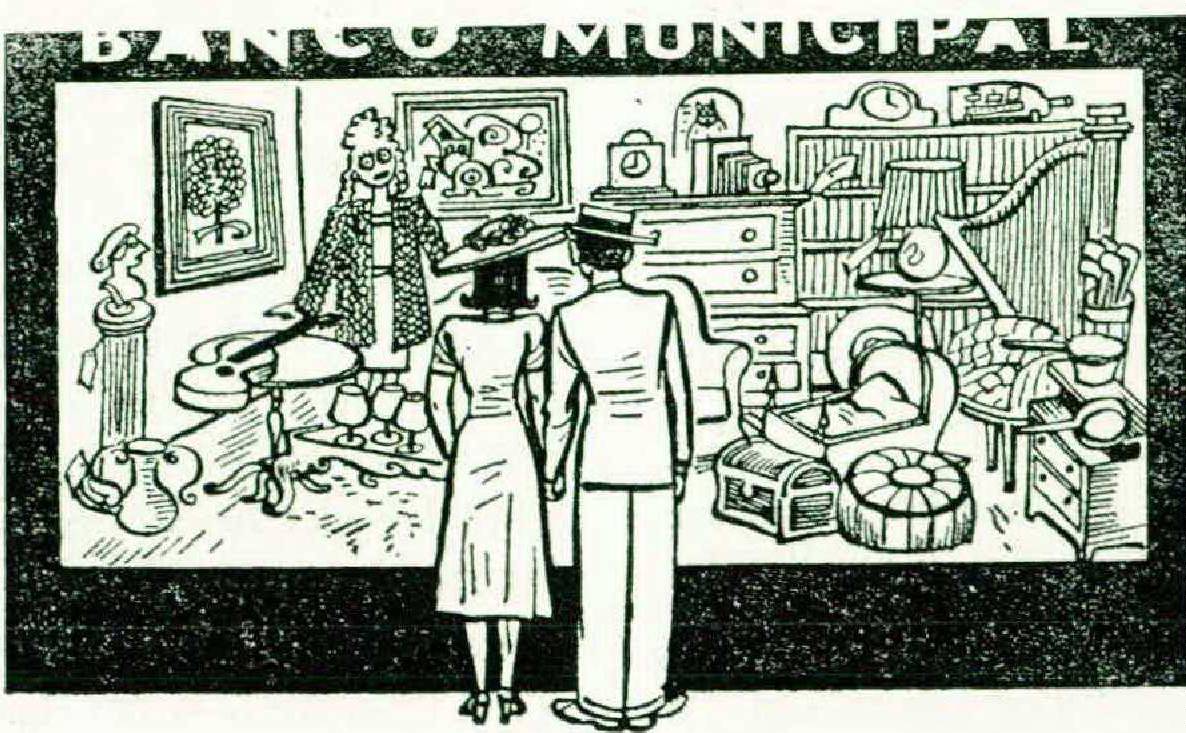
Because the Banco lends on almost anything, it has built up an amazing assortment of goods — building supplies, fine silverware, baby carriages, lamps, electrical equipment. Office furnishings and small printing presses are also available in seemingly unlimited quantities; Argentines are quick to go into any new business at the drop of a sombrero; and a porteño saying has it that whenever two unoccupied Buenos Aires cabelleros get together, the chances are ten to one they will start another newspaper.
The Banco has had loans on as many as 10,000 guitars, 5000 pianos, and 5000 desks at a time. Washing machines, electric toasters, vacuum cleaners, are all rare, for there are comparatively few such imported items in Latin America. But the Banco could stock anything from a one-room flat to a cattleraising estancia without too much trouble. And since the Banco also makes loans on property and has a big mortgage department, you might be able to get the apartment or ranch itself as well.
The ultra-modern, six-story Casa de Ventas (Sales House) of the Banco resembles a Fifth Avenue department store, except that its typically Argentine use of clean line and glass brick makes it look even more up to date than most Manhattan shops. Beautifully lit and decorated show windows line a blocklong arcade. A series of displays offers a complete home, down to the baby’s crib. A living room is tastefully furnished with period objects, all matched with care by professional designers. A kitchen is complete down to items in the pantry. Other windows show radios and musical instruments, luxury furs and clothing, motorboats and fixtures. Inside, departments are grouped and arranged as in a fine store — clocks and jewelry near the front, clothing on the second floor, furniture and antiques on the third, machinery, cars, heavy items in the basement.
Wide aisles and spacious elevators invite browsing. Salesmen have been carefully trained to point out bad as well as good points. Since the municipality does not run the Banco merely for profits, its theory is that the customer, as well as the borrower, should get every possible break.
Special sales are on a regular schedule: furniture on Fridays, musical instruments on Tuesdays, and so on. Ads in La Prensa and other newspapers keep Buenos Aires advised on specials. The bidding itself, conducted in one of the several large amphitheaters in the Banco’s Casa de Ventas, is one of the best free shows in a city whose 3,500,000 people keep thirty theaters going in season.
If you want to bid and cannot attend in person, a ghost bidder acts as your agent, paying up to the maximum you have previously set. The auctioneer does not know your price, and the ghost bidder tries to get the article for you as cheaply as possible. The charge for each service is less than five cents. If the price obtained for the article is above the amount loaned, the Banco merely deducts its interest and service charges and returns the rest to the borrower.
Once a year the Banco looks over its stock of unredeemed winter clothing and blankets and then conducts a lottery to determine which outstanding notes it will cancel. Holders of lucky numbers are notified to come in and pick up their goods with the Banco’s compliments. Like all mortgage-issuing Argentine institutions, the Banco also holds semiannual drawings to determine which clients will have mortgages paid up out of a reserve fund and publicly burned.
Despite the small percentage of profit, the porteño habit of overspending and buying on installments has given the Banco such a remarkably large business that it has never required a subsidy and has, in fact, become a prime source of municipal revenue. In addition to building its own imposing headquarters, it once loaned Buenos Aires $5,100,000 to pave streets; it frequently lends provincial cities cash for water plants, highways, and other improvements.
Another odd project of the Banco has been a scholarship fund for young musicians and a fellowship institute for artists. Finding so many talented painters forced to pawn their canvases and so many budding musicians bringing in their instruments, Banco authorities began to give them special attention. Today the Banco’s special committees select the country’s likeliest talents, underwrite their work, education, and progress, and provide imposing galleries and recital halls in the Banco Building for public exhibitions and presentations.
By stressing that its storerooms were already overcrowded with copies of European painting — long dominant in imitative Argent ina — the Banco has encouraged a truly indigenous art and music, and has developed talents which might otherwise have gone begging. Profits also provide for close to one hundred other scholarships and fellowships ranging from high school courses to postgraduate studies. The winners are often outfitted from head to foot from the Banco’s own ample supplies.
Free dining rooms and maternity clinics have also been set up in poorer neighborhoods; the tuberculosis ward of the Muñiz Hospital and the operating rooms at the Hospital Piñera are Banco gifts.
Recently the Banco established a savings bank for the public, paying an interest rate of 6 per cent and encouraging its regular pawning customers to save everyt hing possible. W hen I pointed out to Banco officials that such a step might eventually end the need for pawning, they appeared to be unconcerned. “So long as there are people in Buenos Aires,” they said, “our job will go on. For the porteño is like everybody else who needs a little money — only here we understand him.”