Our Doubting Landlord
By ELINOR GOULDING SMITH

IN THESE turbulent months of peace, our home has gradually taken on a new and confusing ap pearance. There is, in its furnishings, an evident struggle taking place. The post-war world is beginning to show in spots, alongside pre-war relics, giving the house an air of being unable to decide between the modern new shiny world of steel and plastic, and a sloppy, well-worn old one of scratched wood, frayed fabrics, chipped china, and dingy peeling paint.
Slowly, one bit at a time, we have been trying to replace the things that wore out, broke, tore, or just disintegrated during the years of closing our eyes to the slow decay.
Replacing the battered percolator is a shiny new glass coffee maker with plastic trimmings, which makes me feel like the Mad Doctor every morning when I make the breakfast coffee. I always expect, when I use it, either that a genie will emerge from the bubbling brown brew that rises mysteriously to the top half of the pot, or else that I shall slowly become transparent and then disappear altogether to lead a strange disembodied and invisible existence. 1_ nfortunately, the beautiful new glass coffee maker stands on the stove which the landlord bought fifteen years ago in one of his more violently Silas Marnerish moods and has never seen fit to replace. The oven door has warped to the point where the cake stays raw while the wall beside the stove turns a beautiful golden brown, delicately crusted and all ready for the icing.
I take the coffee itself, vacuum-packed in a glass jar, from a refrigerator which was an early experimental model in the first days of artificial refrigeration, and which the same landlord bought at a discount when the manufacturers discarded it as unworkable. Perhaps, though, I am not being altogether fair: by now there is little of the original refrigerator left, bit by bit having gone the way of all refrigerators, a hairpin here replacing an essential wire, an old nail file there replacing a necessary bolt. The grill that hid the works has long since been discarded. Yes, it was unfair — one can no longer say that it is the same refrigerator.
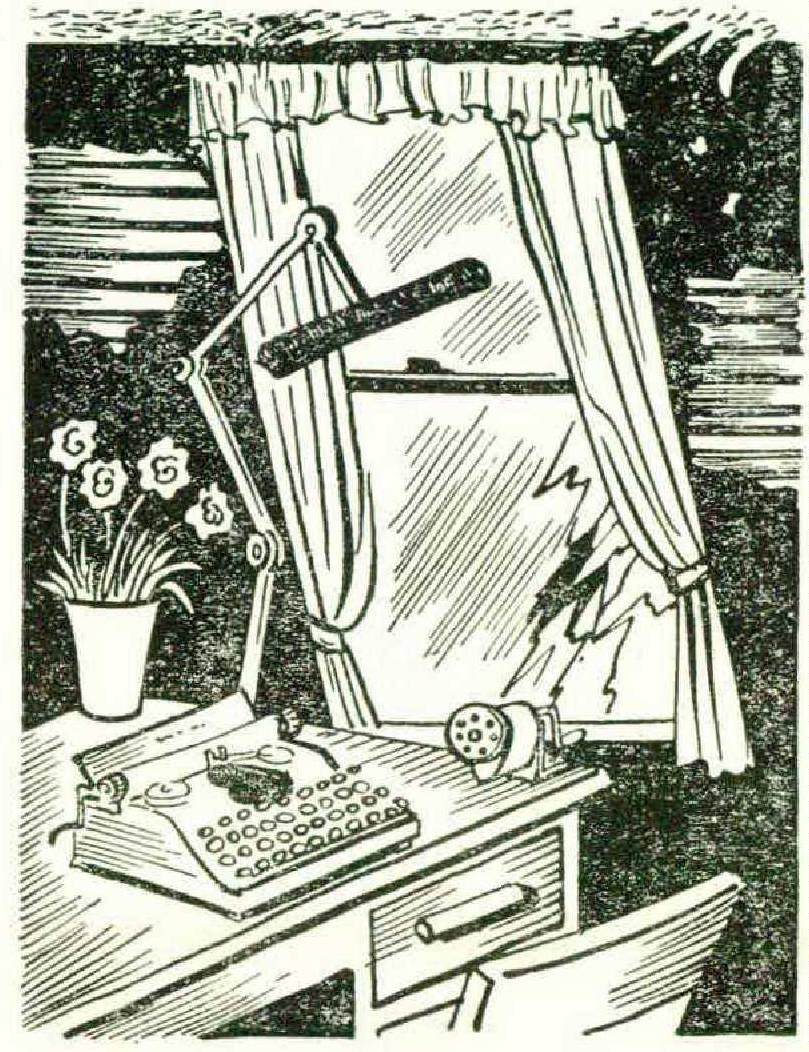
I write now on a beautiful new typewriter with a crackle finish to protect my eyes from any harmful glare. I can change my margins or set the tabulator with a flick of a finger instead of having to climb over the top and do things upside down in the back, and I sit at the Finger-Flow Keyboard and the fortyfour controls like the pilot of a DC-6. However, when I sit at the new typewriter, I must still sit in an awful draft, because one of the windowpanes at my right has a big hole in it, and our landlord, a cautious man, seems to feel that it might be foolish to replace it at this time. It may be, he thinks, that in the next two or three years the price of glass will go down.
The desk and typewriter used to be lit haphazardly from the living-room window, and on gray days we just strained our eyes and hoped our touch typing was more accurate than we knew it was. Now, clamped to the back of the desk, and soaring up in an incredible steel structure, is a Dazor Floating Fluorescent Lamp, which casts on the FingerFlow Keyboard of the typewriter the brilliant cold light and low watt consumption of the modern world. The lamp is breath-takingly suspended from about five feet of metal tubes, springs, elbow joints, universal joints, sockets, bolts, wing nuts, and God knows what else. Wherever you place it, it mysteriously stays, suspended but unmoving, really putting light where you want it, and making the rest of the lamps in the room look like props for a Technicolor movie of the Civil War.
However, this world-of-tomorrow lamp gets its electric current from an outlet which bristles with a complex arrangement of double sockets, triple sockets, quadruple sockets, and old extension cords. This condition is making our insurance company old before its time, not to mention us. Our landlord seems to have felt, back in the thirties, that with the state of the world so unsettled, it would be foolish to spend the money for more than one outlet to a room. Now, with prices high, he feels it would be unwise to make any important changes in the building.
Next to the tin can full of pencils — a tin can that dates back to the days before we took to flattening cans out neatly after eating their contents — stands a new pencil sharpener in a soft green finish guaranteed to be easy on the eyes. This pencil sharpener is securely bolted to the desk and has numerous holes for the insertion of pencils of different sizes. It somehow stops itself when the pencil is sharp, sternly refraining from the practice of previous pencil sharpeners of happily chewing away the entire pencil while you wondered if it was done yet.
While you sharpen pencils in this wonderful little machine, it is hardly possible to avoid seeing the window sill. Other people’s window sills are made of wood. Ours are made of plaster, and are obviously the result of an experiment that failed. Plaster, j udging by our sills, is not in the least resistant to moisture, sun, occasional steam heat, or soot, and our window sills bear a strong resemblance to certain parts of New Mexico. Our landlord, a penurious fellow, readily admits that the plaster sills were a bad mistake, and suggests that we hire a carpenter to cover them with wood.
An Early American cupboard with hand-carved doors that are only a little warped, and for which we may one day find a bit of hardware that we could easily use as a knob, houses the rubber cement, the half-empty India ink bottle, the window spray, the penknives, the thumbtacks, the old paintbrushes, the leather dressing, the 3-in-l oil, and the protractor for which no one has found any use.
Beside it stands the new stapling machine. This machine, a colossal mass of steel, we bought yesterday to replace the ailing and rusted instrument which for years faithfully mended shoes, did emergency sewing jobs, fixed window shades, upholstered upholstery, and lined overcoats. The new machine, instead of having staples in it, has somewhere inside its gray steel body a coil of wire from which it makes its own staples as it goes along. When you press the big black plastic lever, gears inside mesh, and cogs trip and springs snap, and the machine chews off just the right length of wire, folds it into the proper shape, inserts it in the papers, and bites it firmly closed. However, when my husband wanted to shave this morning, I had to heat water in a kettle on the stove because something seems to be wrong with the hot water, and our landlord, a frugal man, feels that if we wait a few days the handy man may figure out what is wrong, and then he won’t have to call in a plumber or boilermaker after all.
In the bedroom we rest our heads on new all-down pillows, but the paint on the ceiling floats gently down in big flakes like snow, because our landlord, in an economical mood, bought paint that doesn’t stick to the ceiling.
In the bathroom a beautiful pale-yellow shower curtain of a miraculous new plastic guaranteed not to crack, streak, fade, tear, or stick together replaces the old torn one, but the faucets still leak because the landlord, in an earnest endeavor to prevent inflation, has not seen fit to supply washers of the appropriate size.
In the kitchen I can now have whipping cream, canned foods, cheese, chickens, and sometimes good fresh butter; but I cannot close the kitchen window, no matter how cold the weather, because it has warped, and our landlord hesitates to spend money needlessly in repairs.
We have Scotch tape in a plastic holder, but the doorbell does not work. We use the Scotch tape to put up little signs advising would-be visitors to knock in the old-fashioned way with the knuckles. Our landlord, no spendthrift he, suggested helpfully that if my husband would buy and install a set of chimes we might be happier.
For our baby, there are now available nylon crib sheets, plastic toys, carriages w ith springs, disposable diapers, electric bottle warmers and sterilizers, and all the blankets, towels, shirts, sweaters, and safety pins that a baby could possibly want. But if I take the baby out for some sun and fresh air, we shall still have to grope our way from the front door to the elevator. Our landlord supplies one 15-watt bulb to light the hall. We have offered to buy a 25-watt bulb, or even a reckless 40-watt bulb, but the landlord feels that this would run up his electric bills beyond all reason.
I guess we’re living in the better world —but who’s going to tell the landlord?