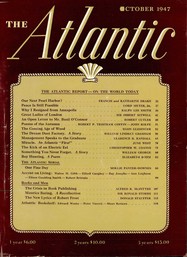
October 1947
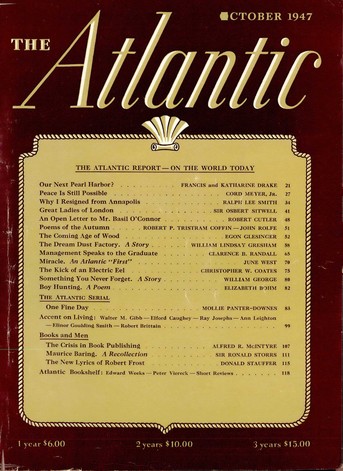
In This Issue
Explore the October 1947 print edition below. Or to discover more writing from the pages of The Atlantic, browse the full archive.
Articles
My First Alarm
Return
People's Banco
Sauce for the Gander
Our Doubting Landlord
The Lime Tree
The Crisis in Book Publishing
Maurice Baring: A Recollection
The New Lyrics of Robert Frost
The Peripatetic Reviewer
The Middle East
Poets Who Wear Well
House Divided
Some Tasks for Education
Eugene Delacroix: His Life and Work
The Last Days of Hitler/to the Bitter End
Poetry for You
How to Disappear for an Hour
Lonely Crusade
Silver Nutmeg
The Boston Book
Seedtime
Way of Life
Latin America
Our Next Pearl Harbor?
Peace Is Still Possible
If the United Nations is not strengthened in time to avert tear, a long night of brutality will descend upon the survivors on this planet. CORD MEYER, JR., the President of United World Federalists and a former Marine, tells us specifically how the Charter can be amended and the UN strengthened by giving it the legal authority and material power to prevent war and competitive arming. The article which follows is one of the climactic chapters in Mr. Meyer’s forthcoming book, Peace or Anarchy? which will be published in November.
Moscow
Why I Resigned From Annapolis
Great Ladies of London
An Open Letter to Mr. Basil O'Connor
The Corner of the Year
Small Cricket Vanquished
The Coming Age of Wood
Our sawmills waste from 40 to 70 per cent of the forest tree. Were pulp mills, sawmills, and plants producing alcohol and plastics combined in an integrated industry, the whole tree could be made to yield such a variety of lumber, insulating boards, plastics, paints, and varnishes that our shortages in America would be wiped out and there would be surpluses for export. EGON GLESINGER is Chief of the Forest Productions Branch and Assistant Director of the Division of Forestry of the United IVations. Phis article is taken from his forthcoming book to be published by Simon and Schuster.
The Dream Dust Factory
Management Speaks to the Graduate
Vice President and Director of Inland Steel Company, CLARENCE B. RANDALL puts the problems of management squarely up to the young graduate. A large percentage of the veterans now coming out of our colleges are eager to work in personnel relations. Dealing with the employees of industry is a highly specialized job, and here, says Mr. Randall, are the key decisions which a young man must confront before he steps in to represent management in collective bargaining.
Miracle
The Kick of an Electric Eel
After a somewhat restless youth, CHRISTOPHER W. COATES landed a job in the Old New York Aquarium at Battery Park, was put in charge of the fresh-water tropical fish, and for the first time felt the jolt of the electric eel. Today, as Curator-Aquarist of the New York Aquarium, he is intimately involved in the behavior offish. In the planning of the New York Aquarium, he is confronted with the problem of how to build tanks holding several million gallons of forty different kinds of water and how to move thousands of gallons a minute without letting any metal touch the fish.
Something You Never Forget
Boy Hunting
One Fine Day
SUMMARY. — Laura Marshall and her husband Stephen live in the country near the tiny Fnglish village of Wealding. Stephen has returned from the war to find the train to London as stuffy as ever, his garden choked with weeds, his daughter Victoria growing up fast, and Laura dead weary from the daily battle of rationed shopping and unceasing housework. “So far as I can see,” says Laura’s mother, Mrs. Herriot, reproachfully, “you spend the day doing the work of an unpaid domestic servant. When I think how you were brought up —” And indeed Laura, as she tries to keep their home alive, does think back to those lazy, hot summers before the war when several maids and a cook ran the house so smoothly. As she listens to her part-time charwoman, Mrs. Prout, and watches their gardener for a day, frail, deaf old Voller, in his hopeless struggle with the weeds, Laura remembers the clipped turf, the roses, and their friends chatting through the long June dusks. Now she tends the ducks and chickens herself, and as this installment opens, is riding alone on her old bicycle to find her runaway dog Stuffy among the Roman stones of Barrow Down.